
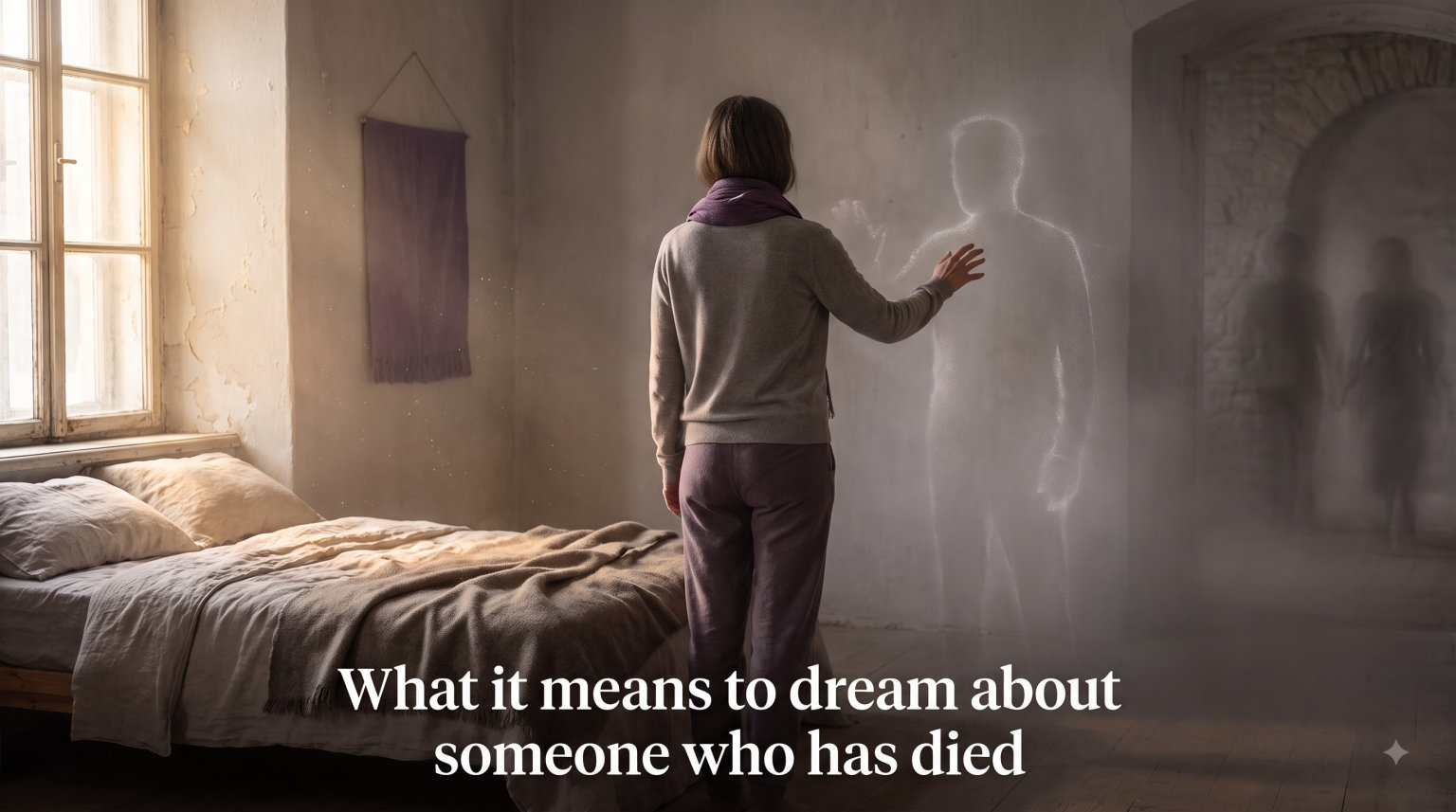
I still remember the first time I dreamed of my grandmother after she passed. She was sitting at her old kitchen table, and the dream felt so vivid that I woke up certain I had heard her voice. If you have had a similar experience, I want you to know this: you are not alone, and there is nothing wrong with you.
Dreams about someone who has died are among the most common, most emotionally loaded dreams a person can have. Researchers, therapists, and spiritual teachers have all weighed in on what they mean, and the honest answer is that a single dream can hold several meanings at once. In this guide, I will walk you through the psychological, spiritual, and cultural perspectives on what it means to dream about someone who has died, so you can decide for yourself what your dream is offering you.
Table of Contents
Why Do We Dream About Someone Who Has Died?
Dreams about a deceased loved one usually show up because your brain is still working through the loss, even when your waking mind has tried to move on. During sleep, the prefrontal cortex, the part of your brain that manages logic and filtering, quiets down. This frees the amygdala and the hippocampus to replay emotionally charged memories, and grief is one of the most emotionally charged experiences a human can have.
That is why these dreams often feel more real than ordinary dreams. Your brain is replaying real memories with the emotional filter turned all the way up. In a 2026 study published in the journal Dreaming, more than 60 percent of bereaved participants reported at least one vivid dream of the person who had died within the first year of their loss.
So when you dream about someone who has died, the simplest and most accurate first answer is this: your mind is still processing the relationship. The dream is not a malfunction. It is your grief continuing its work.
Psychological Perspectives on These Dreams
Psychology offers three overlapping frameworks for understanding a dream about someone who has died. Each one gives you a different angle, and most dreamers find that their experience sits somewhere in between.
The Freudian View: Unfinished Business
Sigmund Freud argued that dreams are the disguised fulfillment of repressed wishes. In his view, a dream of a dead person often points to unresolved feelings, guilt, anger, or longing that you have not fully acknowledged while awake. If you and the person who died had a complicated relationship, Freud would say the dream is your unconscious giving you a safe space to say the things you never got to say.
The Jungian View: An Unconscious Conversation
Carl Jung took a softer stance. He believed that dreams of the deceased are messages from the deeper self, and that the deceased person in the dream often represents not just them but a part of you that is changing. Jung would say that dreaming of someone who has died can mark a psychological transition, such as moving into a new phase of life, healing from an old wound, or integrating a lesson that person taught you.
Modern Grief Research: Continuing Bonds
Today, grief researchers like Dennis Klass and Margaret Stroebe describe what they call continuing bonds. The idea is that healthy grieving does not mean letting go of the person who died. It means keeping a living, evolving relationship with them in your mind. Dreams, in this view, are one of the most natural ways humans maintain those continuing bonds.
Psychologist Dr. Joshua Black, writing in Psychology Today, has noted that bereavement dreams can ease symptoms of complicated grief when they feel warm or healing. They often become less frequent over time, but they rarely disappear entirely, and that is not a sign of being stuck.
Common Dream Themes and What They May Mean
Across thousands of bereavement dreams, certain themes repeat again and again. Here are the most common, with the meaning therapists tend to assign to each.
- Having a normal conversation with them. This is the classic continuing bonds dream. Your mind is reaching out for the connection you miss.
- Seeing them healthy and happy. Often a sign of acceptance. Your subconscious is picturing them at peace.
- Receiving a warning or a piece of advice. Many dreamers report that the deceased offered a specific message. These dreams tend to feel unusually clear and memorable.
- Not recognizing that they have died. This usually appears soon after a loss. Your brain is rehearsing the reality, testing it the way you test a new idea.
- Trying to say goodbye and failing. Often a marker of unfinished emotional business. Worth journaling about.
- They are sick, hurt, or trapped. Frequently reflects the dreamer’s lingering guilt or helplessness around the death.
- Holding a child version of them. Jungian interpreters read this as the dreamer tending to the inner child that this person represented in their life.
- They hand you something. Many cultures read this as a symbolic transfer of a quality, lesson, or blessing they want you to carry forward.
- They appear in a crowd and then disappear. A common processing dream where your brain is letting them go gently, a face in a crowd rather than the center of attention.
- You cannot reach them in time. Often points to unresolved regret. Worth a gentle conversation with a therapist if it keeps recurring.
- They tell you they are okay. Frequently reported as one of the most comforting dream types, and often the one that dreamers describe as a visitation.
Spiritual Interpretations and Visitation Dreams
A visitation dream is a specific type of dream about someone who has died that feels distinct from ordinary dreams. They tend to be unusually vivid, emotionally calm, and free of the strange plot twists that normal dreams have. Many people report that the deceased looks healthy, speaks clearly, and sometimes delivers a sentence that lingers for years.
Within spiritual traditions, visitation dreams are often read as the deceased reaching out to offer comfort, closure, or guidance. Mediums and pastoral counselors will tell you that these dreams often arrive around meaningful dates, such as a birthday, an anniversary, the death date, or a major life decision.
I want to be careful here. Whether or not a visitation dream is a literal spiritual contact is a question science cannot answer, and faith traditions answer it differently. What I can say from working with readers is this: if a dream leaves you feeling peaceful, loved, and lighter, it has done something good in your heart, and that matters regardless of its metaphysical source.
Cultural Perspectives on Dreams of the Dead
Almost every culture has an interpretation for what it means to dream about someone who has died. The table below summarizes the most common traditions.
| Tradition | Common Interpretation |
|---|---|
| Christianity (popular and Catholic) | A sign of their soul at peace, a message of love, or occasionally a reminder to pray for them. Many saints and mystics wrote about dreams of the dead as legitimate spiritual contact. |
| Islam | Dreams of the deceased are considered true dreams (ru’ya) that can carry guidance, requests for prayer, or comfort. Speaking gently to the deceased in the dream is encouraged. |
| Hinduism | Often seen as the soul visiting from pitri loka, the realm of ancestors. Dreams may carry ancestral wisdom or unresolved karmic messages, especially if you dreamt of them healthy. |
| Buddhism | Generally viewed as the mind processing attachment. Tibetan Buddhists specifically practice dream yoga to meet deceased teachers and relatives consciously. |
| Judaism | Dreams of the dead are taken seriously, and the Talmud records several. A dream on the yahrzeit, the anniversary of death, is considered especially meaningful. |
| Chinese and East Asian folk tradition | Dreams of the deceased are sometimes read as their soul visiting, especially on Qingming and the Hungry Ghost Festival. Dreams of them happy are auspicious. |
| Indigenous traditions worldwide | Ancestors are seen as active participants in daily life. Dreams are a primary channel for their guidance, and ignoring them is considered unwise. |
| Mexican Dia de los Muertos tradition | Dreams around November 1 and 2 are welcomed as direct visits from returning ancestors. |
| Ancient Greek and Roman | Dreams were messages from the underworld. Pliny and Cicero wrote that the dead appeared to warn, teach, or request rituals. |
| African diasporic traditions | Dreams of the deceased are honored as communication from the ancestors. Dreams often guide decisions about family, work, and ceremony. |
What stands out across all of these is that dreams of the deceased are rarely treated as meaningless. Whether the lens is grief, prayer, ancestors, or memory, every tradition treats these dreams as worth listening to.
Dreams Do Not Predict Death: A Reassurance
One of the most common worries I hear from readers is this: if I dream that someone I love dies, does that mean they will die? The short answer is no. Decades of dream research have found no evidence that dreams predict the death of a living person.
Psychologists interpret dreams of a living person dying as a symbol of transition. That could mean you are worried about them, sensing change in the relationship, or processing some part of yourself that feels like it is coming to an end. If the dream leaves you worried about a real person in your life, the kindest thing you can do is reach out, tell them you care, and put the phone down. The dream is rarely about their future. It is almost always about your feelings.
When These Dreams Signal a Need for Support
Most grief dreams are healthy. Some are not. Consider reaching out to a grief counselor or therapist if your dreams of the deceased are mostly distressing, if the dreams have become more intense months or years after the loss instead of fading, if you find yourself dreading sleep because of them, or if the dreams are accompanied by intrusive thoughts, numbness, or a sense that life has lost its color.
These signs do not mean you are broken. They often point to complicated grief, a recognized condition where the natural grieving process gets stuck. Complicated grief responds very well to therapy, especially to approaches like Complicated Grief Therapy developed by Dr. Katherine Shear.
How to Cope With Distressing or Recurring Dreams
If a dream about someone who has died is keeping you up at night, here are some gentle, evidence-informed ways to work with it.
- Write it down within five minutes of waking. Dreams fade fast. A small notebook by the bed, or a voice memo on your phone, lets you capture the image and emotion before they slip.
- Try imagery rehearsal therapy. This is a CBT-based technique where you rewrite the dream while awake, with a calmer ending. Studies show it reduces nightmare frequency by 40 to 60 percent.
- Create a simple bedtime ritual. A few minutes of slow breathing, a photo of the person nearby, and a quiet sentence like I am open to comfort can soften the transition into sleep.
- Talk about the dream out loud. Sharing it with a trusted friend, a grief group, or a therapist takes the dream out of your head and lets it live in the world.
- Bring closure into your waking life. Light a candle, write them a letter, visit a meaningful place. Sometimes the recurring dream is your brain waiting for a real-world completion.
- Consider professional support if it persists. A therapist trained in grief or dream work can help you find the thread the dream is handing you.
Journaling Prompts for Processing Grief Dreams
If you want to go deeper, try working through one of these prompts the morning after the dream.
- What did the person say to me, in their actual words, if anything?
- What were they wearing, and where were we? Describe the scene in detail.
- How did I feel when I saw them? Use three specific words.
- Was there anything I wanted to say to them but did not? Write that down now.
- If I could send them one message back, what would it be?
- What part of my waking life might this dream be pointing to?
- Is there a small action I could take today to honor what this dream showed me?
You do not need to answer all of them. Even one honest paragraph is enough to start moving the dream from a haunting into a conversation.
Frequently Asked Questions
What does it mean when a deceased person appears in your dream?
A deceased person appearing in your dream most often reflects your mind processing grief and maintaining a continuing bond with them. It can also carry spiritual meaning, depending on your tradition, and is usually a sign that the relationship still matters to you.
What does the Bible say about dreaming of someone who passed away?
The Bible records several dreams of the dead, including the medium of Endor account in 1 Samuel 28 and revelations given through heavenly visitations in the New Testament. Many Christian traditions interpret these dreams as messages of comfort, peace, or a call to pray for the soul of the person who died.
What does it mean when you dream about someone who died who is still alive?
Dreaming of a living person dying is almost always symbolic rather than predictive. It usually points to a transition in the relationship, a fear of losing them, or an ending of a chapter of your own life. There is no scientific evidence that such dreams predict the person’s actual death.
Is seeing dead people in dreams good or bad?
Seeing deceased loved ones in dreams is generally considered neutral or positive. These dreams are widely seen as a normal part of grief, a way of maintaining a healthy bond, and in many traditions, a form of contact or blessing. Distressing dreams are usually a sign that more support or processing is needed, not a bad omen.
Why do dreams of deceased loved ones feel so real?
Grief dreams feel unusually real because the brain activates many of the same emotional and sensory regions it uses during waking experiences, while the prefrontal cortex that normally flags the dream as unreal is less active. Combined with strong memory and emotion, this produces the vivid, lifelike quality people describe.
How long do grief dreams usually last?
Most bereaved people experience grief dreams intensely in the first one to three years after a loss. They typically become less frequent and more peaceful over time, though they often return on anniversaries or during stressful periods, and many people continue to have them for life.
Should I be worried about recurring dreams of someone who died?
Recurring dreams of the deceased are very common and usually reflect an unresolved feeling or unfinished emotional work. They are only a concern if they are deeply distressing, increase over time rather than fade, or interfere with sleep and daily life, in which case a grief therapist can help.
Key Takeaways
If you take nothing else from this guide, take these three things. First, a dream about someone who has died is one of the most normal experiences a grieving person can have. Second, the dream is almost always about love and processing, not prediction, and certainly not a sign that anything is wrong with you. Third, what you do with the dream matters more than what it means. Write it down, talk about it, and let it tell you what your heart still needs.
Whether you read your dream as a quiet message from the unconscious, a visitation, a memory replay, or all three at once, the work of the dream is the same. It is your heart continuing to love someone who has died. That is a very human thing, and it is a very beautiful thing. If you want, light a candle tonight. Say their name. And let yourself remember.