
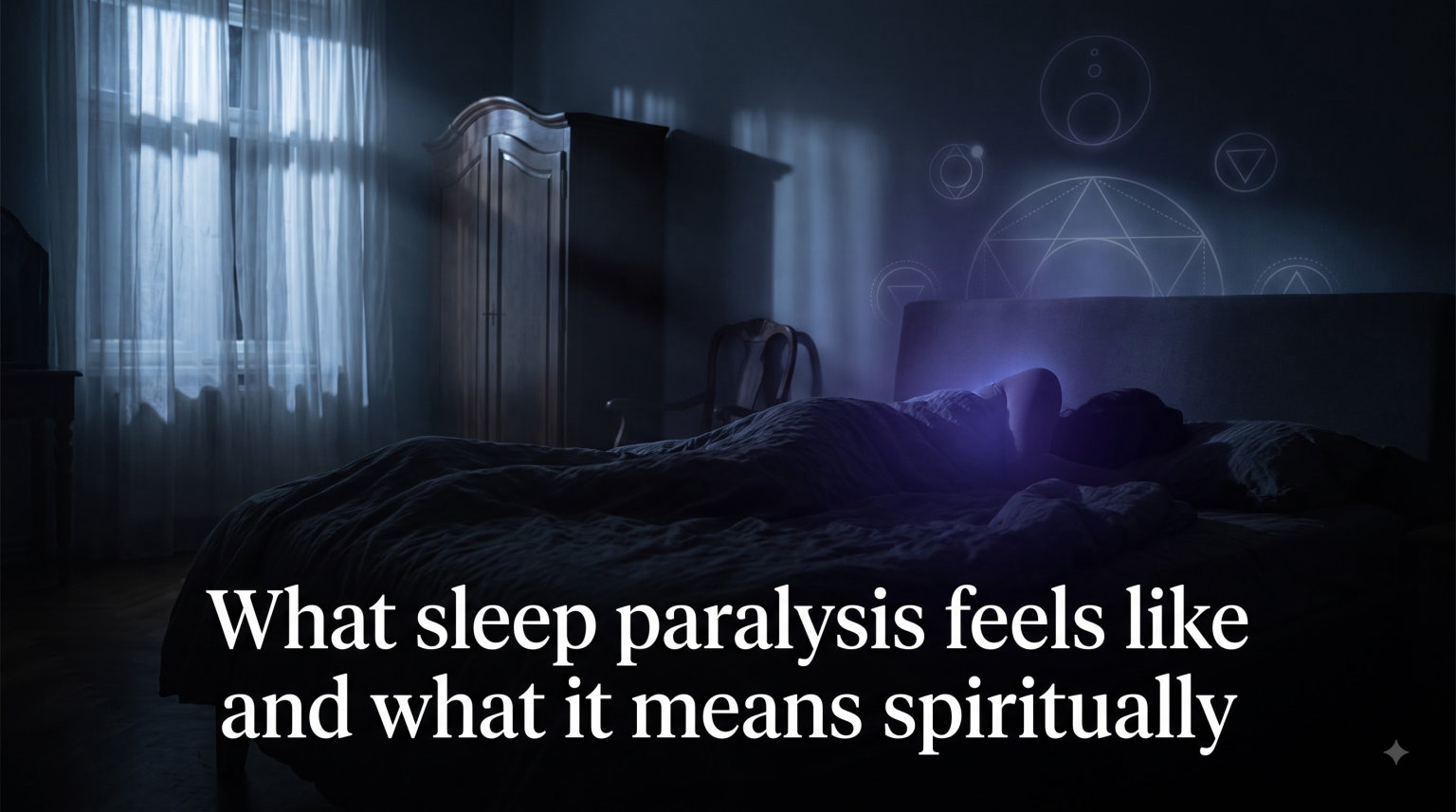
If you have ever woken up unable to move, with a crushing weight on your chest and a sense that something is watching you, you already know how unsettling sleep paralysis can be. The experience leaves people searching for answers that medicine alone does not always give, which is why so many ask about the sleep paralysis spiritual meaning behind it.
I have spent the last several years studying the dream world, meditation traditions, and the hidden corners of human consciousness. I have also interviewed dozens of people who have lived through these episodes. In this guide, I want to walk you through what sleep paralysis feels like in your body, what is happening in your brain, and what this phenomenon can mean spiritually across the world’s traditions. By the end, you will have both the science and the soul perspective, so you can decide which one fits your own experience.
Table of Contents
What Sleep Paralysis Feels Like During an Episode?
Sleep paralysis feels like being trapped between two worlds, fully awake in your mind but locked inside a body that will not obey you. Your eyes are open. You can see your bedroom, the wall, the curtains. Yet your arms, legs, and torso feel like concrete. No matter how hard you try, you cannot lift a finger.
Most people describe three sensations stacked on top of each other. The first is the physical lock, a heaviness that starts at the chest and spreads outward. The second is a presence, that unmistakable feeling that someone, or something, is standing just out of sight. The third is fear, raw and primal, the kind that floods your body with adrenaline even though you are lying still.
For some, it lasts a few seconds. For others, it stretches into what feels like minutes. People regularly report these sensations during an episode:
An invisible hand pressing down on the chest, sometimes with choking or suffocation feelings
A loud buzzing, ringing, or roaring sound in the ears
Shadow figures, hooded beings, or faces appearing at the edge of vision
The sense of being dragged, levitated, or pulled out of the body
A vivid out-of-body experience in which you watch yourself from above
An overwhelming feeling of dread, as if something evil has entered the room
I want to be honest with you here. The first time this happened to me, I was 19 years old. I was lying in my dorm room, opened my eyes, and felt a weight step onto the bed. There was nothing there, yet every cell in my body screamed that something was. That blend of absolute certainty and absolute helplessness is what defines the experience for most people I have spoken with.
Even though the terror feels otherworldly, the experience is real, common, and shared across every culture on earth. Roughly 8 percent of people will have at least one episode in their lifetime, and that number climbs higher for students, shift workers, and people with anxiety. You are not alone in this, and you are not losing your mind.
The Science Behind Sleep Paralysis and REM Atonia
Sleep paralysis happens when your brain wakes up before your body does, and the root of it lies in REM sleep. REM stands for Rapid Eye Movement, the stage of sleep where your most vivid dreams occur. During REM, your brain deliberately paralyzes your muscles through a process called atonia, so that you do not physically act out the dreams you are having.
Two neurotransmitters do this work. Glycine and GABA suppress the motor neurons in your spinal cord, switching your muscles off like a light. In a healthy sleep cycle, atonia switches off the moment REM ends, and your muscles wake up with the rest of you. In a sleep paralysis episode, your conscious mind snaps to attention before that switch is thrown.
The result is a strange hybrid state. Your prefrontal cortex is online, so you are aware. Your visual cortex is still partly in dream mode, so you see things that are not really there. Your amygdala, the brain’s fear center, is firing on all cylinders because it cannot tell the difference between a dream threat and a real one. That is why the hallucinations feel so vivid and terrifying.
There are two windows where this is most likely to happen. Hypnagogic sleep paralysis strikes as you fall asleep, while hypnopompic sleep paralysis hits as you wake up. Researchers believe the waking version is more common because the brain is more alert, which is also why most people remember the experience in sharp detail.
If you have ever had the eerie feeling of floating above your bed, that is your vestibular system firing while your body is still paralyzed. If you have ever heard your name whispered, that is your auditory cortex finishing a dream loop just as you become conscious. None of it is supernatural, but every piece of it feels personal.
The Three Types of Sleep Paralysis Hallucinations
Researchers have grouped the strange sights and feelings of sleep paralysis into three main categories. Knowing these helps you understand what your mind is doing, and it gives you language to describe an experience that often defies words.
The Intruder
The intruder hallucination is exactly what it sounds like. You sense, hear, or see another presence in the room. People report footsteps, breathing, a shadow in the doorway, a faceless figure standing at the foot of the bed, or glowing eyes in the dark. Some describe a heavy presence that walks around the room, while others see a single entity that locks onto them without moving.
This type of hallucination is the most reported, and it is also the most linked to the cultural idea of demons, witches, or night visitors. Your brain, half in REM and half awake, is trying to explain an unexpected stimulus. When the lights are off and your muscles are dead, the simplest story your mind can tell is that someone, or something, has come in.
Chest Pressure, or the Incubus
The second type is the chest pressure hallucination, sometimes called the incubus or succubus experience. You feel a crushing weight on your chest, ribs, or throat. Breathing becomes shallow or seems to stop entirely. Many people feel a hand gripping their throat, or an unseen figure sitting directly on top of them.
This is the experience most often tied to the old folklore of the incubus demon, a spirit said to sit on sleepers and steal their breath. In medieval Europe, the incubus and its female counterpart, the succubus, were blamed for these exact sensations. Today we know the weight comes from your breathing muscles still being partly paralyzed, while your mind invents a story to make sense of the pressure.
Vestibular-Motor Hallucinations
The third type is the vestibular-motor hallucination, sometimes shortened to V-M. This is the out-of-body category. You feel like you are floating, spinning, falling, or being pulled out of your body. Some people feel their bed is tilting. Others feel themselves rise toward the ceiling and look back down at their sleeping form.
These sensations come from your brain misreading the signals from your inner ear and your muscle system. Because you are paralyzed, your body cannot confirm where it is in space, and your dream brain fills the gap with motion. This is also the type of hallucination most often associated with what mystics call astral projection or out-of-body experiences.
Cultural Folklore and Sleep Demons Across the World
Every culture on earth has a story about what sleep paralysis feels like, and almost every one of those stories involves a creature. The fact that humans across thousands of years, separated by oceans and continents, all invented similar beings tells us something real about how the experience hits the human psyche.
In Newfoundland, Canada, the phenomenon is called the Old Hag. People say an old woman sits on your chest at night and steals your breath. In Japan, the visitor is called kanashibari, bound by a spirit, and is tied to Buddhist folklore about mischievous monks and foxes. In Turkish tradition, the creature is called a karakara, a dark figure that pins you down and weighs on your chest.
Across the Islamic world, the experience is often linked to jinn, unseen beings made of smokeless fire. Sleep paralysis is sometimes called jinn pressing on the chest, and protective prayers and recitations are a common response. In Hindu tradition, similar episodes are tied to bhuts or pretas, wandering spirits, and in some Buddhist regions, to hungry ghosts or unbalanced energies.
In medieval Europe, the incubus and succubus demons filled the same role. The word incubus literally means one who lies upon. Many medieval texts described these entities in vivid detail, with the male incubus attacking women and the female succubus attacking men. The church saw these experiences as spiritual attacks, and entire rituals were developed to protect sleeping households.
The Hmong people of Southeast Asia have a version too, called the dab tsog, a crushing spirit that visits at night. After a wave of refugee deaths linked to nighttime terror in the 1980s, the condition was named sudden unexplained nocturnal death syndrome, and the Hmong community worked with researchers to show that cultural framing of the experience, not the experience itself, was driving fatal cardiac events. Even the way we interpret sleep paralysis can shape what happens to our bodies.
What Sleep Paralysis Means Spiritually?
This is the question at the heart of the topic, and it deserves a careful, multi-tradition answer. Sleep paralysis spiritual meaning is not one thing. It shifts depending on the tradition you stand in, and often depending on the life you are living at the time it shows up.
Spiritual Awakening or Transition
Across many modern spiritual circles, sleep paralysis is read as a sign of awakening. The idea is that as your consciousness expands, your old sleep patterns get disrupted, and the boundary between your waking mind and your dreaming mind becomes thin. The paralysis is the old self trying to hold on. The presence you sense is your higher self, or a guide, trying to get your attention.
People going through grief, big life changes, or deep inner work often report an uptick in episodes. In this view, sleep paralysis is not an attack. It is a doorway. The trick is to stop fighting it and start listening. Once you stop feeding the fear, the experience tends to soften, and many people report breakthrough insights, vivid prophetic dreams, or a stronger intuitive life afterward.
Spiritual Attack or Energy Intrusion
Other traditions read the same experience very differently. In Christian, Islamic, and many African and Caribbean folk traditions, sleep paralysis is sometimes framed as a spiritual attack. The presence is taken to be a demonic entity, a wandering spirit, or a malevolent force. The chest pressure is seen as the entity trying to steal your breath or your soul.
In this view, the answer is protection. Christians often recite Psalms, call on the name of Jesus, or sleep with scripture. Muslims often recite the Ayat al-Kursi and the last two surahs of the Quran. Practitioners of Afro-Caribbean traditions may call on ancestors, light specific candles, or use blessed water. The common thread is turning to a higher power for defense.
Cross-Tradition Comparison
Looking across traditions, you can see a clear pattern. The waking world is treated as a battleground in some views, and as a training ground in others. Christianity and Islam tend to emphasize protection from outside forces. Hinduism and Buddhism tend to emphasize inner karmic or energetic imbalances. New Age traditions tend to emphasize personal growth.
None of these frameworks are right for everyone, and none of them are wrong for everyone. The spiritual meaning of sleep paralysis is partly shaped by the meaning system you bring to it, and that is itself a clue. Whatever you believe about the unseen world, the experience tends to confirm that belief.
Natural Phenomenon With Spiritual Echoes
A fourth view, held by many thoughtful practitioners, is that sleep paralysis is simply a natural brain state that opens a door to spiritual experience. The REM intrusion is not the message. The message is what comes through when you stop fighting the experience and start paying attention to it.
In this view, the science and the spirituality are not in conflict. The brain produces the conditions, and your soul uses those conditions to show you things you cannot see in ordinary waking life. Some people meet guides. Some people relive trauma in a way that finally lets them process it. Some people simply feel the presence of loved ones who have died.
How to Fight Sleep Paralysis: Spiritual and Practical Techniques
Whether you frame the experience as an attack or an opening, the coping tools are similar. The goal is to break the paralysis cycle, reduce the fear response, and reclaim your authority in the dream state.
Here is the approach I recommend, in the order I use it myself and teach it to others.
Stop fighting the paralysis. The more you try to thrash, the deeper the fear feeds the loop. Instead, consciously relax your shoulders, jaw, and hands. This small surrender often breaks the spell.
Focus on a tiny muscle. Move your toe, finger, or tongue. Even a twitch is enough to signal to your brain that the body is waking up. Lab studies show that small voluntary movements end episodes fastest.
Shift your eyes. REM is linked to eye movement. Blinking, rolling your eyes, or trying to look in different directions can pull you out of the paralyzed state.
Control your breath. Slow, deliberate breathing tells your amygdala you are safe. Inhale for four counts, hold for four, exhale for six. The fear begins to fade within a few rounds.
Speak or recite. In Christian tradition, calling on the name of Jesus is a powerful interrupter. In Islamic tradition, reciting a known prayer does the same. Even a simple phrase like I am safe can act as a verbal anchor.
Set intention before sleep. Before bed, ask for protection, guidance, or a clear dream. Many traditions treat the moment before sleep as a thin veil, and a short prayer or affirmation can shape what comes through.
Keep a dream journal. Writing down what you remember right after waking trains your brain to stay aware during these states. Over time, this can turn episodes into lucid dreams.
I have also seen people use small physical anchors, like a rosary under the pillow, a crucifix on the wall, or a piece of black tourmaline on the nightstand. None of these are magic on their own. What they do is give your mind something familiar to lock onto when the dream world feels overwhelming.
Sleep Hygiene Tips to Prevent Future Episodes
Most episodes can be reduced, and in many cases eliminated, with a few changes to your sleep setup. The basics matter more than most people think.
First, fix your schedule. Go to bed and wake up at the same time every day, even on weekends. Irregular sleep is the single biggest trigger I see in people with frequent episodes. Second, avoid sleeping on your back. Studies show that supine sleep increases the odds of paralysis and snoring. Side sleeping tends to help.
Third, manage stress. Chronic stress and anxiety are the next biggest drivers. Even 10 minutes of meditation or breathwork before bed can lower the odds of an episode. Fourth, cut the late-night stimulation. Heavy meals, alcohol, and screens close to bedtime all push your brain toward fragmented REM, which is where the paralysis spikes happen.
Finally, treat any underlying sleep disorders. Sleep apnea, narcolepsy, and insomnia all increase the risk of sleep paralysis. If you snore loudly, fall asleep suddenly during the day, or struggle to fall or stay asleep most nights, talk to a doctor. The spiritual work and the medical work are not enemies. They are partners.
One last note that often gets missed. Keep your bedroom as a low-stress space. Avoid work, news, and argument in the hour before bed. Light a candle, play soft music, or take a warm shower. The body takes its cues from the environment around it, and a calm room teaches the nervous system that sleep is safe. Many of the people I have worked with report that simply clearing the bedroom of clutter and screens cut their episodes in half within a month.
Frequently Asked Questions About Sleep Paralysis and Its Spiritual Meaning
What does it mean spiritually if you get sleep paralysis?
Spiritually, sleep paralysis is often read as a sign of heightened sensitivity, an awakening, or an opening between your conscious mind and unseen realms. Some traditions frame it as a protective warning, while others see it as a chance to meet guides, process trauma, or receive intuitive insight. The meaning often depends on what is happening in your life at the time of the episode.
Is sleep paralysis a warning?
In many traditions, yes. Recurring episodes are sometimes read as a wake-up call to slow down, pay attention to your inner life, or address unresolved stress or trauma. From a spiritual angle, the warning may be about boundaries, energy hygiene, or a need for deeper rest. From a medical angle, it can warn of sleep deprivation, anxiety, or an underlying sleep disorder.
How to fight your sleep paralysis demon?
Start by relaxing your body instead of fighting it. Focus on a small movement, like wiggling a toe or rolling your eyes, to break the paralysis. Slow your breath, speak a prayer or affirmation, and remind yourself the experience is temporary. Over time, dream journaling and a consistent sleep schedule reduce how often the episodes occur.
What demon is associated with sleep?
Across many cultures, the most common sleep demon is the incubus, a male spirit said to sit on the chest of sleepers. Its female counterpart, the succubus, appears in medieval European folklore. Other traditions have their own versions, including the Old Hag of Newfoundland, the jinn of Islamic tradition, the kanashibari spirits of Japan, and the karakara of Turkish folklore.
Is sleep paralysis a sign of spiritual attack?
Some traditions teach that recurring, terrifying episodes with a heavy presence and chest pressure can indicate a spiritual attack. In those views, the response is prayer, recitation, or calling on a higher power. Other traditions see the same experience as a natural brain event with no malicious intent. Both views agree that reducing stress, fear, and sleep disruption lowers how often the episodes occur.
Can sleep paralysis be a sign of spiritual awakening?
Yes, many people going through spiritual awakening report an increase in sleep paralysis, vivid dreams, and out-of-body experiences. The awakening view treats the episodes as a thinning of the veil between your waking self and deeper layers of consciousness. Practices like meditation, lucid dreaming, and dream journaling can help you work with the experience instead of fearing it.
A Final Word on the Sleep Paralysis Spiritual Meaning
Sleep paralysis is one of those rare experiences where the body, the brain, and the soul all show up at once. The science tells us it is a glitch in REM sleep, a moment where consciousness arrives before the body does. The traditions of the world tell us it is a doorway, sometimes to danger, sometimes to growth, almost always to something deeper than an ordinary dream.
If you have been searching for the sleep paralysis spiritual meaning, the most honest thing I can tell you is this. The experience is real, the interpretations matter, and you get to choose the one that helps you live with more peace. Build a steady sleep routine, learn the techniques that break the paralysis, and stay open to the message your tradition, your body, and your dreams are trying to send. Updated for 2026, this guide will keep pointing you back to that path whenever the night gets heavy.