
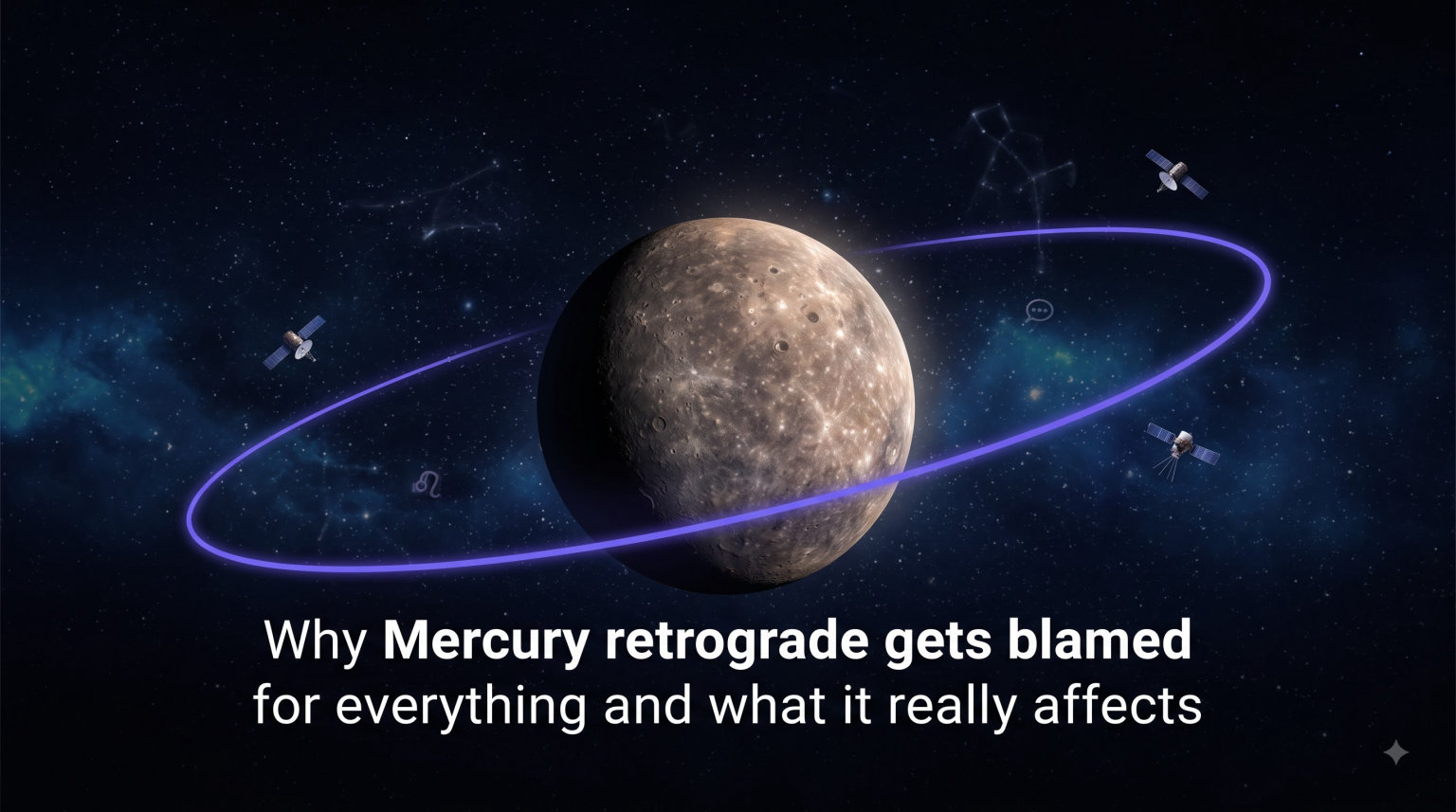
Every few months, social media lights up with the same warning: Mercury is in retrograde, so brace yourself. Lost emails, cracked phone screens, cancelled flights, sudden arguments with friends — all of it gets pinned on this one planetary event. The question of why Mercury retrograde gets blamed for everything has become both a genuine curiosity and a cultural running joke.
But what is actually happening in the sky during these periods? And is there any real connection between a planet appearing to move backward and your wifi router suddenly giving up?
In this guide, I’ll walk you through what Mercury retrograde actually is, why it became the go-to scapegoat for daily frustrations, and what the phenomenon genuinely affects. We’ll cover the astronomy behind it, the astrology built around it, and the psychology that keeps the belief alive and thriving.
Whether you read your horoscope every morning or roll your eyes at the whole thing, understanding the gap between what people claim and what science shows gives you a clearer picture of this endlessly fascinating cultural phenomenon.
Table of Contents
What Is Mercury Retrograde? The Real Science
Mercury retrograde is an optical illusion that occurs when Mercury appears to move backward in its orbit from our vantage point on Earth. The planet itself never actually reverses direction — it simply looks that way to us down here.
Here is the mechanics behind it. Mercury orbits the Sun faster than Earth does, completing a full lap in just 88 days compared to our 365. About three to four times per year, Earth catches up to and passes Mercury on the inside track. During that passing maneuver, Mercury appears to slow down, stop, and then drift backward against the background of distant stars for roughly three weeks at a time.
Think of it like two cars on a circular highway. When you are in the faster car overtaking a slower one, that slower vehicle briefly appears to move backward relative to your window — even though both cars are still driving forward. The same principle applies here, just on a planetary scale.
This effect is called apparent retrograde motion, and it is not unique to Mercury. Every planet in our solar system can appear to go retrograde from Earth’s perspective. Mars, Jupiter, and Saturn all do it. But Mercury’s retrograde periods happen most frequently because of its short, fast orbit close to the Sun.
The critical word in all of this is “apparent.” Mercury’s actual orbital path does not change during retrograde. Its gravitational pull on Earth does not shift. Its physical properties remain exactly the same as always. The only thing that changes is our line of sight.
Astronomers have understood this mechanism for centuries. It is basic orbital mechanics, predictable down to the minute. You can look up the exact dates and times of every Mercury retrograde for the next hundred years with complete accuracy.
The phenomenon was well known to ancient skywatchers, who tracked these backward movements carefully and gave them meaning. Before the heliocentric model of the solar system gained acceptance, explaining retrograde motion was one of astronomy’s greatest puzzles. The old geocentric model — with Earth fixed at the center — required elaborate systems of loops and epicycles to account for why planets sometimes appeared to reverse course.
It was not until Copernicus placed the Sun at the center in the 1500s that retrograde motion finally made sense as a straightforward perspective effect. What once required complex mathematical gymnastics to explain became a simple consequence of two planets moving at different speeds around the same star.
Why Mercury Retrograde Gets Blamed for Everything
So how did an optical illusion become the most feared event in pop astrology? The answer involves ancient symbolism, modern media, and the internet’s talent for turning everything into a meme.
In traditional astrology, each planet supposedly governs specific areas of human life. Mercury rules communication, travel, technology, contracts, and information exchange — essentially anything involving the flow of ideas or data. When Mercury goes retrograde, astrologers claim these domains become disrupted, leading to misunderstandings, delayed messages, crashed computers, and cancelled plans.
That connection stretches back to ancient Babylon and later Hellenistic Greece, where Mercury was associated with the swift-footed messenger of the gods. The idea that a planet named for communication would create communication problems when it appeared to malfunction feels symbolically neat. It gives the belief system a kind of internal logic that makes it easy to remember and repeat.
But the real explosion happened in the internet age. Social media transformed Mercury retrograde from a niche astrological concept into a full-blown mainstream cultural event. Instagram accounts, TikTok astrologers, and Twitter memes turned “Mercury is in retrograde” into a punchline that everyone understood — even people who knew nothing about astrology at all.
The phrase became a convenient shorthand for life’s inconveniences. Instead of admitting “I sent that email to the wrong person because I was rushing and not paying attention,” you could laugh it off with “Mercury retrograde, right?” It is relatable, it is funny, and it quietly shifts responsibility away from human error.
Pop culture amplified this further. When a celebrity scandal broke during a retrograde window, gossip blogs pointed to the stars. When your phone died during those three weeks, someone inevitably mentioned Mercury. The narrative reinforced itself with every retelling and every shared post.
The blame game also creates a powerful feedback loop. If you genuinely believe Mercury retrograde causes technology problems, you will notice every glitch and crash during that window. You will also conveniently forget the dozens of times your computer froze when Mercury was moving perfectly normally. That selective attention is the engine that keeps the entire belief system running.
It does not help that Mercury retrograde occurs three to four times a year for about three weeks each time. That means roughly 25 percent of the entire year falls under retrograde conditions. With a window that large, any random problem has a one-in-four chance of happening during retrograde purely by coincidence — and believers will remember every hit while ignoring every miss.
What Mercury Retrograde Really Affects?
From a scientific standpoint, Mercury retrograde affects exactly one thing: how the planet appears to move against the star field when viewed from Earth’s surface. That is the complete list. The planet’s gravity, electromagnetic output, distance from Earth, and physical properties all remain completely unchanged throughout the entire event.
There is no measurable physical mechanism by which an optical illusion on a planet tens of millions of miles away could influence your email server, your car engine, or your conversation with a coworker. No force, no energy, and no known physical process connects Mercury’s apparent backward motion to daily events on Earth.
No peer-reviewed scientific study has ever demonstrated a link between Mercury retrograde and communication failures, technology breakdowns, travel delays, or any other human-scale event. Researchers have tested these claims specifically — examining traffic accident rates, stock market performance, and technology failure data during retrograde periods — and found zero statistical correlation above random chance.
The gravitational influence Mercury exerts on Earth is vanishingly small. The gravitational pull of the person sitting next to you at your desk is actually stronger than Mercury’s pull on your body. If planetary gravity caused communication problems, you would have far bigger disruptions from your office mate than from a planet between 48 and 138 million miles away.
From the astrological perspective, believers say Mercury retrograde affects communication, contracts, technology, travel, and interpersonal relationships. Astrologers advise against signing important documents, purchasing electronics, launching new projects, or starting new relationships during these windows. Instead, they suggest using the time for reflection, revisiting old conversations, and reconnecting with people from your past.
Here is the key distinction between the two perspectives, laid out plainly:
What astrologers claim it affects: Communication clarity, electronic device reliability, travel schedules, contract negotiations, relationship dynamics, and decision-making quality.
What science confirms it affects: Mercury’s apparent position against the background stars as seen from Earth. Nothing else has been measured or demonstrated.
Now, some people genuinely find practical value in the astrological approach. Setting aside three weeks several times a year to slow down, review your commitments, and be extra careful with important decisions is not harmful advice. The wisdom of double-checking contracts and avoiding impulsive purchases stands perfectly well on its own merits, regardless of what Mercury is doing in the sky.
The confusion arises when that practical caution gets bundled with supernatural causation. Taking extra care with communication during a busy month is genuinely smart. Believing a distant planet caused your argument with a friend is a different matter entirely.
What Mercury retrograde really affects, then, is human behavior and perception — but only because people expect it to. The belief itself shapes how people interpret events, not the other way around.
Astrologers typically say the zodiac signs most heavily affected by Mercury retrograde are Gemini and Virgo, since Mercury is considered the ruling planet of both. They also point to whichever sign Mercury happens to be passing through during a particular retrograde as receiving heightened influence. In practice, these claims are not testable — there is no objective way to measure whether a Gemini experiences more communication issues than a Scorpio during any given retrograde period.
The Psychology Behind the Blame Game
If there is no science backing Mercury retrograde’s effects, why do so many intelligent people swear it is real? The answer lies in how human brains are wired — and those wiring patterns affect everyone, skeptics included.
Confirmation bias is the star player in this particular drama. This well-documented cognitive bias makes us notice and remember information that confirms our existing beliefs while quietly filtering out anything that contradicts them. If you believe Mercury retrograde causes bad luck, you will vividly remember every delayed flight and every broken phone during those three weeks. You will not remember — or even register — the hundreds of times things went wrong when Mercury was moving forward at its normal pace.
Our brains are also relentless pattern-seeking machines. We evolved to find connections between events because spotting cause-and-effect relationships kept our ancestors alive in a dangerous world. The downside is that we often see patterns where none exist, weaving random coincidences into meaningful narratives. When your computer crashes during retrograde, your brain immediately links the two events — even though computers crash constantly regardless of planetary positions.
There is also a powerful psychological comfort factor at work. Blaming a planetary event for your problems is oddly soothing. It externalizes responsibility. Instead of acknowledging that you made a mistake or that life is simply unpredictable, you can point to Mercury and say the cosmos is acting up. That feels considerably better than sitting with the uncomfortable reality of randomness and uncertainty.
Social reinforcement strengthens the effect dramatically. When your friends, your horoscope app, and your Instagram feed all confirm that Mercury retrograde is causing chaos, you have an entire community validating your experience. Beliefs held and shared by a group feel more real than beliefs held alone.
Research on belief in astrology consistently shows it is strongest during periods of personal stress, uncertainty, or major life transition. When life feels out of control, people naturally turn to systems that promise meaning and predictability. Mercury retrograde offers a ready-made explanation for why things feel chaotic — and critically, a timeline for when it will all get better. That psychological function may be the most real effect of all.
None of this makes believers foolish or irrational. These cognitive processes happen automatically, beneath conscious awareness, and they shape the thinking of skeptics just as much. The difference is that skeptics apply the same critical scrutiny to astrology claims that they would apply to any other extraordinary assertion, while believers tend to give astrology a pass.
Frequently Asked Questions
Why does everything go wrong during Mercury retrograde?
From a scientific perspective, things do not actually go wrong more often during Mercury retrograde. The perception that everything falls apart comes from confirmation bias — people notice and remember problems during retrograde periods while forgetting similar problems that occur at other times. Since Mercury retrograde covers about 25 percent of the year, random bad events have a one-in-four chance of happening during a retrograde window purely by coincidence.
What does blame it on Mercury retrograde mean?
Blaming something on Mercury retrograde means attributing everyday problems — like miscommunications, technology glitches, travel delays, or relationship friction — to the period when Mercury appears to move backward in its orbit. It has become a popular cultural shorthand for explaining why things feel chaotic, even though there is no scientific evidence linking the astronomical event to daily life events.
Why is Mercury retrograde nonsense?
Mercury retrograde is considered scientifically unsupported because the phenomenon is simply an optical illusion caused by Earth overtaking Mercury in their respective orbits. The planet never actually moves backward, and its physical properties remain unchanged. No peer-reviewed study has found any correlation between retrograde periods and communication failures, technology issues, or travel disruptions. The gravitational effect Mercury has on Earth is negligible — the person sitting next to you exerts a stronger gravitational pull.
What signs are heavily affected by Mercury retrograde?
According to astrological tradition, Gemini and Virgo are the signs most heavily affected by Mercury retrograde because Mercury is their ruling planet. Astrologers also say the zodiac sign Mercury is currently transiting through during a retrograde receives heightened influence. However, these claims are not scientifically testable, and no evidence supports the idea that certain signs experience more problems than others during retrograde periods.
What to Take Away
Understanding why Mercury retrograde gets blamed for everything and what it really affects comes down to separating a genuinely fascinating astronomical event from the elaborate mythology built around it. The real phenomenon — a small, fast planet appearing to drift backward because of simple orbital perspective — is interesting on its own merits without any supernatural additions.
The claims about crashed computers, ruined conversations, and travel disasters are cultural inventions, not scientific facts. Multiple studies have looked for connections and found nothing beyond random chance.
That said, the instinct to pause, reflect, and be extra careful during certain periods is not a bad one. If Mercury retrograde reminds you to double-check your emails and think twice before signing a contract, that is a practical benefit — even if the cosmic reasoning behind it does not hold up to scrutiny.
The next time someone blames Mercury retrograde for a bad day, you will know exactly what is happening in the sky, why it became such a powerful cultural scapegoat, and what cognitive processes keep the belief going. Sometimes the most interesting thing about a phenomenon is not the science itself — it is what it reveals about the human minds watching it.