
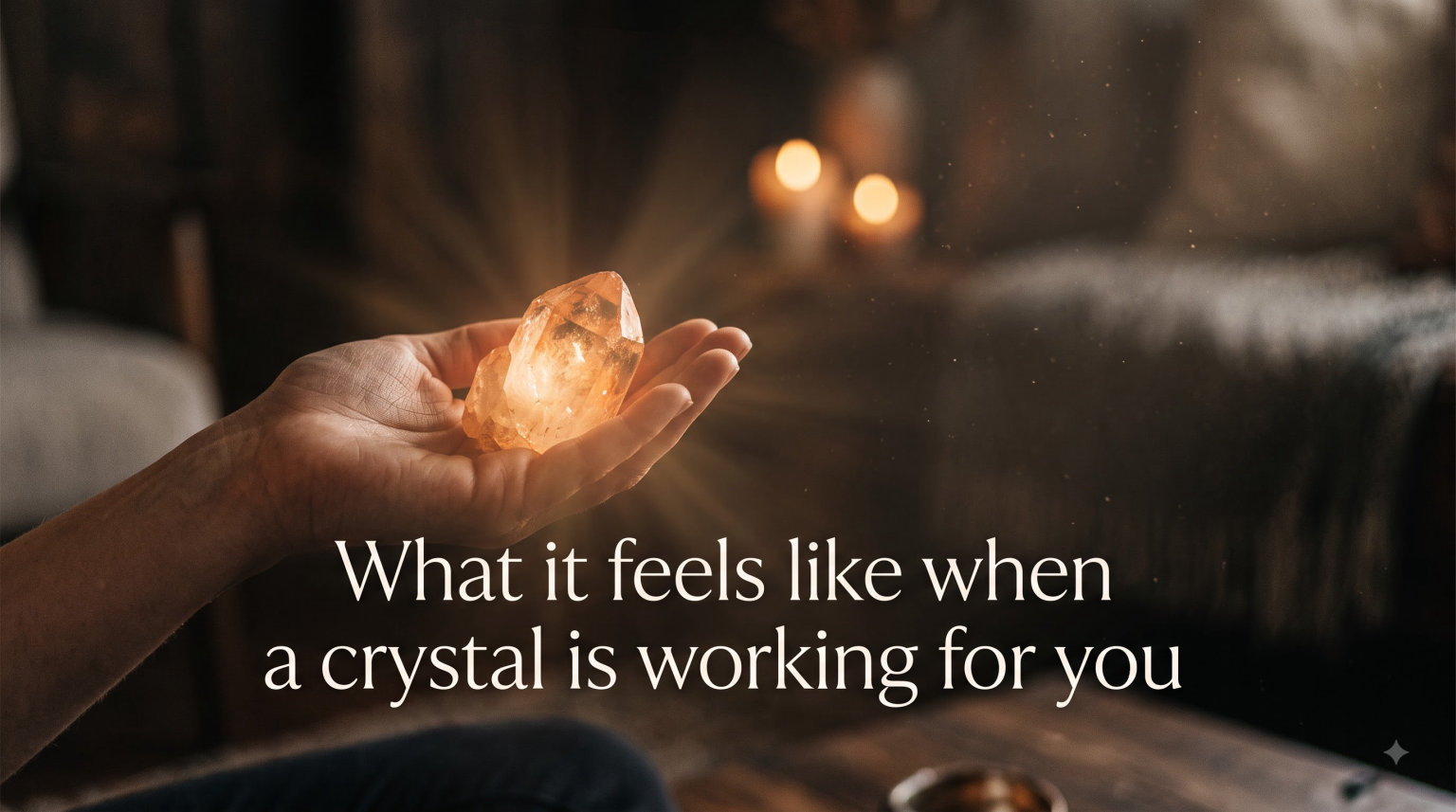
When you first hold a crystal and wait for something to happen, the silence can feel like a personal failure. If you’ve been wondering what it feels like when a crystal is working for you, you’re asking one of the most common questions in every crystal forum I’ve spent time in.
The honest answer is that crystal energy doesn’t show up the same way for everyone. Some people feel an immediate buzz or wave of warmth. Others notice nothing physical at all, but their mood quietly shifts over the next few hours. Both are valid experiences, and neither one means you’re doing it wrong.
In this guide, I’ll walk you through the full spectrum of sensations people report when a crystal is actively working — the physical tingles, the emotional shifts, and the quiet intuitive nudges. I’ll also address the worry that so many beginners carry: “What if I don’t feel anything at all?”
By the end, you’ll know what to look for, how to recognize your own version of “the crystal is working,” and how to gently develop your sensitivity over time if that’s something you want.
Table of Contents
What It Feels Like When a Crystal Is Working for You: The Physical Signs
The most commonly reported sign that a crystal is working is a sensation of energy moving through your hands or body. People describe this in surprisingly consistent ways across the crystal forums and shops I’ve spent time in over the years.
Here are the seven physical sensations most often reported when a crystal is actively working:
Tingling or pins-and-needles in the palms or fingers, often subtle but unmistakable
Warmth radiating from the crystal into your hand, sometimes spreading up the arm
A gentle pulsing, almost like a slow heartbeat held between your palms
A buzzing or humming feeling, occasionally audible as a faint high tone
Coolness, especially with calming stones like selenite or celestite
Pressure or fullness in the palm, chest, or forehead depending on the stone
A sudden “zap” or jolt, most often with high-vibration stones like moldavite or herkimer diamond
These sensations typically appear within seconds to a few minutes of holding the stone. Some people describe the feeling as subtle, like a soft hum in the background. Others feel it strongly enough to set the crystal down and shake out their hand.
Your non-dominant hand — the left hand for most right-handed people — is usually more receptive to crystal energy. The left side of the body is often called the “receiving” side in energy work. If you’re not feeling anything, try switching hands before assuming the crystal isn’t doing anything.
Emotional and Intuitive Signs That a Crystal Is Working
Not everyone feels crystal energy physically. In fact, many long-time crystal workers say the emotional and intuitive signs are far more reliable indicators that a stone is doing its work.
Common emotional shifts include a sudden sense of calm washing over you, anxiety that was present moments ago quietly fading, mental clarity replacing brain fog, an unexpected wave of emotion or release (especially with heart or sacral chakra stones), and a subtle mood lift that lingers for hours after you put the crystal down.
Intuitive signs are harder to describe but unmistakable when they happen. You might feel a deep “knowing” that this particular stone is yours. You might find yourself drawn to pick up the same crystal from a shelf over and over. Some people describe feeling protected, grounded, or simply more themselves within minutes of holding a stone.
I’ve spoken with practitioners who have worked with crystals for decades, and many say the deepest effects are the ones you don’t notice in the moment. You only recognize them later, when you realize you slept better, snapped less at your family, or made a calmer decision than you would have a week earlier.
That delayed recognition is one of the most overlooked signs of crystal energy at work. Pay attention to the patterns that show up over days, not just the sensations you feel in the first minute.
What Different Crystals Feel Like?
This is the section I wish I’d had when I started, because different crystals produce genuinely different sensations. The idea that “a crystal is a crystal” doesn’t match what experienced practitioners report. Here’s what you might expect from some of the most popular stones.
Clear quartz often feels like a gentle vibration or a clear, focused hum. It’s considered a master healer and tends to amplify whatever you’re already feeling, so your experience with it can change depending on your mood.
Amethyst usually presents as a soft, calm wave — sometimes a slight coolness in the hand. People often describe it as feeling like “purple calm,” and it’s one of the most recommended stones for beginners because the sensation tends to be gentle.
Black tourmaline and obsidian are grounding stones. They tend to feel heavy, dense, or rooted. Some people report a slight downward pull in their hand or a sense of weight settling into their feet. These stones are commonly turned to for protection and for anchoring anxious energy.
Selenite is light and airy. Many describe a cool, clean energy — sometimes barely perceptible physically, but unmistakable in the mental clarity it brings. Selenite is also one of the few crystals said to self-cleanse, which adds to its reputation as a high, clear-frequency stone.
Moldavite is the famous outlier. It’s a tektite formed by a meteorite impact millions of years ago, and crystal forums are full of stories about its intensity. Common reports include a flush of heat, dizziness, a racing heart, or a strong emotional release. If you try moldavite, start with just a few minutes at a time and stay seated.
Rose quartz is warm and soft. People often feel a gentle expansion in the chest or a quiet sense of self-compassion. It’s a stone I recommend to almost anyone working through grief or low self-worth, because the sensation tends to feel supportive rather than intense.
What It Means If You Don’t Feel Anything
Here’s the reassurance that most crystal articles bury at the bottom: you do not need to feel physical energy for a crystal to be working.
Crystals work on a frequency level, not just a tactile one. Their stable molecular structure emits a consistent vibration that interacts with your energy field regardless of whether your nervous system is tuned in enough to notice. Think of it like background music in a store — you may not consciously hear it, but it’s still affecting your mood.
Some people are naturally more sensitive to subtle energy. Others build that sensitivity over time. And many people simply never feel much physically but still notice real shifts in their mood, sleep, or stress levels over the days and weeks they work with a stone.
If you’ve ever felt like something is wrong with you because you don’t get the buzz others describe, let that go. The crystal community has a long history of gatekeeping around sensitivity, and it’s worth pushing back on. Your experience is your own, and a stranger on a forum feeling a strong tingle from amethyst doesn’t make their healing any more real than yours.
A more useful question than “do I feel it?” is “am I different than I was before I started working with this stone?” That’s where the real evidence lives — in your sleep quality, your reactions, your sense of balance, and the small changes that add up over weeks.
How to Develop Your Crystal Sensitivity
Sensitivity to crystal energy is something most people can develop with practice. Think of it like learning to taste the difference between two similar wines — at first everything seems the same, but over time your senses sharpen and you start picking up subtle notes.
Here’s a simple step-by-step process I recommend to anyone who wants to tune in more clearly.
Step 1: Quiet your body. Sit somewhere comfortable, take three slow breaths, and consciously let go of any expectations. Expectation is the biggest blocker to subtle sensing.
Step 2: Hold the crystal in your non-dominant hand. Cup it gently without gripping. Your receiving hand tends to be more open to subtle frequencies.
Step 3: Close your eyes and tune in. Notice any sensation at all — temperature, weight, texture, a subtle pulse, a sense of pressure or lightness.
Step 4: Stay with it for two to five minutes. Sensitivity often builds during the second minute, once your nervous system has settled. Don’t judge the first ten seconds as the whole picture.
Step 5: Set the crystal down and notice the contrast. What feels different in your hand now? Often the absence of the stone is what makes its presence obvious.
Step 6: Keep a simple journal. Note the crystal, the date, and anything you felt — even “nothing” is useful data worth recording. Patterns emerge over weeks that you can’t see in a single session.
Practice with the same crystal for a full week before moving on to another. Consistency matters far more than variety in the early stages of developing sensitivity.
Why Some People Feel More Than Others?
This is one of the biggest unanswered questions in the crystal world, and it comes up constantly on forums. The variability can feel unfair when you’re watching other people describe intense sensations while you’re sitting with the same stone and feeling nothing.
Several factors appear to influence sensitivity. People who already practice meditation, yoga, breathwork, or other body-awareness disciplines tend to notice crystal energy faster. So do people who are highly empathic or sensitive to environments, lighting, sounds, and other people’s moods.
Your physical state matters too. When you’re exhausted, stressed, or running on caffeine, your nervous system may be too noisy to pick up subtle signals. The same person can feel a crystal strongly one day and notice absolutely nothing the next, and that’s completely normal.
There’s also a learning curve that nobody really warns you about. The first time you feel a crystal, it can be easy to dismiss it as imagination or coincidence. Over time, as the sensations repeat and align with the type of stone you’re holding, you start to trust what you’re sensing.
And finally — healthy skepticism is a good thing. Wondering whether what you felt was real doesn’t mean you’re not cut out for crystal work. It means you’re paying attention. Skeptics who stay curious tend to develop the most grounded, reliable sensitivity of all.
How Long Does It Take for Crystals to Work?
There is no universal timeline for crystal energy, and that’s worth saying plainly. Some people feel a crystal’s effects within seconds of holding it — a warmth in the palm, a settling in the chest, a sudden sense of clarity. Others feel absolutely nothing for days or weeks.
What tends to happen for the second group is a slow build. You might not feel the stone in the moment, but after a week of sleeping with amethyst under your pillow, you notice your dreams have been more vivid. After a month of carrying black tourmaline, you realize you’ve been less reactive in stressful situations.
Several things influence the timeline: your natural sensitivity, how often you work with the stone, your intention when you hold it, and whether you’ve cleared and charged the crystal regularly. A stone that’s been sitting on a shelf for months may take longer to feel than one you’ve just cleansed under running water.
As a general guideline, give a new crystal at least two to three weeks of consistent use before deciding whether it’s working for you. Track small changes in sleep, mood, energy, and reactivity. The pattern is almost always clearer in hindsight than in the moment.
FAQs
How do you know if a crystal is working?
A crystal is likely working if you notice any combination of physical sensations (tingling, warmth, pulsing), emotional shifts (calm, clarity, mood lift), or behavioral changes over time (better sleep, less reactivity). The most reliable sign is a sustained, subtle change you notice in hindsight rather than a dramatic moment.
What does crystal healing feel like?
Crystal healing feels different for everyone. Common descriptions include a gentle warmth in the hands, a sense of calm settling over the body, mental clarity, and sometimes an emotional release. Many people feel little to nothing physically but notice cumulative effects over days or weeks of working with the stone.
How long does it take for crystals to start working?
Some people feel a crystal’s effects within seconds of holding it. Others notice nothing for days or weeks, then realize their sleep, mood, or stress levels have shifted. There is no standard timeline — sensitivity, intention, and how often you work with the stone all play a role.
How to tell if a crystal is for you?
A crystal is for you if you keep being drawn to it, if it feels right when you hold it, or if you notice positive changes after working with it for a few days. Trust your gut response over what a chart or shop owner tells you is supposed to happen.
Why can’t I feel anything from my crystals?
You may not feel anything because your sensitivity is still developing, your nervous system is overstimulated, or you simply process crystal energy on an emotional level rather than a physical one. None of these mean the crystal isn’t working — crystals affect your energy field whether or not your hands register the sensation.
Final Thoughts on Recognizing Crystal Energy
Understanding what it feels like when a crystal is working for you is a personal practice, not a checklist to perform. Some days you’ll feel the buzz in your palm. Other days you’ll only notice the calm afterwards, when you realize you slept through the night or responded to a stressful email without spiraling.
Both count. Both are real. The crystals will meet you wherever you are.
Start where you are. Hold one stone at a time. Trust the version of sensing that shows up for you, and let the patterns emerge over weeks rather than minutes. That’s how the relationship with crystal energy actually grows.