
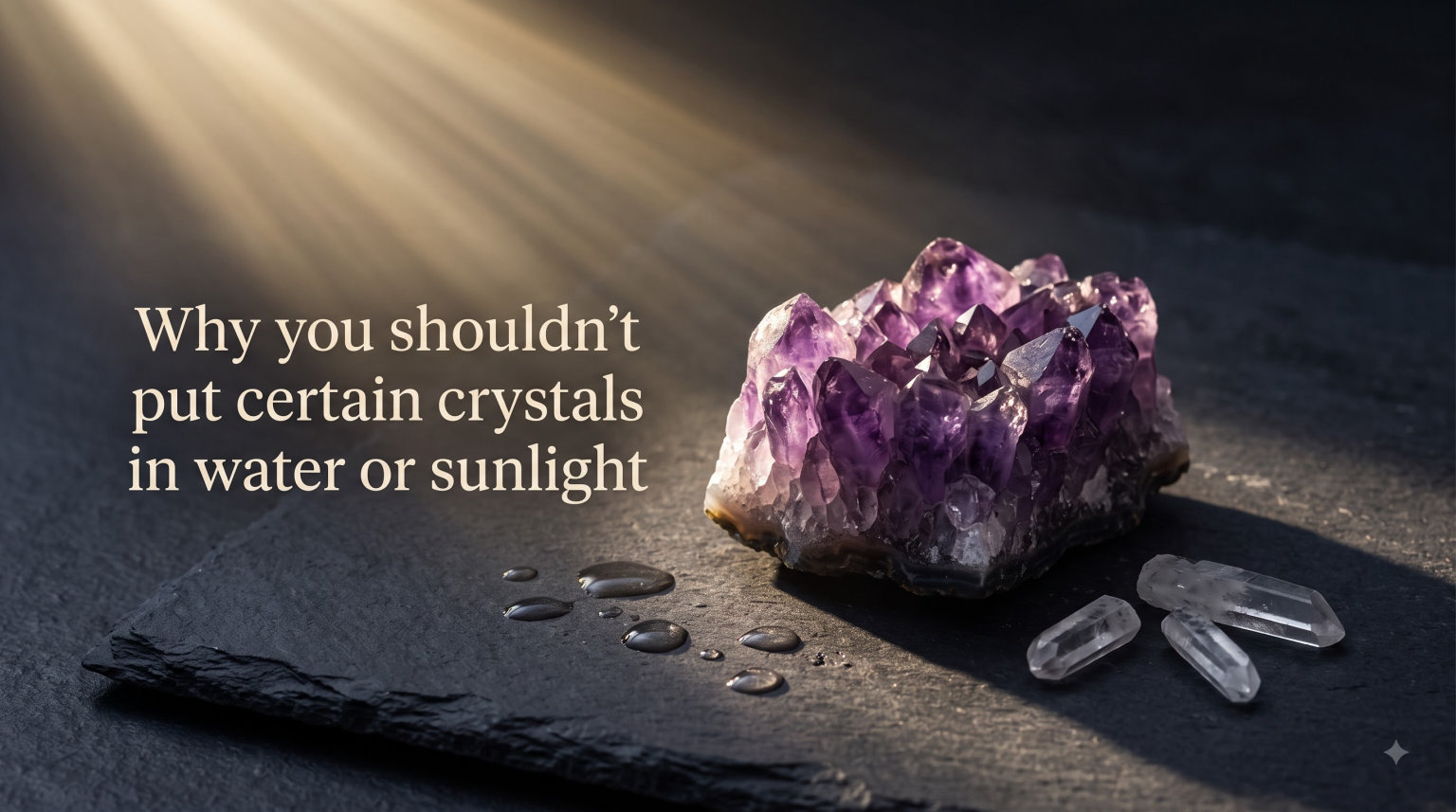
If you have ever dropped a favorite crystal into a bowl of water to cleanse it, only to pull out something chalky, cracked, or faded, you already know the heartbreak. Crystals look tough, but many are surprisingly fragile when exposed to water or sunlight. The truth is that certain crystals should not be in water or sunlight because their mineral structure, hardness, and chemical makeup make them vulnerable to permanent damage.
I have seen collectors ruin pieces worth hundreds of dollars in a single afternoon. One person left a beautiful deep purple amethyst cluster on a sunny windowsill for three months, and it faded to a washed-out lavender. Another soaked a raw selenite wand in saltwater overnight and found a pile of white sludge the next morning.
This guide breaks down exactly which crystals you should keep away from water and sunlight, why the damage happens at a chemical level, and what you can do instead to cleanse and charge your collection safely. Whether you work with healing crystals for meditation or simply love collecting beautiful minerals, knowing these rules will save your stones for years to come.
Table of Contents
Why You Shouldn’t Put Certain Crystals in Water or Sunlight?
Crystals get damaged by water and sunlight for three main reasons: low hardness, chemical sensitivity, and photosensitivity. Understanding these mechanisms helps you protect every stone in your collection instead of memorizing endless lists.
The Mohs Hardness Scale Explained
Mineral hardness is measured on the Mohs hardness scale, which runs from 1 to 10. Talc sits at 1, and diamond sits at 10. The scale works by scratching, so a crystal rated 3 will scratch if something rated 4 or higher rubs against it. As a general rule, crystals below 5 on the Mohs scale are too soft for prolonged water exposure.
Water does not just sit on the surface of soft crystals. It works its way into microscopic fractures, dissolves weak bonds, and gradually eats away the structure. A crystal that feels solid today can turn brittle and crumbly after repeated soaking. This is why crystal care guides always emphasize hardness before recommending any wet cleansing method.
Photosensitivity and UV Damage
Sunlight damage comes from ultraviolet radiation. Many crystals get their color from trace minerals like iron, manganese, or copper embedded in their structure. When UV rays hit these trace minerals, they break the chemical bonds responsible for the color. The crystal does not fall apart, but the color drains away permanently.
This process is called photobleaching, and it is the same thing that happens to fabric left in the sun. The difference is that a faded shirt can be replaced, but a rare crystal cannot. Photosensitive crystals can lose their color in as little as a few hours of direct sun, though most take weeks or months of repeated exposure.
Temperature Shock and Structural Stress
Sunlight does more than bleach color. It also heats crystals, and sudden temperature changes cause thermal shock. A cold crystal placed in hot sunlight can crack from the inside out. This is a real concern that collectors on mineral forums bring up constantly, because the damage is invisible at first and then a hairline fracture appears weeks later.
Water temperature matters too. Placing a warm crystal into cold water, or vice versa, creates the same stress. Opal is notorious for this, and many people have watched an expensive opal split in half after a quick rinse under the tap.
Crystals That Should Never Go in Water
Not every crystal reacts the same way to water, but the ones below will dissolve, release toxins, rust, or crumble. If a crystal is on this list, keep it dry and use alternative cleansing methods instead.
Soft and Dissolvable Crystals
Soft crystals are the most obvious risk group. Selenite tops the list at around 2 on the Mohs scale, which means it is barely harder than a fingernail. Selenite is a form of gypsum, and gypsum is actually used to make plaster of Paris. When you put selenite in water, you are slowly dissolving it. A quick rinse might seem harmless, but even brief exposure leaves the surface rough and pitted.
Halite is another salt-based crystal that dissolves on contact with water. It is literally rock salt, so water destroys it almost instantly. Celestite, with its delicate blue color and soft structure, also degrades when soaked. Ulexite, sometimes called TV stone, flakes apart and loses its fibrous optical properties.
Fluorite sits at 4 on the Mohs scale, which puts it right at the borderline. It can survive brief contact with water, but prolonged soaking causes tiny cracks and a cloudy surface. Many collectors recommend keeping fluorite away from water entirely to preserve its clarity.
Crystals That Become Toxic in Water
Some crystals do not just take damage, they release harmful substances when submerged. This category is the most dangerous because the risk extends beyond the crystal itself. If you are making crystal elixirs by placing stones directly in drinking water, these are the ones that can poison you.
Pyrite, also known as fool’s gold, contains iron sulfide. When pyrite oxidizes in water, it can create sulfuric acid. The crystal develops a rusty coating and the water becomes acidic. Malachite contains copper, which leaches into water and is toxic to humans and pets. Even handling wet malachite and then touching your eyes or mouth can cause irritation.
Cinnabar is a mercury sulfide mineral and should never touch water under any circumstances. Stibnite contains antimony, another toxic element. Galena is a lead ore that releases lead particles when wet. Realgar and orpiment both contain arsenic. These crystals are striking to look at, but they belong in display cases, not water bowls.
Crystals That Rust or Degrade
Iron-bearing crystals react with water through oxidation, which is a fancy word for rusting. Pyrite is the most famous example, but hematite can also develop a rusty film when exposed to moisture over time. Magnetite and limonite fall into the same category.
Tangerine quartz and other iron-stained crystals can lose their coating or develop ugly brown spots after soaking. The iron oxides that give these stones their warm orange and red colors are not chemically bonded to the quartz. Water can wash them right off.
Fibrous crystals like asbestos varieties, including some forms of actinolite and tiger’s eye in raw form, should also stay dry. Water can loosen the microscopic fibers, which then become an inhalation hazard when the crystal dries.
Crystals That Should Never Go in Sunlight
Sunlight damage is harder to notice than water damage because it happens slowly. You might not see a difference after one day, but after a season your crystal looks washed out and lifeless. The crystals below are the ones most vulnerable to UV fading and heat damage.
Photosensitive Crystals That Fade
Amethyst is the crystal most people ask about, and the answer is yes, amethyst fades in sunlight. The purple color comes from iron trace elements and natural irradiation within the quartz. UV exposure breaks down this color center, turning deep royal purple stones into pale grayish-pink. I have spoken with collectors who left amethyst geodes in sunny rooms and watched them lose their vibrancy over a single summer.
Citrine faces the same risk, especially heat-treated amethyst that has been sold as citrine. Because the color is artificially induced, it fades even faster than natural stones. Smoky quartz also lightens with prolonged sun exposure, gradually losing its rich brown tones.
Fluorite is extremely photosensitive and can lose its purple, green, or blue banding after just a few days in direct sun. Kunzite is so sensitive that gemologists warn against even bright indoor lighting. Hiddenite and prasiolite are in the same family and fade quickly outdoors.
Aura quartz deserves special mention. These are clear quartz crystals bonded with thin layers of gold, titanium, or other metals to create iridescent coatings. The metallic layer is delicate, and sunlight breaks it down. Crystal forums are full of posts from people whose aura quartz turned dull and patchy after sun charging.
Other notable fade risks include aquamarine, which shifts from blue toward clear, and rose quartz, which can pale over time. Dyed or heat-treated crystals of any type will always fade faster than their natural counterparts.
Crystals That Crack From Heat or Dry Out
Sunlight brings heat, and heat brings trouble for crystals that hold water in their structure. Opal is the classic example, containing up to 21 percent water by weight. When an opal heats up in the sun, the water evaporates and the stone develops stress fractures called crazing. Once those cracks form, they are permanent.
Angelite and apophyllite also contain water molecules in their crystal lattice. Heating them causes the water to expand and escape, leading to surface pitting and internal fractures. Gypsum-family stones like selenite and desert rose dry out and become more brittle with heat exposure.
Any crystal that has been treated, dyed, heat-enhanced, or irradiated is at higher risk from sunlight. The treatments alter the structure, making it less stable under UV. When in doubt about whether a stone is natural or treated, keep it out of direct sun.
How to Cleanse Crystals Without Water or Sunlight?
Just because a crystal cannot go in water or sun does not mean you cannot cleanse and recharge it. Crystal collectors have used alternative methods for centuries. These techniques are gentle, effective, and safe for even the most delicate stones in your collection.
Sound Cleansing
Sound is one of the safest and most versatile cleansing methods available. You can use a singing bowl, tuning fork, bells, or even a recorded frequency played through speakers. The sound waves pass through the crystal and clear stagnant energy without touching the physical structure at all.
I like to place crystals in a circle around a singing bowl and play it for five to ten minutes. There is zero risk of damage, and you can cleanse an entire collection at once. This method works for every crystal on the no-water and no-sun lists.
Smoke and Smudging
Smudging with sage, palo santo, cedar, or sweetgrass is a traditional cleansing practice that works beautifully on crystals. Light your chosen herb, let it smolder, and pass each crystal through the smoke several times. The smoke neutralizes energy without introducing moisture or heat.
Be gentle with fragile stones and hold them securely, because the smoke itself is harmless. Some practitioners prefer to place crystals in a line and fan smoke over them with a feather. Either approach works, and the scent adds a grounding ritual element to your practice.
Moonlight Cleansing
Moonlight is the classic alternative to sunlight charging. Place your crystals on a windowsill or outdoor surface during a full moon and leave them overnight. Moonlight provides gentle energy without the UV radiation that causes fading, so it is safe for photosensitive stones.
Even selenite, which dissolves in water, and amethyst, which fades in sun, can safely bathe in moonlight. This makes it the universal charging method for any collection. If you are worried about dew or humidity, keep the crystals on an indoor windowsill where they still receive moonlight through the glass.
Earth and Salt Methods
Burying crystals in dry earth overnight reconnects them with grounding energy. Use a pot of clean soil rather than the ground outside, where you can control moisture and avoid losing small stones. Brush the crystals clean afterward with a soft dry cloth.
Dry salt works as a purifying bed for crystals. Pour coarse sea salt or Himalayan salt into a shallow dish and rest your crystals on top. Never use salt water for this, because saltwater is even more corrosive than fresh water and will damage soft crystals on contact. Dry salt avoids that problem entirely.
Selenite slabs and clear quartz clusters also cleanse other stones by proximity. Place your crystals on a selenite charging plate or near a large quartz cluster overnight. These two minerals are self-cleansing and pass that property along to whatever sits near them.
Crystals That ARE Safe in Water and Sunlight
For contrast, it helps to know which crystals can handle water and sun without issue. Quartz family stones like clear quartz, smoky quartz in short bursts, and amethyst in very brief dips are generally safe for quick rinsing, though amethyst still should not stay wet long.
Hard crystals above 7 on the Mohs scale are your safest bets for water cleansing. Clear quartz, citrine, topaz, and tourmaline tolerate brief water exposure well. Just avoid saltwater, which is harsher than fresh water on any crystal.
For sunlight, sunstone, carnelian, black tourmaline, obsidian, and jade tolerate sun exposure better than most. Carnelian and sunstone are actually named for their solar connection. Even with these tougher stones, a few hours of morning sun is gentler than all-day direct exposure.
Frequently Asked Questions
Which crystals should not go in water?
Crystals rated below 5 on the Mohs hardness scale should not go in water, including selenite, halite, celestite, fluorite, and calcite. Toxic crystals like pyrite, malachite, cinnabar, stibnite, and galena should never be submerged because they release harmful substances. Iron-bearing stones like hematite and magnetite can rust.
Which crystals should not be in the sun?
Photosensitive crystals that fade in sunlight include amethyst, citrine, smoky quartz, fluorite, kunzite, aquamarine, and aura quartz. Heat-sensitive stones like opal, angelite, and apophyllite can crack from thermal shock. Dyed or treated crystals of any type fade faster than natural ones.
What crystals become toxic in water?
Malachite releases toxic copper, pyrite creates sulfuric acid, cinnabar releases mercury, stibnite releases antimony, and galena releases lead. Realgar and orpiment contain arsenic. Never use these crystals to make direct-contact elixirs in drinking water.
What crystals are safe in the sun?
Crystals that tolerate sunlight well include clear quartz, carnelian, sunstone, black tourmaline, obsidian, jade, and howlite. Even with sun-safe crystals, morning sun for a few hours is gentler than prolonged afternoon exposure.
Conclusion
Protecting your crystals comes down to understanding that not every stone plays by the same rules. Soft crystals dissolve, toxic crystals release poison, photosensitive crystals fade, and water-bearing crystals crack. When you know which crystals should not be in water or sunlight, you can keep your collection vibrant and intact for decades.
Start by sorting your stones into three groups: water-safe, sun-safe, and everything else. For the fragile ones, reach for sound cleansing, smudging, moonlight, or a selenite charging plate instead. A few minutes of mindful crystal care today prevents the permanent disappointment of a ruined stone tomorrow.