
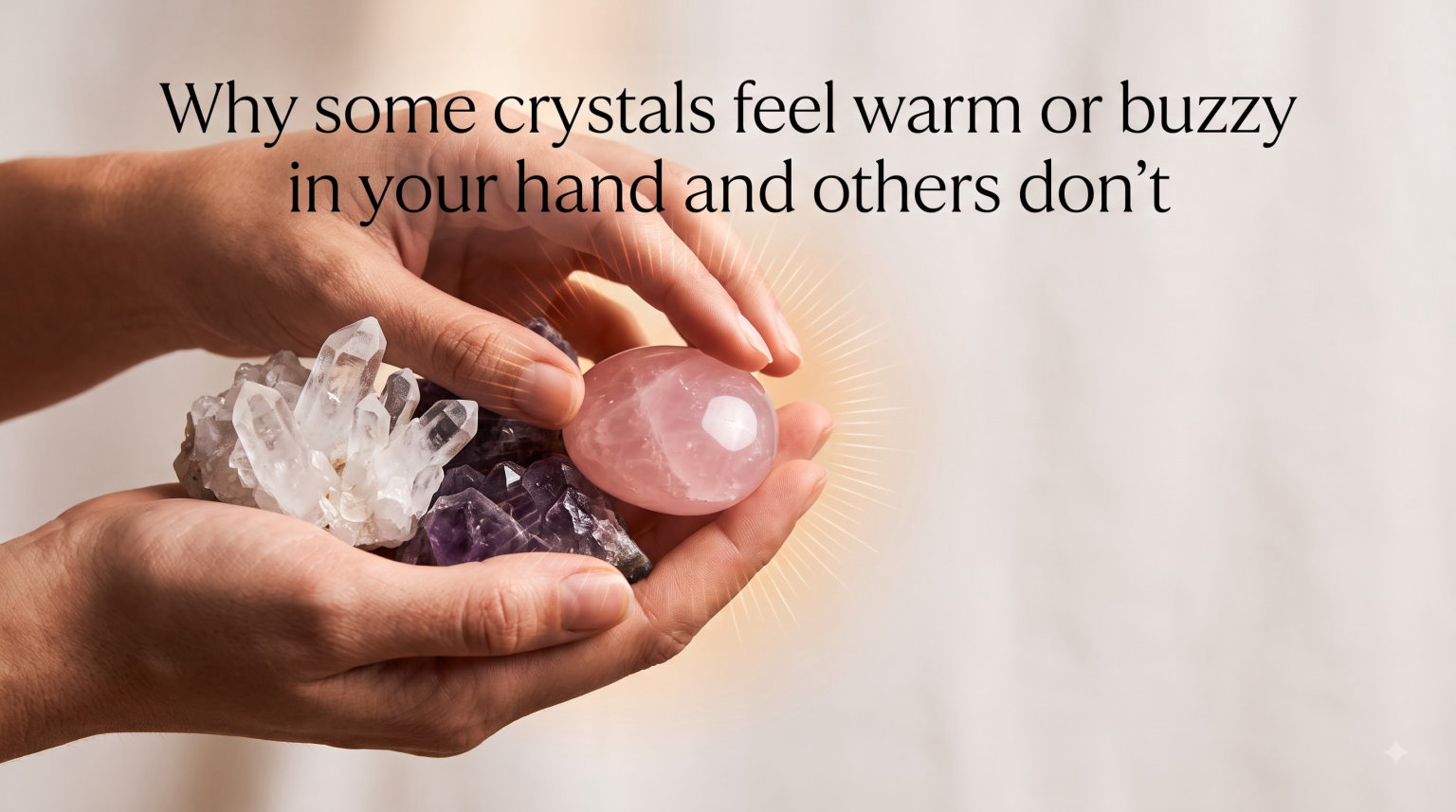
I still remember the first time I held a piece of clear quartz in my palm and felt a tiny electric hum travel up my wrist. My friend picked up the same stone two minutes later and said, “It just feels like a rock.” That difference set me on a years-long search for the answer to a question I now hear from readers almost every week: why some crystals feel warm or buzzy in your hand and others don’t.
The honest answer is that two things are happening at once. Your hand and the crystal are exchanging heat based on physics, and your nervous system is also responding to subtle vibrations, pressure, and intention. In this guide, I will walk you through the science first, then the metaphysical side, so you can decide what feels true in your own hands.
If you have ever wondered whether you are imagining the warmth, or worried that you cannot feel anything at all, you are in good company. Let us unpack it.
Table of Contents
The Science Behind Why Crystals Feel Warm
At its core, crystal warmth is a heat transfer problem. When your hand touches a stone, heat moves from the warmer object (usually your skin, around 91°F) to the cooler one until they equalize. The speed of that transfer depends on a property called thermal conductivity, and crystals vary widely in how quickly they conduct heat.
Metals feel cold instantly because they pull heat away from your skin very fast. Crystals like quartz and selenite also conduct heat efficiently, so they pull warmth out of your hand quickly, which your nerves read as coolness at first. Then, as the crystal warms up, the temperature change in your skin registers as a faint shift, sometimes described as “warming,” “tingling,” or a low-grade buzz.
There is a related property called thermal effusivity, which is the measure of how much heat a material can pull from your skin per second. Stones with high thermal effusivity feel cold quickly and then warm up in your grip. Stones with low thermal effusivity, like amber or some soft stones, feel warmer from the first touch because they do not draw heat away from you as aggressively.
So the short scientific answer is this: when you hold a crystal, your skin temperature drops slightly and then rebounds. Sensitive nerve endings in your fingertips can detect that rebound, especially when your hands are relaxed and you are paying attention.
What Your Nerves Are Actually Doing
Your fingertips contain thousands of mechanoreceptors and thermoreceptors per square centimeter. When a stone’s temperature changes by even one or two degrees, those receptors fire. Some crystals also have very smooth or very textured surfaces, which adds a tactile signal your brain can interpret as “buzzy” or “electric.”
In other words, part of the warm-crystal sensation is your nervous system doing its job. That does not make the experience imaginary. It makes it real in a different way than you might expect.
The Piezoelectric Effect and Crystal Vibrations
Some crystals do more than just conduct heat. They generate a tiny electrical charge when you squeeze, press, or flex them. This is called the piezoelectric effect, and it is one of the most common reasons people describe a crystal as “buzzy.”
Quartz is the classic example. When you press two quartz crystals together, or press a single quartz point firmly in your palm, the mechanical stress produces a measurable voltage. You cannot feel the voltage directly, but you can sometimes feel the micro-vibration it creates in surrounding tissues, especially in the soft, nerve-rich skin of your palms.
Tourmaline is another well-known piezoelectric stone. Some practitioners even use it in electronic equipment because its piezoelectric response is so reliable. In a meditation context, that same responsiveness is what gives certain stones their signature hum.
If a crystal feels noticeably buzzy to you, it often contains quartz, tourmaline, or another piezoelectric mineral. That is a measurable physical property, not a placebo.
Why Some Crystals Feel Warm and Others Feel Cold?
Not every stone feels the same. Composition, crystal structure, and even color all influence how a stone feels in your hand. Here is the practical breakdown.
High-Conductivity Crystals (Feel Cold, Then Warm)
Clear quartz, smoky quartz, amethyst, selenite, and most members of the quartz family pull heat quickly from your skin. The first touch usually feels cool. After 30 to 90 seconds, your hand warms the stone, and you may notice a gentle rising heat or pulse.
Low-Conductivity Crystals (Feel Warm From the Start)
Amber, lepidolite, and softer stones like howlite feel closer to skin temperature right away. They do not draw much heat from your palm, so they tend to read as neutral or warm rather than cool.
Dense, Heavy Crystals (Feel Grounded or Heavy)
Hematite, labradorite, and obsidian are dense and often feel “weighty” rather than warm. People frequently describe them as grounding rather than buzzy, which fits their physical properties.
Metallic or Ore-Based Stones (Feel Cold Longest)
Pyrite, magnetite, and galena contain metal or metallic bonds, so they pull heat very efficiently. They tend to feel distinctly cool and stay cool in your hand longer than silicate-based stones.
So when you wonder why some crystals feel warm and others feel cold, composition is doing most of the talking.
The Metaphysical View: Crystal Energy and Vibration
For readers who work with crystals intentionally, the warmth has a different layer of meaning. Many practitioners describe crystal energy as a subtle vibration that interacts with the body’s own energy field, often connected to the chakra system.
In this view, when a stone feels warm, it is because the crystal is “activating” or moving energy through your field. Tingling, pulsing, or a buzzy sensation in the hand holding the stone is interpreted as a sign of energetic exchange rather than heat transfer.
I have worked with crystals for over a decade, and I will tell you what I have personally observed. Some stones warm up only when I am emotionally activated or working through something specific. Other stones stay cool no matter what. The pattern, in my experience, is that the warmth tracks my state more than the stone’s.
Whether you interpret that observation as energetic resonance, focused attention, or sympathetic nervous system activation is up to you. Both interpretations have value, and they are not mutually exclusive.
Chakras and Common Sensations
If you work with chakras, certain sensations are commonly reported. A warm or pulsing root chakra stone (like black tourmaline or hematite) is often felt in the lower abdomen. A buzzy or tingling heart chakra stone (like rose quartz or green aventurine) is often felt in the chest or fingertips. These reports are consistent across thousands of practitioner accounts.
Why Some People Feel Crystal Energy More Than Others?
Forum threads on this topic run for hundreds of comments, and they share a common theme: some people feel something strongly, some feel nothing at all, and most sit somewhere in between. There are a few real reasons for that variation.
Neurodivergence and Sensitivity
People with heightened sensory processing, including many who identify as empaths, often report feeling crystal sensations more vividly. This tracks with research on interoception, which is the ability to notice internal body signals.
State of Attention
If you are distracted, scrolling your phone, or half-thinking about dinner, you will likely feel less. People who slow down, close their eyes, and breathe with a stone for two to three minutes report sensations far more often.
Hydration and Circulation
Cold hands feel less. If your circulation is sluggish or you are dehydrated, your fingertips will not register subtle temperature changes as easily. Warming your hands before holding a stone can make a noticeable difference.
Practice
Like any sensory practice, paying attention builds the skill. People who work with crystals daily report that their sensitivity increases over weeks and months, even if nothing about the stones has changed.
So if you have ever worried that you cannot feel crystal energy, please hear this: it is a learned skill, not a pass-or-fail test. Your nervous system is trainable.
Practical Ways to Experience Crystal Energy
If you want to test your own sensitivity, here is a simple routine our team uses during workshops. It takes about five minutes.
Step 1: Settle and Warm Your Hands
Rub your palms together for 30 seconds. Breathe slowly for one minute. This calms your nervous system and improves blood flow to your fingertips.
Step 2: Hold the Stone Quietly
Place a quartz point or tumbled stone in your non-dominant hand. Close your eyes. Breathe normally. Do not try to feel anything. Just hold the stone with soft attention.
Step 3: Notice Without Naming
After 60 to 90 seconds, you may notice temperature, weight, pulse, or a faint vibration. Resist the urge to label it. Just notice.
Step 4: Compare Two Stones
Pick up a second stone of similar size. Hold it the same way. Most people notice a difference between two different crystals within two minutes, even when they cannot describe what the difference is.
That simple test is more useful than any chart of “healing properties” because it grounds you in your own experience.
Crystals Known for Noticeable Sensations
Based on practitioner reports and our own observations, these stones tend to produce the most consistent sensations in beginners.
Clear Quartz
The classic “buzzy” stone. High thermal conductivity and strong piezoelectric response make it the gold standard for feeling crystal energy.
Selenite
Often described as “cool and floating.” Many people feel a soft humming sensation rather than warmth.
Black Tourmaline
Heavier and grounding. The sensation is usually described as warmth traveling down through the hand, especially when held during stressful moments.
Citrine
Frequently described as warm and slightly electric. Its iron content and quartz base give it both a stable temperature and a subtle piezoelectric charge.
Rose Quartz
Soft, gentle warmth, especially when held over the heart. It does not usually buzz, but the warmth is consistent for most practitioners.
Lapis Lazuli and Sodalite
Both are often described as “cool and still,” with sensations building slowly over several minutes.
Remember, your experience is the only one that matters. These are common reports, not promises.
Frequently Asked Questions
What does it mean when a crystal gets warm in your hand?
When a crystal gets warm in your hand, two things are usually happening. Your body heat is being absorbed by the stone based on its thermal conductivity, and your nerve endings are registering that temperature shift. From a metaphysical perspective, many practitioners interpret the warmth as a sign of energy exchange between you and the stone.
How do you tell if a crystal is working?
Signs your crystal is working include subtle warmth, tingling, pulsing, or a slight shift in mood or breathing when you hold it. You may also notice clearer thinking, emotional release, or a sense of calm. If you feel nothing, that does not mean it is broken. It may mean you need a few minutes of quiet attention to notice what is happening.
Which hand receives energy from crystals?
In most traditions, the left hand is considered the receiving hand, while the right hand is the projecting hand. If you are meditating with a stone for the first time, try holding it in your non-dominant hand, which is usually the receiving side, and notice what you feel.
Why do some crystals feel cold to the touch?
Crystals with high thermal conductivity pull heat from your skin quickly, which your nerves read as cold. Quartz, selenite, and tourmaline are common examples. Once the stone warms to your body temperature, the cold sensation usually fades within a minute.
Why can’t I feel crystal energy?
Many people cannot feel crystal energy at first. Common reasons include distraction, cold hands, dehydration, and simply not having practiced. Try warming your hands, closing your eyes, and holding a quartz point for two full minutes without trying to feel anything. Sensitivity often builds with repeated practice.
Final Thoughts on Why Some Crystals Feel Warm or Buzzy in Your Hand
The reason some crystals feel warm or buzzy in your hand while others feel cold or inert comes down to a layered combination of thermal conductivity, piezoelectric activity, your nervous system, and your state of attention. Science explains the heat. Your nervous system explains the sensation. Your intention explains the meaning you assign to it.
If you take one thing from this guide, let it be this: your experience with crystals is real, valid, and worth paying attention to. Whether you are a seasoned practitioner or a curious skeptic, the stones are waiting patiently in your hand to teach you something. You just have to slow down enough to notice.
Grab a quartz point, settle in for two minutes, and see what you feel. I would love to hear what you notice.