
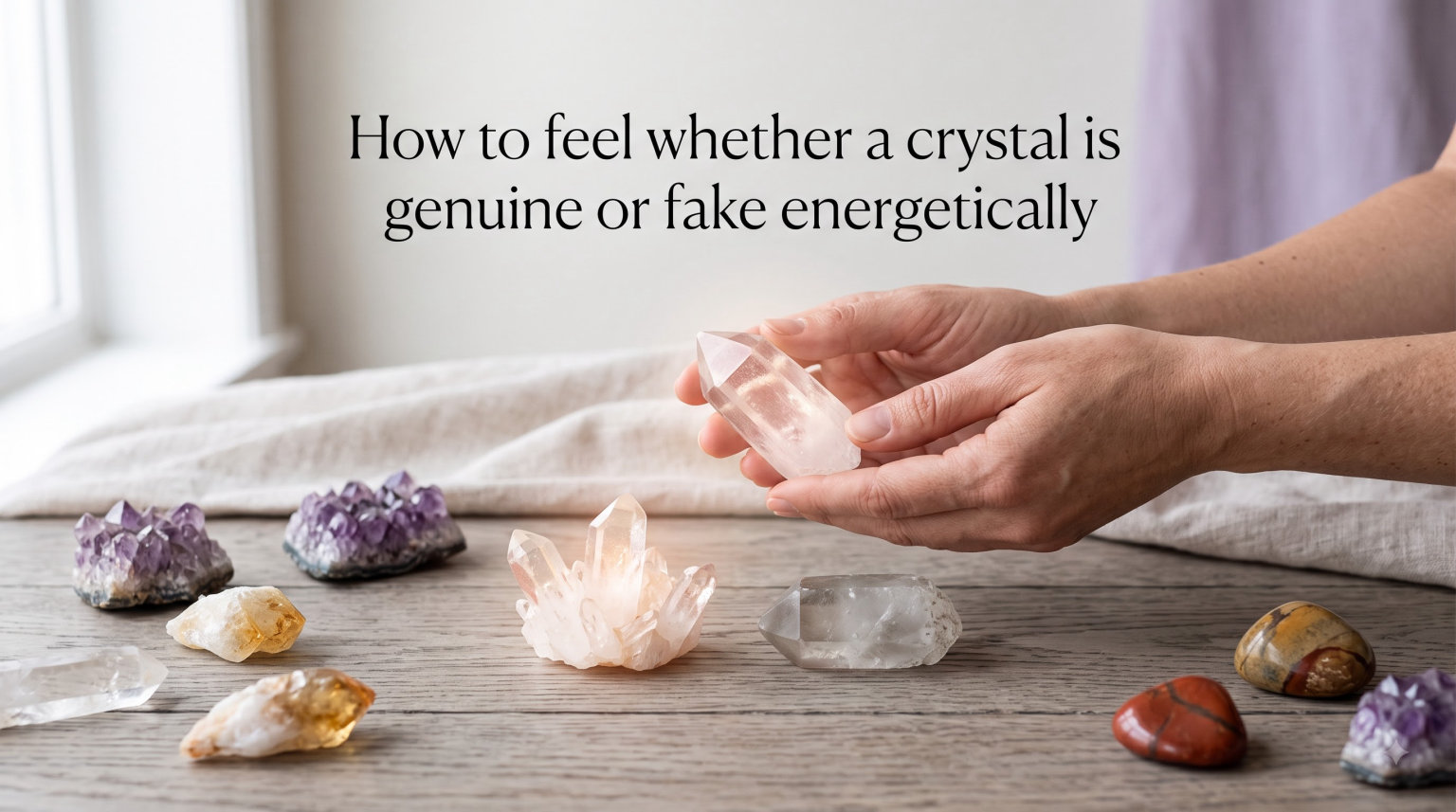
Have you ever held a crystal and sensed something was off, even when it looked perfect? You’re not imagining it. Learning to feel whether a crystal is genuine or fake energetically combines physical observation with intuitive sensitivity, and it grows stronger with practice.
In this guide, I’ll walk you through the exact sensations to look for, the at-home tests you can run in minutes, and the meditation practices that sharpen your inner radar over time.
Our team has worked with crystals for years. We’ve handled everything from raw quartz clusters to polished amethyst towers, bought duds, returned fakes, and built a reference collection of known genuine stones. What follows is the practical, hands-on method we wish someone had shared with us on day one.
Your hands already know more than you realize. The goal here is to bring that knowing into conscious awareness so you can use it every time you pick up a new piece.
Table of Contents
How Genuine Crystal Energy Actually Feels?
Genuine crystal energy feels like a cool, steady hum beneath your fingertips, almost as if the stone is breathing slowly. When you hold a real crystal, you’ll often notice a subtle tingling, a faint magnetism, or a sense of weight that goes beyond its physical mass.
Many people describe genuine stones as feeling “present” or “awake.” That grounded quality is part of what practitioners mean when they say a crystal is “alive.”
Fake crystals, by contrast, often feel inert or “dead.” Glass imitations warm up quickly in your palm and lack that inner pulse entirely.
Plastic or resin fakes feel light, slightly warm, and emotionally flat. Experienced practitioners often describe them as feeling “hollow” or “muffled,” while genuine stones feel “open” or “resonant.”
There is also an emotional layer. Some genuine crystals produce a sense of calm, focus, or uplift simply by being held. Fakes tend to evoke nothing at all, or in rare cases a vague sense of unease.
When I first started collecting, I dismissed these feelings as imagination. Years later, after handling hundreds of stones side by side, the difference became undeniable. Fakes leave my hand feeling slightly flat. Genuine stones leave me feeling grounded.
If your body tenses when you pick up a stone, pay attention to that signal. If you’re new to this work, don’t worry. Sensitivity grows with practice, and the rest of this guide gives you concrete tests and exercises to build that awareness from the ground up.
The Touch Test: Temperature and Texture
A genuine crystal feels noticeably cool to the touch and stays cool longer than glass or plastic. Hold the stone against your cheek or the inside of your wrist for ten seconds.
Real stones maintain their temperature slowly because of higher thermal conductivity. Fakes warm up almost immediately because they don’t have the same mineral density.
Texture matters too. Genuine crystals often have small irregularities like tiny pits, natural fractures, or slight roughness on less-polished surfaces.
Glass fakes feel uniformly slick, almost frictionless. Resin imitations can feel waxy or slightly sticky in warm weather, and you may notice faint mold lines on the edges where the two halves of a cast met.
Run your thumb across the surface slowly. Real stones have a mineral grain, even when polished. That grain may feel slightly directional, like wood.
Synthetic pieces feel manufactured, often with edges that look too perfect or too soft. If a tumbled stone looks like a perfect oval with no nicks anywhere, that’s a red flag.
One more touch test is the breath test. Breathe on the crystal as you would a mirror.
Real quartz and most genuine minerals fog briefly, then clear quickly. Glass behaves similarly, but the fog pattern on real crystals often shows subtle internal lines through the cloud.
Resin barely fogs at all. This is a quick, low-risk way to confirm what your fingers are telling you.
If a stone passes both the temperature and texture tests, it’s likely genuine. If it fails even one, dig deeper before committing.
Weight and Density: The Grounded Feel
Real crystals feel heavier than they look. Pick up a quartz point and a glass replica of the same size. The genuine stone will surprise you with its heft.
This grounded weight is part of what people describe as “feeling the energy.” It is tied directly to specific gravity, the density of the mineral.
Density comes from the mineral composition. Stones like quartz, amethyst, and citrine have specific gravity values around 2.65, meaning a one-inch cube weighs roughly the same as a small apple.
Fakes made of glass are usually close in weight, but plastic and resin fakes are noticeably lighter, often by 30 to 50 percent. If a stone feels light or hollow, that’s a red flag.
Hold the stone in your dominant hand, then hold a known genuine stone of similar size in the other. Your hands will register the difference immediately.
Once you’ve calibrated your hand with a few genuine pieces, the weight difference becomes obvious. Trust that calibration every time you pick up something new.
Visual Indicators Your Hands Will Notice
Look closely at the crystal while holding it in your receptive hand. Genuine stones have inclusions, small flaws, color variations, and natural veining. These “imperfections” are actually proof of authenticity.
A piece that looks too clean, too perfectly colored, or has visible air bubbles inside is likely glass or resin. Real quartz often shows rainbow fractures, internal veils, or tiny mineral traces.
Amethyst may have color zoning, where deeper purple fades into lighter tones within the same piece. Moldavite has characteristic pitted surfaces with deep groves.
If the color looks dyed, painted, or unnaturally uniform, treat that as a warning sign. You can also use a flashlight to confirm what your hands are sensing.
Hold the stone up to a bright light source and look at how it transmits. Real quartz shows double refraction, a faint doubling of internal lines when you view through it.
Glass doesn’t refract the same way. This is one of the more reliable visual tests.
Check for chips along edges and points. Real quartz chips conchoidally, leaving curved, shell-like fractures.
Glass chips leave sharper, more angular breaks. If you spot a chip on a piece you’re considering, take a close look at its shape. The break itself tells a story.
Internal Vibrations and Resonance
When you sit quietly with a genuine crystal, you may feel a soft pulsing or vibration, especially during meditation. Practitioners describe it as a low hum, a sense of warmth radiating outward, or a magnetic pull toward the stone.
Some people report feeling the energy move up their arm, into their chest, or settling in their solar plexus. These sensations vary from stone to stone.
This vibration isn’t mystical magic. It’s your nervous system responding to subtle cues like the stone’s weight, temperature, surface texture, and possibly its piezoelectric properties.
Quartz is piezoelectric, meaning it generates a tiny electrical charge under pressure. Your body may be picking up on that, even at levels below conscious thought.
Over time, your body learns to interpret these signals as “real” or “off.” To test this, close your eyes and hold two stones side by side, one known genuine and one suspected fake.
Notice which one feels “present” and which feels “empty.” Most people can spot the difference within seconds once they know what to look for.
You can also test resonance audibly. Gently tap two genuine quartz points together. They produce a clear, ringing tone, almost musical.
Two glass imitations produce a duller thud. The difference is subtle but consistent, and once you’ve heard real quartz ring, you don’t forget it.
Hardness Test: The Mohs Scale Feeling
The Mohs hardness scale measures how easily a mineral can be scratched. Genuine quartz sits at 7, meaning it scratches glass and steel.
Real amethyst, citrine, and rose quartz share this hardness. If a stone scratches easily with a steel blade or your fingernail, it likely isn’t quartz.
You don’t need a kit to test this. Try the stone against a piece of glass you don’t care about, like an old jar or bottle.
If the crystal leaves a mark on the glass, it’s probably real quartz. If the glass scratches the crystal instead, walk away. This is one of the most reliable at-home tests.
Be gentle with this test on polished or rare pieces. A scratch test should be on an inconspicuous area, ideally the base, and only done when you’re willing to risk a small mark.
For display pieces or valuable specimens, skip this test and rely on the other methods instead.
Commonly Faked Crystals to Watch For
Some crystals get faked more often than others. Turquoise is one of the most commonly imitated stones, often dyed howlite or magnesite sold as the real thing.
Moldavite has many glass replicas because genuine moldavite is rare and expensive. Aura quartz is sometimes sold as natural when it’s actually metal-bonded in a lab.
Opalite, frequently labeled “moonstone,” is often just glass with a milky sheen. Other frequently faked stones include amber (plastic imitations are extremely common), larimar (dyed agate), and sugilite (dyed quartz).
Lapis lazuli is sometimes reconstituted from chips and sold as solid stone, though this is usually disclosed.
If you’re buying any of these, apply all the tests above. Coolness, weight, surface texture, and visual inclusions all matter most when the stone is heavily faked.
When in doubt, buy from a seller who provides a certificate of authenticity or who is willing to discuss the stone’s origin in detail.
Enhanced vs Fake: Know the Difference
An enhanced crystal isn’t the same as a fake. Heat-treated amethyst turns into citrine, and irradiated quartz becomes smoky quartz.
Dyed agate is still agate, just colored differently. These treatments are common in the industry and not necessarily deceptive when disclosed.
A fake, on the other hand, is a different material entirely. Glass sold as quartz, plastic sold as amber, or reconstituted stone sold as natural.
The energetic feel often differs. Enhanced stones still carry their original mineral structure, while fakes lack that core vibration entirely.
Ask sellers about treatment. Honest dealers will tell you upfront. If a seller claims “natural” but the price seems too good to be true, dig deeper.
If they can’t or won’t explain where the stone came from, consider buying elsewhere. Transparency is one of the strongest trust signals in the crystal world.
Meditation Exercises to Develop Your Sensitivity
Your ability to feel whether a crystal is genuine or fake energetically sharpens with practice. Try this first exercise to get started.
Sit quietly for five minutes holding a known genuine stone in your non-dominant hand. Notice the weight, temperature, and any subtle sensation. Breathe slowly and let your attention settle into your palm.
Then switch to a piece of plain glass of similar size and hold it the same way. Most people report the genuine stone feels “fuller” or more “present,” while the glass feels neutral.
Another method is pendulum work. Suspend a crystal on a string and hold it over your palm.
Genuine stones often produce steadier, more circular motion when you’re energetically connected. Fakes may produce weak, erratic, or no movement at all.
This isn’t scientific proof, but it’s a useful intuitive tool that many practitioners trust.
A third exercise is the comparison meditation. Gather three stones: one known genuine quartz, one suspected fake, and one piece of glass.
Spend five minutes with each, eyes closed, simply holding and breathing. Notice the differences in temperature, weight, vibration, and emotional response.
Journal your observations afterward. Over weeks, your sensitivity will grow. Soon you’ll trust your hands without needing every physical test.
Daily practice matters more than duration. Even two minutes a day with a single stone builds the muscle of attention. Over a month, you’ll notice clear shifts in how you experience the stones in your collection.
Trusting Your Instincts and Seller Verification
Beyond physical and energetic tests, gut feeling matters. If a crystal feels “off” in any way, even when you can’t explain why, trust that signal.
Many experienced practitioners report that fake stones feel draining, heavy in a negative way, or simply “wrong.” Your subconscious picks up on cues your conscious mind hasn’t labeled yet.
When buying, choose sellers who share sourcing information. Look for those who list the country of origin, treatment disclosure, and geological details.
Reputable dealers don’t hide these facts. Avoid sellers with no return policy, vague descriptions, or prices far below market average. If a deal seems too good, it usually is.
Buy from shops you trust. Local crystal stores where you can handle pieces in person, established online retailers with detailed listings and customer reviews, or gem shows where you can meet the miner directly.
Ask questions. A good seller welcomes curiosity and answers without defensiveness.
Build a reference collection over time. Owning a few known genuine stones gives you a baseline for comparison.
Without that baseline, even experienced intuitions can drift. A small starter set of quartz, amethyst, and rose quartz is enough to train your hand and your instincts.
Keep a small journal. Note how each new crystal feels when you first receive it. Record the temperature, weight, surface texture, and any emotional or physical sensations.
Over time, patterns emerge, and your “feeling” gets sharper with data behind it. This journal also becomes a record of how your sensitivity has developed, which can be deeply affirming on its own.
When a stone doesn’t feel right, give yourself permission to set it aside. Not every crystal is meant for you, and not every crystal in the marketplace is genuine.
Learning to let go of pieces that feel wrong is part of building a collection you truly trust. Your future self will thank you for the patience.
Frequently Asked Questions
How to tell if your crystal is real or fake?
Touch it against your inner wrist. Genuine crystals feel cool and stay cool for several seconds, while glass or plastic warms quickly. Combined with weight and surface texture checks, this gives you a fast answer in most cases.
What does energy from crystals feel like?
Most people describe crystal energy as a subtle tingling, gentle warmth, or steady hum in the palm. It can also feel grounding, calm, or magnetically present. Fake stones usually feel inert or emotionally flat in comparison.
How do I test if my crystal is real?
Run four quick checks: temperature (cool and slow to warm), weight (heavier than expected), visual inclusions (natural flaws present), and hardness (real quartz scratches glass). Each test adds confidence.
How to tell if crystal is real by touching?
Hold the stone against your cheek or inner wrist. Genuine crystals stay cool for 10 seconds or more. Glass, plastic, and resin fakes warm almost instantly. Surface texture also reveals authenticity, real stones have mineral grain.
What does real crystal sound like?
Genuine quartz has a clear, ringing tone when struck gently. Glass produces a duller thud. Tapping two real quartz points together creates a faint musical note you can feel through the stone.
How to test if crystals are pure?
Pure crystals have consistent temperature, density, and internal structure. Check for air bubbles (suggests glass), overly uniform color (suggests dye), and unusual lightness (suggests resin). Combinations of tests give clearer results.
Final Thoughts on Sensing Real Crystal Energy
Learning to feel whether a crystal is genuine or fake energetically takes time, but it gets easier with every stone you hold. Start with the touch test: coolness, weight, and texture give you fast answers.
Add visual checks for inclusions, bubbles, and color zoning. Practice short meditations daily to sharpen your intuition. Build a reference collection from trusted sellers.
Buy from dealers who share sourcing details and welcome your questions. Your hands know more than you think.
The more time you spend genuinely holding crystals, the clearer that knowing becomes. Trust what you feel, keep practicing, and the energy of every stone in your collection will become clearer as we move through 2026 and beyond.