
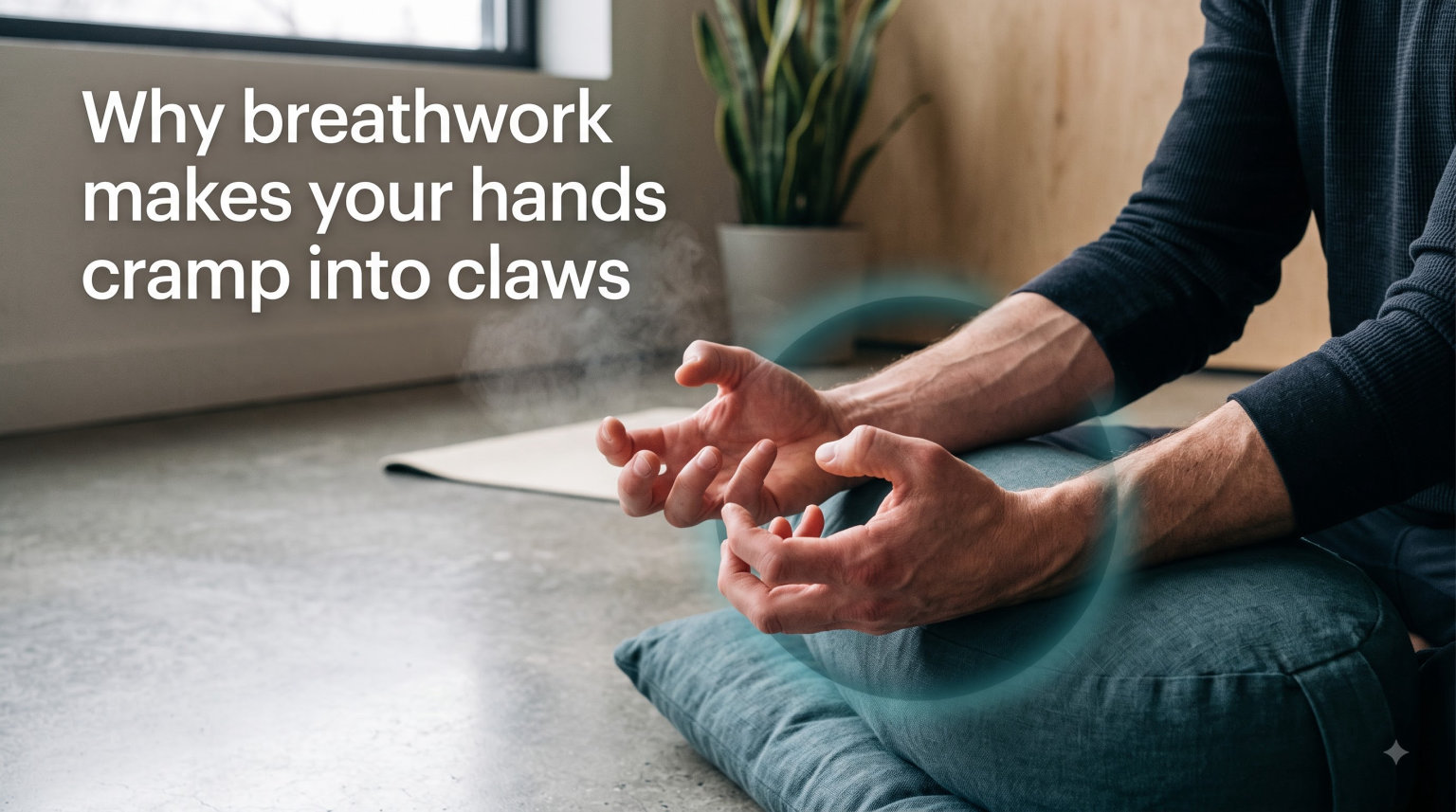
You take a deep connected breath, then another, and suddenly your fingers curl into a claw. Your wrists lock. Your face tingles. If you have ever wondered why breathwork makes your hands cramp into claws, you are not alone. I have watched this happen to first-time practitioners and seasoned facilitators alike, and the answer sits at the intersection of blood chemistry, breath patterns, and the body’s alarm system.
This guide unpacks the exact mechanism behind claw hands during breathwork, what it means energetically, and what to do when it shows up. By the end, you will understand the Bohr effect, the role of ionized calcium, and why slow exhales often resolve the sensation faster than fighting it.
Table of Contents
What Is Tetany in Breathwork?
Tetany is a temporary state of involuntary muscle contractions caused by nerves becoming hypersensitive, most often showing up in the hands, feet, and around the mouth. During breathwork, it is the medical name for what practitioners call claw hands, T-Rex hands, lobster claw hands, or carpopedal spasm. The contractions are real, but they are not a sign of damage.
Up to 80% of participants in a connected breathwork session experience some form of tetany. It can show up as light tingling in the fingertips or as a full cramping lock where the fingers cannot open. The intensity depends on your breathing rate, baseline mineral status, and how much tension you are already carrying.
The Physiological Explanation: CO2, Calcium, and the Bohr Effect
The dominant cause of breathwork hand cramping is a chain reaction that starts with you exhaling too much carbon dioxide (CO2). When blood CO2 drops below a healthy threshold, blood pH rises and becomes more alkaline. This state is called respiratory alkalosis, and it is the same shift that happens during a panic attack.
How Rapid Breathing Changes Blood Chemistry
During connected breathwork, holotropic breathwork, or pranayama practices like kapalbhati, you breathe faster and deeper than your body is used to. Each exhale offloads CO2. Normally, your body carefully balances CO2 and oxygen through a relationship called the Bohr effect: when CO2 rises, hemoglobin releases oxygen to tissues. When CO2 drops, hemoglobin holds oxygen more tightly.
Here is the catch. When you breathe rapidly for an extended period, CO2 drops so low that hemoglobin stops offloading oxygen efficiently, even though your blood is saturated with it. Your muscles receive less usable oxygen at the exact moment your nerves are becoming more excitable. That mismatch is the metabolic fuel for tetany.
Why Calcium Binding Triggers Claw Hands?
Rising blood pH from low CO2 changes how calcium behaves in your blood. Specifically, calcium binds more tightly to albumin, a carrier protein. Less calcium floats around as free, ionized calcium, which is the form your nerves use to regulate firing.
When ionized calcium dips, nerve cells fire more easily. Motor neurons begin sending rapid signals to the muscles in your hands, feet, and face. The result is the unmistakable claw shape, with fingers flexed hard and wrists drawing inward. If you have ever heard someone say your body is “running out of calcium” during breathwork, this is the nuance they are pointing at: it is not a calcium deficiency in your bones, but a temporary redistribution in your blood.
The Bohr Effect in Plain Language
The Bohr effect is the bridge between your breath and your muscles. Watch a slow rhythmic practice and you stay in the green zone, where CO2 control and oxygen delivery stay balanced. Push into fast, forceful breathing and you cross into the red zone, where alkalosis, calcium binding, and nerve hyperexcitability all stack on top of each other. This is why gentle inhalation and a longer, slower exhale typically prevent claw hands.
The Psycho-Spiritual Side of Claw Hands
Tetany is not just a chemistry event. For decades, breathwork pioneers like Stanislav Grof have framed it as a doorway. In holotropic breathwork, claw hands often emerge when the body is releasing stored tension, sometimes from early life or from older trauma the conscious mind has filed away. The locked posture is energy moving out through the fingers.
In our breathwork circles, we have seen participants experience a breakthrough alongside tetany. They breathe through the lock, the muscles soften, and a wave of emotion or memory arrives. The clamping reflex, in this frame, is the body trying to hold onto something it is finally ready to release. Practitioners call this letting go while the body grips. The hands often relax first, then the diaphragm, then the mind.
From a nervous system perspective, claw hands also connect to the vagus nerve. Breathwork stimulates the vagus nerve through slow rhythmic exhale patterns, which helps shift you from a sympathetic fight-or-flight state into a parasympathetic rest-and-digest state. The muscle rigidity of tetany is part of that transition, a final guard post coming down before the system softens.
How to Manage Tetany When It Happens
If your hands cramp during breathwork, here is the sequence I teach and use myself. Move through these steps in order, and most cases resolve within one to two minutes.
Step-by-Step Relief Techniques
Lengthen your exhale. Inhale for a count of 4, then exhale for a count of 8. You are trying to retain a little more CO2 without holding your breath.
Slow your breath rate. Drop from connected breathing to a gentler rhythm. Even cutting your pace in half often releases the clamp.
Press your palms together. Gentle pressure from the hands can interrupt the cramping nerve signal. Many practitioners swear by this trick.
Touch your fingertips. Bringing the tip of your index finger to the tip of your thumb, then moving finger by finger, helps reset the motor neurons.
Bring the paper bag if needed. Re-breathing exhaled air (carbon dioxide rich) restores blood CO2 levels. A small paper bag held loosely over the nose and mouth works for home use.
Place a hand on your chest and breathe slowly. This grounds the nervous system and signals safety.
Prevention Strategies for Next Time
Prevention is easier than management. In the 24 hours before a breathwork session, drink plenty of water and eat mineral-rich foods like leafy greens, bananas, and pumpkin seeds. Magnesium in particular supports nerve relaxation. Avoid heavy caffeine, which primes your nervous system for tetany. During the session itself, keep your inhale passive and your exhale slightly longer. If you are facilitating, mention the possibility of tetany upfront; surprise is what turns mild tingling into panic.
Is Tetany During Breathwork Dangerous?
Tetany during breathwork is not dangerous for healthy adults. The cramping is uncomfortable, sometimes painful, and it can be disorienting, but it is not a sign of damage to your muscles, brain, or heart. Once your breathing normalizes, blood CO2 stabilizes, calcium rebinds back into its free form, and the muscles release within minutes.
Real concern is rare. Talk to a healthcare provider if tetany happens outside of breathwork, comes with severe chest pain, prolonged confusion, or loss of consciousness, or if you have a known condition like epilepsy, heart arrhythmia, or uncontrolled blood pressure. Pregnancy and glaucoma are also worth flagging with your doctor before deep breathwork. For the vast majority of people, claw hands are a temporary, harmless signpost that your body is shifting.
One thing that does cause harm is fighting the sensation. Clenching against the cramp, holding your breath, or trying to “push through” with faster breathing makes everything worse. The fastest path back is to slow down, breathe normally, and let the lock release on its own timeline.
Frequently Asked Questions
Why do my hands cramp up during breathwork?
Your hands cramp during breathwork because rapid, deep breathing causes you to exhale too much carbon dioxide. Lower CO2 raises blood pH, which causes calcium to bind more tightly to proteins, making nerves in your hands hypersensitive and triggering involuntary muscle contractions known as tetany.
Is tetany during breathwork dangerous?
Tetany during breathwork is not dangerous for most healthy adults. The cramping is uncomfortable but temporary and resolves once your breathing rate normalizes. Talk to a medical professional if tetany occurs outside of breathwork or is accompanied by chest pain, fainting, or severe confusion.
What causes tetany in breathwork?
Claw hands tetany in breathwork is caused by respiratory alkalosis, a state where blood becomes too alkaline from excessive CO2 loss. This shift reduces free ionized calcium, making nerves fire more easily and causing muscles in your hands, feet, and face to contract involuntarily.
Does breathwork stimulate the vagus nerve?
Yes, breathwork stimulates the vagus nerve, especially when you extend your exhale. Slow exhale patterns activate the parasympathetic nervous system, which supports relaxation, lowers heart rate, and helps release the muscle tension that drives claw hand tetany.
What is your body lacking when your hands cramp?
During breathwork, your body is not necessarily lacking calcium itself, but free, ionized calcium in the blood. Rapid breathing causes calcium to bind more tightly to proteins, lowering the amount available to nerves, which is why hand cramping and tingling occur.
Final Thoughts
When breathwork makes your hands cramp into claws, your body is showing you a chemistry lesson in real time. CO2 drops, pH rises, calcium binds too tightly, and your nerves fire faster than your muscles can relax. None of this is a warning sign. It is a doorway. Slow your exhale, breathe into the sensation, and let the lock release. Over time, you will notice that claw hands show up less often, and when they do, you will know exactly what to do. If you are new to breathwork, work with a trained facilitator for your first sessions so they can guide you through the experience safely and help you integrate what unfolds.