
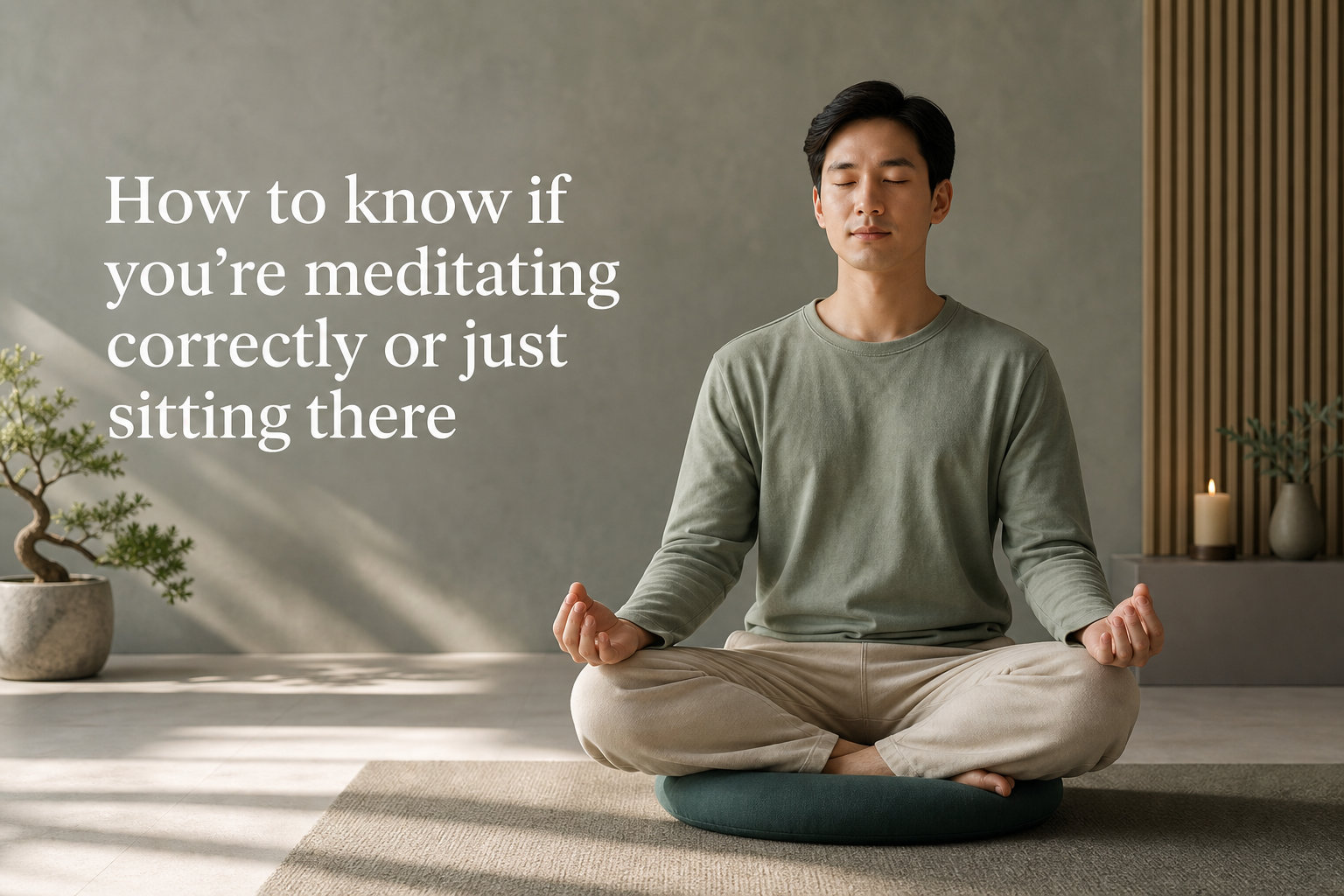
If you have ever sat down, closed your eyes, and then spent the whole session wondering whether you are actually meditating or just sitting there, you are in good company. Almost every beginner asks this question, and most experienced meditators asked it for years before things clicked. I remember my first month of practice feeling like an extended argument with my own mind.
Here is the short answer that took me too long to learn: if you notice your mind has wandered and you bring your attention back to your anchor, you are meditating correctly. That single moment of noticing is the practice. The wandering is not the problem, and the returning is not a fix. The returning is the whole thing.
In this guide I will walk through how to know if you’re meditating correctly, the signs that separate real practice from daydreaming with your eyes shut, what to do when thoughts will not stop, and how long it takes to see meditation actually change your life. By the end you should be able to sit down for your next session and know, with confidence, that you are doing it right.
Table of Contents
How to Know If You’re Meditating Correctly: The One Sign That Matters
There is one core indicator that cuts through all the confusion about meditating correctly. The moment you become aware that your attention has drifted off and you choose to bring it back, that is a complete meditation. Not a failed one.
Most people picture meditation as a long, unbroken stretch of perfect stillness. They imagine a clear mind, no thoughts, total peace. So when they sit and their mind races, they assume they are failing. The opposite is true. A session where you notice the wandering fifty times and return fifty times is a strong session, because you trained the noticing muscle fifty times.
Think of it like a rep at the gym. You do not do one bicep curl and call the workout done. Each notice-and-return cycle is a rep for your attention. More reps, more strength. A “busy” session where you kept catching yourself is often more valuable than a still session where nothing happened.
The ‘Clearing Your Mind’ Myth You Need to Drop
The single biggest reason people doubt whether they are meditating correctly is a myth: that meditation means emptying the mind of all thoughts. This idea causes more frustration and abandonment than almost anything else I see in meditation communities.
Your brain produces thoughts the way your heart produces beats. You cannot stop it by force, and trying to only creates more thinking about not thinking. Meditation is not about eliminating thoughts. It is about changing your relationship to them.
Instead of being pulled into each thought like a current carrying you downstream, you learn to stand on the bank and watch the thoughts float by. You notice a thought arise, you let it pass without grabbing it, and you rest your attention back on your anchor. The thoughts keep coming. You just stop getting hooked by every single one.
So if your mind feels loud during a session, that does not mean you failed. It means you finally got quiet enough on the inside to notice how loud it always was.
7 Signs You’re Actually Meditating (Not Just Sitting There)
If you want concrete confirmation that your practice is real and not just spaced-out sitting, look for these signs. You do not need all seven every session. Even one or two means the practice is alive.
You catch yourself wandering. At some point you realize you have been thinking about lunch, an argument, or tomorrow’s meeting. That realization is awareness waking up. That is the practice working.
You return without punishing yourself. When you notice the drift, you bring attention back gently rather than sighing or judging yourself. Self-attack is not part of meditation. Kind return is.
Your breath slows and softens on its own. Many practitioners notice that after a few minutes of settling, breathing becomes shallow, slow, and almost invisible. Forum meditators describe it as the breath becoming very small and still. This natural shift is a recognized sign of settling in.
Thoughts feel less sticky. As a session deepens, thoughts may still arise but they pass more quickly. You stop getting fully absorbed in each storyline. They feel more like clouds than commands.
Your body feels heavier or lighter. Somatic changes are common. You might feel your hands grow warm, your shoulders drop, or a sense of weight settling into the chair. Some people feel almost floaty. These are signs the nervous system is downshifting.
Time behaves strangely. Ten minutes can feel like two, or like an hour. When attention leaves the usual loop of clock-watching and story-spinning, your sense of time warps. That distortion is a good sign you were genuinely present.
You finish calmer than you started. Not blissed out, not transported. Just slightly clearer, slightly softer, slightly more spacious. That quiet afterglow is the signature of real practice.
The Notice-and-Return Technique, Step by Step
If there is one technique to internalize, it is this one. Everything else in meditation is built on it. Here is how I practice it, broken down so you can follow along in your next session.
Step 1: Choose your anchor. Pick one thing to rest your attention on. The breath at the nostrils is the classic choice. The rise and fall of the belly works well too. You can also use body sensations, the sound of the room, or a phrase you repeat silently. Pick one and commit to it for the whole session.
Step 2: Settle in and feel the anchor. Do not think about the breath conceptually. Feel it. Notice the cool air at the tip of the nose, the warmth leaving, the slight pause at the top. Stay close to the raw sensation, not the idea of it.
Step 3: Notice when you wander. Sooner than you expect, you will be gone. Planning, remembering, fantasizing, judging the session. This is not failure. The instant you realize you drifted, awareness has already returned. Celebrate that.
Step 4: Return without commentary. Bring attention back to the anchor. No scolding, no narrating. You would not yell at a puppy for wandering off. Treat your attention the same way. Just gently bring it back.
Step 5: Repeat for the whole session. That is the entire technique. Notice, return, notice, return. Hundreds of times if needed. Each cycle strengthens the same muscle. This is how you know you are meditating correctly rather than just sitting there.
Meditation vs Daydreaming vs Just Sitting: How to Tell
The confusion between meditation, daydreaming, and plain sitting is one of the most common questions I see in meditation forums. Here is how I tell them apart, both from the inside and from the outside.
Just sitting means your body is still but your mind is on autopilot. You are not consciously directing attention anywhere. Time passes, you might feel vaguely relaxed, but there is no intentional awareness. It is rest, not meditation.
Daydreaming is more active. You get absorbed in a storyline, usually pleasant or anxious. You are inside the thought rather than watching it. The daydream carries you, and you forget you are sitting at all until something snaps you out.
Meditation is the deliberate act of placing attention on an anchor and noticing when you leave it. The key word is deliberate. There is an intention behind it, even when the mind is wild. You are training the noticing, not producing a particular feeling state.
The practical test: at any moment in your session, can you say where your attention is right now? If yes, you are meditating. If no, you are somewhere else, and the moment you realize that, you are meditating again.
What to Do When You Can’t Stop Thinking
This is the most frequent frustration I hear. You sit down, you intend to focus on the breath, and the thoughts do not slow down at all. Sometimes they get louder. People assume this means they are doing it wrong.
First, know that this is universal. Long-term meditators still have sessions where the mind will not settle. The mind’s job is to think. Meditation is not asking it to stop doing its job. It is asking you to stop treating every thought as an emergency you must respond to.
Try shifting your relationship to the thoughts. Instead of pushing them away, label them lightly. “Planning.” “Remembering.” “Worrying.” Then let them go and return to the anchor. The labeling creates a tiny gap between you and the thought, and that gap is where awareness lives.
You can also widen the anchor. If the breath feels too small and the thoughts too loud, open your attention to the whole body, or to the sounds in the room. A wider anchor can be easier to hold when the mind is stormy. There is no rule that says breath is the only valid object.
Finally, lower the bar for a successful session. A session where you sat for the full time, even if it was noisy, counts. Consistency matters more than any single session’s quality.
How Long Before You Know Meditation Is Working?
People want a timeline, and I understand why. You put in the time, you want to know it is paying off. The honest answer is that meditation shows its results in two waves: a short-term one you can feel within weeks, and a long-term one that shows up in how you live.
Within the first two to four weeks of daily practice, most people notice small shifts. Slightly less reactivity when something annoying happens. A bit more space between a trigger and a response. Better sleep. These are signs the practice is landing.
Over months and years, the deeper markers appear. Practitioners across communities describe the same pattern: less anger, less reactivity, more patience with difficult people, a calmer baseline mood, and a growing ability to watch emotions arise without being controlled by them. These long-term shifts are the real proof that you have been meditating correctly all along.
If you track anything, track your life, not your sessions. Are you kinder this month than last? Do you recover faster from stress? Do the people close to you notice a difference? Those external changes are more reliable evidence than anything you feel while sitting.
How to Build a Practice That Tells You It’s Working?
Knowing whether you are meditating correctly gets much easier when your practice has a stable structure. A scattered, inconsistent practice gives you little signal to read. Here is how I recommend setting things up so the feedback loop is clear.
Pick a length you can sustain. Ten minutes daily beats sixty minutes once a week. Start short enough that you almost never skip. You can always grow the session later. For most beginners, ten to fifteen minutes is the sweet spot.
Pick a time and tie it to a habit. Same time every day, attached to something you already do. Right after you wake up, or right before bed, or after your morning coffee. The anchor habit makes the meditation habit stick.
Choose one technique and stay with it. Hopping between guided apps, breathing methods, and visualizations every week makes it hard to read your progress. Pick a simple breath-based or body-scan technique and give it at least a month before switching.
Keep a loose journal. One line after each session. Not a verdict, just a note. “Restless.” “Calm.” “Kept drifting to work.” Over weeks, patterns appear, and those patterns tell you whether the practice is deepening.
Consider a teacher if you stall. If you have been practicing for months and feel genuinely stuck, a single conversation with an experienced instructor can save you years of confusion. Community feedback and instructor guidance are among the most trusted sources for meditators trying to confirm they are on the right track.
FAQs
How do I know if I meditated correctly?
You meditated correctly if at any point during the session you noticed your mind had wandered and you brought your attention back to your anchor. That cycle of noticing and returning is the practice itself. You do not need a clear mind, a special feeling, or a long still stretch. Even one genuine return means the session worked.
Is meditation just sitting there?
No. Just sitting means your body is still but your attention is on autopilot. Meditation is the deliberate act of placing attention on an anchor, like the breath, and noticing when it drifts. The intention and the noticing are what turn sitting into meditation.
What are the signs of deep meditation?
Common signs include breath becoming slow, shallow, and almost still; thoughts arising but feeling less sticky; the body feeling heavy or light; a distorted sense of time; and finishing the session calmer and clearer than you started. You will not feel all of these every time, and you do not need to.
How do you know when you’re done meditating?
You are done when your set time is up, not when you reach a particular feeling. If you set a timer for ten minutes, the session is complete when it rings, regardless of whether the mind felt busy or quiet. Avoid ending early because it feels hard, and avoid extending because it feels good.
How do you know if you are actually meditating vs just sitting quietly?
The test is whether you can identify where your attention is right now. In meditation, you are deliberately aware of your anchor and you notice when you leave it. In just sitting quietly, attention drifts with no awareness and no returning. The moment you catch yourself drifting and come back, you are meditating.
Conclusion
If there is one thing to take from this, it is that knowing how to meditate correctly is much simpler than the doubt in your head suggests. You are meditating correctly whenever you notice your mind has wandered and you bring it back. The wandering was never the failure. The noticing is the success.
Stop waiting for a blank mind or a transcendent feeling. Sit, choose your anchor, and return to it as many times as the session demands. Do that consistently, watch your life over the coming months, and you will not need to ask whether you are meditating correctly or just sitting there. The way you respond to the world will answer the question for you.
Your next session is the place to test all of this. Sit down, set your timer, and treat every single notice-and-return as proof that the practice is alive. That is all the confirmation you need.