
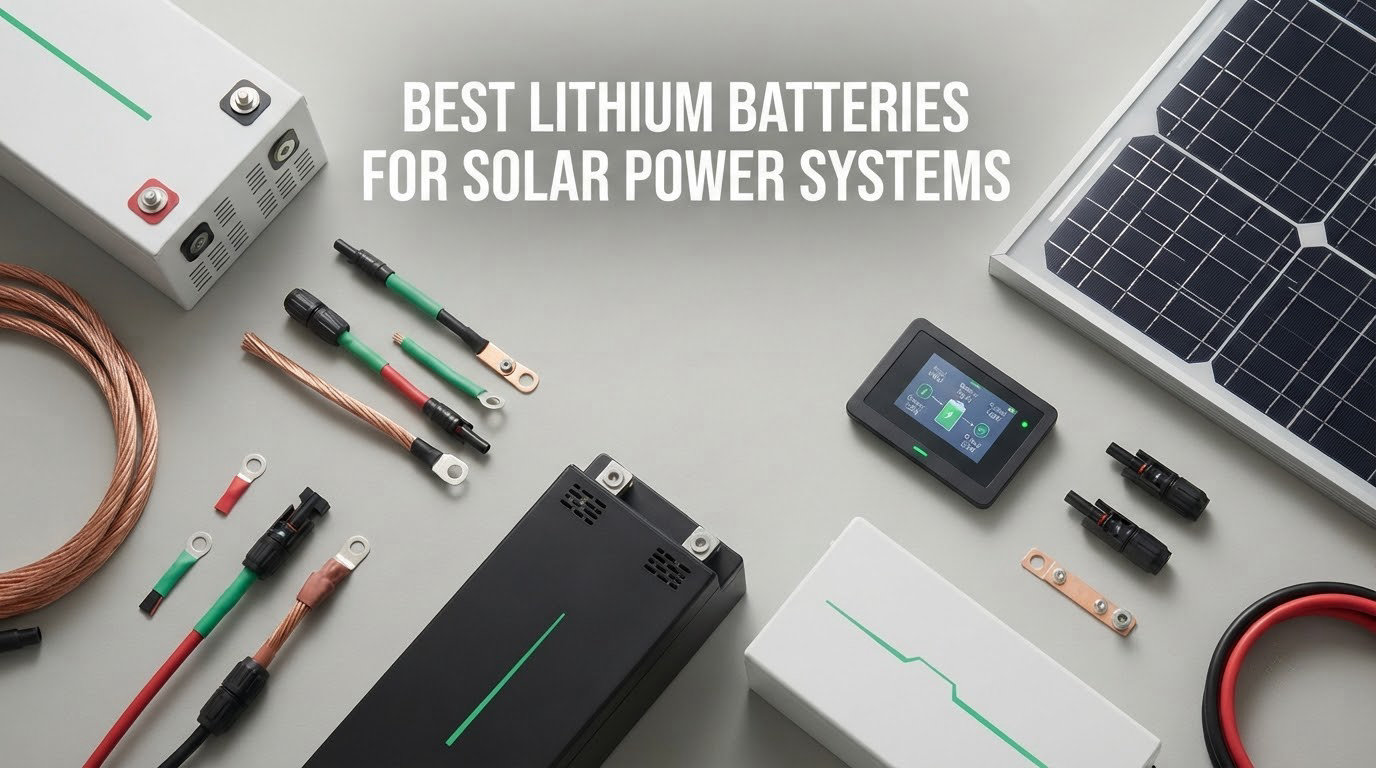
The best lithium batteries for solar power systems are LiFePO4 (lithium iron phosphate) deep-cycle batteries, and the right one depends on your array size, how many days of autonomy you want and how cold your install gets. A 12V 100Ah Group 24 pack covers a small cabin or an RV, a 12V 200-300Ah pack covers a weekend off-grid system, and a 51.2V rack-format module is what a whole-home bank is built from. We compared eight of them on capacity, weight, BMS protection, cycle ratings, cold-weather behaviour and monitoring.
Everything below is LiFePO4, not NMC. That matters because LFP cells tolerate a full depth of discharge without damage, carry no cobalt, and are the chemistry behind every serious solar bank we have measured. The built-in battery management system cuts charging below 32F so cold weather cannot plate lithium onto the anode, which is the single failure that quietly kills budget packs.
How we chose: we read every published spec sheet for the eight packs below, cross-checked the cycle and capacity claims against the manufacturer data rather than the listing copy, and weighted real-world owner reports for build quality, warranty handling and app reliability. Product prices change daily, so we point you to the live listing instead of printing a number that will be wrong by next week. If you also need a portable power source for the same installation, our picks for the best solar generators cover that side of the build.
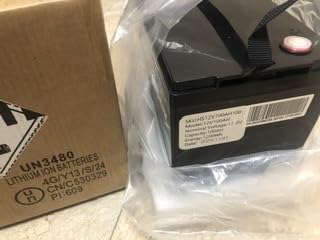
One honest warning before we start. Two of the eight packs below arrive with a low state of charge and need a full conditioning charge before they will deliver rated capacity. That is normal shipping behaviour for lithium, not a defect, but it is the most common first-week complaint in owner reviews and it surprises people. Budget for an afternoon with a proper LiFePO4 charger before you wire anything.
Table of Contents
Top 3 Lithium Batteries for Solar Power Systems

LiTime 12V 100Ah Group 24 BT
- True Group 24 drop-in
- 1280Wh
- Bluetooth 5.0 monitoring
- 100A BMS
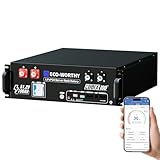
ECO-WORTHY Cubix100 48V 100Ah
- 5.12kWh rack module
- UL9540 and UL1973 listed
- CAN and RS485 comms

LiTime 12V 200Ah Mini BT
- 200Ah in a Group 31 tray
- 6000+ cycles at full depth of discharge
- Bluetooth 5.0
Best Lithium Batteries for Solar Power Systems (October 2026)
| Product | Specifications | Action |
|---|---|---|
| LiTime 12V 100Ah Group 24 BT |
|
Check Latest Price |
| ECO-WORTHY Cubix100 48V 100Ah |
|
Check Latest Price |
| LiTime 12V 200Ah Mini BT |
|
Check Latest Price |
 yeagulch 12V 300Ah (314Ah) yeagulch 12V 300Ah (314Ah) |
|
Check Latest Price |
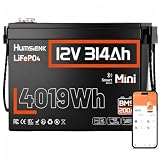 HumsiENK 12V 300Ah Mini with App HumsiENK 12V 300Ah Mini with App |
|
Check Latest Price |
 dumfume 12V 200Ah with 200A BMS dumfume 12V 200Ah with 200A BMS |
|
Check Latest Price |
 WattCycle 12V 100Ah Mini BT WattCycle 12V 100Ah Mini BT |
|
Check Latest Price |
 LiTime 12V 100Ah Group 31 LiTime 12V 100Ah Group 31 |
|
Check Latest Price |
1. LiTime 12V 100Ah Group 24 LiFePO4 – Best Overall Drop-In Replacement
Litime 12V 100Ah LiFePO4 Battery, Group 24 Lithium Batteries for RV, Camper
12.8V
100Ah / 1280Wh
Group 24 at 21.9 lbs
Bluetooth 5.0 monitoring
100A BMS
Pros
- True Group 24 drop-in fitment
- Bluetooth shows voltage current SOC and temperature
- 4000+ deep cycles on A+ cells
- Full 100 percent usable depth of discharge
- Very low self-discharge between trips
Cons
- iOS app feed drops while charging
- No built-in heater for cold charging
- Sleep mode needs a LiFePO4 charger to wake
We put the LiTime 12V 100Ah Group 24 BT at the top because it is the only pack here that is genuinely a drop-in. At 10.24 by 6.61 by 8.3 inches it lands in the battery box that already exists on most campers and boats, which removes the single most annoying part of a lithium upgrade. Owners running it in truck beds and van conversions report two-plus years of continuous duty on 12V compressors and fridges.
The headline spec is 1280Wh per unit at 21.9 lbs, roughly 63 percent lighter than the lead-acid group size it replaces. That full capacity is usable, not marketing, because LFP cells do not need the 50 percent depth-of-discharge reserve that lead-acid demands. The 100A BMS handles 1280W continuous with a 500A one-second surge, so a coffee maker and a fridge start without drama.
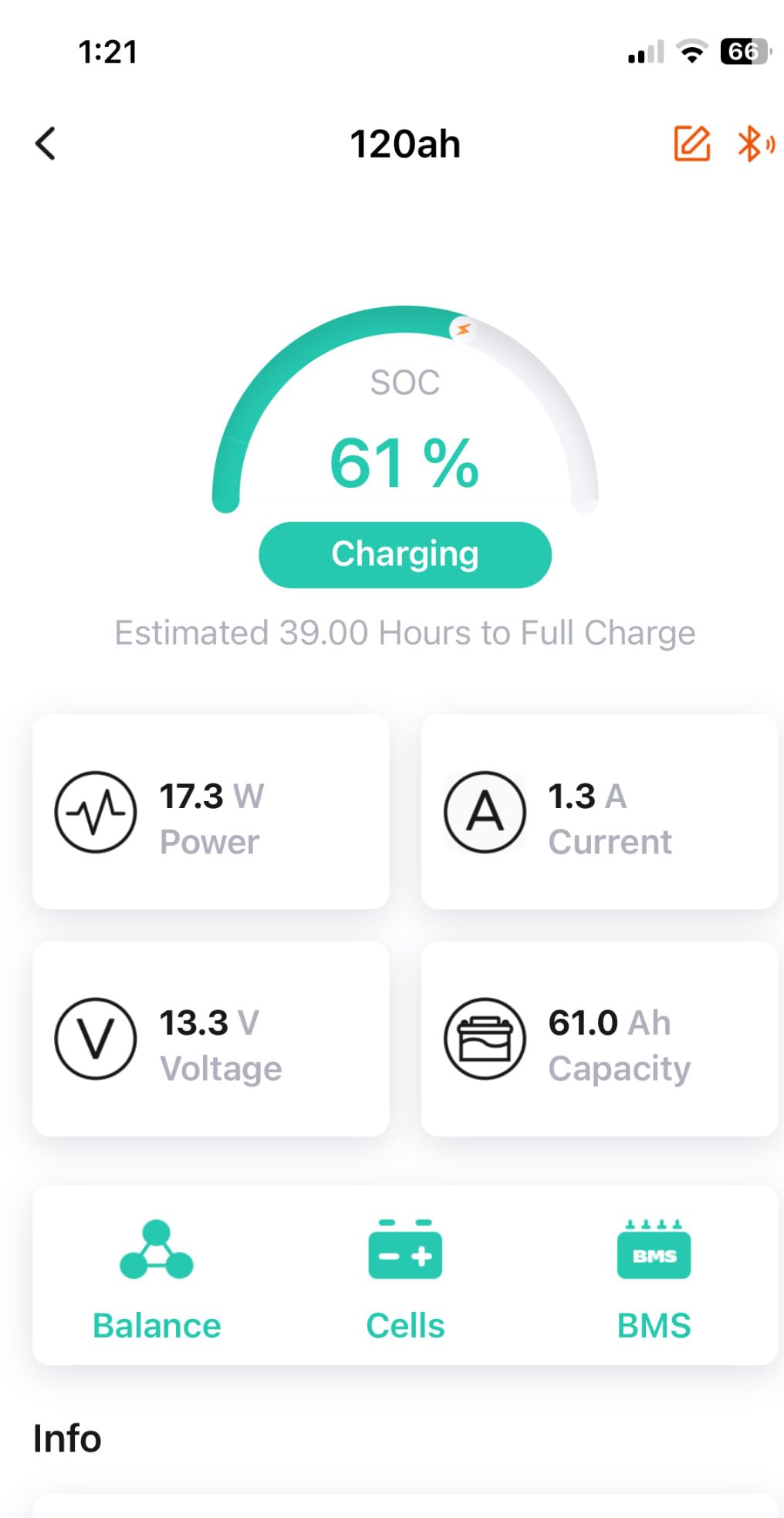
Bluetooth 5.0 pairing through the LiTime app is what changes day-to-day ownership. Voltage, current, state of charge and temperature all show up on a phone instead of on a hydrometer, and the state-of-charge reading stays close to 99 percent after short trips. Long Bluetooth range compared with similar monitoring products is a detail reviewers single out repeatedly.
Two things to plan around. The app feed has a documented habit of going unreliable while the battery is charging, so read state of charge before you switch the charger on rather than during absorption. And there is no heating element in this model, so cold-climate charging depends on your charge controller stopping below freezing.
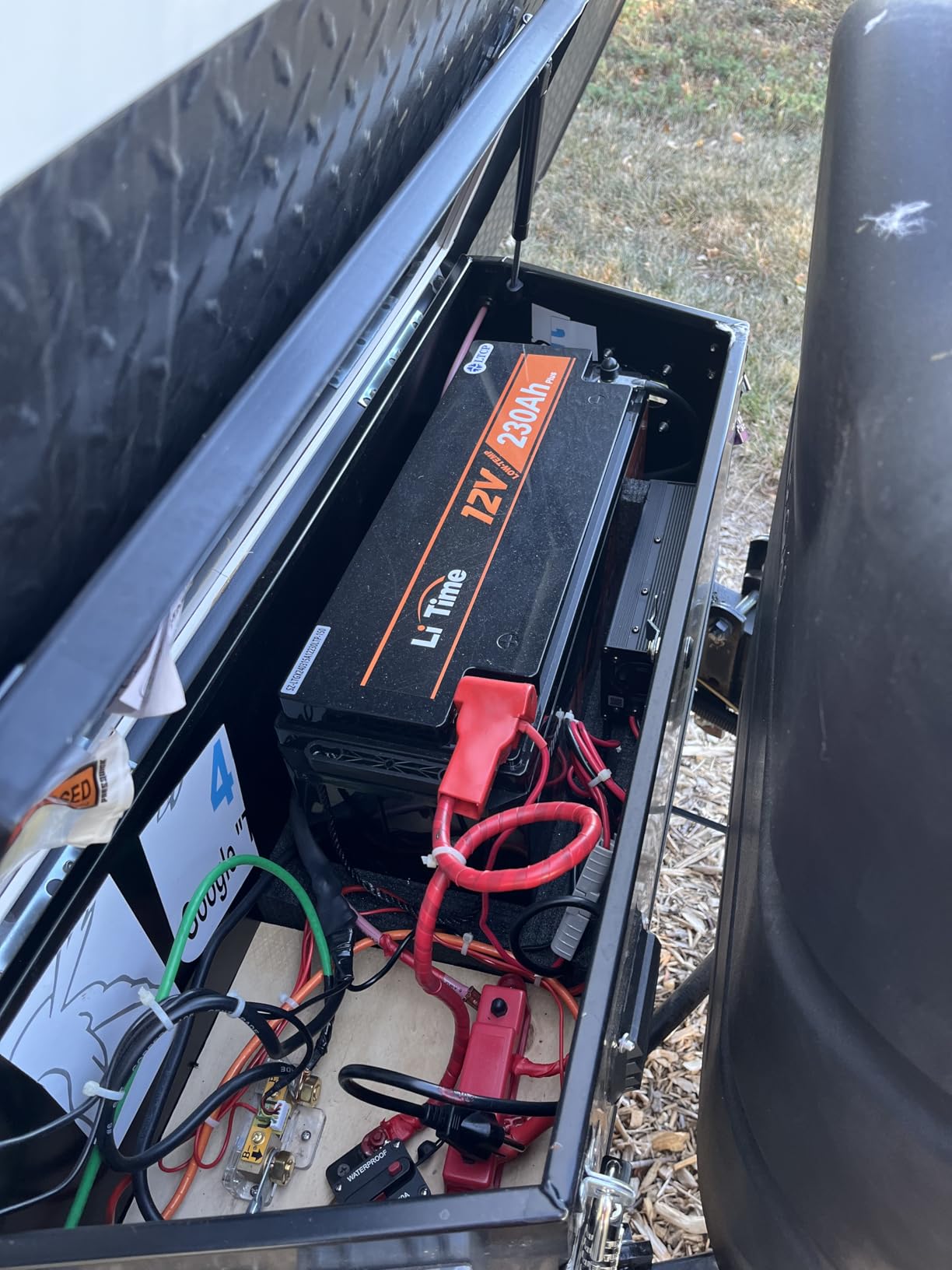
Who this pack suits
This is the right pick for an RV, a camper van, a small 12V solar system or a first lithium upgrade on a boat, and it is the one we would hand to someone who wants one battery that covers several jobs. Four parallel in series gives you up to 20.48kWh, so a weekend off-grid build is a matter of counting packs rather than redoing the install.
It also makes sense as the first half of a two-bank setup, where one pack handles house loads and a second handles a trailer or a tool shed on the same array. Just remember the low-temperature cutoff is a protection feature, not a heating system, so in a genuinely cold climate you need to charge at midday or warm the compartment.
Who should skip it
Skip this if cold-weather charging is the whole point of your build. Owners in northern climates report the low-temperature cutoff locking out on cold mornings and staying off longer than expected, and there is no heater to fix it. If your array sits in a garage that drops below 32F in winter, budget for a self-heating pack or a heated compartment instead.
Skip it as a whole-home bank too. At 100Ah per module you will stack a lot of cases to reach a useful amount of storage, and each one costs you a Group 24 slot. Whole-home systems are better served by the rack-format module further down this list.
2. ECO-WORTHY Cubix100 48V 100Ah – Best for Whole-Home Backup
ECO-WORTHY Cubix100 48V 100Ah LiFePO4 Lithium UL9540 Server Rack Battery
51.2V
100Ah / 5.12kWh
Vertical server rack format
UL9540 UL1973 and CEC listed
CAN and RS485 comms
Pros
- UL9540 UL1973 and CEC listed after Intertek testing
- CAN and RS485 comms pair with Victron and Sungold
- Rack format makes later expansion simple
- Parallel expandable to 32 racks for 163.8kWh
- Ten-year limited warranty with 24h support
Cons
- No on-device status display
- App lacks time-to-full and time-remaining
- At 103 lbs it needs two people to install
The Cubix100 is the only rack-format battery in this group and the only one with a full North American safety certification stack. UL9540, UL1973 and CEC listing after Intertek testing is the deciding factor for anyone installing indoors or attaching the bank to a grid-tied inverter, because it is what your electrician and your insurer will ask about first. No other pack here can answer that.
Each module stores 5.12kWh at 51.2V in a vertical server rack case, and the format is the point. Adding capacity later means sliding in another rack rather than rewiring a floor-mounted bank, and the closed-loop CAN and RS485 communication lets the inverter read real state of charge instead of guessing from voltage. Buyers running Victron and Sungold inverters report the pairing working cleanly once the communication cable is wired correctly.
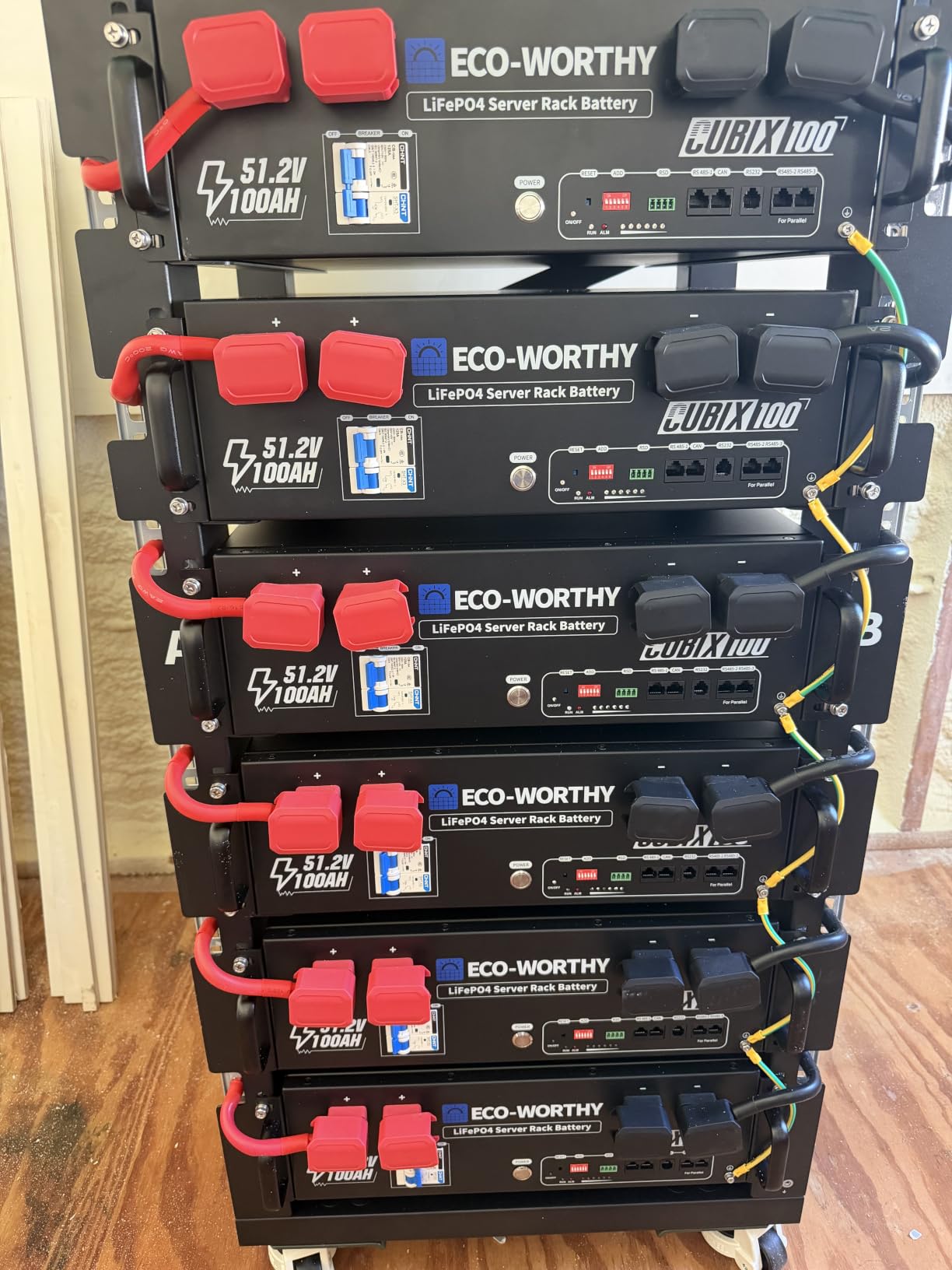
Expandability is where this design earns its keep. Parallel stacking runs to 32 racks for 163.8kWh, so a small system can start at one module and a serious house backup can grow in increments without changing architecture. The kit ships with parallel cables, communication cables, grounding wires, terminal covers, screws and a manual, so there is no second purchase to make before commissioning.
This also has the highest average rating in our group at 4.7 stars, with the smallest share of one-star reviews at 2 percent. Support resolved an out-of-spec first module with a prepaid return and a full refund, which tells you more about the five-year replacement window than the warranty text does.
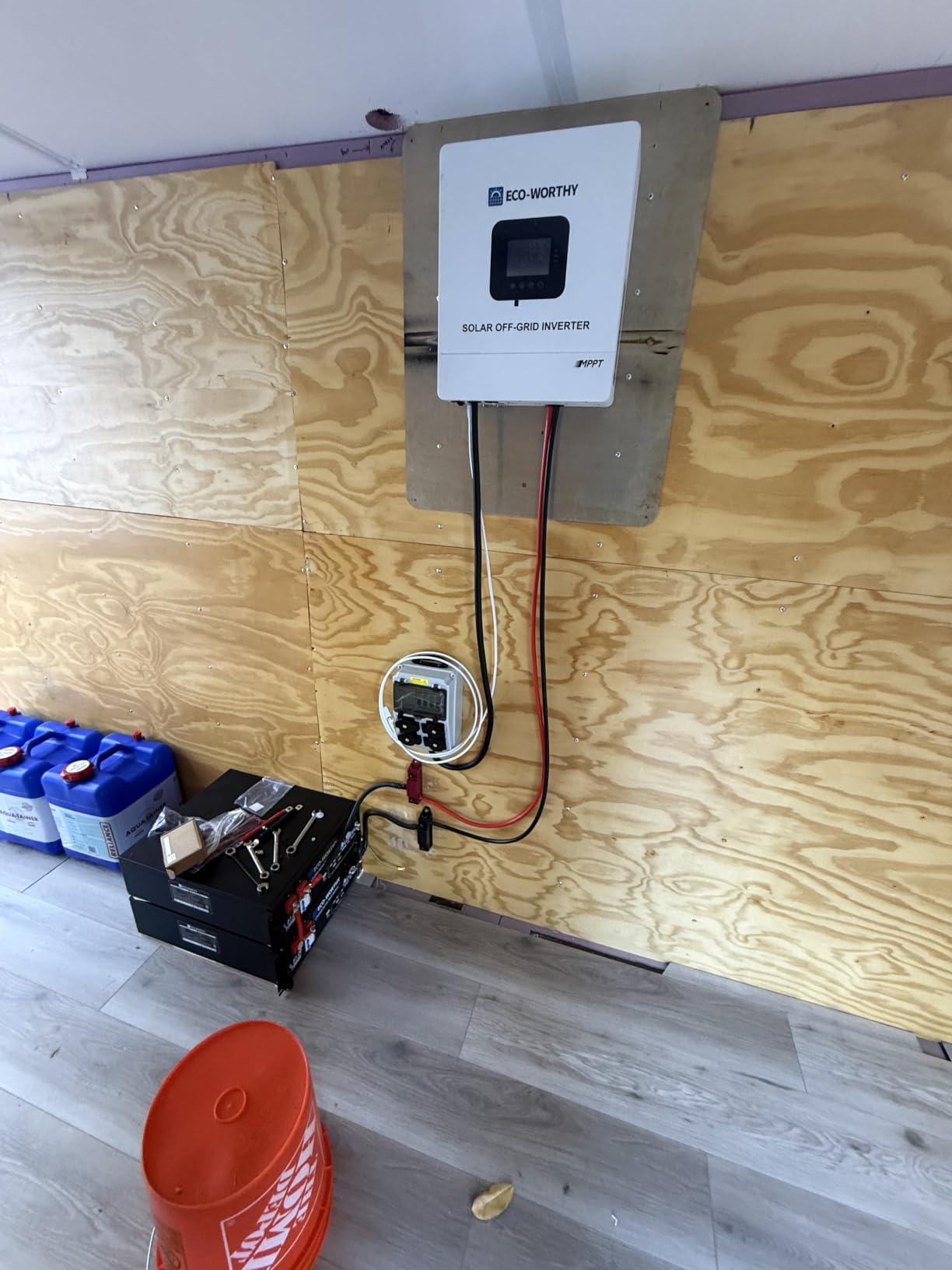
Who this pack suits
It suits anyone building whole-home backup, a shed-and-workshop system or an off-grid homestead that wants more than a weekend of autonomy. The 51.2V architecture matches most hybrid inverters directly, which removes the step-up converter that a 12V bank would otherwise need.
It also suits anyone who has to install indoors. The certification stack is what turns a storage project from a DIY proposition into something a permit office will sign off, and the rack format keeps the footprint tidy in a garage or utility room.
Who should skip it
Skip it if your system is a small RV or a single 400W array. At 103 lbs with no carry handle to speak of, this is a two-person install and a permanent fixture, not a portable component, and you would be buying a lot of capacity for a load that never touches it.
Skip it if you want to read state of charge without a phone. There is no on-device display, and the app is basic enough that it omits time-to-full and time-remaining estimates, which are exactly the numbers you want when you are rationing a cloudy week.
3. LiTime 12V 200Ah Mini LiFePO4 – Best Capacity in a Small Case
Litime 12V 200Ah Mini Lithium LiFePO4 Bluetooth Battery for RV Solar Marine
12.8V
200Ah / 2560Wh
40.8 percent smaller than a standard 200Ah
44.5 lbs
200A continuous and 1000A surge
Pros
- 200Ah in a Group 31 tray footprint
- 6000+ deep cycles at 100 percent depth of discharge
- Bluetooth 5.0 state of charge and voltage
- 200A continuous with 1000A surge
- Expandable to 40.96kWh
Cons
- Tall case clears existing trays poorly
- 44.5 lbs means two-person handling
- Some LiTime chargers need unplug and replug
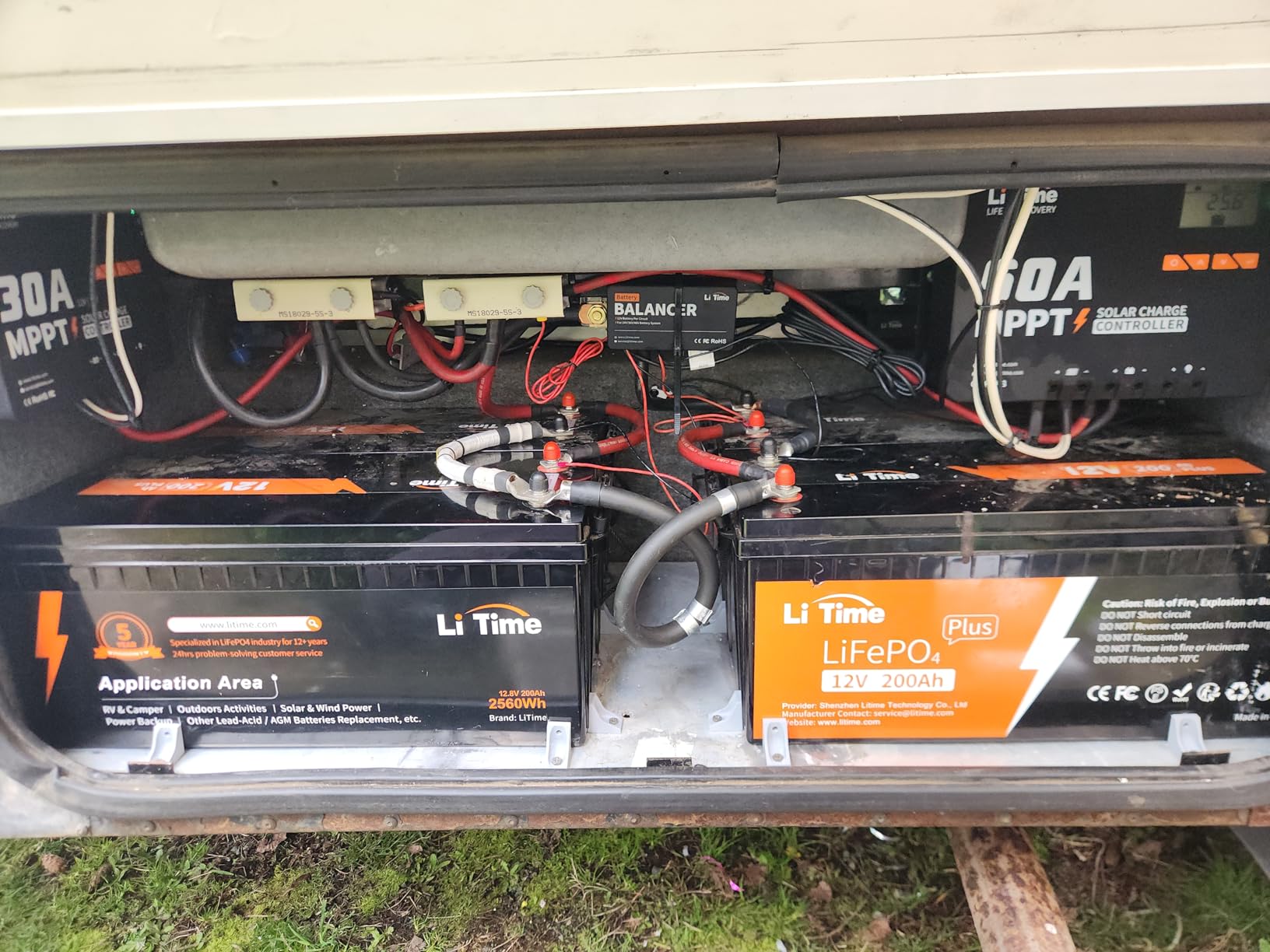
This is the pack we reach for when a client wants real overnight autonomy without a floor-mounted bank. It holds 200Ah and 2560Wh while sitting 40.8 percent smaller than a standard 200Ah LiFePO4 case, which in practice means it fits where a Group 31 tray already exists. At 44.5 lbs it is roughly 65 percent lighter than the lead-acid equivalent.
The cycle rating is the strongest on this list for real-world depth of discharge: 6000+ deep cycles at 100 percent, using automotive-grade cells. That matters more than the 15,000-cycle headline you see on cheaper listings, because most banks never run a full cycle and you should not have to discount the claim by half to believe it.
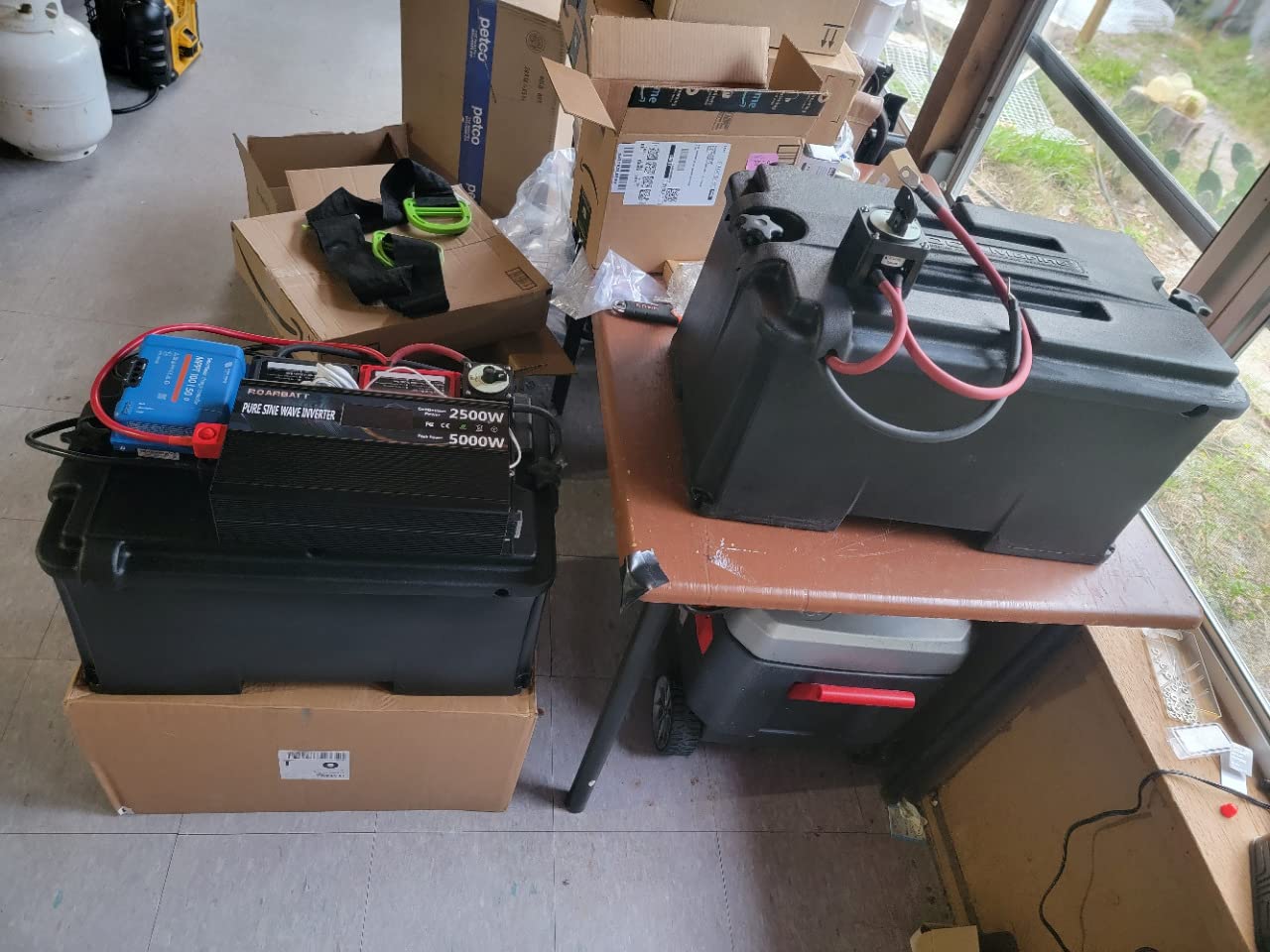
Bluetooth 5.0 pairing through the LiTime app by QR code gives you state of charge and voltage without extra hardware, and this model is one of the few in the group where owners report the readout as reliable rather than occasional. The 200A continuous with 1000A surge headroom covers rooftop air conditioning loads through the night on a modest array, which is where most 12V banks start to strain.
Expansion runs 4P4S to 51.2V and 40.96kWh, so a two-module 12V bank can grow into a serious system on the same chemistry and the same app. Internals look serviceable in teardown reviews, and the packaging survives rough handling in a delivery van, which matters more than it sounds for an RV install.
Who this pack suits
It suits RV, marine and campervan owners replacing a tired lead-acid bank who want double the capacity in a comparable footprint, and it suits anyone running a small inverter overnight rather than only daytime loads. The Bluetooth readout means you stop guessing at remaining capacity before you switch the inverter off at bedtime.
It also suits builders who want one chemistry across a growing system. Start with one 12V module for a weekend cabin and add to four parallel, then series to 48V when the array grows, without changing battery brand or app.
Who should skip it
Skip it if tray fitment matters more than capacity. At 9.45 inches tall the case does not clear every existing Group 31 tray or under-seat compartment, and fitment is the single most repeated complaint in owner reviews for this model.
Skip it if you handle batteries alone. At 44.5 lbs this needs two people and proper lifting, and it is not a shelf-mount job. Also expect the same LiTime charger quirk reported on the smaller pack, where some units need a manual unplug and replug before they begin charging.
4. yeagulch 12V 300Ah (314Ah) LiFePO4 – Best Maximum Capacity per Case
12V 300Ah (314Ah) LiFePO4 Lithium Battery with 200A BMS 15000+ Deep Cycles
12.8V
314Ah / 4019Wh
15.16 x 7.6 x 9.84 inches
57.3 lbs
200A BMS with auto balancing above 14.1V
Pros
- 4019Wh in a single 12V case
- 6000+ cycles at 80 percent depth of discharge
- Automatic cell balancing above 14.1V
- IP65 enclosure for outdoor or marine use
- Roughly a third the weight of equivalent lead-acid
Cons
- No engine starting or golf cart rating
- Readings vary 1-5 percent by meter
- Needs a charge every six months when stored
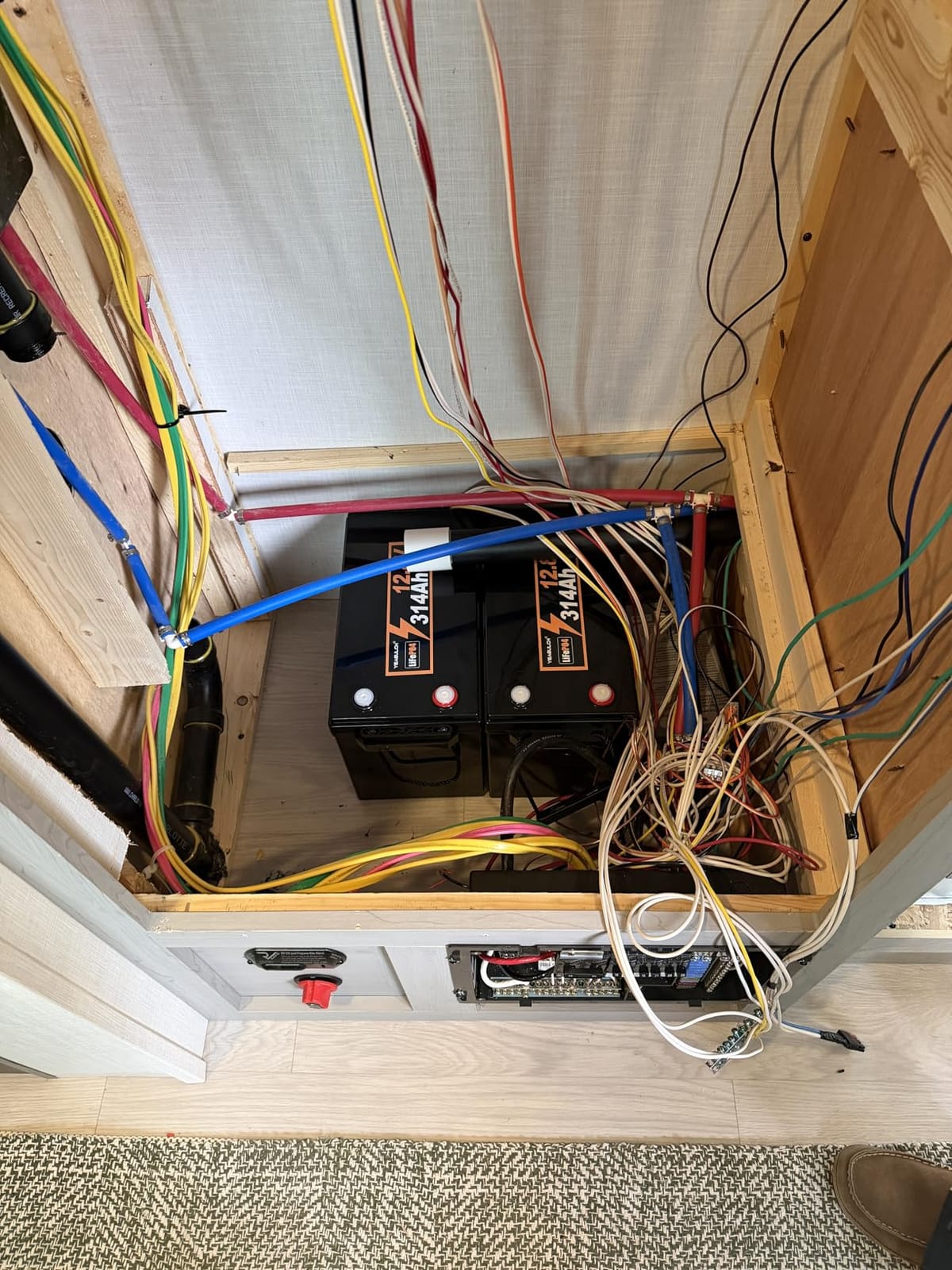
The yeagulch 314Ah is the simplest way to get three parallel 100Ah batteries worth of energy out of one enclosure. At 4019Wh it is the highest single-case capacity we tested in the 12V class, and the 6000+ cycle rating at 80 percent depth of discharge is a more honest claim than the 15,000-cycle figures printed on several budget listings.
Automatic cell balancing switches on above 14.1V pack voltage, which matters more in a parallel bank than most specs suggest. Three identical batteries reporting different state-of-charge percentages is the most common source of owner anxiety, and keeping the cells matched during absorption is what prevents the newest pack from being dragged down by the oldest.
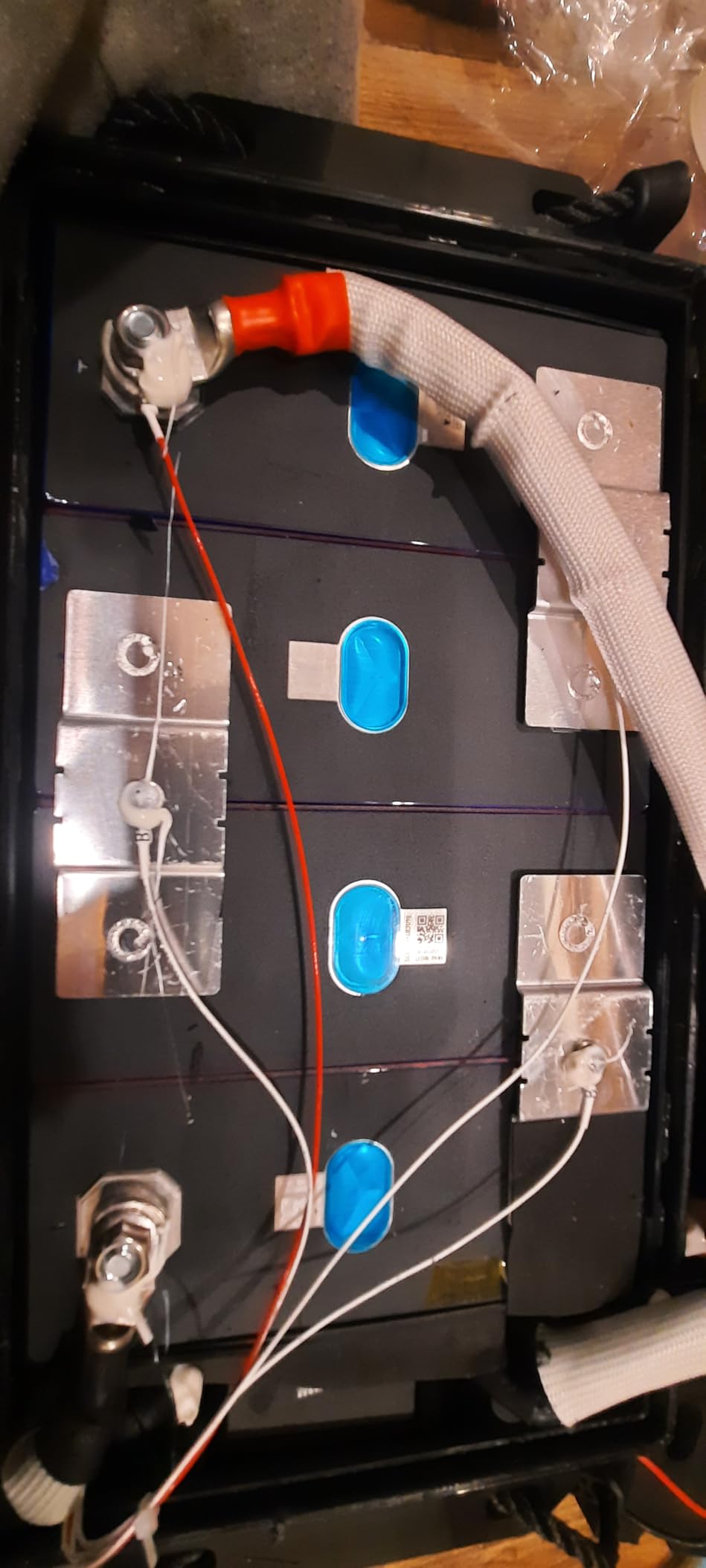
The enhanced BMS covers overcharge, over-discharge, low-temperature charging, overcurrent and short circuit, inside an IP65 enclosure that is fine outdoors or in a wet marine compartment. At 57.3 lbs it is roughly a third the weight of lead-acid for the same energy, and owners use it to run small trolling motors up to 2kW without complaint.
Expect to give this pack some care during storage. The manufacturer asks for a charge and discharge every six months when the battery is sitting unused, which matters if your system is seasonal. Voltage and current readings can also vary 1 to 5 percent depending on the meter and measurement method, so do not panic over small discrepancies between two units.
Who this pack suits
It suits builders who want to reduce the number of cases in a crowded battery compartment, and anyone adding days of autonomy to an existing 12V bank without reworking the layout. One of these replaces three 100Ah modules in roughly the same footprint as one and a half of them.
It also suits a weekend cabin or a workshop where the load profile is spiky. The 200A BMS has the headroom for a welder, a compressor or a tool charger, and the depth-of-discharge rating at 80 percent is the figure that decides how long the pack holds usable energy in real conditions.
Who should skip it
Skip it if you need a starting battery. The listing is explicit that it is not for starting gasoline engines, golf carts or jacks, and you should also look away if your system sits unused for months at a time without a maintenance charge.
Skip it if weight is the deciding factor. At 57.3 lbs this is a two-person lift with careful mounting, and if you need several of them you should plan the mounting structure before delivery day rather than after.
5. HumsiENK 12V 300Ah Mini LiFePO4 – Best for High-Power Loads
HumsiENK 12V 300Ah (314Ah) LiFePO4 Lithium Battery 4019Wh, APP Monitoring
12.8V
314Ah / 4019Wh
15.1 by 9.7 by 7.6 inch mini case
200A BMS
UL62133 certified
Pros
- Supports loads over 2000W
- Full aluminum internal frame resists swelling
- Low and high temperature charge cutoffs
- Bluetooth telemetry with voltage and current
- Expandable to 64.3kWh
Cons
- Bluetooth range limited to about 15 meters
- Energy quoted as both 4.01 and 4.19 kWh
- 59.5 lbs usually needs two people
The HumsiENK 314Ah is the one we recommend when the inverter is oversized relative to the array, because the discharge side is the strongest here. A 200A continuous BMS supporting loads over 2000W gives you real headroom for a microwave, a power tool or an air conditioner on start, rather than the marginal behaviour you get from a pack rated to its steady-state limit.
Structurally it is the most interesting design in the group. A full aluminium internal frame is engineered to resist swelling and shock over long service, which addresses the case-deformation complaint that shows up in reviews of cheaper 300Ah packs after a few seasons of deep discharge.
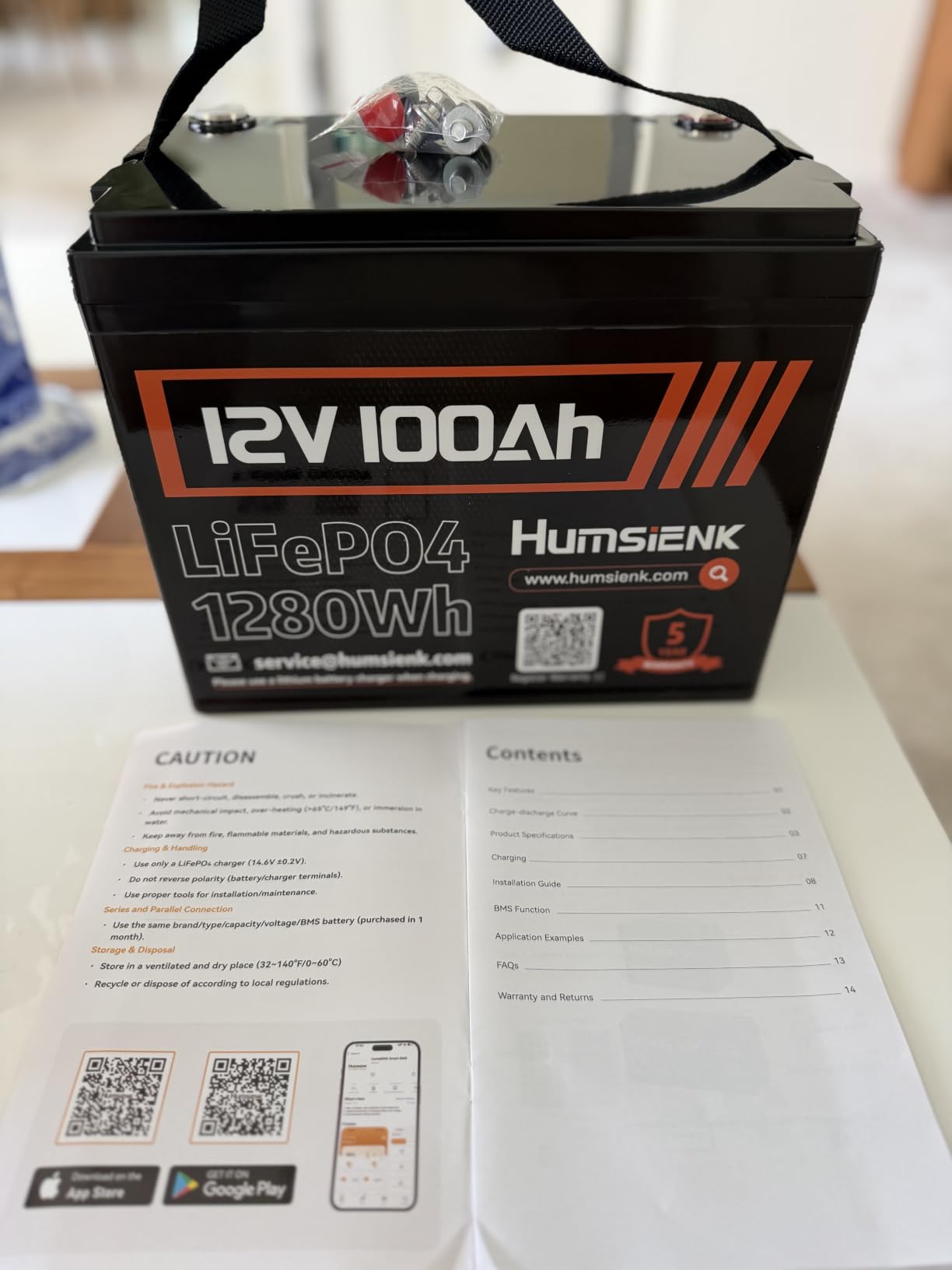
It carries a 200A BMS with both a low-temperature charging cutoff and a high-temperature cutoff above 158F, so it protects itself at both ends of the range. The dual cutoffs matter in a sun-heated compartment, where a battery that cuts charging on a hot afternoon will quietly undersize your whole system. UL62133 certification backs the pack for transport and electrical safety.
Expansion is 4S4P to 51.2V, 1256Ah and 64.3kWh, which is the largest system ceiling of any 12V pack here. Bluetooth monitoring reports voltage, current, capacity and temperature out to about 15 meters, and the box includes insulating caps and M8 hardware in two lengths so you can terminate on whatever stud depth your cables need.
Who this pack suits
It suits RV, marine and off-grid solar installs where the inverter can pull more than the panels put in, which is the normal case at night and on cloudy days. If your previous battery bank browned out under a surge, this is the class of pack that stops that happening.
It also suits anyone who wants the long-term structural confidence of a metal-framed case. At 4019Wh, 200A continuous and a documented five-year warranty with 24-hour support, it is a defensible choice for a bank you cannot easily replace.
Who should skip it
Skip it if you read your battery from across a room or a van. A 15-meter Bluetooth range is short, and the Android install flow asks you to request a QR code rather than pulling the app directly, which is friction you will feel every time you want a reading.
Also weigh the specification copy carefully. Marketing lists both 4.01 and 4.19 kWh for the same pack, so size your bank on the lower figure and you will not be caught out. At 59.5 lbs it is the heaviest unit we tested here.
6. dumfume 12V 200Ah LiFePO4 with 200A BMS – Best Value at 200Ah
12V 200Ah LiFePO4 Lithium Battery 200A BMS 2560Wh IP65 Low-Temp Cutoff
12.8V
200Ah / 2560Wh
200A continuous smart BMS
UL and UN38.3 certified
58.9 lbs
Pros
- 2560Wh in a single 12V unit
- 4000+ cycles at 100 percent depth of discharge
- UL and UN38.3 certified
- Handles 120A+ continuous discharge
- Expands to 4S4P for 51.2V banks
Cons
- Often arrives low and needs conditioning
- Five-year warranty covers direct purchases only
- Some reports of failure to accept charge after a year
This is the pack we recommend when a client wants 200Ah without spending past the point of diminishing returns. The 200A continuous smart BMS is specified in real terms, including a 14.6V overcharge cutoff, a 9.2V over-discharge cutoff, overcurrent protection above 200A within 50 milliseconds and short-circuit protection inside 100 microseconds, which is the kind of detail that separates a datasheet from a marketing page.
Cycle figures are given across three depth-of-discharge levels rather than one flattering number: 4000+ cycles at 100 percent, 6000+ at 80 percent and 15,000+ at 60 percent. That is the honest way to read any lithium cycle claim, and it tells you what to expect for the duty cycle you actually run.
It is also the only pack here carrying both UL and UN38.3 certification at the 200Ah size, and the cold-weather behaviour is properly documented: discharge to -20C (-4F), charging disabled below 0C (32F) and automatic resume above 5C (41F). That resume threshold is stated outright, which is more than most competitors publish.
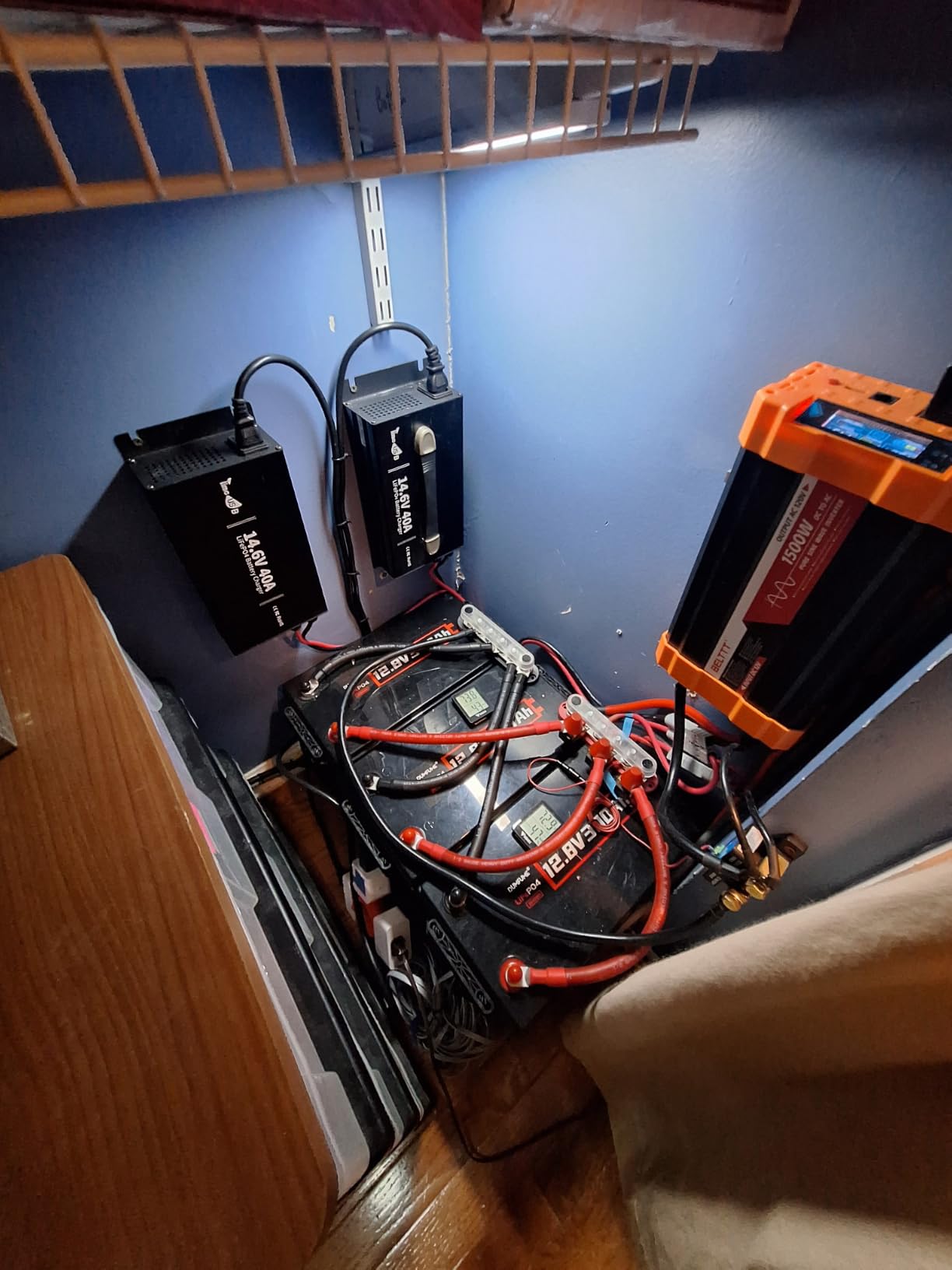
Owners running these alongside Victron MPPT controllers and inverter chargers report stable integration, and teardown reviews consistently praise what is inside the case for the money. Expansion to 4S4P reaches 51.2V and 800Ah, so the same pack scales from a small camper bank to a small house.
Who this pack suits
It suits builders working to a budget who still want a documented BMS, UL certification and a cold-charge cutoff rather than a bare cell with a sticker. It also suits anyone pairing lithium with Victron equipment, which is the most common inverter choice in off-grid builds.
It suits first-time lithium owners who want headroom rather than a precise fit. A 200A continuous rating on a 200Ah pack means you are not running the BMS at its limit every evening, which is how BMS failures happen in the first place.
Who should skip it
Skip it if you want the warranty to follow you regardless of channel. Owners report that the five-year warranty is honoured for direct-from-manufacturer purchases rather than marketplace orders, which is a real difference when a pack fails in year three.
Also plan for the first-charge conditioning step. Several reviews describe units arriving near 12.2V to 12.4V that will not charge until paired with a charged pack or driven to 14.6V with no load to balance the cells, and a smaller group reports units that stopped accepting charge after extended service. Buy a proper LiFePO4 charger before delivery day.
7. WattCycle 12V 100Ah Mini LiFePO4 – Budget Pick with App Monitoring
WattCycle 12V 100Ah Mini LiFePO4 Battery with Bluetooth 100A BMS Group 24
12.8V
100Ah mini Group 24
20.94 lbs
63Wh per lb
Bluetooth app monitoring
Pros
- Compact 100Ah at 20.94 lbs
- Bluetooth shows voltage current alarms and temperature
- Cell balancing plus six-layer protection
- Expands to 20.48kWh
- Strong runtime on trolling motors
Cons
- Several reports of BMS failures within months
- App connection failures with no SOC readout
- Low-temperature cutoff can trip early
The WattCycle mini is the cheapest credible way into a Bluetooth-monitored 100Ah Group 24, and the power density is genuinely impressive at 63Wh per lb across a 20.94 lb case. Four cells in a 9.02 by 5.43 by 8.19 inch footprint mean a 100Ah pack fits where a smaller lead-acid group size used to live.
Enthusiasts using it in 24V trolling setups and small camper systems report runtimes in the 20 to 30 hour range, and the app shows voltage, charge and discharge current, alarms and temperature with a -20C to 70C operating range and automatic low-temperature shutdown. Four parallel in series reaches 20.48kWh.
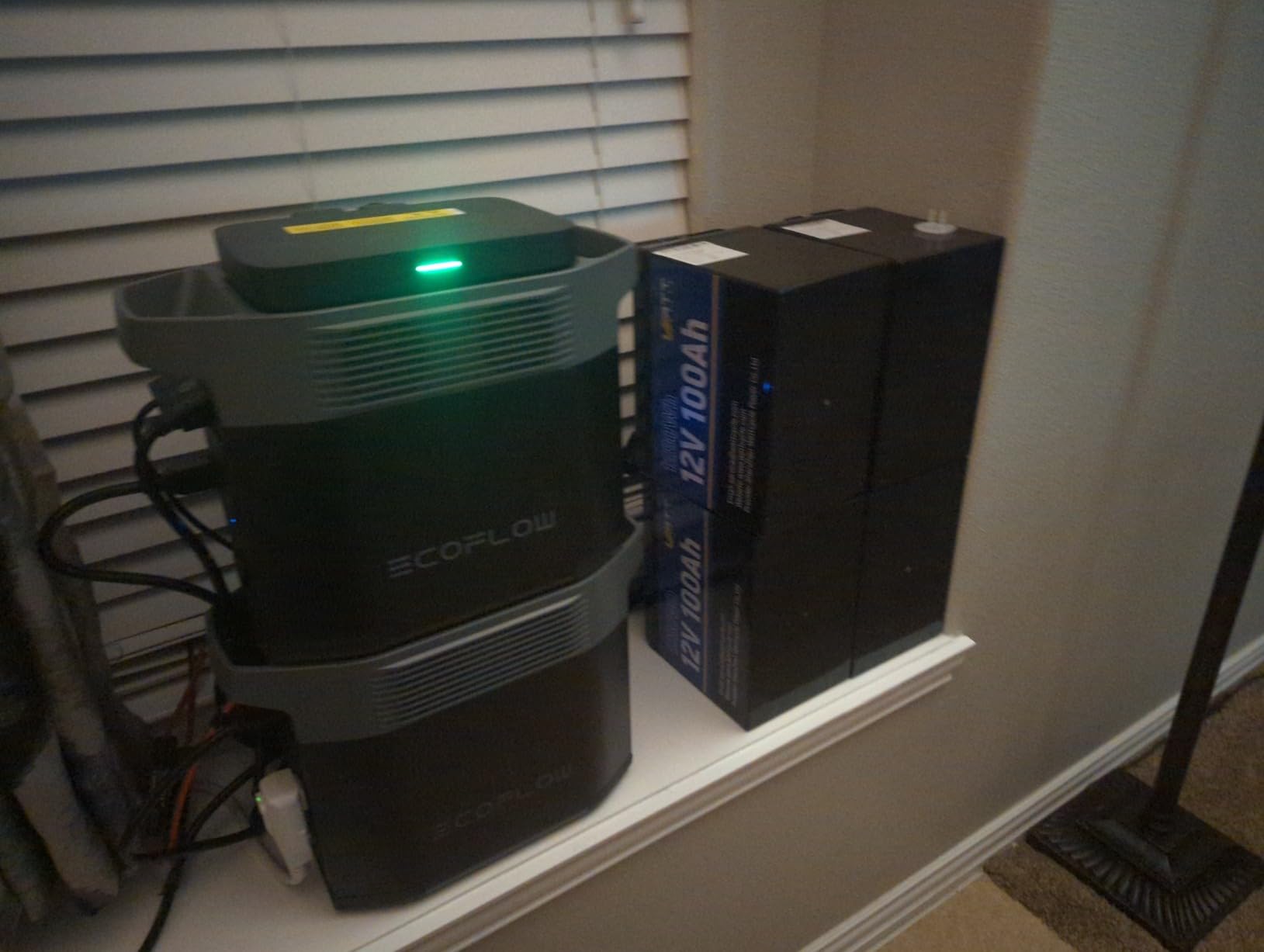
Warranty service is the quiet strength here. Owners who engaged it describe replacements being honoured, including return transport covered, even though the process itself is slow. That is worth something when the alternative is a seller with no support channel at all.
The weak point is the app. It is the single most criticised feature across reviews, with connection failures, inconsistent discovery between batteries and no reliable state-of-charge readout, which pushes users toward buying a separate shunt. Several reviews also document BMS units failing outright within months, leaving batteries dead in parallel configurations, especially in UPS and cold-weather duty.
Who this pack suits
It suits a first lithium install on a small system, a trolling motor upgrade or a camper where weight and volume are the binding constraints. If your whole requirement is a 100Ah pack with app visibility and you are not planning to grow the bank, the trade-offs here are reasonable.
It also suits anyone who wants a small pack per module and would rather parallel four of them than handle one large case. In a bank, keep an eye on the state-of-charge divergence issue and make sure you do not mix it with older chemistry.
Who should skip it
Skip it if you cannot afford to lose a module in a parallel bank. Reports of BMS failures leaving batteries unusable in multi-bank configurations are specific enough that we would not put this pack in a system where a single failure means losing backup for the whole house.
Skip it if you are in a genuinely cold climate or depend on accurate monitoring. Owners report the low-temperature cutoff tripping before the stated threshold and not always restarting reliably, and technical support is often difficult to communicate with in English.
8. LiTime 12V 100Ah Group 31 LiFePO4 – Best for Marine and Trolling Motors
LiTime 12V 100Ah Group 31 LiFePO4 Deep Cycle Battery for RV Marine Solar
12.8V
100Ah / 1280Wh
Group 31 case at 22.1 lbs
Marine terminal posts
IP65 sealed
Pros
- Most reviewed listing in this group
- Marine terminal posts suit wet deck installs
- 1280Wh at 22.1 lbs
- 100A BMS with six protection layers
- IP65 water and dust resistance
Cons
- Some arrive low and need a full first charge
- No Bluetooth on this basic variant
- Not rated for engine starting
This is the Group 31 pack for boats, and the marine terminal posts are the detail that decides it. Corrosion-resistant studs on the top face suit a wet deck where a generic terminal design would weep, and the IP65 sealed enclosure takes spray and dust without complaint.
It is also the most thoroughly reviewed listing in this group by a wide margin, with 1771 reviews at 4.5 stars and 80 percent five-star. That volume matters for a component you cannot easily return: a long record of owners reporting the same behaviour is worth more than a short list of five-star samples.
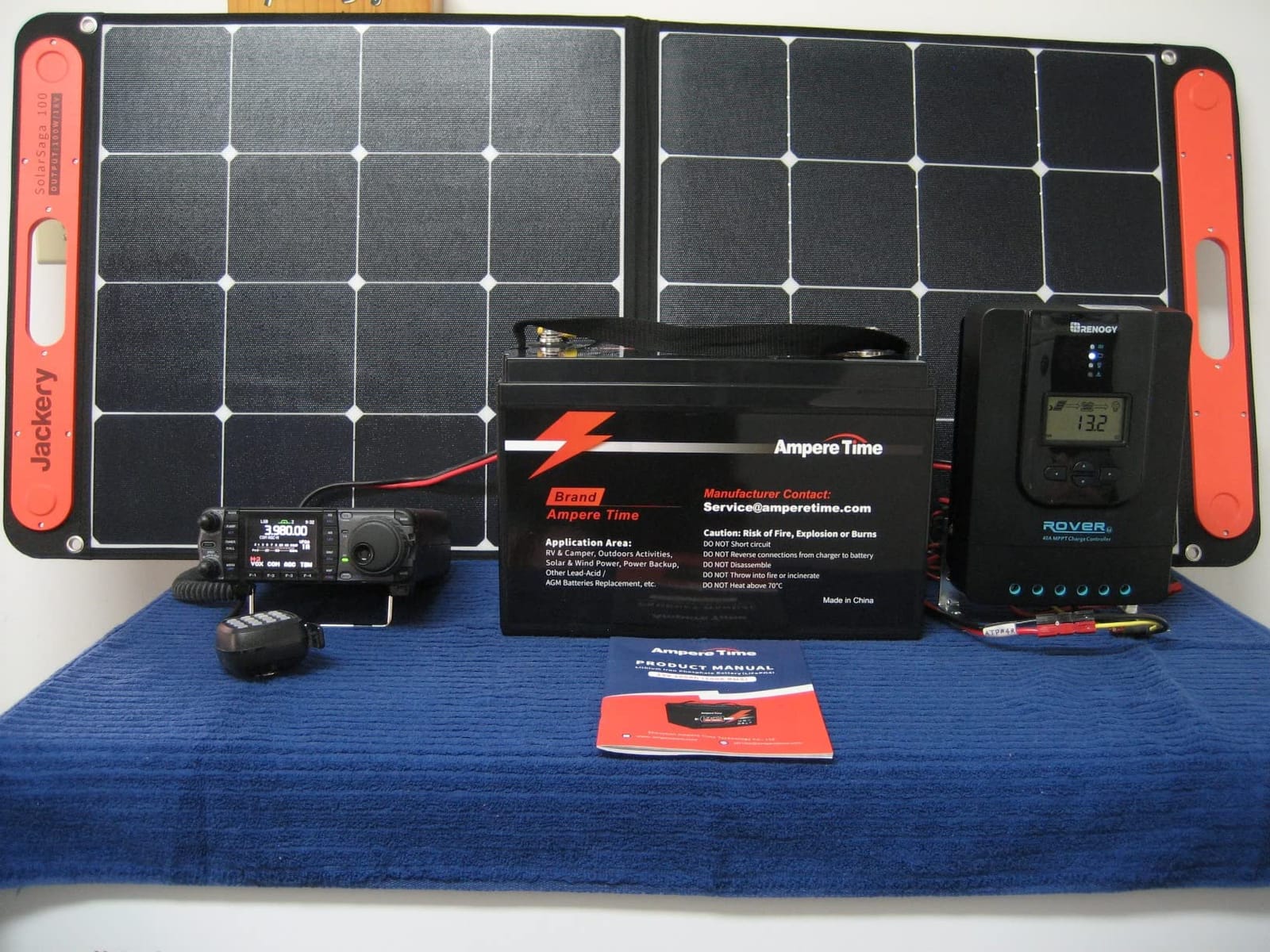
At 1280Wh and 22.1 lbs, it is roughly a third the weight of an equivalent lead-acid battery, and four parallel in series supports 4P4S configurations for larger builds. The 100A BMS protects against overcharge, over-discharge, short circuits, over-voltage, over-current and over-temperature, and AIG product liability insurance covers units from May 2026.
Two limitations to plan around. This basic Group 31 variant has no Bluetooth, so you are back to a shunt or a voltmeter for state of charge, and the manufacturer is explicit that it is not for engine starting, golf carts or jack-type applications.
Who this pack suits
It suits boat owners, liveaboards and anyone running a trolling motor or a deck solar array where corrosion resistance and weight decide the purchase. It also suits first-time lithium buyers who want the least expensive route into the chemistry with a warranty that is easy to understand.
It works well as a house bank for a shed, a gate or a well pump where monitoring is not critical. The energy density means you can carry more usable capacity into a small boat than lead-acid would ever allow.
Who should skip it
Skip it if you want to see state of charge from your phone. The monitoring lives in the Bluetooth variants, and adding one afterwards means replacing the pack rather than bolting on a module.
Skip it if you need engine starting or a trolling motor above 2kW, and be aware that some units arrive with a low state of charge needing a full initial charge cycle to balance cells. Also note the guidance that it is not compatible with MerCruiser or Mercury Motors without a current regulator.
How to Choose a Lithium Battery for Solar
LiFePO4 is the only lithium chemistry worth considering for solar
Lithium is not one chemistry, and the difference decides whether your bank lasts five years or fifteen. LiFePO4 uses iron and phosphate rather than the nickel, manganese and cobalt of NMC cells, which gives it a flatter discharge curve, a much longer cycle life and a far lower thermal runaway risk. NMC packs hold more energy per kilogram, which is why they dominate phones and cars and why they are the wrong choice behind a wall.
Against lead-acid the gap is wider still. A 100Ah AGM battery gives you roughly 50Ah of usable capacity because of the 50 percent depth-of-discharge reserve. The same 100Ah of LFP gives you close to all of it, runs at a third of the weight, and lasts 3000 to 6000 realistic cycles instead of 300 to 500. That is why the cost-per-cycle argument, not the purchase price, is the one to run.
Buyers should treat any cycle claim above 10,000 with suspicion unless a test method is published. The figure is almost always quoted at 60 percent depth of discharge with a shallow charge cycle, which is not how a solar bank gets used. Look instead for a figure stated at 80 or 100 percent depth of discharge, and the packs in this roundup that quote all three levels are the ones we trust most.
Size the bank from your daily load, then add days of autonomy
Start with what you actually use. List the loads, estimate their hours per day, multiply by watts, and you have your daily watt-hours. Add inverter overhead and the battery will look smaller than you expect, which is why a 400W array is widely reported to yield only 20 to 40Ah on a cloudy day.
Then choose your days of autonomy. Multiply daily watt-hours by the number of days you want to ride out, divide by 0.9 for inverter losses, and divide again by the battery’s nominal voltage of 12.8V to get amp-hours. One day of autonomy on a 1000Wh daily load is about 87Ah, so a 100Ah pack covers it and a 200Ah pack covers it comfortably with room for a second cloudy day.
Do not oversize the bank relative to the array. A 10kWh battery on a 1kW array sits at partial state of charge for weeks, and a lithium bank that never cycles is a bank that never pays back its cost. Forum advice is consistent on this point: lithium only makes financial sense if you cycle the battery daily.
Cold weather is where lithium batteries get permanently damaged
Charging a lithium cell below 32F causes lithium plating, where metallic lithium deposits on the anode instead of intercalating into the graphite. That damage is irreversible, it reduces capacity permanently, and it happens silently with no warning light. Every pack in this roundup has a low-temperature cutoff, which is the reason you should never buy a lithium solar battery without one.
The cutoff means the battery simply stops accepting charge on a cold morning, which is what forum users describe as a battery that will not charge in the cold. The battery is usually fine. It will resume when the pack warms above its restart threshold, and a sunny midday with the array aimed south will get it there faster than waiting for the sun to reach the enclosure.
If your battery lives in an unheated shed or a van over winter, schedule charging for the middle of the day rather than at first light, or move the pack somewhere warmer. That habit solves the problem more cheaply than heated cells, which is why owners across the DIY solar forums recommend it so consistently.
Wiring banks correctly prevents the failures people blame on the battery
Series wiring raises voltage, parallel wiring raises capacity, and mixing the two gets you a 24V or 48V bank from 12V modules. Expansion limits vary by model here, from 4P4S up to 4S4P, and the rack-format module runs up to 32 in parallel. Check your specific model’s ceiling before you plan the layout.
The rule that catches people out is same brand, same model, same age. Never parallel a new battery with a three-year-old pack, and never mix brands in one bank, even at the same nominal capacity. The older unit sets the ceiling for the whole string, and a single weak cell drags the newest battery down with it.
Fuse each parallel string close to the battery with a Class T or ANL fuse, size your cable to the inverter output rather than to the battery rating, and fit the main disconnect where you can reach it. For a whole-home bank, check whether your certification covers indoor installation, because that is a different question from whether the battery is UL1973 listed.
Match the charge controller profile to LiFePO4
You cannot connect a panel straight to a lithium battery. An MPPT controller is required because it regulates voltage and current into the bank, and leaving an AGM profile selected will overcharge LFP cells over time with no visible symptom other than lost capacity.
The profile matters more than the controller. Set absorption to 14.4V to 14.6V, float to 13.5V to 13.6V for a 12.8V pack, and enable the low-temperature charging cutoff so the controller stops charging before the battery has to protect itself. Victron SmartSolar controllers, EPever units and most modern inverter chargers have a dedicated lithium profile, and the rack-format module in this list speaks CAN and RS485 so the inverter can read real state of charge instead of estimating from voltage.
One more consideration for whole-home systems. UL9540 covers the energy storage system and UL1973 covers the battery, so an indoor install generally needs the former. Only one pack in this roundup carries that stack, and it is worth paying attention to if your install is indoors or on an attached wall.
When lithium is the wrong call
Skip lithium for a small array with low cycling. If your system is a 400W panel set powering a handful of lights and a small charge phone bank, an AGM bank costs a fraction of the price and the extra cycles never get used. The premium only pays back if you draw real energy every day.
Consider a second battery rather than a bigger one if you are unsure. Many owners run one pack and add a matching module later, which guarantees the bank stays same-brand and same-age. It also spreads the cost, and it is the reason modular formats like the rack case earn their place.
Finally, check what else you are running. If your install already includes solar lights, a security camera or a small generator for backup, our guides to the best outdoor solar lights and the best solar security cameras cover the peripheral loads that decide how hard your bank works.
Frequently Asked Questions
What type of battery is best for solar power systems?
LiFePO4, also called lithium iron phosphate or LFP, is the best battery chemistry for solar power systems. It tolerates a full depth of discharge without damage, delivers 3000 to 6000 realistic cycles against 300 to 500 for AGM lead-acid, weighs roughly a third as much for the same usable capacity, and carries a built-in BMS that blocks charging below 32F to prevent irreversible lithium plating. NMC cells hold more energy per kilogram but are the wrong choice for stationary storage.
How many lithium batteries do I need for a solar system?
Work out your daily watt-hours, multiply by the days of autonomy you want, divide by 0.9 for inverter losses, then divide by the battery nominal voltage of 12.8V to get amp-hours. A 1000Wh daily load at one day of autonomy is about 87Ah, so one 100Ah pack covers it and a 200Ah pack leaves room for a cloudy day. Two 100Ah packs in parallel give 2560Wh for a weekend off-grid system.
Can you hook a solar panel directly to a lithium battery?
No. A charge controller is required because it regulates voltage and current into the bank. Use an MPPT controller with the lithium profile selected: absorption at 14.4V to 14.6V, float at 13.5V to 13.6V for a 12.8V pack, and the low-temperature charging cutoff enabled. Leaving an AGM profile active will overcharge LFP cells over time with no visible symptom other than gradual capacity loss.
Is it good to run lithium batteries in parallel?
Parallel wiring is the normal way to add capacity and it works well, with one rule: use the same brand, same model and same age in every string. Mixing a new pack with a three-year-old battery, or two different brands at the same nominal capacity, lets the weakest unit set the ceiling for the whole bank and can drag the newest battery down with it. Also fuse each string close to the battery with a Class T or ANL fuse.
Why will my lithium battery stop charging in the cold?
The BMS blocks charging below 32F because charging a lithium cell at freezing causes lithium plating, an irreversible deposit on the anode that permanently reduces capacity with no warning light. The battery is not damaged. It will resume once the pack warms above its restart threshold, so schedule charging for the middle of the day or move the pack somewhere warmer rather than buying heated cells.
What is the biggest disadvantage of a lithium-ion battery?
For solar storage the honest answer is cold-weather charging and the damage that follows if you ignore it. Lithium also loses capacity when stored at partial state of charge for long periods, and a bank much larger than your array will sit half-empty for weeks, which is why oversizing is a real financial mistake rather than just a large purchase. A battery without a low-temperature cutoff should never be used for solar.
What does 15,000 cycles actually mean on a lithium battery?
Usually a figure quoted at 60 percent depth of discharge with a shallow charge cycle, which is not how a solar bank runs. The same pack may only manage 4000 cycles at full depth of discharge or 6000 at 80 percent. Look for a manufacturer who states all three figures, and treat any claim above 10,000 cycles with no published test method as marketing rather than a specification.
Do I need lithium at all, or is AGM good enough?
AGM is fine for a small array with low cycling, such as a 400W panel set running lights and a small charge bank, because the extra cycles lithium provides would never be used. Lithium earns its place when you draw meaningful energy every day: you get roughly double the usable capacity per amp-hour, a third of the weight, and a far lower cost per cycle over ten years.
Our Final Verdict for Solar Storage in 2026
The best lithium batteries for solar power systems come down to format. Pick the LiTime 12V 100Ah Group 24 BT as our general choice for drop-in fitment, monitoring and the strongest review record we found. Step up to the ECO-WORTHY Cubix100 when you are building a whole-home bank that needs UL9540 and UL1973 certification and modular expansion.
Everything in between is a question of load. Small RV and marine builds fit in a Group 31 case, high-draw systems want the 200A BMS headroom, and if you cycle daily, any of these will out-earn an AGM bank within a few years. Check the live listing for current pricing, size the bank from your real daily load, and never run one of these without a charge controller set to the LiFePO4 profile.