
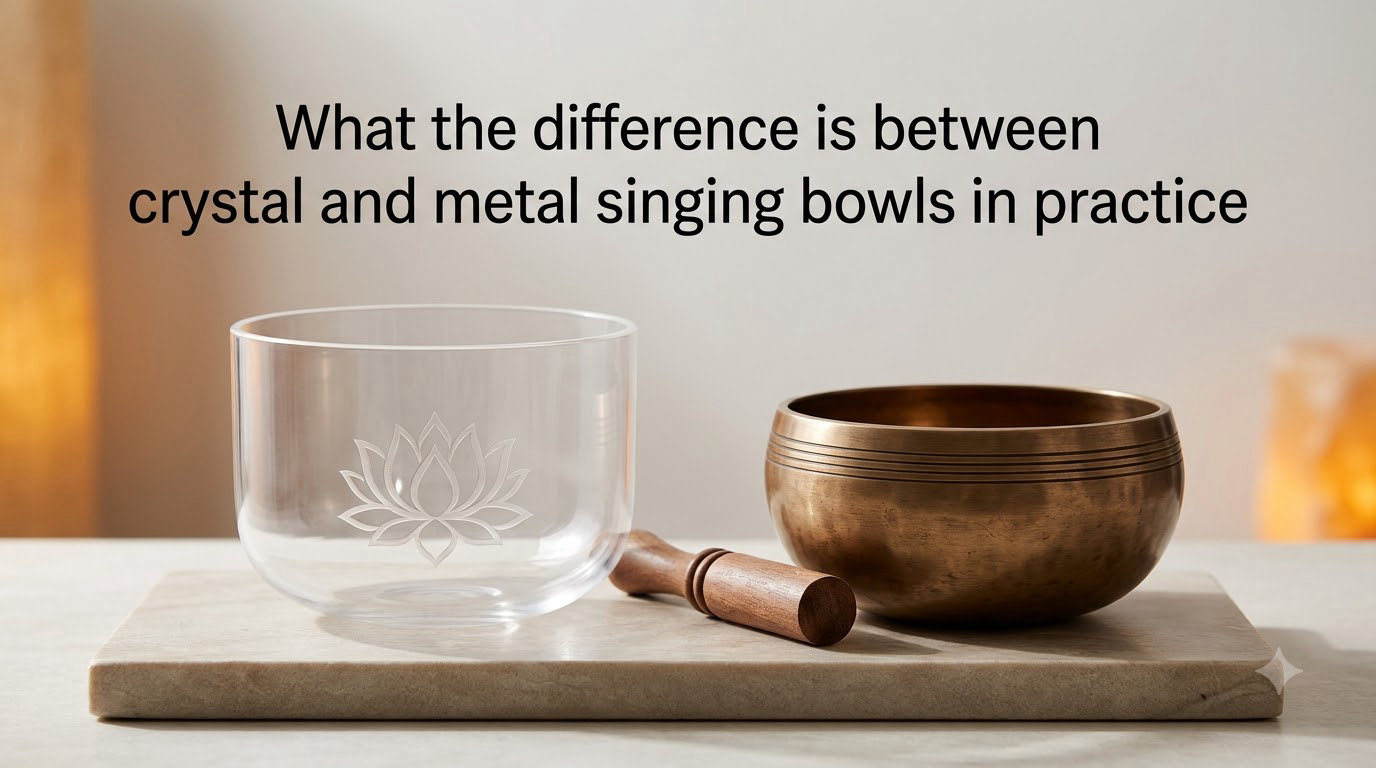
A singing bowl is a type of standing bell, a vessel that produces sustained tones when struck or when a mallet circles its rim. Two main families exist: metal bowls forged from bronze alloy and crystal bowls shaped from pure quartz.
Both are used for sound healing, meditation, and chakra balancing, but they behave very differently in practice. If you have ever wondered whether the crystal and metal singing bowls difference matters for your own sessions, the short answer is yes, and the gap shows up in tone, weight, durability, technique, and price.
In our team’s comparison work, we spent time with both bowl types across group sound baths, private meditation, and chakra work. Here is what we found when we put them side by side, and how to choose the right one for your own practice.
Table of Contents
Metal singing bowls trace back thousands of years and are made from bronze alloy
Metal singing bowls, sometimes called Tibetan bowls or Himalayan bowls, are hammered or cast bowls traditionally made from a bronze alloy. The classic recipe blends seven metals, each tied in Himalayan tradition to a celestial body: gold for the sun, silver for the moon, copper for Venus, iron for Mars, tin for Jupiter, lead for Saturn, and mercury for Mercury.
The oldest known metal bowls date back over a thousand years, and some scholars trace the lineage further into pre-Buddhist shamanic practices in the Himalayan region. They served as ritual objects, meditation tools, and eating vessels across cultures.
Two production styles matter when you shop. Hand-hammered bowls are shaped by skilled artisans who tune the metal through repeated strikes, and each one carries small variations in tone. Machine-made or cast bowls are produced in molds for consistency and a lower price, but they often lack the harmonic depth of hand-worked pieces.
In our testing, the hand-hammered bowls consistently produced richer overtones. The difference is most obvious when you circle the mallet slowly around the rim rather than striking the bowl once.
Crystal singing bowls are modern quartz instruments invented in the 1990s
Crystal singing bowls are made from crushed clear quartz that is fused at extremely high temperatures inside a spinning mold. The process was developed in the early 1990s, which makes these bowls a very recent addition to the sound healing world compared to metal bowls.
Quartz is piezoelectric, meaning it produces a small electrical charge under mechanical pressure. Practitioners believe this property amplifies the bowl’s effect on the body’s energetic field, though the science is still debated. What is not debated is that quartz rings with extraordinary clarity and sustain.
Three main types sit on the market today. Frosted quartz bowls have a sandblasted matte finish, weigh more, and produce a slightly warmer tone. Clear quartz bowls are transparent, lighter, and ring brighter. Alchemical quartz bowls are infused with precious metals or gemstones during production, which practitioners associate with specific intentions.
Color matters too. Many crystal bowls are tinted by adding minerals during the fusion process, and each color is often linked to one of the seven chakras in sound healing practice.
Sound is the biggest practical difference between crystal and metal singing bowls
Metal bowls produce complex overtones with a warm, grounding tone. A typical metal singing bowl rings with multiple harmonics stacked together, which gives the sound a textured, almost singing quality. Frequencies usually sit between 110 Hz and 660 Hz depending on size.
Crystal bowls produce a pure, focused tone with strong sustain. Because quartz is rigid and uniform, the bowl vibrates with fewer competing overtones, often producing the fundamental note plus a clear octave or third above it. The tone can linger for 30 seconds or more on a well-made bowl.
In practice, this means metal bowls feel rich and earthy, while crystal bowls feel clear and high vibration. Neither is objectively better, but they do suit different intentions. Grounding meditations tend to pair well with metal, while chakra alignment work often calls for the precision of crystal.
Here is a quick sound comparison:
- Metal bowls: complex overtones, warm tone, shorter sustain
- Crystal bowls: pure fundamental, clear tone, long sustain
- Best for sound baths: both work, but crystal carries farther in large rooms
- Best for personal meditation: depends on whether you want grounding or uplift
Metal bowls are far more durable than crystal bowls in daily use
Drop a metal bowl on a wooden floor and you will likely dent it, maybe slightly warp the rim, but it will keep ringing. Drop a crystal bowl and you risk a crack or full shatter. Quartz is hard but brittle, and a single fall from waist height can end its life.
Crystal bowls also react to sudden temperature changes. Moving a cold bowl into a warm, humid room can create stress fractures over time. Many practitioners store crystal bowls in padded cases and let them acclimate before playing.
Cleaning is simpler with metal. A soft cloth and mild soap handles most smudges. Crystal bowls need gentler care, often just a dry microfiber cloth, because harsh cleaners can damage the frosted finish or strip tinted layers.
If you travel with bowls or plan to use them in group sessions with lots of movement, metal bowls forgive more mistakes. Crystal bowls reward a stable, protected setup.
Crystal singing bowls typically cost more than metal bowls at every size
Entry-level metal bowls cost a small fraction of what crystal bowls do, and small hand-hammered pieces are the most accessible option for new practitioners. Premium antique or large ceremonial bowls climb much higher, but most beginners find a solid daily-use bowl at the lower end of the metal range.
Crystal bowls sit in a higher bracket across the board. A small frosted bowl in a single chakra color costs several times more than a comparable metal bowl. Mid-size bowls in clear quartz or with color infusion run into the mid-hundreds. Large, premium alchemical bowls with precious metal infusion can pass the four-figure mark.
Price tracks several factors: material purity, size, hand finishing, brand reputation, and whether the bowl has been tuned to a specific frequency. A bowl tuned to a chakra note like 432 Hz or 528 Hz often costs more than an untuned equivalent.
For someone just starting out, a mid-range metal bowl gives the most sound per dollar spent. A crystal bowl is a longer investment that pays off if you commit to regular practice.
Crystal bowls are easier to play while metal bowls reward patience
Beginners usually find crystal bowls more forgiving. A single firm strike with the suede-wrapped mallet produces a clean, sustained tone almost every time. The wide rim gives you room to circle the mallet for the singing effect without much skill.
Metal bowls ask for more finesse. The mallet can stick or skip on the rim if your pressure is wrong, and you need a steady, even circular motion to bring out the overtones. Many forum users on r/SoundHealing describe metal bowls as a pain to use until they get the technique down.
Once you build the skill, metal bowls open up richer harmonic play than crystal bowls. You can coax multiple tones from a single bowl by varying speed and pressure. Crystal bowls tend to give you one strong fundamental, which is cleaner but less expressive.
For client sound baths, ease matters. Most sound bath facilitators we spoke with prefer crystal bowls for group sessions because participants get a clean tone even when the room is noisy.
Each bowl type fits different healing and meditation scenarios
Personal meditation at home pairs naturally with a single metal bowl you can place on a cushion or your lap. The warm tone supports quiet sitting, breath work, and grounding practices.
Chakra work often calls for a set of crystal bowls tuned to the seven chakra frequencies. The clear, sustained tone of each bowl maps cleanly onto a specific energy center, which is why so many chakra practitioners favor quartz.
Group sound baths run smoother with crystal bowls, especially in larger spaces. The pure tone carries across a room without distortion. Metal bowls work beautifully in smaller, more intimate circles where the harmonic complexity adds to the atmosphere.
Water-based sound work, where bowls float on water for visual and vibrational effect, almost always uses crystal bowls. Quartz is non-reactive and produces a coherent vibration through water that metal bowls cannot match.
Body placement therapy, where the bowl sits on or near the body, often uses metal bowls because they are heavier, more stable, and transfer vibration through direct contact more reliably.
Match the bowl to your goal, your space, and your playing style
If you want an affordable, durable, deeply textured sound for personal meditation, start with a hand-hammered metal bowl in the 6 to 8 inch range. Look for one tuned to a note you find calming, and budget for a quality mallet.
If you want a clear, sustained tone for chakra work, group sessions, or water sound healing, invest in a frosted or clear quartz crystal bowl. Start with a single mid-size bowl in the color or frequency you want most, and add more over time.
Some practitioners end up with both. A common setup is a metal bowl for daily home practice and a crystal bowl for client sessions or chakra meditation. The two complement each other rather than compete.
The crystal and metal singing bowls difference comes down to what you value more: complex harmonics and durability, or pure tone and sustain. Neither wins on every measure, and the best choice is the one that matches the practice you actually do.
Frequently asked questions about crystal and metal singing bowls
What is the best material for a singing bowl?
There is no single best material. Metal bowls made from bronze alloy are durable, affordable, and produce rich overtones, while quartz crystal bowls produce a pure, sustained tone that many practitioners prefer for chakra and sound bath work. Choose based on your goal, space, and playing style.
Which singing bowl is best for beginners?
Beginners usually find crystal bowls easier to play because a single strike produces a clean tone. However, a small hand-hammered metal bowl at the lower end of the price range offers great sound per dollar and rewards a beginner who is willing to learn rim play technique.
How can I tell if a singing bowl is authentic?
For metal bowls, authentic hand-hammered pieces show irregular tool marks and have a balanced, complex tone. For crystal bowls, authentic quartz feels heavy for its size, rings with long sustain, and has consistent wall thickness. Mass-produced bowls often feel lighter and ring with shorter, duller tones.
Are all singing bowls the same?
No. Singing bowls vary widely in material, size, weight, tuning, and craftsmanship. The two main families, metal and crystal, produce very different sounds and serve different purposes. Even within each family, quality and tone vary significantly between makers.
Do crystal bowls really work better for healing than metal bowls?
There is no scientific consensus that one material heals better than the other. Both create vibrations that can entrain brain waves and support relaxation. Practitioners report different subjective experiences: metal bowls feel grounding, while crystal bowls feel uplifting. Choose based on the response you want in your body.
The crystal and metal singing bowls difference is real, and it shows up in every part of your practice from the first strike to the long sustain. Metal bowls bring ancient craft, complex harmonics, and tough daily use. Crystal bowls bring modern precision, pure tone, and water-friendly versatility.
If you are ready to start, pick one bowl that fits your main goal and your budget. Hold it, strike it, and listen to how your body responds. The right bowl is the one that pulls you back to your mat.