
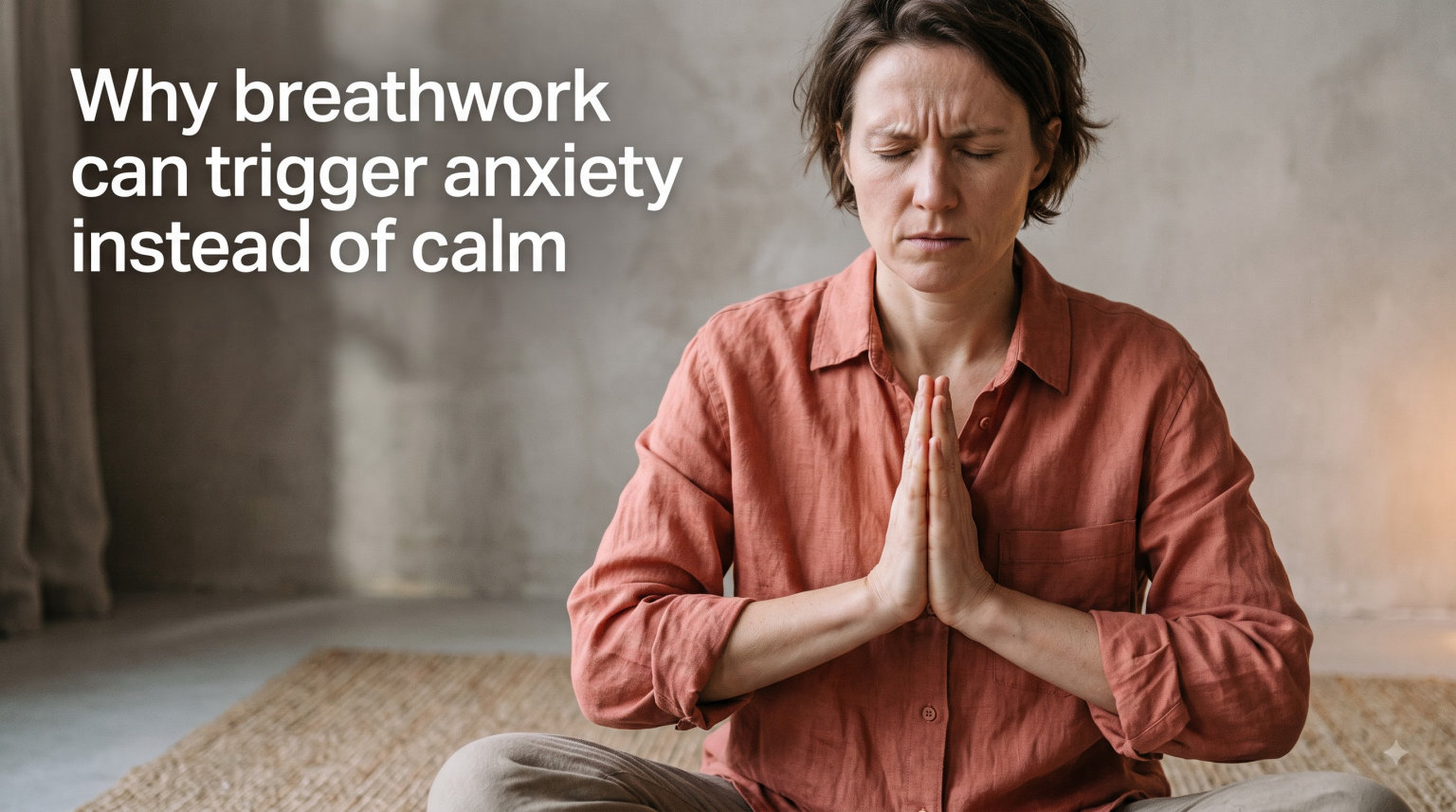
You close your eyes, take a deep breath, and try to relax. Within seconds your heart is pounding, your chest feels tight, and your anxiety has doubled. If this has happened to you, you are not broken. You are not doing it wrong. And you are far from alone.
Our team has spent months researching why breathwork can trigger anxiety instead of calm, and the answer comes down to physiology, psychology, and nervous system sensitivity. The same techniques that calm one person can send another into a full-blown panic spiral.
In this guide, we break down the science behind breathwork-induced anxiety, explain who is most vulnerable, and share what actually works when traditional breathing exercises backfire. By the end, you will understand exactly what is happening in your body and what to do about it.
Table of Contents
Why Breathwork Can Trigger Anxiety Instead of Calm?
Breathwork triggers anxiety instead of calm when it disrupts your carbon dioxide levels, activates hyperventilation patterns, or forces you to hyperfocus on bodily sensations that your brain interprets as danger. The result is a cascade of physical symptoms that feel identical to a panic attack.
This paradoxical reaction is surprisingly common. Across Reddit threads in r/Anxiety, r/Meditation, and r/breathwork, thousands of people describe the same experience. They try a recommended breathing exercise, and instead of feeling peaceful, they feel worse than before they started.
The core issue is that breathing is not a simple on-and-off switch for relaxation. It is a complex interaction between your respiratory system, your autonomic nervous system, and your brain’s threat-detection circuits. When those systems are already on high alert, adding structured breathing can push them over the edge.
Think of it like trying to fall asleep. The harder you try, the more impossible it becomes. Breathwork works the same way for many people with anxiety. The effort itself becomes the problem.
The Science: CO2, Hyperventilation, and Your Nervous System
To understand why breathwork triggers anxiety, you need to understand what happens chemically when you breathe. Most people assume more oxygen equals more calm. That assumption is wrong, and it drives a lot of failed breathing exercises.
Your body does not run on oxygen alone. It runs on a delicate balance between oxygen and carbon dioxide. When that balance shifts, your nervous system reacts. Sometimes it reacts with alarm.
The CO2-Hyperventilation Connection
Every time you exhale, you release carbon dioxide. When you breathe deeply and rapidly, as many breathing exercises encourage, you blow off more CO2 than your body produces. Your CO2 levels drop below the healthy range.
This condition is called hypocapnia, and your brain treats it as a serious problem. Low CO2 changes the pH of your blood, triggers blood vessel constriction, and reduces oxygen delivery to your brain. You feel dizzy, lightheaded, and short of breath, even though you are breathing more air than usual.
Here is the cruel twist: those symptoms feel exactly like anxiety. Your brain, already primed to detect threats, interprets the dizziness and chest tightness as evidence that something is wrong. The anxiety spiral begins, and it started with the very technique meant to stop it.
This is why deep breathing makes anxiety worse for so many people. They are not imagining it. They are experiencing a real physiological reaction called the hyperventilation-anxiety cycle, where breathing too much creates symptoms that trigger fear, which triggers more rapid breathing, which creates more symptoms.
Respiratory Alkalosis: When Breathing Too Much Backfires
When CO2 drops too low, your blood becomes more alkaline than normal. This state is called respiratory alkalosis, and it produces a specific set of physical symptoms that can be terrifying if you do not know what is happening.
The symptoms of respiratory alkalosis include tingling in your fingers and lips, a feeling of tightness or pressure in your chest, dizziness, heart palpitations, and a sense that you cannot get a full breath. In severe cases, it can cause muscle spasms in your hands and feet, a condition called carpopedal spasm or tetany.
If you have ever finished a breathing exercise feeling worse than when you started, respiratory alkalosis was likely the cause. Your blood chemistry shifted in a way your brain registered as dangerous.
The fix is not to breathe more. The fix is to breathe less. We will cover specific techniques for this later, but the key insight is that most people with breathwork-induced anxiety are overbreathing, not underbreathing.
Why Focusing on Your Breath Makes Anxiety Worse?
Here is something almost no one talks about: the act of paying attention to your breath can itself trigger anxiety, completely independent of how you are breathing. This is a phenomenon called interoceptive sensitivity, and it affects more people than you might think.
Interoception is your brain’s ability to sense what is happening inside your body. It is how you feel your heartbeat, your hunger, and yes, your breathing. For some people, this internal awareness system is turned up too high.
When you have high interoceptive sensitivity, focusing on your breath amplifies every sensation. You notice your chest rising and falling. You feel your heart beating. You become aware of the pause between breaths. For someone already prone to anxiety, this flood of bodily information is overwhelming.
Your brain, receiving all this internal data, starts scanning for danger. Is that heartbeat too fast? Is that breath too shallow? Why does my chest feel tight? Each question feeds the anxiety, and the anxiety produces more physical sensations to notice.
This is why meditation and breathwork can feel unbearable for some people. It is not the breathing pattern that is the problem. It is the attention itself. When you direct focused attention inward and your interoceptive system is hyperactive, you create a feedback loop of physical awareness and anxiety.
One Reddit user in r/Meditation described it perfectly: “Deep breathing used to cause me anxiety. I now understand that it was the hyperfocus on my body that triggered it, not the breathing itself.”
If this sounds like you, the solution is not to breathe differently. The solution is to redirect your attention outward while you breathe, or to skip breath-focused techniques entirely and use grounding methods instead.
Who Is Most Vulnerable to Breathwork Anxiety?
Not everyone reacts to breathwork the same way. Some people can do a 20-minute Wim Hof session and feel amazing. Others try one round of 4-7-8 breathing and end up in a panic. Understanding your risk factors helps you choose techniques that work with your nervous system instead of against it.
Trauma Survivors
If you have a history of trauma, especially trauma involving physical threat, medical procedures, or suffocation experiences, breathwork can be intensely triggering. Your nervous system has learned to associate loss of physical control with danger, and controlled breathing requires exactly that: surrendering control of your body to a technique.
Trauma experts use the concept of “window of tolerance” to explain this. When you are inside your window, you can handle challenging experiences. When breathwork pushes you outside that window, your body responds with a fight-or-flight reaction rather than relaxation.
This does not mean trauma survivors can never benefit from breathwork. It means they need trauma-informed approaches that prioritize safety, choice, and gradual exposure rather than intense, prolonged breathing sessions.
People With Anxiety Sensitivity
Anxiety sensitivity is a personality trait where you fear the physical symptoms of anxiety themselves. If you are afraid of your heart racing, your chest tightening, or feeling dizzy, then breathwork is a minefield. Every breathing exercise can produce sensations your brain has learned to fear.
People with high anxiety sensitivity often avoid exercise, caffeine, and strong emotions for the same reason. Any physical sensation that resembles anxiety becomes a threat. Breathwork, which deliberately creates changes in heart rate and body sensations, can feel like voluntarily triggering a panic attack.
If you scored high on anxiety sensitivity, the goal is not to push through the discomfort. The goal is to choose techniques that create minimal physical sensation while still calming your nervous system.
Neurodivergent Individuals
This is an area almost completely ignored by existing breathwork content. People with ADHD, autism, sensory processing differences, and other neurodivergent profiles may experience breathwork very differently from neurotypical people.
For autistic individuals, interoceptive awareness can be either heightened or diminished. Some autistic people struggle to feel their breath at all, making breath-focused exercises frustrating and dysregulating. Others feel internal sensations so intensely that focused breathing becomes sensory overload.
For people with ADHD, the sustained attention required for structured breathing can feel impossible and stressful. The mental effort of counting breaths or holding patterns can create more anxiety than it relieves.
Neurodivergent individuals often benefit from movement-based or external-focus techniques rather than internal, stillness-based approaches. If traditional breathwork has never worked for you and you are neurodivergent, that is not a personal failure. It is a nervous system mismatch.
Why Timing Matters: Mid-Panic vs. Calm State
Breathing techniques that work when you are already calm can backfire badly during an active anxiety spike. This is one of the most overlooked aspects of breathwork advice, and it causes enormous frustration.
When you are in a calm state, your parasympathetic nervous system is active. Slow, deep breathing reinforces that calm state. It works because your baseline is already regulated.
But when you are mid-panic, your sympathetic nervous system is fully engaged. Your body is in fight-or-flight mode. Trying to force slow, deep breathing in this state is like trying to stop a runaway train by pulling the emergency brake gently. The mismatch between what your body wants to do and what the technique demands creates more stress.
This is why therapists often recommend breathing exercises as a daily practice, not as a panic-attack intervention. Building the skill when you are calm makes it more accessible when you are stressed. But expecting a breathing technique to rescue you from a full panic attack is often unrealistic.
A Stanford Medicine study published in 2023 found that cyclic sighing, a specific technique involving double inhales and extended exhales, was more effective at reducing anxiety than other breathing methods. The key was that it worked with the body’s natural stress response rather than fighting against it.
If you are already in a panic state, grounding techniques that redirect your attention outward are often more effective than inward-focused breathing exercises. Focus on what you can see, hear, and touch rather than what you feel inside your body.
Why Forcing Your Breath Backfires
One theme that appeared over and over in forum discussions was the word “forced.” People described breathing exercises as feeling forced, unnatural, and effortful. That sensation of effort is itself an anxiety trigger.
Your autonomic nervous system controls breathing automatically. You breathe roughly 20,000 times per day without thinking about it. When you suddenly take conscious control of that process, your brain can interpret the shift as a sign that something is wrong.
The logic is simple: if automatic breathing was working fine, why does it now require effort? Your threat-detection system does not know you are doing a relaxation exercise. It just knows that something changed, and change can mean danger.
This is why the best breathing techniques for anxiety involve minimal effort. The physiological sigh, extended exhales, and simple nasal breathing all work with your body’s natural rhythms rather than imposing rigid patterns that feel like work.
One therapist we studied described it well: calm cannot be forced. It can only be invited. When you approach breathing as something you must get right, you create performance anxiety on top of your existing anxiety. Two layers of stress for the price of one.
What to Do Instead: Techniques That Actually Work
If traditional deep breathing makes your anxiety worse, you have plenty of alternatives. The techniques below create calm without triggering hyperventilation, interoceptive overload, or the effort-anxiety cycle.
The Physiological Sigh
The physiological sigh is the technique that Stanford researchers found most effective for anxiety reduction. Here is how it works: take two quick inhales through your nose, followed by one long exhale through your mouth. Repeat this pattern three to five times.
What makes the physiological sigh different is the emphasis on the exhale. The double inhale fully inflates your lung’s tiny air sacs, called alveoli, and the long exhale activates your parasympathetic nervous system. It is fast, requires no counting, and produces almost immediate results.
You can do one physiological sigh in about five seconds. No setup, no app, no special posture. Just two inhales and a long exhale. This makes it ideal for situations where you feel anxiety rising and need a quick intervention.
Extended Exhale Breathing
If you want something slightly longer than the physiological sigh, try extended exhale breathing. The rule is simple: make your exhale longer than your inhale. Start with a 4-second inhale and a 6-second exhale, and adjust from there.
The reason this works is pure physiology. Your heart rate speeds up slightly on each inhale and slows down on each exhale. When your exhale is longer than your inhale, you spend more time in the heart-rate-slowing phase. Over several breaths, this shifts your autonomic balance toward calm.
The key difference between this and traditional deep breathing is that you are not trying to breathe deeply. You are not trying to fill your lungs completely. You are just making sure the exhale is longer. This prevents the overbreathing that triggers CO2 depletion and respiratory alkalosis.
Forum users repeatedly mentioned that focusing on the exhale rather than the inhale was what finally made breathing exercises work for them. One user called it their breakthrough moment after years of failed attempts.
Grounding Techniques That Skip the Breath Entirely
For some people, the best breathing technique is no breathing technique at all. If focusing on your breath in any form triggers anxiety, redirect your attention outward with grounding exercises.
The 5-4-3-2-1 technique is the most popular grounding method. Name five things you can see, four things you can touch, three things you can hear, two things you can smell, and one thing you can taste. This pulls your attention out of your body and into your environment, breaking the interoceptive anxiety loop.
Temperature changes also work well. Splash cold water on your face, hold an ice cube, or step outside into cool air. The sudden sensory input resets your nervous system through a process called the mammalian dive reflex, which slows your heart rate and shifts you out of fight-or-flight mode.
Physical movement is another alternative that many people overlook. A brisk walk, a few jumping jacks, or even shaking out your arms can discharge the physical tension of anxiety more effectively than stillness. For people whose anxiety is expressed physically, movement often works better than breathing.
Progressive muscle relaxation is another option that avoids breath focus entirely. Tense and release each muscle group from your feet to your head. This reduces physical tension without requiring you to monitor your breathing at all.
How to Build Breathwork Tolerance Gradually?
If you want to eventually use breathwork for anxiety but your current attempts backfire, you can build tolerance slowly. The key is to start so small that your nervous system never crosses into the danger zone.
Start with just three breaths. Not three minutes. Three individual breaths, with a longer exhale, done once per day. If that feels fine, add one more breath each week. If it triggers anxiety, drop back to two breaths and stay there longer.
Pair your breathing with an external focus point. Look at a tree, listen to music, or hold a textured object while you breathe. This prevents the interoceptive hyperfocus that triggers anxiety for many people.
Never push through discomfort. If you feel anxiety rising, stop immediately. Pushing through reinforces the association between breathwork and danger, making future attempts harder. Stopping early teaches your nervous system that breathwork is safe and optional.
Over weeks and months, your tolerance will increase. Some people eventually transition to full breathing sessions. Others stay with just a few breaths and that is perfectly fine. The goal is calm, not a badge of completion.
When to Seek Professional Help?
If breathwork consistently triggers panic attacks, or if your anxiety is severe enough to interfere with daily life, a mental health professional can help. Look for therapists trained in somatic processing, trauma-informed care, or nervous system regulation.
A trained professional can assess whether your breathwork reactions are rooted in trauma, anxiety sensitivity, or a physiological issue like a breathing pattern disorder. They can design a personalized approach that works with your specific nervous system rather than applying generic advice.
There is no shame in needing guidance. The breathing techniques circulating on social media are one-size-fits-all solutions applied to highly individual nervous systems. Getting professional support is often the fastest path to finding what actually works for you.
FAQs
Why does breathwork make me more anxious?
Breathwork makes you more anxious when it depletes carbon dioxide through overbreathing (hyperventilation), triggers interoceptive sensitivity by forcing you to focus on body sensations, or activates your threat-detection system through the effort of controlling an automatic process. These factors create physical symptoms like dizziness, tingling, and chest tightness that your brain interprets as danger, sparking an anxiety spiral.
Can breathing exercises actually trigger panic attacks?
Yes. Deep breathing exercises can trigger panic attacks by causing respiratory alkalosis, a condition where breathing too much drops your CO2 levels and makes your blood too alkaline. This produces dizziness, tingling, heart palpitations, and chest tightness that can feel identical to a panic attack and trigger one in people prone to anxiety.
Why does deep breathing make my anxiety worse?
Deep breathing makes anxiety worse for three main reasons: it causes hyperventilation that drops CO2 levels and triggers physical panic symptoms, it forces attention inward on body sensations that anxious brains interpret as threats, and it creates performance anxiety when you feel like you are not doing it correctly.
What breathing technique is best for anxiety?
The physiological sigh is the most effective technique for anxiety according to Stanford research. Take two quick inhales through the nose followed by one long exhale through the mouth. Alternatively, extended exhale breathing where your exhale is longer than your inhale also works well because it avoids the overbreathing that triggers panic.
How do I stop hyperfocusing on my breath during exercises?
Redirect your attention outward while breathing by focusing on a visual object, listening to ambient sounds, or holding something with texture. You can also skip breath-focused techniques entirely and use grounding methods like the 5-4-3-2-1 technique, cold water exposure, or progressive muscle relaxation that do not require internal attention.
Is it normal for breathwork to cause anxiety?
Yes, it is completely normal. Breathwork-induced anxiety is a well-documented phenomenon that affects people with trauma histories, high anxiety sensitivity, neurodivergent profiles, and naturally high interoceptive awareness. You are not doing anything wrong, and there are alternative techniques that work better for your nervous system.
What to Take Away
Understanding why breathwork can trigger anxiety instead of calm changes everything. It means your reaction is not a personal failure. It is a measurable, explainable response from a nervous system doing exactly what it evolved to do: protect you from perceived threats.
The key points are simple. Overbreathing depletes CO2 and triggers physical panic symptoms. Hyperfocusing on internal sensations floods an anxious brain with threat signals. Forcing an automatic process like breathing creates effort-based stress. And all three of these factors compound when you are already in a state of high anxiety.
What works instead is working with your body, not against it. The physiological sigh takes five seconds and requires no effort. Extended exhales calm your nervous system without causing hyperventilation. Grounding techniques and physical movement redirect attention outward, away from the internal sensations that trigger anxiety spirals.
If breathwork has never worked for you, stop forcing it. Try the alternatives in this guide. Build tolerance gradually if you want to, or skip breath-focused techniques entirely. The goal is not to master a breathing exercise. The goal is to feel calm. And there are many paths to that destination.