
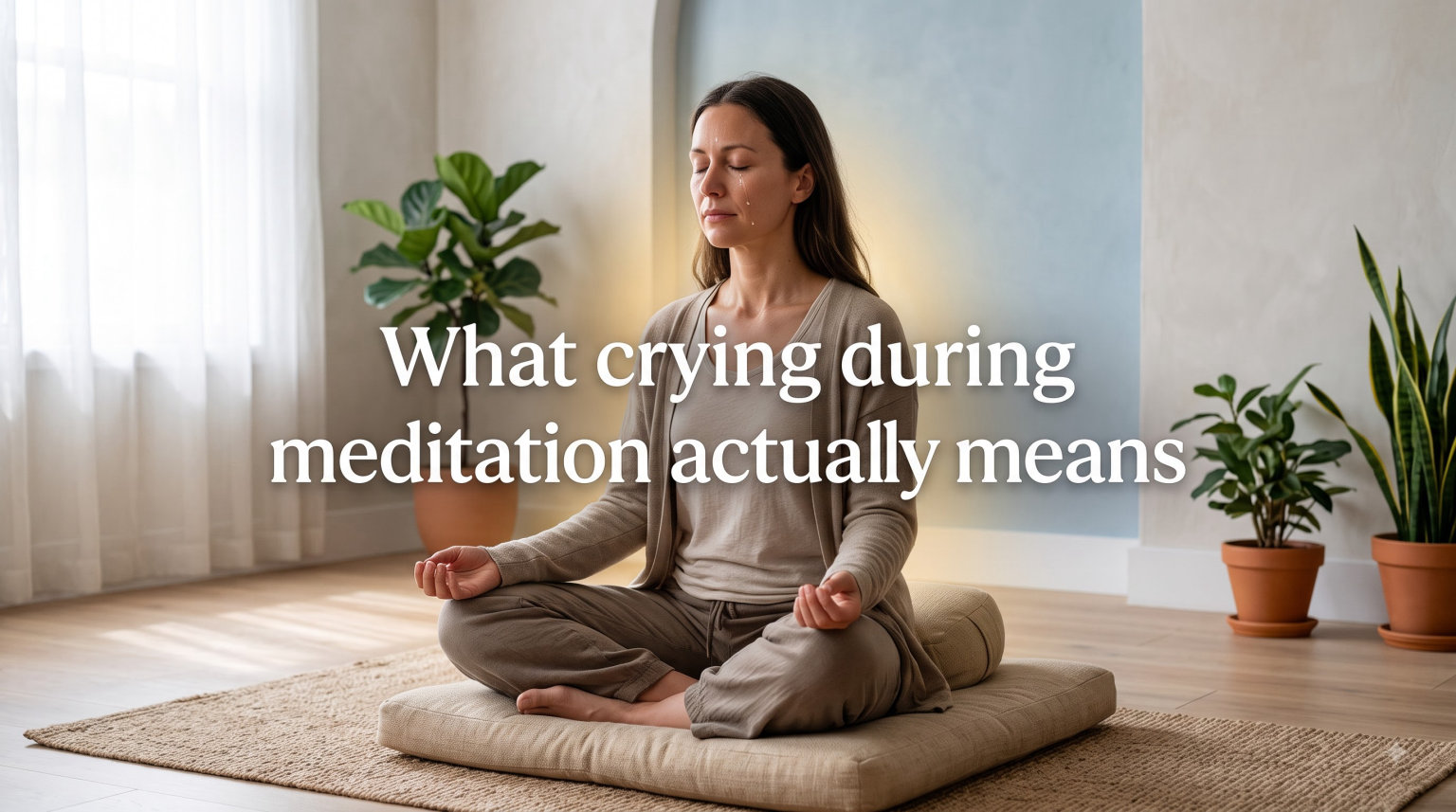
Crying during meditation is one of the most common, and most misunderstood, experiences a meditator can have. You sit down to quiet your mind, and within minutes tears are rolling down your cheeks, sometimes without any obvious reason. If you have searched “is it normal to cry during meditation” after a session left you confused, you are far from alone. Our team has worked with hundreds of meditators over the years, and the question comes up constantly, especially from people in their first few months of practice.
The short answer: crying during meditation is a normal, healthy emotional release. It signals that your body and mind are finally processing stored stress, suppressed feelings, or old emotions that have been waiting for a safe moment to surface. Meditation creates that safe space, and your nervous system takes the opportunity to let go. Rather than something going wrong, it is often a sign your practice is working exactly as it should.
In this guide, we break down what crying during meditation actually means from both scientific and spiritual perspectives. We cover why it happens, how long it typically lasts, what to do in the moment, and when tears might point to something that needs professional support.
Table of Contents
What Crying During Meditation Actually Means?
At its core, crying during meditation means your body is releasing emotions it has been holding onto. Throughout the day, week, or even years, you accumulate stress, grief, frustration, and unspoken feelings. Most of the time, you push these aside to keep functioning. They do not disappear. They get stored in your nervous system, your muscles, and your breath.
When you meditate, you finally stop pushing. The mental noise quiets. The defenses you run on all day soften. With nothing left to suppress the feelings, they rise to the surface and move out, often as tears. This is not a breakdown. It is the opposite. It is your system doing exactly what it was designed to do when given the chance.
Many people cry without being able to name why. This is normal too. The emotion being released may be years old. You may not have a conscious memory attached to it. The body remembers what the mind has filed away, and meditation gives it permission to let go.
This is why suppression causes harm over time. Emotions that stay trapped do not simply sit quietly. They leak out as anxiety, tension, irritability, poor sleep, and eventually physical illness. Crying during meditation is your body’s way of preventing that buildup from doing damage.
Why You Cry During Meditation: The Science
The scientific explanation for crying during meditation starts with your nervous system. When you sit down to meditate and slow your breathing, you activate the parasympathetic branch of your autonomic nervous system. This is the “rest and digest” mode, the opposite of the fight-or-flight state most of us live in.
During the day, your sympathetic nervous system keeps you alert and ready. It pumps out cortisol and adrenaline. Over weeks and months of stress, your body holds tension in a constant low-level state of readiness. Meditation flips that switch. The moment you settle in and your breath deepens, your body starts receiving the signal that it is safe to stand down.
That safety signal triggers a cascade of biochemical changes. As you relax, your brain releases several key chemicals:
Oxytocin, often called the bonding hormone, rises during deep relaxation and compassion-based practices. It opens you emotionally and can soften the walls you have built around difficult feelings.
Endorphins, your body’s natural pain relievers, increase as stress drops. They create a sense of ease that can make long-held sadness finally feel safe to feel.
Dopamine and serotonin shift as well, helping regulate mood. When these rebalance after a period of stress, the emotional recalibration itself can trigger tears.
GABA (gamma-aminobutyric acid) is a neurotransmitter that calms neural activity. Meditation measurably raises GABA levels, which quiets the mental chatter that normally keeps a lid on buried emotions.
At the same time, cortisol drops. For someone who has been running on stress hormones for months, that sudden drop can feel like a dam breaking. The emotions the cortisol was holding at bay rush forward. Your tear glands respond. The result is the cleansing release so many meditators describe.
This neurochemical shift explains why crying during meditation often happens even when you walked into the session feeling fine. You were not consciously sad. But your nervous system was carrying a load, and the moment it relaxed enough, that load moved out.
The Spiritual Meaning of Crying During Meditation
For many practitioners, the spiritual interpretation of crying during meditation resonates more deeply than the scientific one. Across traditions, tears during practice are understood as a sign of something opening, healing, or being purified.
In the yogic and energy-based traditions, meditation tears are often linked to the heart chakra, or anahata. The heart chakra sits at the center of the chest and governs love, compassion, grief, and forgiveness. When you meditate, especially practices focused on compassion or loving-kindness, energy begins to move through this center. If it has been closed off, guarded, or burdened by old wounds, the opening itself produces tears. Meditators frequently report a sensation of warmth or expansion in the chest right before the crying begins. This is what teachers often call “heart opening.”
Spiritually, these cleansing tears are understood as purification. The practice is clearing what does not belong so that something more genuine can take its place. You are not crying because something is wrong. You are crying because something old is leaving.
The Buddhist perspective is worth understanding in depth, because it is often mentioned only in passing. In Vipassana and other Buddhist meditation traditions, crying is seen as a natural part of seeing clearly. The practice trains you to observe sensations and emotions without reacting. As concentration deepens, you begin to perceive the layers of suffering, attachment, and impermanence that shape everyday experience. Facing those realities directly, sometimes for the first time, produces tears. Buddhist teachers do not treat this as a problem to fix. They treat it as part of wisdom ripening. The tears are the mind meeting truth.
Many people who ask “what does crying during meditation mean spiritually” are sensing that something larger is happening than simple stress relief. Often they are right. Spiritual crying can mark a genuine shift in awareness, a moment where you touched a deeper layer of yourself than your usual thoughts allow.
Common Reasons You Might Cry During Meditation
People cry during meditation for many different reasons. Recognizing which one applies to your experience can help you understand what your body is working through.
1. Releasing pent-up emotions. This is the most common cause. Suppressed emotions from daily life, frustration at work, conflict in relationships, worry about the future, accumulate until meditation gives them an exit. The tears are simply the exit.
2. Processing grief or loss. Grief does not follow a schedule. A loss from years ago can surface during a quiet sit because you finally have space to feel it fully. Meditation removes the distractions you normally use to avoid it.
3. Trauma release from the body. People with a trauma history often experience deeper and more frequent emotional releases. The body stores traumatic stress in the nervous system, and meditation can unlock it. This is real healing work, but it can also be intense, which is why we address professional support separately below.
4. Heart opening and gratitude. Not all meditation tears come from sadness. Many meditators cry from an overwhelming sense of love, gratitude, or compassion, especially during loving-kindness or heart-centered practices. These tears feel warm and expansive rather than heavy.
5. Relief from chronic stress. If you have been tense and wired for months, the sudden relief of finally relaxing can itself trigger tears. Your body is letting go of a burden it forgot it was carrying.
6. A meditation breakthrough. Sometimes crying marks a genuine shift in your practice. You may have just released a deep pattern, seen something about yourself clearly for the first time, or moved past a layer of resistance. Practitioners often describe a sense of lightness and clarity afterward.
7. Overwhelming joy. Joy can be just as overwhelming as sadness. Some meditators cry from sheer happiness or a sense of connection that exceeds what they normally allow themselves to feel.
8. Physical eye irritation. Not every tear is emotional. If your eyes water but you feel no emotional charge, it may simply be dry air, a draft, or eye strain from concentrating. Emotional tears usually come with a recognizable feeling in the chest or throat.
Is Crying During Meditation Normal?
Yes. Crying during meditation is completely normal and extremely common. In our experience working with meditators, the majority of regular practitioners report crying at least occasionally, and beginners frequently cry during their first several sessions.
It is especially common in three groups: people new to meditation, people carrying unprocessed emotions, and people with a history of trauma. Beginners cry because they are encountering stillness for the first time, and stillness strips away every distraction that was keeping old feelings at bay.
Experienced meditators do not see tears as a sign of failure. They expect emotional release as part of the path. A teacher with decades of practice once told us that if you meditate seriously for years and never cry, something is probably being held back.
How long do crying episodes typically last? Most last anywhere from a few seconds to several minutes. Rarely do they extend beyond ten or fifteen minutes in a single session. If you find yourself crying for very long stretches, day after day, that may be a signal to read the section below.
What to Do When Crying During Meditation?
When tears come during a session, your response shapes how the release unfolds. Here is the approach we recommend, step by step.
Step 1: Do not fight it. The single most important thing is to allow the release. If you clench down, hold your breath, or try to shut the feeling off, you push the emotion back down, where it will only resurface later. Give yourself permission to cry.
Step 2: Stay with your breath. You do not need to abandon the meditation. Keep your attention on the breath, even if it is shaky. The breath is your anchor. Let the tears flow while you keep breathing slowly. This keeps the release controlled rather than overwhelming.
Step 3: Ground through your body. If the emotion feels too intense, shift attention to physical sensations. Feel your sit bones on the cushion, your hands resting in your lap, your feet on the floor. This grounds you in the present moment and prevents the mind from spinning into a story about why you are crying.
Step 4: Label the feeling without judgment. Silently name what you feel. “Sadness.” “Grief.” “Relief.” “Something old.” Labeling creates a small amount of distance, enough to observe the emotion without drowning in it. Avoid analyzing or explaining it mid-session. That can wait.
Step 5: Close gently when ready. There is no rule that says you must finish a timed session. If the release feels complete or the emotion is too raw to continue, open your eyes, stretch, and end the sit. You have not failed. You have done the work.
For managing particularly intense moments, one breathing technique helps reliably. Breathe in slowly through the nose for a count of four, hold gently for two, and exhale through the mouth for a count of six. The longer exhale activates the parasympathetic system further and signals safety to the body. Use this for a few rounds whenever the crying feels like it is tipping from release into overwhelm.
Afterward, give yourself time before jumping back into your day. Drink water. Move your body. Journal if it helps. The hours following an emotional release are when integration happens, and rushing back into tasks can shortchange that process.
When to Seek Professional Support?
Most crying during meditation is healthy and needs no intervention. But there are moments when tears point to something that deserves more support than a solo practice can provide. No competitor article addresses this clearly, so we want to be direct.
Consider working with a therapist or trauma-informed practitioner if any of the following are true. The emotions feel unmanageable, meaning they do not settle down after the session and instead carry into your day, your sleep, or your relationships. You find yourself crying for very long stretches in nearly every session without any sense of relief or completion. The content of the emotions feels related to a specific traumatic event that you have not been able to process.
Also take note if meditation leaves you feeling worse over time rather than better. While short-term intensity is normal, a sustained decline in wellbeing is not. If weeks go by and you feel more dysregulated, more anxious, or more depressed than when you started, that is worth a conversation with a professional.
Trauma-informed therapy, somatic experiencing, and EMDR are all modalities that pair well with meditation for people working through deeper material. A skilled therapist can help you pace the work so that emotional release happens in manageable doses rather than all at once. None of this means you should stop meditating. It means you may benefit from guidance while the deeper layers move.
None of this is a replacement for professional care. If you are in crisis, reach out to a mental health professional or a local helpline immediately.
Signs Your Meditation Is Working
One of the most common questions, especially on meditation forums, is whether crying means the practice is working or failing. The answer is that emotional release is one of the clearest signs your meditation is doing something real.
Other signs that your practice is effective include greater self-awareness between sessions, reduced emotional reactivity when something stressful happens, improved sleep, a sense of calm that lingers after you stand up from the cushion, and a growing ability to sit with discomfort rather than fleeing from it. Spontaneous releases like yawning, trembling, deep sighs, and sudden laughter are also common. They are all expressions of the nervous system letting go, just like tears.
If you notice these shifts alongside the occasional cry, your meditation is on track. The tears are part of the evidence, not an exception to it.
Frequently Asked Questions
What does crying symbolize spiritually?
Spiritually, crying during meditation symbolizes purification and the opening of the heart. In many traditions, tears are seen as cleansing energy clearing stored pain so that a deeper layer of self can be felt. They often mark a moment of awakening or release, especially during heart-centered practices.
What are signs my meditation is working?
Signs your meditation is working include greater self-awareness, reduced reactivity to stress, improved sleep, emotional releases like crying or yawning, a calmer mood between sessions, and an increased ability to sit with discomfort. Crying itself is one of the clearest signs that the practice is processing real material.
What chemical is released when meditating?
Meditation releases several beneficial chemicals. It increases oxytocin, endorphins, dopamine, serotonin, and GABA, while reducing cortisol and adrenaline. The rise in GABA and oxytocin, combined with the drop in stress hormones, is what allows suppressed emotions to surface and release as tears.
Does crying release stored trauma?
Yes, crying can be one way the body releases stored trauma. Traumatic stress is held in the nervous system, and meditation can create the safety needed for it to move out. However, for significant trauma, pacing matters, and working with a trauma-informed therapist alongside meditation is often the safest approach.
Is it normal to cry during meditation?
Yes, crying during meditation is completely normal and very common. It is especially frequent among beginners and people carrying unprocessed emotions or a trauma history. Experienced meditators expect emotional release as a natural part of deepening practice.
How long do crying episodes during meditation typically last?
Most crying episodes during meditation last from a few seconds to several minutes. They rarely extend beyond ten to fifteen minutes in a single session. If crying becomes very prolonged or happens in nearly every session without relief, it may be worth exploring with a mental health professional.
Conclusion
Crying during meditation is not a sign that something has gone wrong. It is a sign that something is finally being allowed to move. Whether you understand it as the nervous system releasing stored stress or the heart chakra opening to clear old pain, the message is the same: your body is healing itself, and your practice is giving it the space to do so.
If tears come during your next session, let them. Stay with your breath, ground through your body, and trust that what is leaving needed to leave. And if the emotions ever feel too heavy to hold alone, there is no shame in reaching for support. Working with your emotions gently, at your own pace, is the most sustainable way forward.