
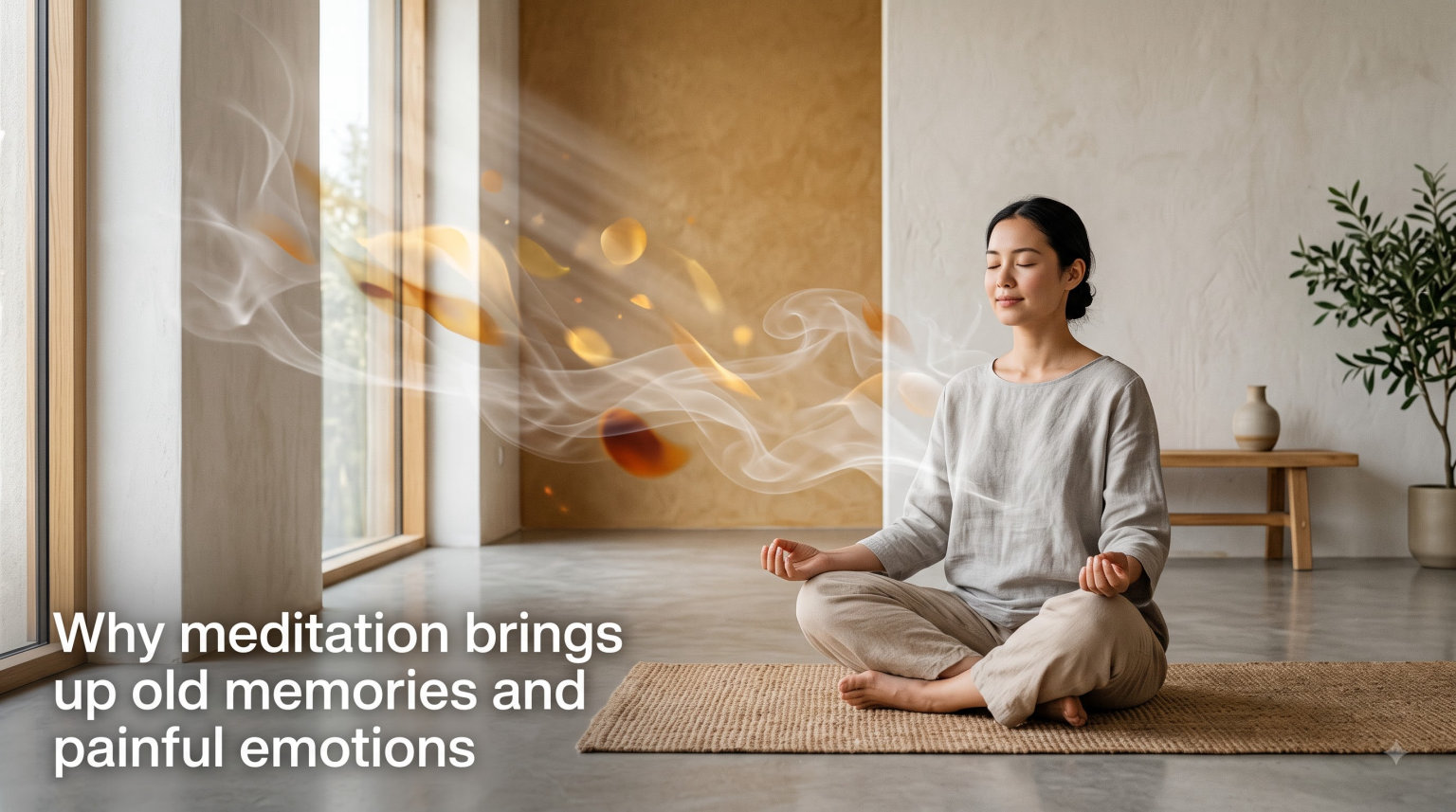
You sit down, close your eyes, and expect a few minutes of quiet. Instead, a memory from years ago crashes through your mind. Maybe it is a breakup, a childhood moment, or something you thought you had dealt with long ago. The emotion hits hard. Your chest tightens, tears form, and you wonder if something is wrong.
Nothing is wrong. In fact, something is working exactly as it should. Meditation brings up old memories and painful emotions because the practice itself relaxes the mental defenses that keep difficult material pushed below the surface of your awareness. When the constant noise of daily thinking quiets down, what was hidden has room to rise.
This is one of the most common and least talked about experiences in meditation. Browse any meditation community and you will find the same story repeated hundreds of times. A practitioner on Reddit described it perfectly: they had been meditating consistently for a couple of months, feeling calmer and more patient, when suddenly old trauma, fears, and unwanted memories started surfacing out of nowhere.
That experience is not a sign that meditation is hurting you. It is a sign that your mind is doing something it has wanted to do for a long time. In this guide, we will explain exactly why this happens, what is going on in your brain and nervous system, and how to handle it when emotions arise so your practice stays safe and healing.
Table of Contents
Why Meditation Brings Up Old Memories and Painful Emotions?
The short answer is that meditation removes the lid your mind places over difficult experiences. Your conscious mind spends most of the day filtering, suppressing, and redirecting attention away from painful material. It does this to keep you functioning. When you sit in meditation and deliberately quiet that filtering process, the material underneath has nowhere to go but up.
Think of your mind like a room where you have been shoving things into the closet for years. Every painful experience, every unresolved conflict, every moment you told yourself to just move on from goes into that closet. During normal daily life, the door stays shut. Meditation is like opening that door and shining a light inside.
This is rooted in a principle that meditation teachers have taught for centuries: what you resist persists. The energy you spend pushing something away is the same energy that keeps it alive in your system. When you stop resisting during meditation, the stored material surfaces because the force holding it down has been removed.
From a neurobiological perspective, the explanation is just as clear. Painful and traumatic memories are processed heavily by the amygdala, the brain structure responsible for threat detection and emotional intensity. When a memory gets encoded as threatening, the amygdala keeps it in a heightened state of activation. Your nervous system stays partially on alert, even years later.
Meditation activates the prefrontal cortex, the part of the brain involved in awareness, attention, and emotional regulation. As prefrontal activity increases and the default mode network (your brain’s background chatter) quiets, the amygdala’s constant suppression patterns also relax. Memories that were being held in a state of high activation suddenly become available to conscious awareness.
This is why old memories surfacing during meditation feels so vivid and real. You are not just remembering an event. Your nervous system is re-experiencing the emotional charge that was stored alongside it. The memory comes with its original intensity because it was never fully processed the first time around.
Many meditators describe this as suppressed feelings finally surfacing after years of suppression. One person on a 10-day retreat said they spent days confronting and freeing themselves from negative memories they did not even know they were carrying. The mechanism of suppression itself gets released during deep meditation.
The Psychological Mechanisms Behind Emotional Release
To understand why meditation surfaces painful material, you need to understand how that material got stored in the first place. Two related but distinct processes are at work: repression and suppression.
Suppression is a conscious choice. You experience something painful, and you deliberately decide to set it aside and deal with it later. You know the feeling or memory is there. You are just choosing not to engage with it in this moment.
Repression is unconscious. The mind automatically pushes a painful experience below the level of awareness without you deciding to do it. This is a protective mechanism. When something is too overwhelming to process, the mind tucks it away so you can continue functioning. The problem is that repressed material does not disappear. It stays active in your nervous system, influencing your reactions, triggers, and emotional baseline without your knowledge.
Meditation reaches both types. Suppressed material surfaces relatively easily because you were already aware of it. Repressed material can be more surprising and intense because it shows up uninvited, sometimes as a memory you had completely forgotten or an emotion you cannot immediately connect to a specific event.
How Trauma Gets Stored in the Body
Trauma is not just a psychological phenomenon. It lives in the body and the nervous system. When you experience something overwhelming, your body activates a fight, flight, or freeze response. Ideally, once the threat passes, your nervous system completes the cycle and returns to a regulated state.
But when the threat is too intense, or when there is no opportunity to discharge the survival energy, the response gets stuck. Your body holds the incomplete pattern. This is why trauma survivors often experience physical symptoms like chronic tension, digestive issues, shallow breathing, or a constant sense of alertness. The nervous system is still trying to manage a threat that already happened.
Meditation can trigger the release of this stored material. As you relax and bring awareness inward, your body may begin to shake, tremor, cry, or feel waves of heat or cold. These are signs of the nervous system discharging energy that has been held for a long time. Somatic therapy practitioners recognize these as healthy release responses, not symptoms of something going wrong.
Witness Consciousness: Creating Safe Distance
The most important skill for navigating painful memories in meditation is what teachers call witness consciousness. This is the ability to observe your experience without becoming consumed by it.
In ordinary life, when a painful memory surfaces, you tend to merge with it. You feel like you are inside the memory, reliving it. The emotion takes over. Witness consciousness creates a gap between you and the experience. You are aware of the memory, but you are also aware that you are the one watching it.
This gap is what makes healing possible. From the perspective of the witness, a painful memory is just another object appearing in awareness. It arises, stays for a while, and passes. You do not have to fight it, fix it, or analyze it. You simply let it be there and watch.
Eastern traditions distinguish between the subconscious mind, where repressed material is stored, and the superconscious mind, which you access through deep meditation. The superconscious is the level of pure awareness from which you can observe all content of the mind without identification. When you rest in witness consciousness, you are operating from this superconscious level, and material from the subconscious rises to be witnessed and released.
One Ananda teaching describes this beautifully: old memories are stored in the subconscious, but meditation gives you access to the superconscious. The meeting point is where old material gets seen, held, and integrated rather than relived.
How to Handle Painful Memories During Meditation?
Knowing why memories surface is only half the battle. The other half is knowing what to do in the moment when you are sitting on your cushion and a wave of emotion crashes through. Here is a step-by-step approach that works.
Step 1: Stay With Your Body, Not the Story
When a memory arises, your instinct will be to follow the narrative. You will start remembering details, replaying conversations, thinking about what you should have said. Resist that pull. Shift your attention away from the story and toward what is happening in your body right now. Where do you feel the emotion physically? Is it tightness in the chest, a lump in the throat, heat in the face? Stay with the physical sensation and let the story fade into the background.
Step 2: Let the Emotion Move
Emotions are energy in motion, and they want to move through you. If tears come, let them. If your body shakes, allow it. If anger surges, feel it without acting on it. The more you can let the physical expression of the emotion happen without resistance, the faster it will pass. Crying during meditation is extremely common and is often described as one of the most releasing experiences a practitioner can have.
Step 3: Rest as the Witness
Once the peak intensity begins to settle, shift into witness mode. Observe the emotion the same way you observe your breath. It is arising in awareness, and it will pass. You do not need to understand it, resolve it, or make meaning from it right now. Just watch it move and change. This is the moment where witness consciousness does its deepest work.
Step 4: Return to Your Anchor
When the wave has passed, gently bring your attention back to your meditation anchor. Whether that is the breath, a mantra, or body scanning, return to your practice as if nothing happened. You have just completed a natural cycle of release. No fanfare needed.
Six Practical Tips for Managing the Process
Beyond the step-by-step approach above, these tips will help you navigate the surfacing process over weeks and months of practice.
First, shorten your sessions if emotions get intense. If 30 minutes feels like too much, drop to 10 or 15. You are not failing. You are working with real material, and pacing matters.
Second, ground yourself after each session. Walk barefoot, drink water, eat something, or do light stretching. This helps your nervous system transition back to ordinary awareness without leaving you in a raw, exposed state.
Third, keep a journal nearby. After meditation, write down what came up. You do not need to analyze it, but getting it on paper helps your mind acknowledge that the material has been seen.
Fourth, consider open-eyed meditation styles if closed-eye practice feels too intense. Practices like mindful walking or gentle yoga keep you connected to your external environment while still allowing emotional processing.
Fifth, do not force the process. If a memory arises and feels manageable, stay with it. If it feels overwhelming and destabilizing, open your eyes, change your posture, and take a break. There is no medal for pushing through a trauma response.
Sixth, meditate with community or a teacher when possible. Group meditation and guided sessions provide a container of support that makes it easier to hold space for difficult material. Many practitioners find that what feels overwhelming alone becomes manageable in a group.
Different Meditation Types and Their Trauma Sensitivity
Not all meditation styles interact with stored trauma in the same way. Silent sitting and vipassana, which involve long periods of inward attention, tend to surface material most directly and intensely. This can be powerful for healing, but it can also be destabilizing for people with significant trauma history.
Mantra-based practices, where you repeat a word or phrase, give the mind something to return to when emotions arise. This can create a gentler container because you always have an anchor pulling you back from the depths.
Body-based practices like body scanning and somatic meditation work directly with the physical dimension of stored trauma. They tend to be more gradual and can feel safer because you are working with sensations rather than memories and narratives.
Loving-kindness meditation, which cultivates warmth and compassion, can be especially helpful as a complement to other practices. It builds a sense of internal safety that makes it easier to hold difficult material when it arises.
If you have a trauma history, it is worth experimenting with different styles and noticing how each one affects you. There is no single right way to meditate. The best practice is the one that allows healing to happen at a pace your system can handle.
When to Seek Professional Help?
Emotional release during meditation is normal and, in most cases, a sign of healthy processing. But there is a difference between a normal release and a trauma response that needs professional support. Knowing the difference keeps your practice safe.
Normal Emotional Release vs. Trauma Response
A normal emotional release feels intense but ultimately relieving. You might cry, shake, or feel a surge of sadness or anger during meditation, but afterward you feel lighter, clearer, and more grounded. The emotion moves through and passes. You can return to your day without difficulty.
A trauma response feels different. Instead of passing through, the emotion loops and intensifies. You feel overwhelmed, disconnected, or stuck in a state of fear or dissociation that does not resolve after the session ends. You might experience intrusive memories throughout the day, insomnia, hypervigilance, or a sense that your nervous system has been thrown into dysregulation. If this happens, it is a signal to pause your meditation practice and seek professional support.
Warning Signs to Watch For
Certain signs indicate that the material surfacing is beyond what meditation alone should handle. If you experience persistent anxiety or panic that lasts hours or days after meditating, that is a red flag. If you find yourself dissociating, feeling numb, or losing track of time during or after sessions, pay attention. If intrusive memories or flashbacks begin interfering with your daily life, that is your nervous system telling you it needs more support than solo meditation can provide.
People with PTSD or significant trauma histories are especially vulnerable to these responses. Research on mindfulness meditation and trauma has shown that for some individuals, certain meditation practices can actually increase distress rather than relieve it. This does not mean meditation is harmful. It means the approach needs to be trauma-informed.
Therapy Options That Complement Meditation
If you need professional support, several therapeutic approaches work well alongside a meditation practice. EMDR (Eye Movement Desensitization and Reprocessing) is specifically designed to help the brain reprocess traumatic memories. Many people find that EMDR and meditation complement each other powerfully.
Cognitive-behavioral therapy (CBT) helps you work with the thought patterns and beliefs that painful memories carry. It is particularly effective for addressing the rumination and self-criticism that can accompany surfacing material.
Somatic therapies work directly with the body and nervous system to release stored trauma. Practices like Somatic Experiencing and Sensorimotor Psychotherapy are especially relevant for meditators because they address the physical dimension of trauma that meditation also touches.
A trauma-informed therapist who understands meditation can help you navigate the relationship between your practice and your healing process. They can help you identify when to push deeper and when to slow down, which is exactly the guidance that solo meditators often lack.
The most important takeaway is this: seeking help is not a failure of your meditation practice. It is an extension of the same healing impulse that brought you to meditation in the first place. Sometimes the wisest thing you can do is get support.
Frequently Asked Questions
How to release emotional pain from the body?
Emotional pain stored in the body can be released through body-based practices. Start by bringing gentle awareness to the physical sensation of the emotion without trying to change it. Allow natural responses like shaking, crying, or deep breathing to happen. Somatic therapies, body scanning meditation, and gentle movement like yoga or walking help the nervous system complete stuck stress cycles. Consistency matters more than intensity; short daily sessions are more effective than occasional long ones.
Why do old memories hurt?
Old memories hurt because they are stored in the brain along with their original emotional charge. The amygdala encodes painful experiences as threats, keeping the nervous system partially activated even years later. When the memory surfaces, your body re-experiences that stored intensity. The pain is not just psychological; it is your nervous system responding as if the event is happening again.
What are the signs of deep meditation?
Common signs of deep meditation include a sense of stillness and mental quiet, reduced awareness of physical surroundings, feelings of spaciousness or expansiveness, spontaneous emotional release, and a deep sense of calm afterward. Physical signs can include slowed breathing, warmth or tingling in the body, and sometimes trembling as the nervous system releases stored tension. Surfacing memories and emotions are also a sign that meditation is reaching a deep level.
Can you release trauma through meditation?
Meditation can support trauma processing, but it is not a replacement for professional treatment when trauma is significant. Witness consciousness and body-based meditation help create the conditions for stored material to surface and release. However, people with PTSD or severe trauma may find that certain meditation styles increase distress rather than relieve it. A trauma-informed approach, ideally with professional guidance, is the safest path for trauma recovery through meditation.
Conclusion
Understanding why meditation brings up old memories and painful emotions changes the entire experience. What once felt alarming becomes a recognizable and manageable part of the healing process. Your mind is not malfunctioning. It is doing exactly what it was designed to do when given the space and attention it needs.
The key is to approach surfacing material with witness consciousness, stay grounded in your body, and know your limits. Pace yourself, seek community or professional support when needed, and trust that the emotions that arise are moving toward release, not away from it. The process can feel harder before it gets easier, but the calm and clarity waiting on the other side are worth it.