
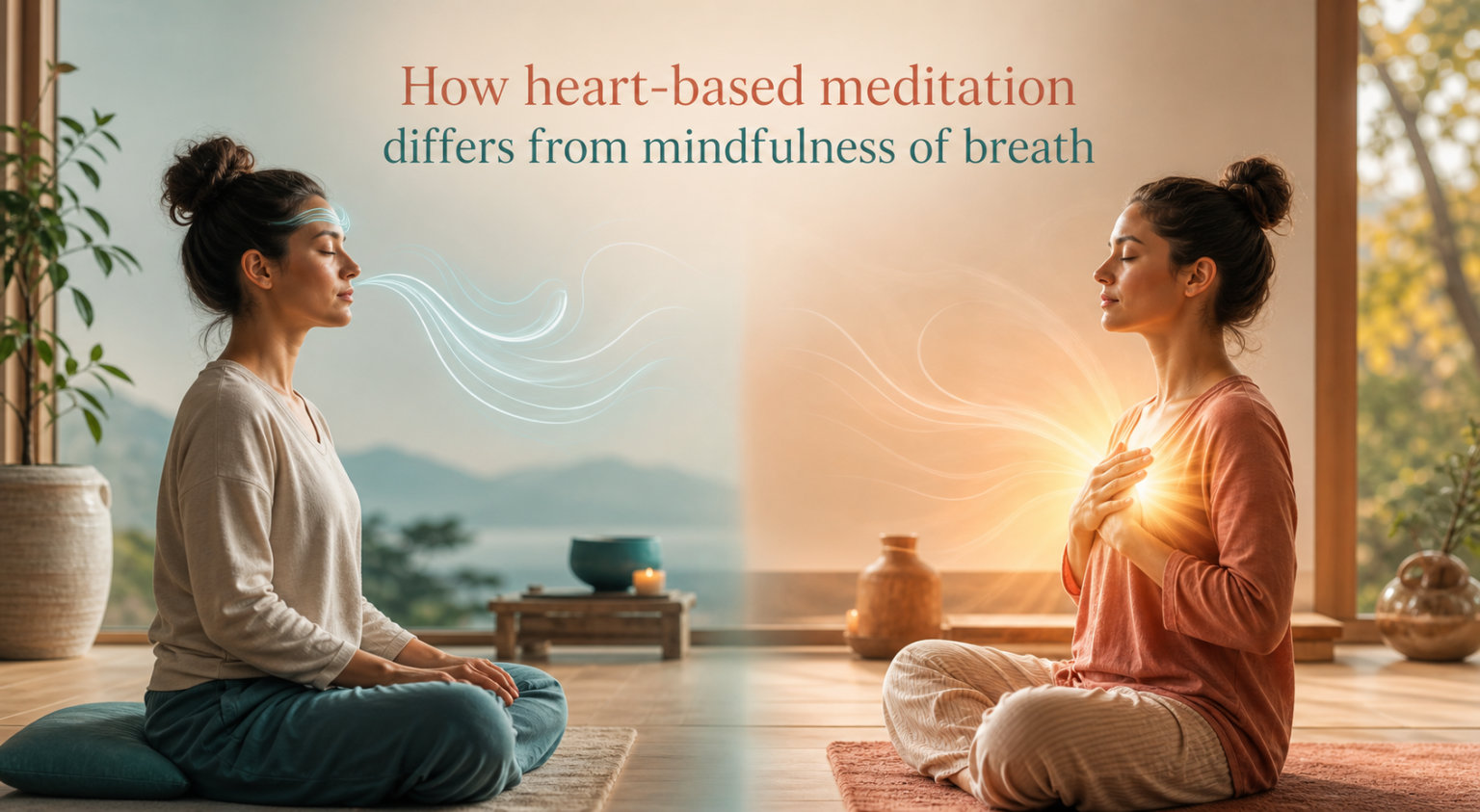
When I first sat down to meditate, my teacher told me to follow my breath. Within two minutes I was controlling it, counting it, and wondering why something so simple felt so hard. Years later, a friend suggested I try resting my attention on my heartbeat instead. The shift was immediate. My breath settled on its own. My mind stopped grabbing. That single change opened a door I did not know existed, and it is the door this article is here to open for you.
In this guide, I’ll walk you through how heart-based meditation differs from mindfulness of breath. We will look at the origin of each practice, the science behind why they work, the real benefits you can expect, and clear step-by-step instructions for both. By the end, you will know which one to choose on any given day, and how to combine them when your practice needs a deeper layer of support.
Table of Contents
What Is Heart-Based Meditation?
Heart-based meditation is a practice that uses the physical sensations of the heart as the anchor for attention. Instead of following the rise and fall of the breath, you rest your awareness on the pulse, the warmth, or the subtle movement in the center of the chest. The breath keeps moving in the background. You simply stop making it the main event.
The modern form most people know as Heart Rhythm Meditation was developed by Puran Bair in the 1990s, drawing on Sufi, Hindu, and Christian contemplative traditions. Earlier roots show up in the Christian practice of “centering prayer,” in the Sufi dhikr of the heart, and in Tibetan heart-center visualizations. Across all of these traditions, the heart is treated as more than a muscle. It is a doorway into present moment awareness and emotional balance.
In a typical heart-based meditation, you sit comfortably, close your eyes, and gently bring your attention to the area of the heart. You may feel the pulse under the skin, the warmth of blood moving, or a faint sense of expansion with each beat. When your mind wanders, you return to that sensation without judgment. The practice is non-controlling. You do not try to change your heartbeat any more than you would try to change your digestion.
What Is Mindfulness of Breath?
Mindfulness of breath is a focused attention meditation that uses the breath as the primary object of awareness. It is one of the oldest documented meditation techniques in the world, found in the Buddhist Anapanasati Sutta over 2,500 years ago and adapted into modern Mindfulness-Based Stress Reduction (MBSR) by Jon Kabat-Zinn in 1979.
The core instruction is simple: notice the breath as it enters and leaves the body. You can feel the air at the nostrils, the rise and fall of the belly, or the cool and warm temperatures at the lip. Each time the mind drifts into thought, you gently bring it back. Over time, this repeated return strengthens what researchers call “attentional muscle” and trains the nervous system to stay in the present moment.
For most beginners, the breath is the easiest anchor available. It is always there, requires no equipment, and gives you constant feedback about whether you are present or lost in thought. It is the foundation of most secular mindfulness programs taught in hospitals, schools, and corporate wellness settings today.
Heart-Based Meditation vs Mindfulness of Breath: The Core Differences
The two practices look similar on the outside. You sit, you close your eyes, you bring your attention back when it wanders. The differences sit underneath, in what you are actually paying attention to, how much control you try to exert, and what happens in your nervous system as a result.
| Feature | Heart-Based Meditation | Mindfulness of Breath |
|---|---|---|
| Focus object | Pulse, warmth, or sensation in the heart area | Breath at nostrils, chest, or belly |
| Control level | Non-controlling – heartbeat cannot be directed | Often subtly controlling – breath is easy to manipulate |
| Beginner friction | Low – heartbeat happens automatically | Moderate – many people try to control the breath |
| Primary nervous system effect | Heart rate variability, cardiac coherence | Parasympathetic activation, slower respiration |
| Emotional tone | Tends toward warmth, connection, gratitude | Tends toward calm, neutrality, clarity |
| Best for | Emotional regulation, heart-opening work | Stress reduction, focus training, beginner practice |
| Historical roots | Sufi, Christian contemplative, Tibetan | Buddhist Anapanasati, modern MBSR |
| Effort level | Soft, receptive, allowing | Steady, attentive, returning |
The biggest practical difference is what happens when your mind wanders. In mindfulness of breath, you usually return to a count, a sensation, or the breath itself. In heart-based meditation, you return to a feeling, often one of appreciation or care. That subtle shift in tone changes the entire emotional flavor of the practice.
Controlling vs Non-Controlling Focus
This is the single most important distinction. The breath is partly under voluntary control. You can hold it, deepen it, or slow it down. The heartbeat is not. When you place your attention on the heart, your mind has nothing to grab, adjust, or improve. This is why so many meditators report that heart-based practice feels more restful. The “doing” part of the mind finally has a place to settle.
The Science Behind Each Practice: HRV, the Vagus Nerve, and Coherence
Both practices are well-studied, but they engage the nervous system through slightly different pathways. Understanding the science helps you choose the right tool for the right moment.
Heart Rate Variability and Coherence
Heart rate variability (HRV) is the variation in time between heartbeats. Higher HRV is associated with better stress recovery, emotional regulation, and cardiovascular health. Researchers at the HeartMath Institute have spent over 30 years studying what they call “cardiac coherence,” a state where HRV becomes smooth, ordered, and synchronized with the breath and emotional state.
Heart-based meditation, especially when paired with a feeling of appreciation or care, has been shown in multiple HeartMath studies to increase cardiac coherence within 3 to 5 minutes. The mechanism is the vagus nerve, the longest cranial nerve in the body, which links the heart, brain, and gut into one feedback loop. Focused attention on the heart directly stimulates this nerve.
Parasympathetic Activation Through Breath
Mindfulness of breath activates the parasympathetic nervous system through slow, deep breathing. When you extend the exhale, you stimulate the vagus nerve indirectly through pressure changes in the chest and diaphragm. A 2023 study published in Cell Reports Medicine compared three breathing techniques (cyclic sighing, box breathing, and cyclic hyperventilation) against mindfulness meditation. Cyclic sighing produced the largest improvement in mood and the greatest reduction in breathing rate, with effects noticeable after just 5 minutes.
Breath-focused meditation also strengthens prefrontal cortex activity, which is the part of the brain responsible for attention and executive function. This is why MBSR programs are now prescribed for ADHD, anxiety, and chronic pain in clinical settings.
Where the Two Practices Overlap
Despite different entry points, both practices share the same outcome: increased present-moment awareness and reduced reactivity. Both engage the parasympathetic nervous system. Both reduce cortisol. Both have been shown to grow gray matter density in the hippocampus after 8 weeks of regular practice. The difference is mostly in the flavor of attention, not the destination.
Benefits Comparison: Which Practice Does What Best?
I have practiced both daily for over a decade. In my experience, and confirmed by research, each practice has areas where it shines.
Where Heart-Based Meditation Excels
Emotional regulation and mood lift, especially when paired with gratitude
Releasing stored tension from grief, heartbreak, or anxiety
Building self-compassion and a felt sense of safety in the body
Helping people who cannot stop controlling their breath
Deepening intuition and connection to others
Where Mindfulness of Breath Excels
Training sustained attention and reducing mental chatter
Lowering acute physiological stress within minutes
Building the foundation for all other meditation practices
Improving sleep onset and sleep quality
Supporting clinical protocols for anxiety, depression, and chronic pain
What the Research Shows on Anxiety
A 2014 meta-analysis in JAMA Internal Medicine found that mindfulness meditation programs produced moderate improvements in anxiety, depression, and pain. A separate 2018 study on heart rhythm meditation showed similar reductions in anxiety, with the added benefit of improved HRV. If anxiety is your primary concern, breath practice has the larger evidence base. If emotional numbness or disconnection is your concern, heart practice may serve you better.
How to Practice Heart-Based Meditation: A Step-by-Step Guide
This is the section I wish had existed when I started. Most articles mention heart-based meditation in a single paragraph. Few actually walk you through it. Here is the exact sequence I use with my own students.
Step 1: Prepare Your Space
Sit in a chair with your feet flat on the floor, or on a cushion with your hips slightly higher than your knees. Rest your hands on your thighs or one over the other in your lap. Let your spine be tall but not rigid. The goal is comfort, because tension in the body will pull your attention away from the heart.
Step 2: Close Your Eyes and Settle
Take three slow breaths. Do not try to control them. Simply notice them as they come and go. After the third breath, let the breath settle into whatever rhythm is natural.
Step 3: Locate the Heart Area
Bring your attention to the center of your chest. Do not visualize anything. Just feel. You may notice your pulse, a gentle warmth, a sense of fullness, or even tightness. Whatever you feel is correct. There is no wrong sensation.
Step 4: Anchor on the Pulse
Once you have located the area, narrow your attention to the pulse itself. Feel the beat. Do not count it. Do not try to slow it. Just feel it. If you cannot feel the pulse at first, place one hand over your heart and use that touch as your anchor for the first few minutes.
Step 5: Add a Feeling of Appreciation
This is the key that activates the heart’s coherence response. Recall a person, place, pet, or moment that brings up a genuine feeling of appreciation, gratitude, or care. Let that feeling warm the area of the heart. Breathe it in. You are not generating an emotion. You are remembering one that already exists.
Step 6: Rest in the Heart
Stay here for 10 to 20 minutes. When the mind wanders, return to the pulse and the feeling. Do not judge the wandering. The practice is the return. Each return is a small act of self-compassion.
Step 7: Close Gently
When you are ready to end, place your hands over your heart. Take one deeper breath. Open your eyes slowly. Carry the warmth of the practice with you for at least the first 60 seconds of your next activity.
How to Practice Mindfulness of Breath: A Step-by-Step Guide
Mindfulness of breath is the most widely taught meditation technique in the world. Here is the version taught in MBSR programs and most meditation centers.
Step 1: Set Your Posture
Sit upright with your feet on the floor or legs crossed. Let your hands rest wherever is comfortable. Your head should float above your spine, and your chin should be slightly tucked. The posture is dignified but relaxed.
Step 2: Close Your Eyes or Soften Your Gaze
Closing your eyes removes visual distraction. If you are in a public place, lower your gaze to the floor two feet in front of you.
Step 3: Notice the Breath
Bring your attention to the breath. Most beginners start at the nostrils, feeling the cool air entering and the warm air leaving. Others prefer the belly, feeling it rise and fall. Choose the location that feels most vivid and least forced.
Step 4: Count If You Need To
Counting from 1 to 10 is a classic beginner tool. Inhale, exhale, count one. Inhale, exhale, count two. When you lose count, simply return to one without frustration. The counting is training wheels. You will not need it forever.
Step 5: Let the Breath Breathe Itself
After 5 to 10 minutes, drop the counting. Just feel the breath as it is. Long or short, deep or shallow. Do not change it. The moment you notice you are trying to control the breath is the moment of insight.
Step 6: Rest in the Breath
Continue for 10 to 30 minutes. When the mind wanders, return to the breath without commentary. Some teachers suggest labeling thoughts as “thinking” and returning. Others suggest simply noticing and returning. Either works.
Step 7: End With Awareness
Take a moment to feel the whole body before opening your eyes. Notice the quality of attention you have now compared to when you started. Carry that quality into your next activity.
When to Use Each Technique (And When to Combine Them)
After years of practice and conversations with other meditators, here is the simplest framework I have found for choosing between them.
Choose Heart-Based Meditation When You Need To
Process strong emotions like grief, anger, or heartbreak
Feel more connected to yourself or others
Break out of emotional numbness
Cultivate gratitude or self-compassion
Stop the habit of trying to control everything
Choose Mindfulness of Breath When You Need To
Calm acute anxiety or panic
Focus before a meeting, exam, or creative session
Fall asleep at night
Build a daily meditation habit from scratch
Reset between stressful tasks at work
How to Combine Them in One Practice
My favorite 20-minute combined practice goes like this. Start with 5 minutes of mindful breathing to settle the nervous system. Then move into 10 minutes of heart-based meditation with appreciation. Finish with 5 minutes of returning to the breath to integrate. This sequence has been shown in pilot studies to produce higher cardiac coherence than either practice alone.
Common Mistakes in Both Practices (And How to Avoid Them)
Every beginner I have taught makes some version of these mistakes. Recognizing them early will save you months of frustration.
Mistake 1: Trying Too Hard to Control the Breath
This is the number one issue raised in meditation forums. You sit down to follow your breath and within 30 seconds you are deepening it, slowing it, or holding it. The fix is counterintuitive: notice that you are controlling it, smile slightly, and let it return to its natural rhythm. The breath does not need your help.
Mistake 2: Forcing the Heart to Feel a Certain Way
In heart-based meditation, some beginners try to force feelings of love or gratitude. This backfires. The heart opens through remembering, not through performing. If no feeling comes, simply feel the pulse. The feeling will return on its own when the body feels safe.
Mistake 3: Treating Wandering Mind as Failure
The mind wandering is not failure. It is the practice. Every time you notice the wandering and return, you are doing exactly what the practice is designed to train. A “good” meditation is one in which you noticed the wandering 50 times. A “bad” meditation is one in which you zoned out the entire time without noticing.
Mistake 4: Expecting Immediate Calm
Many people give up after one or two sessions because they do not feel calm. The first 30 sessions are like going to the gym. You are building the muscle of attention. The calm comes later. Stick with daily practice for at least 21 days before evaluating.
Mistake 5: Practicing Only When Stressed
Meditation is not a rescue remedy. It works best when practiced daily, even for 5 minutes, so the nervous system learns the new baseline. Waiting until you are overwhelmed is like waiting to exercise until you are out of shape. The practice is what builds the resilience.
FAQs
What is heart-based meditation?
Heart-based meditation is a contemplative practice that uses the physical sensations of the heart, such as the pulse, warmth, or subtle movement in the chest, as the anchor for attention. Instead of following the breath, you rest your awareness on the heartbeat. Because the heartbeat cannot be voluntarily controlled, the practice tends to feel more restful and emotionally warming than breath-focused meditation.
Is heart meditation better than breath meditation?
Neither is objectively better. Research suggests both reduce stress, anxiety, and improve emotional regulation. Breath meditation has the larger evidence base for focus training and clinical anxiety programs. Heart meditation tends to be more effective for emotional processing, gratitude cultivation, and people who cannot stop controlling their breath. The best practice is the one you will do consistently, and many practitioners combine both.
Can I meditate on my heartbeat instead of my breath?
Yes. Meditating on the heartbeat is a well-established technique taught in Heart Rhythm Meditation, Sufi traditions, and many Christian contemplative practices. Many meditators who struggle with breath focus find heart focus more natural because the heartbeat is fully automatic and cannot be controlled, which removes a common source of frustration.
What are the 4 types of mindfulness?
The four most commonly taught types of mindfulness are: 1) Mindfulness of breath, using the breath as the focus object; 2) Mindfulness of the body, scanning sensations throughout the body; 3) Mindfulness of emotions, noticing feelings as they arise without reacting; and 4) Mindfulness of thoughts, observing the contents of the mind as passing events rather than getting lost in them. Some traditions also include mindfulness of sounds, mindfulness of loving-kindness, and mindfulness of choiceless awareness.
Which is better, meditation or pranayama?
Meditation and pranayama serve different but complementary purposes. Pranayama is a set of breathing techniques that consciously regulate the breath to influence the nervous system, often producing rapid shifts in energy and mood. Meditation, including mindfulness of breath and heart-based meditation, focuses on observing experience without manipulation. For stress relief, both work. For deepening self-awareness and emotional regulation, meditation has a stronger evidence base. Many traditions combine them, using pranayama to settle the body before sitting in meditation.
A Simple Way to Choose Your Practice Today
Heart-based meditation and mindfulness of breath are not rivals. They are two doors into the same room. If you are new to meditation, start with the breath. It is well-mapped, clinically supported, and a reliable foundation. If you find yourself fighting the breath or feeling emotionally flat in your practice, try the heart for a few weeks. Many practitioners eventually use breath in the morning to sharpen attention and the heart in the evening to soften and integrate the day.
Whichever you choose, the only rule that matters is this: sit, return, repeat. The difference between heart-based meditation and mindfulness of breath matters far less than the difference between meditating and not meditating at all.