
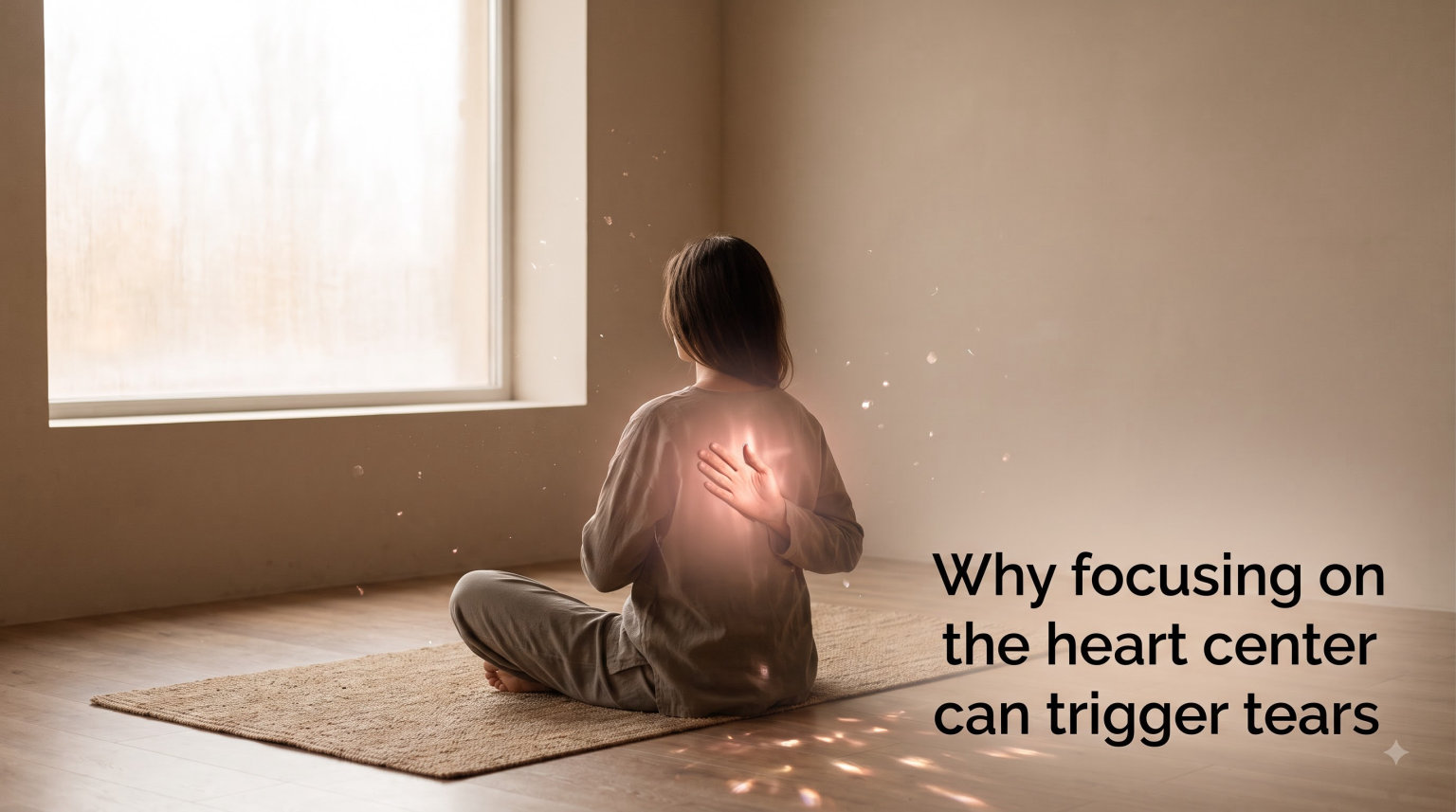
You sit down to meditate, settle your breathing, and gently place your awareness on your chest. Within minutes, tears are streaming down your face. If this has happened to you, you are not alone, and nothing is wrong with you.
Understanding why focusing on the heart center can trigger tears is one of the most common questions people bring to meditation, breathwork, and energy practice. People across forums, retreats, and private sessions describe the same experience: a sudden wave of emotion that arrives the moment they turn their attention toward the heart area.
This response can feel confusing, even frightening, especially the first time it happens. Many people wonder if they are doing something wrong or if the tears signal a problem. The opposite is true.
In this guide, we explain exactly what happens when you focus on the heart center, why tears so often follow, and how to work with this experience rather than against it. Whether you practice heart-focused breathing, chakra meditation, Reiki, or simple mindfulness, this information will help you understand what your body and energy are doing.
Table of Contents
What Is the Heart Center?
The heart center, known in many traditions as the heart chakra or Anahata, is the energetic focal point located in the center of the chest. It sits at the meeting place between the lower chakras, which govern survival and personal identity, and the upper chakras, which connect to expression and higher awareness.
In the chakra system, the heart center is the bridge. It is where we process love, compassion, grief, forgiveness, and connection to others. Every experience of heartbreak, loss, deep affection, and emotional pain passes through this center.
Think of the heart center as a processing station for your emotional life. When you feel love, it expands. When you experience loss, it contracts or tightens. Over time, unresolved grief, hurt, and unspoken emotions can settle here, held in the body and the energy field until they are ready to move.
This is why the heart center carries so much weight in spiritual practice. It is not just a symbolic location. For people who work with energy, breath, or meditation, it is the most emotionally charged area of the subtle body. When you direct your attention there, you are walking directly into the room where your deepest feelings are stored.
Some traditions describe this center as the seat of the soul. Others frame it as the place where physical and spiritual experience meet. Whatever framework you use, the key point is simple: the heart center processes emotion, and focusing on it activates that processing.
Why Focusing on the Heart Center Triggers Tears
Focusing on the heart center can trigger tears because attention itself acts as energy. When you place your awareness on the chest and the heart area, you are feeding that center with focused awareness, and that energy activates whatever is stored there waiting to be processed.
This is the core answer, and it helps to break it down into three connected reasons.
1. Attention Is Energy
In meditation and energy work, where you place your attention is where your energy flows. This is a foundational principle across traditions from yogic philosophy to modern breathwork practices. Attention is not passive observation. It is an active force.
When you direct that force toward the heart center, you are essentially shining a light into a room full of stored material. Whatever has been sitting in the dark, waiting, suddenly has energy moving through it again.
2. Stored Emotions Begin to Move
Throughout your life, emotions that were too intense to fully process at the time get held in the body. Grief from a loss you never fully mourned, hurt from a relationship that ended abruptly, love you never expressed, pain you pushed aside to keep functioning. The heart center holds these unprocessed feelings.
When you focus on this area during meditation or breathwork, you give those stored emotions the energy they need to surface. They begin to move, rise, and release. Tears are one of the body’s most natural mechanisms for that release.
As one meditation teacher puts it, when you put your attention on the heart chakra, you may feel what is waiting there to be processed. The tears are not random. They are the specific emotions that have been held in that space, finally finding their way out.
3. The Heart Center’s Natural Function Is Emotional Processing
It is the job of the heart center to process certain emotions, particularly those connected to love, grief, compassion, and connection. When you focus on it, you are activating its core function.
This is why tears during heart-focused practice often feel different from everyday crying. People describe them as deeper, more cleansing, and sometimes accompanied by a sense of relief or release rather than sadness alone. The tears may carry grief, but they also carry the feeling of something finally being allowed to move.
You might cry about something specific, or the tears may come without any clear story attached. Both experiences are valid. Sometimes the body releases emotion without the mind needing to narrate it.
The Science: Heart-Brain Connection and the Nervous System
You do not have to choose between a spiritual explanation and a scientific one. Both describe the same phenomenon from different angles, and together they offer a fuller picture of why focusing on the heart center can trigger tears.
The sympathetic nervous system plays a direct role. When you experience strong emotions, this system activates and can trigger increased tear production. Emotional tears are chemically different from reflex tears, the kind produced when you get dust in your eye. Emotional tears contain stress hormones and other compounds that the body is actively releasing.
This means crying is not just an expression of feeling. It is a physical release mechanism. The body uses tears to clear stress chemicals from the system.
The vagus nerve is another key player. This long nerve runs from the brainstem down through the neck, chest, and heart, connecting the brain to the heart and the gut. It is the primary pathway of the parasympathetic nervous system, the branch responsible for rest, healing, and emotional regulation.
When you focus on the heart center during meditation or breathwork, you are working directly with the area where the vagus nerve has its most concentrated influence. Slow, heart-focused breathing stimulates the vagus nerve, which shifts the body out of stress mode and into a state where deep emotions can surface and process.
Research on the heart-brain connection has shown that the heart sends more signals to the brain than the brain sends to the heart. The heart has its own complex nervous system, sometimes called the heart brain, with tens of thousands of neurons. This is why focusing on the heart area can produce such immediate and powerful emotional responses.
In simple terms, your heart area is wired for emotional processing. When you bring attention to it, you are activating a system that is designed to feel, process, and release.
Signs Your Heart Center Is Holding Emotional Energy
Before tears come, there are usually signs that the heart center is holding blocked or stored emotional energy. Recognizing these signals can help you understand what is happening when emotions surface during practice.
Tightness or pressure in the chest that has no medical cause, often described as a heavy or constricted feeling.
Sudden waves of emotion that arrive without an obvious trigger, especially sadness, grief, or an aching tenderness.
Difficulty feeling joy or connection, even when life is going well on the surface.
A sensation of something stuck or held in the chest area, sometimes described as a lump or a weight.
Tears that arrive quickly when you slow down, breathe, or place a hand on your heart.
Strong reactions to music, beauty, or kindness that seem disproportionate to the moment.
A pattern of avoiding stillness because quiet moments bring up uncomfortable feelings.
If several of these signs resonate, your heart center may be holding emotional material that is ready to process. This is not a diagnosis or a problem. It is information about where your attention and care might be most needed.
Is Crying During Meditation Normal?
Yes. Crying during meditation, breathwork, and energy practice is completely normal and is one of the most commonly reported experiences among practitioners at every level.
Across meditation forums, retreats, and personal accounts, the same story appears again and again. Someone focuses on their heart, their chest, or their breath, and tears arrive without warning. The experience is so common that experienced teachers expect it and welcome it.
One of the biggest fears people carry is that crying during practice means something is wrong, or worse, that it signals depression. This fear is understandable, but it usually reflects a misunderstanding of what is happening.
Depression typically involves persistent low mood, loss of interest, and a flattening of emotional range. The tears that come during heart-focused practice are different. They are an active release, a sign that energy is moving and emotion is being processed, not a sign that the system has shut down.
That said, if crying is constant, feels endless rather than releasing, or is accompanied by persistent feelings of hopelessness, it is wise to speak with a qualified mental health professional. Emotional release during practice and clinical depression can coexist, and getting support is always a good idea if you are unsure.
For most people, though, the tears that arrive during heart-focused meditation are a sign that healing is working. They mean the practice is reaching the places that need attention.
How to Support Yourself Through Emotional Release
Knowing that tears are normal does not always make them comfortable. When emotional release feels overwhelming, there are practical ways to support yourself and stay grounded through the process.
These techniques are especially relevant for breathwork practitioners, since heart-focused breathing tends to accelerate emotional release. The goal is not to stop the tears but to create enough safety that your system can process without flooding.
Slow your breathing down before it speeds up. Long, gentle exhales activate the parasympathetic nervous system and tell your body it is safe to feel.
Keep one hand on your heart and one on your belly. This physical grounding helps you stay connected to your body rather than getting lost in the emotion.
Let the tears come without analyzing them. You do not need to understand why you are crying in the moment. The body knows what it is doing.
Name what you feel if words help. Saying quietly, “This is grief,” or “This is release,” can help the mind accept what the body is experiencing.
Set a gentle time limit for intense practice. Ten to fifteen minutes of heart-focused attention is enough to create movement. You do not need to push through hours of emotional release.
Ground afterward. Drink water, eat something warm, walk outside, or place your feet on the earth. Emotional release uses energy, and your body needs care afterward.
Journal what surfaced, even briefly. Writing down what you felt, saw, or remembered helps integrate the experience and gives it a place to land.
The most important principle is to treat yourself with the same compassion you would offer a friend going through a difficult release. You are doing deep work, and it deserves gentleness.
When Tears Signal Deeper Healing Work?
Sometimes tears during heart-focused practice point to deeper material that benefits from additional support. This is not a failure of your practice. It is a sign that the work has reached an important layer.
If you notice that the same grief or pain surfaces repeatedly without shifting, if emotions feel stuck rather than releasing, or if memories of trauma arise that feel too large to hold alone, these are signals that working with a trained practitioner could help.
Somatic therapists, breathwork facilitators, energy workers, and counselors who understand the connection between body and emotion can provide a container for processing material that feels overwhelming on your own. Seeking support is a sign of self-respect, not weakness.
It is also worth noting that some people experience a delayed response. After a period of heart-focused practice, emotions may surface days later. This is normal and often means the practice opened something that needed time to reach awareness.
FAQs
Which chakra makes you cry?
The heart chakra, or Anahata, is the chakra most associated with crying during meditation and energy work. It is the energetic center responsible for processing love, grief, compassion, and connection. When you focus on this area, stored emotions activate and release, often through tears.
Is it normal to tear up during meditation?
Yes, tearing up during meditation is completely normal and is one of the most commonly reported experiences among practitioners. Tears indicate that your attention has reached stored emotional material that is ready to process and release. It is a sign that the practice is working, not that something is wrong.
What trauma is stored in the heart chakra?
The heart chakra commonly holds grief from loss and heartbreak, unspoken hurt from relationships, love that was never expressed, betrayal, rejection, and the pain of disconnection. Any emotion connected to love, loss, or relationship that was too intense to process at the time can settle here until it is ready to release.
How do you feel when your heart chakra opens?
When the heart chakra opens, people typically feel a sense of expansion in the chest, warmth, lightness, increased compassion for themselves and others, and a deeper capacity to both give and receive love. There may also be tears, as opening often follows the release of held emotions. The overall sensation is one of relief and connection.
What is the spiritual reason for crying?
From a spiritual perspective, crying is a form of energetic cleansing and emotional release. Tears carry held emotions out of the body and energy field, clearing space for greater presence, love, and awareness. Many traditions view tears during practice as a sign that the heart is opening and that deep healing is taking place.
What part of the brain triggers tears?
The lacrimal glands, which produce tears, are activated by signals from the autonomic nervous system. Emotional tears specifically are triggered when the limbic system, the brain region that processes emotion, sends signals through the sympathetic nervous system. This is why strong feelings directly cause tear production.
Embracing the Tears as Healing
Understanding why focusing on the heart center can trigger tears transforms the experience from something frightening into something meaningful. The tears are not a problem to fix. They are evidence that your attention has reached the places inside you that are ready to heal.
Attention is energy. When you direct it toward the heart, you activate a center that has been processing emotion your entire life. Whatever surfaces was already there, waiting for the right conditions to move. Your practice simply provided those conditions.
If tears come the next time you focus on your heart, let them. Breathe gently, keep a hand on your chest, and trust that your body knows exactly what it is doing. The heart center does its work through feeling, and feeling fully is the path to an open heart.