
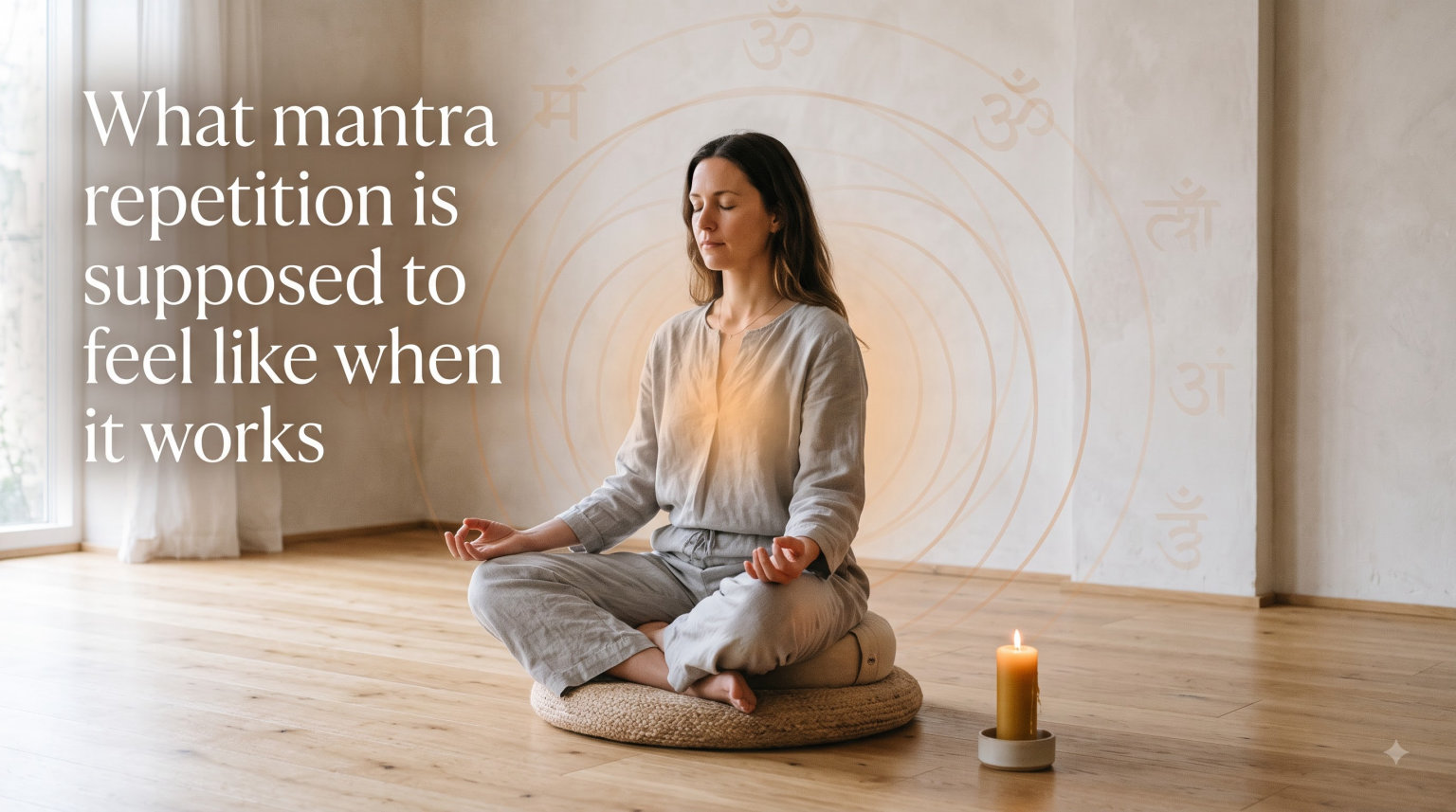
When you first start repeating a mantra, you might wonder whether you are doing it right. The silence feels distant, your mind keeps drifting, and nothing dramatic seems to happen. Understanding what mantra repetition is supposed to feel like when it works can save you months of second-guessing your practice.
I have spent years exploring mantra meditation, and the most common question I hear is surprisingly simple: how do I know if this is actually working? The answer is not about reaching some explosive breakthrough. It is about recognizing a series of subtle shifts that happen gradually as your mind settles.
Most people quit mantra practice too early because they expect fireworks and instead get a quiet, almost unremarkable process. But beneath that quietness, something real is happening. Let me walk you through what to actually expect, sensation by sensation, stage by stage.
Table of Contents
What Mantra Repetition Is Supposed to Feel Like When It Works?
When mantra repetition is working correctly, the experience moves from conscious effort toward something that feels almost automatic. You start by deliberately repeating the sound, and over time the repetition begins to happen on its own — like a song stuck in your head, but peaceful instead of intrusive.
The first sign most people notice is a sense of settling. Your breathing slows down. The tension in your shoulders might release. The constant chatter in your mind does not stop instantly, but it starts to thin out, like fog lifting slowly from a landscape.
Many practitioners describe a feeling of the mantra becoming thinner or lighter. Instead of a strong, clear mental voice, the sound softens. It becomes more subtle — almost like a whisper at the edge of your awareness. This thinning is actually a sign of progress, not a sign that you are losing focus.
Some people feel physical sensations: warmth, tingling, a gentle vibration in the chest or head. Others notice a sense of expanding or pulling inward, as if their awareness is getting larger or drawing deeper into itself. These sensations are normal and well-documented across meditation traditions worldwide.
The deepest experience is often described as a gap — a moment where the mantra seems to disappear entirely and you rest in a pocket of pure stillness. Some traditions call this transcendence or pure awareness. It does not last long at first, but it tends to deepen with consistent practice.
Here is what matters most: what mantra repetition is supposed to feel like varies from person to person. Some practitioners have vivid physical sensations. Others feel almost nothing except calm. Both are perfectly valid experiences, and neither one means you are doing it wrong.
The shift toward an effective practice happens when the repetition becomes gentle and almost self-sustaining. If you are straining to concentrate, gripping the mantra tightly in your mind, or feeling frustrated that thoughts keep coming — that is effort, not progress.
Think of it like floating in water. When you first lie back, you tense up and sink a little. Once you relax and trust the water, you float without trying. Mantra repetition works the same way. The mantra holds your mind afloat once you stop gripping.
I should also mention what it should not feel like. You should not feel anxious, wired, or unsettled during or after practice. If certain sounds like Om make you feel agitated rather than calm, that is worth noting. Some sounds resonate differently with different people. The right mantra should feel neutral or pleasant, never jarring or uncomfortable.
How Mantra Repetition Actually Works?
To understand what you are feeling during mantra meditation, it helps to understand the mechanism underneath. The basic principle is simple: you are using one thought to replace thousands of thoughts.
Your mind produces an enormous stream of thoughts each day. Most are scattered, repetitive, and emotionally charged. When you introduce a mantra, you give your mind a single, neutral focal point. Instead of jumping from worry to memory to planning, your attention has somewhere stable to land.
The mantra works as a placeholder. Every time you notice your mind wandering, you gently return to the repetition. You are not fighting thoughts — you are simply not feeding them. Over time, this starves the mental noise of its energy.
This is fundamentally different from positive affirmations. Affirmations carry meaning — phrases like “I am confident” or “I am worthy.” A traditional meditation mantra, by contrast, is often a sound without specific intellectual meaning. Think of seed syllables like Om, So Ham, or Ram. Their power is not in what they mean but in the vibration they create.
That vibration matters more than people realize. Sound is essentially organized vibration, and when you repeat a mantra mentally or aloud, you create a rhythmic pattern in your nervous system. This rhythm has a calming effect — similar to how listening to slow music lowers your heart rate.
Research in 2026 continues to support what meditators have reported for centuries. Studies show that repetitive focus practices reduce activity in the default mode network — the brain region responsible for mind-wandering and self-referential thinking. As this network quiets, you experience the stillness that practitioners describe.
The hypnotic quality of mantra repetition comes from this rhythm. People on meditation forums frequently describe entering a trancelike state where the repetition almost carries them along. This is not mystical thinking — it is your brain shifting into a pattern of focused relaxation.
The reason it eventually feels effortless is rooted in neuroplasticity. Every time you repeat the mantra and return to it after getting distracted, you are strengthening a neural pathway. After weeks or months of practice, that pathway becomes so well-worn that your mind naturally settles into it.
Think of it like a trail through a field. The first few times you walk through tall grass, there is no path. But after dozens of trips, a clear trail forms and it becomes the easiest route to follow. Your mantra practice creates a similar trail in your consciousness.
The Four Stages: From Effort to Effortless
Mantra repetition does not stay the same throughout your practice. It moves through identifiable stages, and recognizing where you are can help you understand what you are feeling at any given moment.
Stage 1: Spoken Repetition
In the first stage, you repeat the mantra out loud. This is the most concrete and accessible form of practice. Speaking the word engages your mouth, breath, and ears, giving you multiple sensory anchors at once.
This stage is where most beginners start, and for good reason. The physical act of speaking helps ground a busy mind. You can hear the sound clearly and feel it resonating in your body. The downside is that it requires active effort and can feel mechanical or repetitive in a dull way.
I recommend starting here if you are new to mantra practice. The spoken repetition gives your mind something tangible to hold onto before you move inward into subtler territory.
Stage 2: Whispered Repetition
Next, you reduce the volume to a whisper. The mantra is still vocalized, but barely. Your lips and tongue still move, yet the sound is almost inaudible to anyone nearby.
This stage is transitional by nature. It bridges the gap between external and internal practice. Many practitioners find this stage happens on its own — the spoken mantra simply gets quieter as they settle deeper into meditation.
At this point, you may start to notice the vibration of the sound more than the sound itself. The experience shifts from hearing to sensing, which is an important step toward deeper awareness.
Stage 3: Mental Repetition
Now the repetition moves entirely inside your head. You are no longer vocalizing — you are thinking the mantra silently. This is the stage where most traditional meditation practice actually happens.
Mental repetition is subtler and more challenging than the earlier stages. Without the physical anchor of sound and movement, the mind can wander more easily. But this is also where the deeper work begins. The mantra becomes lighter, thinner, and less distinct as a mental event.
This is the stage where you might experience the mantra thinning out in a noticeable way. Instead of a clear mental voice, the sound becomes faint, almost like a distant hum at the edge of perception. This is normal and actually desirable — it means your mind is settling into calmer waters.
Stage 4: Spontaneous Repetition (Ajapa Japa)
The final stage is known in yogic traditions as ajapa japa — spontaneous, effortless repetition. The mantra repeats itself without any conscious effort on your part. It plays like background music running quietly in your mind.
This stage can feel surprising when it first happens. You might realize you have been repeating the mantra for several minutes without trying. Some practitioners describe it as the mantra repeating them, rather than them repeating the mantra. The sense of personal effort drops away entirely.
Ajapa japa does not happen overnight. It is the result of sustained, regular practice — sometimes taking months or years of daily repetition. But you may catch glimpses of it early on. Moments where the repetition flows on its own before your conscious mind steps back in and takes over.
Those glimpses are exactly what you are working toward. They are signs that your practice is deepening and that the neural pathways of calm are becoming established.
Common Sensations During Mantra Practice
One of the biggest gaps I found while researching this topic was a clear, honest description of what people actually feel in their bodies during mantra meditation. Let me address that directly, because knowing what is normal can prevent unnecessary worry.
Vibrations and Tingling
The most commonly reported physical sensation during mantra practice is vibration or tingling. This can occur anywhere in the body — lips, hands, chest, forehead, or throughout the entire frame. The sensation often matches the rhythm of your repetition.
Some practitioners describe it as an electric feeling, particularly in the hands or along the spine. This is not cause for alarm. It is a sign that your nervous system is shifting gears from an active, alert mode into a deeply restful one.
The vibration may intensify as your practice deepens over time. At first it might be subtle — a light buzz you barely notice. Over weeks and months, it can feel more pronounced and steady.
Warmth and Energy Movement
Many meditators report sensations of warmth spreading through the body during mantra repetition. This warmth often starts in the chest or abdomen and radiates outward toward the limbs. Some describe it as feeling energy move along specific internal pathways.
In yogic traditions, these pathways are associated with prana (life force) and nadis (energy channels). You do not need to subscribe to that framework to experience the sensations yourself. They happen regardless of your belief system.
This warmth can feel deeply comforting and grounding. It is one of the reasons people describe feeling pleasantly heavy or profoundly relaxed after a good meditation session.
The Mantra Getting Softer
As I mentioned earlier, the mantra itself changes character during practice. The traditional description is that it gets thinner and lower — like a high-frequency sound fading at the edge of hearing.
This thinning is one of the clearest signs that your practice is working. It means your mind is settling into stillness. The mantra no longer needs to be loud or forceful because your attention has stabilized on its own.
Do not try to make the mantra louder again when this happens. Let it be soft. Let it fade. The softness is the entire point of the practice.
Inner Silence and the Gap
The most sought-after experience in mantra meditation is the moment of pure silence — what some traditions call the gap or transcendence. This is when the mantra briefly disappears entirely and you rest in a pocket of stillness with no mental activity.
The gap might last a single second or stretch into several minutes. During it, you are not thinking the mantra and you are not thinking other thoughts. You are simply aware, present, and awake. Some describe it as a feeling of spaciousness, like the mind has opened up into a vast, quiet room.
Not everyone experiences the gap, and that is completely fine. But if you do encounter it, do not chase it or try to recreate it on purpose. Chasing creates effort, and effort immediately breaks the stillness you found.
Spontaneous Movements
Some practitioners experience involuntary movements during deep mantra practice — twitches, gentle swaying, or subtle adjustments in posture. In certain traditions, these are called kriyas, or spontaneous purification movements.
These movements are generally harmless. They tend to happen as physical tension releases from the body during deep relaxation. If they ever feel uncomfortable or distressing, simply open your eyes and take a short break before returning to practice.
What It Should NOT Feel Like
I want to address the flip side honestly. Certain experiences during mantra practice may indicate you need to adjust your approach rather than push through.
If you consistently feel anxious, agitated, or restless after practicing, something may be off. The mantra might not suit you, or you might be forcing the repetition too hard. Try a different sound or intentionally soften your effort.
Mind wandering is completely normal and does not mean your practice is failing. Every meditator wanders — even experienced ones with decades of practice. The practice lives in the returning, not in never leaving. The moment you notice you drifted and come back to the mantra, that is a successful repetition.
Frequently Asked Questions
How do you know if a mantra is working?
You know a mantra is working when your breathing slows, your body relaxes, the repetition starts to feel more effortless, and the mantra itself becomes softer and thinner in your mind. You may also notice moments of inner silence between repetitions and a general sense of calm after practice.
Does repeating mantras work?
Yes, repeating mantras works by giving your mind a single focal point that replaces scattered thoughts. Research shows mantra-based meditation reduces activity in the brain’s default mode network, lowers stress hormones, and promotes deep relaxation. The key is regular practice rather than expecting instant results.
What is a good mantra to repeat?
A good mantra is a simple sound or short phrase that feels neutral or pleasant to repeat. Traditional options include Om, So Ham, and Ram. You can also use simple words like peace or one. The best mantra is one that does not carry strong emotional meaning, so it serves as a neutral anchor rather than a distraction.
How long does it take for a mantra to work?
Most people notice subtle calming effects within the first few sessions, often within 10 to 20 minutes of practice. Deeper experiences like the mantra thinning out or moments of inner silence typically develop over weeks of regular daily practice. Full effortless repetition can take months of consistent meditation.
What are the effects of mantra meditation?
Regular mantra meditation reduces anxiety, lowers stress, improves focus, and promotes deeper sleep. Practitioners also report increased emotional stability, greater self-awareness, and a sense of inner calm that carries into daily life. Physically, it can lower heart rate and blood pressure over time.
Trust the Process
Understanding what mantra repetition is supposed to feel like when it works removes the single biggest barrier to a successful practice: doubt. When you know that thinning sounds, gentle vibrations, and fleeting moments of stillness are signs of progress — not distractions — you can relax and trust the process.
The progression from effortful repetition to effortless stillness takes patience. But every session, even the restless ones, moves you forward. The mantra is always working beneath the surface, even when you cannot feel it happening.
Start where you are. Repeat the sound. Let it soften. Let it thin. And let the silence find you on its own terms.