
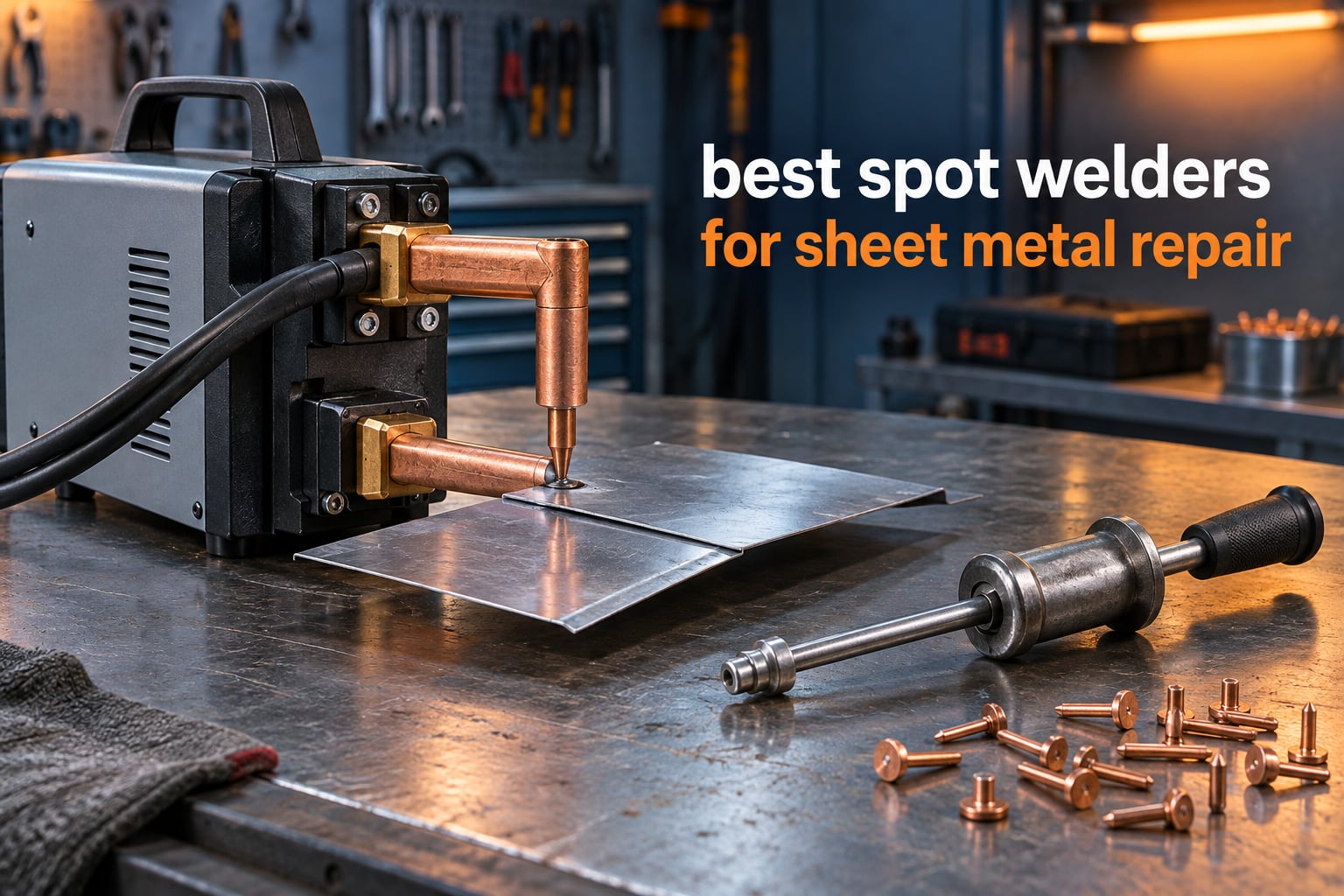
There are two completely different machines sold under the name spot welder, and picking the wrong family is the single most common mistake in this category. A resistance spot welder clamps two overlapping sheets between copper electrodes and fires a timed burst of current through the contact point, melting a small nugget that fuses the panels in under a second. A stud welder dent puller bolts a threaded stud or glue puller to the panel so a slide hammer can reshape the dent. This guide covers both, because the best spot welders for sheet metal repair split cleanly along that line.
Resistance spot welders do the joining. They are what a vehicle plant uses to attach a door skin to a shell, and they are the tool you want for panel-to-panel work, patch panels, floor pans, HVAC duct seams and appliance cabinets. Stud welder dent pullers do the reshaping. They are what a collision technician reaches for after a hail storm puts a crease in a quarter panel, and they are the wrong tool for holding two sheets together permanently.
We spent the last several weeks working through specification sheets, review histories and technician forum threads for eight machines across both families, and we scored each one on the numbers that decide whether a weld holds. That means peak output, single-sided thickness limits, weld-timer resolution, thermal protection, throat depth and machine weight, plus the recurring complaints that only appear after a few hundred pulls. Everything in this list is written from published specs and aggregated buyer feedback rather than from a single lucky test panel.
One safety note before we start. Spot welding throws hot metal, ultraviolet flash and zinc fume, especially the moment a stud pops loose. Wear a proper welding helmet rather than sunglasses, gloves rated for heat, and leather sleeves. Ventilate the panel from the back so you are not inhaling fume, and pull the extraction hose in before you strike an arc. Our guide to the best metatarsal guard boots for welders covers the foot protection side of the same job.
Table of Contents
Top 3 Spot Welder Picks for Sheet Metal Repair in 2026
Three machines carry the roundup. The VEVOR 90E is the strongest-reviewed unit we found and the only one combining seven welding modes with single-sided welding, the technique body technicians use to keep the finish-side coating intact. The Stark USA 55009 is the value pick for anyone joining overlapping sheet rather than pulling dents. The VEVOR DN-100E is the cheapest genuine resistance spot welder in the group, useful if you need to tack thin material and nothing more.

VEVOR 90E 3000W Stud Welder Kit
- 3000W 110V output
- 7 welding modes
- Single-side 0.6+1.2 mm welds

VEVOR DN-100E Portable Spot Welder
- 120V handheld gun
- Welds steel to 1/8 inch
- 6500A max output
8 Best Spot Welders for Sheet Metal Repair in 2026 Compared
This table sorts all eight machines by the job they do. The two resistance spot welders join overlapping sheet directly. The six stud welder kits attach a fastener, then use a slide hammer to move metal.
| Product | Specifications | Action |
|---|---|---|
| VEVOR 90E 3000W Stud Welder Dent Repair Kit |
|
Check Latest Price |
 Stark USA 55009 Portable Spot Welder Stark USA 55009 Portable Spot Welder |
|
Check Latest Price |
| VEVOR DN-100E Portable Spot Welder |
|
Check Latest Price |
 DUOYI Puller-12 3800A Dent Welder DUOYI Puller-12 3800A Dent Welder |
|
Check Latest Price |
 GRAUTOSPOT F98ES 3KW Dent Puller GRAUTOSPOT F98ES 3KW Dent Puller |
|
Check Latest Price |
 VEVOR 5500 Stud Welder Dent Repair Kit VEVOR 5500 Stud Welder Dent Repair Kit |
|
Check Latest Price |
 VEVOR PL-80M 3KW 6 Mode Stud Welder VEVOR PL-80M 3KW 6 Mode Stud Welder |
|
Check Latest Price |
 CMTOOL AQ-41 3000W Dent Puller CMTOOL AQ-41 3000W Dent Puller |
|
Check Latest Price |
1. VEVOR 90E 3000W Stud Welder – Best Overall for Panel Repair
VEVOR 90E Stud Welder Dent Repair Kit
3000W at 110V
Seven welding modes
Single-sided 0.6+1.2 mm welds
53.8 lb with carry handle
Pros
- Highest reviewed kit here at 4.6 out of 5 across 281 reviews with 85 percent five-star feedback
- Single-sided welding preserves back-side coating and paint
- Automatic timing removes guesswork from stud attachment
- Seven modes cover stud types and dent positions
- Toolbox accessory set keeps studs and pullers organized
Cons
- At 53.8 lb it is one of the heaviest machines here and belongs on a cart
- Short power cord forces the machine to sit close to the work
- Stud hold weakens on heavier gauge metal and high power burns holes
The 90E is the machine we kept coming back to while assembling this list. It holds 4.6 stars across 281 reviews with 85 percent of buyers handing over five stars, and that consistency is unusual in a category where a fifth of reviews on some kits sit at one star. Owners consistently describe it as a real step up from threaded bolts and hook-and-chain methods, because the stud welds through to a proper attachment rather than tearing the stud out of thin metal.
The part that matters most for sheet metal work is the single-sided welding rating of 0.6 plus 1.2 mm. That specification describes two layers of sheet joined from one side only, which is exactly what a body shop does when it replaces a door skin without burning off the paint and seam sealer on the inner panel. Full-through spot welds destroy the factory coating on the back of the panel and leave you grinding and resealing every weld.
Seven selectable welding modes do more than vary the timing. Each mode pairs a stud type with a power and time profile, so a shallow crease in a door skin and a deep hail dent in a quarter panel get different heat inputs rather than the same one setting pushed harder. Wiggle-wire studs let you weld and pull with the same fastener, and owners report the twist-off leaves a tidy mark instead of a torn one.
The automatic timing feature is the quiet hero. You select a mode and a power level and the machine handles the weld duration, which removes the most common source of both burned panels and failed attachments. Reviewers with three decades in the trade describe the results as comparable to far more expensive machines, and that is a claim we can find repeated by more than one buyer rather than a single outlier.

Two physical complaints come up again and again. At 53.8 pounds this is not a carry-it-to-the-car machine; plan on a welding cart with casters. And the cord is short, so the machine wants to live near the vehicle rather than trailing behind you, which is exactly what you want to avoid when the job moves from the fender to the rocker.
The most common technical failure is pushing power too high on thicker gauge, which burns a hole straight through rather than holding the stud. Keep the power knob in the middle of its range for vehicle panels and step up only as you learn what the material does. Owners also flag thin instructions, so budget an evening of practice on scrap panel before you touch a quarter panel you care about.
Is the 90E actually strong enough for real panel work?
Yes, with a caveat about technique rather than capability. At 3000W the output sits at the top of what a home garage circuit can deliver continuously at 110V, and the single-sided specification covers the panel thicknesses used on most passenger cars. Deep structural pulls on thicker reinforcement still need a bigger machine, but cosmetic panel work is what this does well.
The stud hold complaints we found cluster around users forcing the top of the power range on a first attempt. Turn the power down, weld twice instead of once, and let the stud cool before you hit it with the hammer. That is a habit thing, not a hardware limit, and most of the negative reviews describe a learning curve rather than a defect.
Who should skip the 90E?
Skip it if you do not have a cart and a dedicated outlet within a few feet of the vehicle. Fifty-three pounds of transformer that has to be dragged around a driveway is a bad trade, and lighter single-sided machines exist for that reason. If your work is joining overlapping sheet rather than pulling dents, this is also the wrong category of machine entirely.
It is also the wrong first machine for someone who wants zero practice. The thin documentation means you will be learning the mode logic on your own. Anyone who wants a guided introduction to dent pulling will get further with a kit that ships with clearer instructions and a bigger consumable bundle, even if the output is lower.
2. Stark USA 55009 Portable Spot Welder – Best Value Resistance Spot Welder
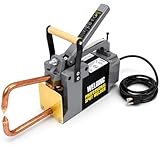
Stark USA Portable Spot Welder 1/8″ Electric Single Phase Handheld Welding Tip Gun Handle Weld Spot 110V 6″ Throat Depth Metal Sheet Spot Welding Machine
110V handheld pencil gun
1.5KVA rated input
5500A maximum output
6 inch throat depth
Pros
- 5500A maximum output covers light to medium gauge sheet in a compact body
- Copper welding tips rated for long service life
- Lever action with attached handle is quick to learn
- Lightweight for a machine of this output class
- Suits both hobby garage and light industrial work
Cons
- Single-phase 110V output is limited compared with three-phase shop machines
- Basic package lists only a manual so tips and accessories are extra
- Thin-gauge control is coarser than machines with fine power adjustment
This is the plain resistance spot welder in the group, and for many sheet metal jobs it is the only category you need. The Stark 55009 clamps your overlapping panels, you pull the lever, and current flows through the contact point for a fixed interval. There is no stud, no hammer and no consumable stud cost, which makes it dramatically cheaper to run than a dent puller over a year of work.
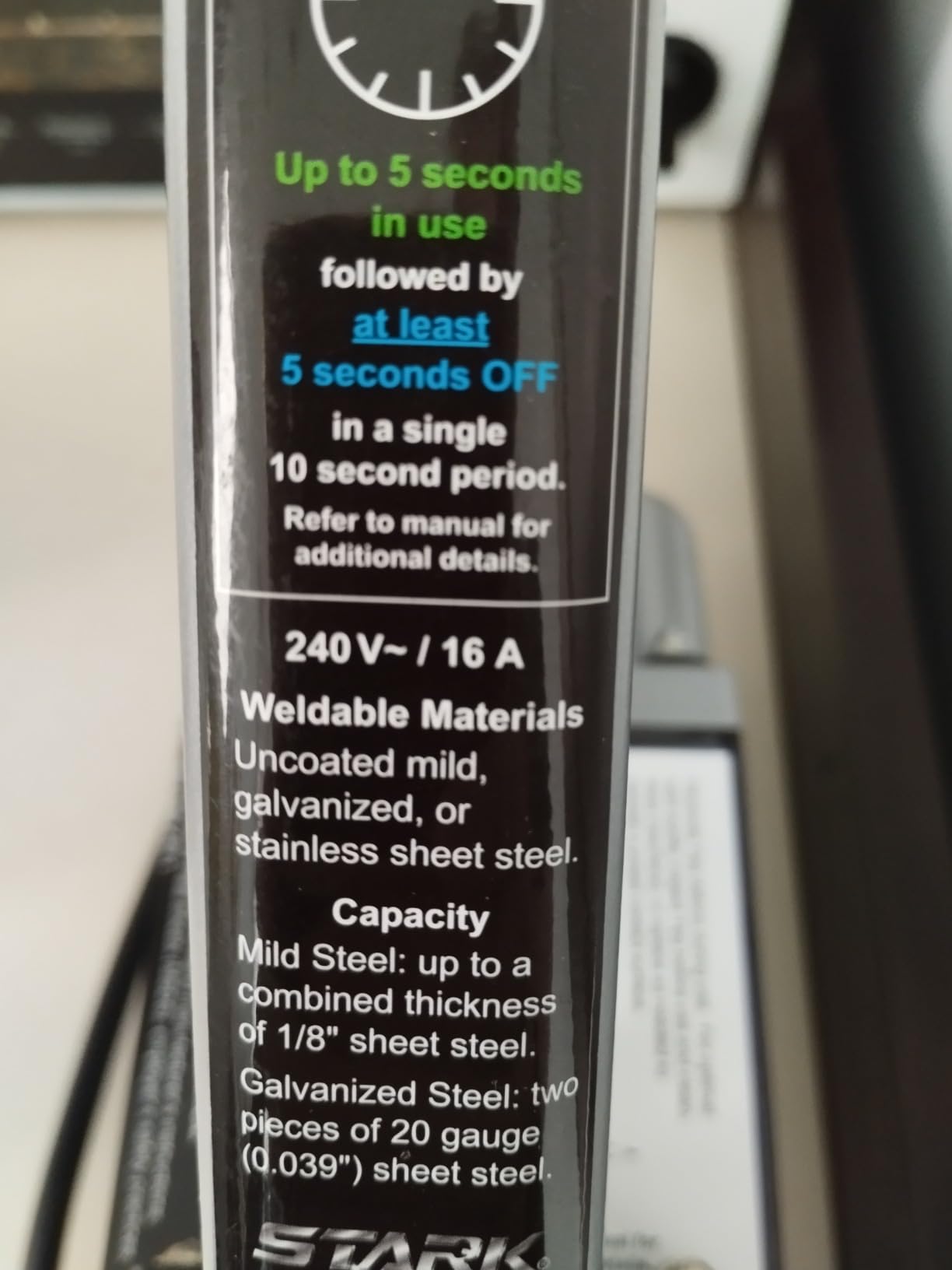
The 1.5KVA rated input with 5500A maximum output is a respectable figure for a 110V machine, and buyers report clean welds across light to medium gauge. The 6 inch throat depth is the number to look at if you work inside a car body, because it tells you how far the tips reach from the gun body. Eighteen and a half inches of overall length keeps it manageable in a footwell or between the rails of a chassis.
Operation is about as simple as machines get: pull the lever, apply pressure, press down. Owners with no welding background get productive on their first afternoon. Buyers also like the copper tips, which are the part that actually touches the work and which you can dress and reshape rather than replace every few hundred cycles.
Review distribution is healthy at 71 percent five-star and 15 percent four-star across 196 reviews. The minority of one-star feedback is not about defects; it is about the ceiling of a single-phase 110V machine, which simply cannot push as much current through thicker material as a shop unit with more headroom.
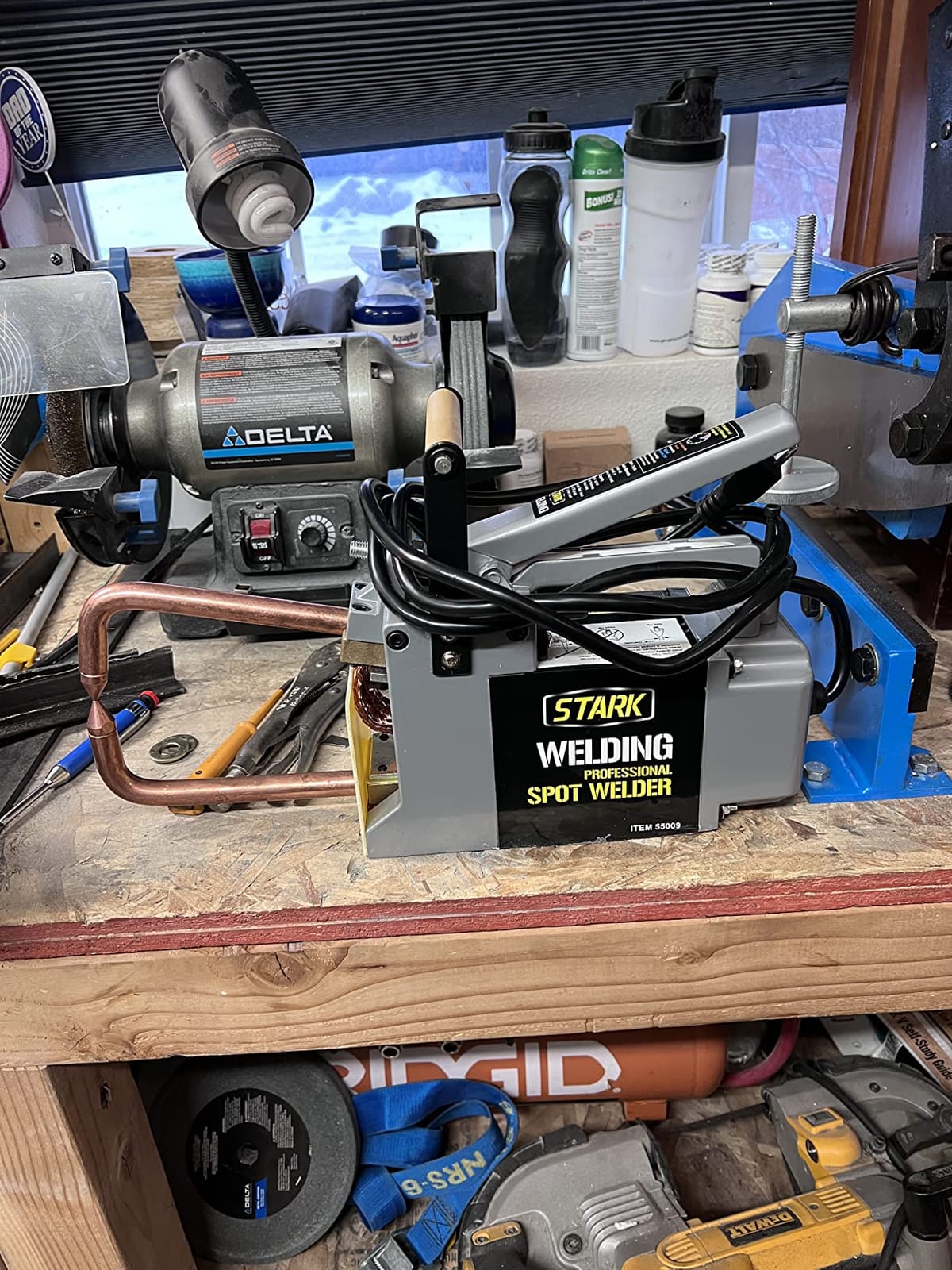
The packaging is the weak point. The listed included components amount to a manual, so copper tips, ground leads and any spare parts come as a separate purchase. Budget for that before the machine arrives, because the tips are consumables and a fresh set is part of getting good results.
Second weak point is control granularity. A fixed output means the only variable you have is how long you hold contact, and on the thinnest material that is a coarse way to manage heat. If your work is 24 gauge and thinner, or if you weld a lot of visible finished surfaces where a burn-through ruins the part, a machine with adjustable power is a better fit.
Does a 1.5KVA 110V gun form a proper nugget?
On light to medium gauge, yes. The 5500A peak figure is the same class of number the higher-priced portable units in this list use, and 1.5KVA of rated input is a real working capacity rather than a headline. Set up on scrap of matching thickness first and check the joint by attempting a peel, not by looking at it.
Where it runs out of headroom is thick material and long seams. When the transformer is asked for sustained output, heat builds faster than a 220V machine of similar size because the input voltage is lower. That is the same thermal limit that shows up in the negative reviews, and it is why we would not choose it for structural or trailer-gauge work.
When is the Stark 55009 the wrong choice?
It is the wrong choice when you need to pull a dent rather than join two panels. There is no stud attachment mode here, and a slide hammer on an un-welded stud does nothing except make a bigger dent. If your work is hail damage or crease repair, look at the stud welder kits further down this list.
It is also the wrong choice if you are restoring a vehicle and want the back side of the panel protected, since it welds through the stack rather than from one side only. For a standalone hobby shop building brackets, duct seams and cabinets, though, it remains the most straightforward machine on this list.
3. VEVOR DN-100E Portable Spot Welder – Best Budget Entry for Thin Sheet
VEVOR Portable Spot Welder, 1/8-inch Spot Welder Machine with 1.5KVA Input Capacity, Handheld Welding Tip Gun, Metal Sheet Spot Welding Machine
120V handheld lever gun
Welds steel sheet to 1/8 inch
6500A maximum output
26.5 lb
Pros
- 6500A maximum output is the highest peak figure among the handheld resistance welders here
- Buyers report clean welds on 18 gauge and stainless sheet
- Runs on a standard 20 amp household circuit in most installs
- Simple pull-lever actuation and compact body
- Lightest full machine in the roundup at 26.5 lb
Cons
- Listing states it is not for aluminum or stainless
- Some buyers report needing a 40 amp dedicated circuit
- Surfaces must be free of paint and rust or the gun only hums
- Only 23 reviews so long-term durability is thin evidence
The DN-100E exists because the DN-100-series line from this manufacturer covers a lot of ground, and this is the entry point. It welds steel sheet up to 1/8 inch with copper tips on a lever-actuated handheld gun. At 26.5 pounds it is the only machine in this roundup you can genuinely carry to the far side of a car by yourself, which is worth more than it sounds when the work is spread across a whole panel.
The 6500A maximum output figure is the highest peak current of the three resistance welders here, and buyers report clean, consistent welds on 18 gauge material. The lever action is identical in feel to the Stark machine, so skills transfer directly. Package contents are lean: a handle, a user manual, two electrodes and four screws.
Two electrical points deserve attention before you plug this in. Most buyers run it on an ordinary 20 amp household circuit without tripping a breaker, but a minority report being told to fit a 40 amp breaker. If your garage circuit is already near capacity, have an electrician confirm it before you rely on the machine rather than after.
The second point is surface preparation. Reviews are consistent that the gun will hum without producing a weld if the contact point still carries paint, rust or seam sealer. Grind or scrape to bare metal, clean the copper tips, and keep a wire brush on the bench. That applies to every resistance spot welder in this list, not just this one.
Will the DN-100E run on a normal home circuit?
In most installations, yes. The machine is rated at 1.5KVA input, and a 20 amp 120V circuit has roughly 2.4 kVA of theoretical capacity, so the machine is within range with headroom for lights and a door opener. The reports of 40 amp requirements are the exception, and they usually come from long extension cords or a shared circuit, not from the machine alone.
If you do need an extension cord, use a heavy-gauge one and keep it short. Under-length cord voltage drop is a leading cause of a spot welder that performs below its rating in the middle of a long pull, and buyers of budget machines report it more often than owners of larger units.
Where does the DN-100E fall short?
The material limitation is the honest one. The manufacturer listing states the machine is not suitable for aluminum or stainless, even though some buyers report success on stainless. Treat that as unverified and buy a dedicated aluminum-capable machine if your panels are alloy.
The evidence base is also thin at 23 reviews, which is the smallest meaningful sample after the F98ES. The rating of 4.2 is encouraging and the owner reports are consistent, but a two-year reliability picture simply does not exist yet. Buy it if you need a small machine this month; wait if you are planning a shop.
4. DUOYI Puller-12 3800A Dent Welder – Best for Thin Panel Work
Spot Welder Dent Puller Machine Body Repair Dent Removal Tools 6 Models Dent Puller Welder 110V 3800A Car Dent Puller Smaller Welding Spot Stud Welder Dent Repair Kit Dent Remover Tool For Car/Trucks
3800A output with built-in transformer
Single-sided 0.6 to 1.5 mm
Six modes, auto or manual
43 lb
Pros
- Single-sided welding up to 1.5 mm gives small joints and low consumable use
- Lighter at 43 lb than most machines in the 3800A class
- Both welding tongs and puller arms ship in one kit
- Overheat alarm pauses and auto-resumes once cool
- Cold-rolled steel body with pure copper welding cable
Cons
- Listed for iron materials only so aluminum panels are out of scope
- Several buyers report weak attachment in automatic mode
- Needs a properly rated 10 gauge extension cord for full output
- One owner received a unit with accessories missing
The DUOYI Puller-12 straddles the two families. It has six welding modes including a single-sided spot welding mode, so it can attach a stud for dent work and it can join overlapping sheet from one side. The 0.6 to 1.5 mm single-sided range is the widest on the stud welder side of this list and the reason we ranked it fourth.
Wider range matters because it decides which panels you can leave alone. A 1.2 mm ceiling covers most cosmetic sheet on a car. A 1.5 mm ceiling adds the heavier inner structure, floor pans and older thicker-gauge panels that would otherwise need a separate machine or a plug-weld approach with a MIG.
The 3800A output runs through a built-in high-frequency transformer, and the kit includes both the welding tongs and the puller arms. That combination saves time, because the same person can weld and pull without crossing the shop to swap tools. At 43 pounds it is lighter than the 90E and the PL-80M while carrying a comparable working current.
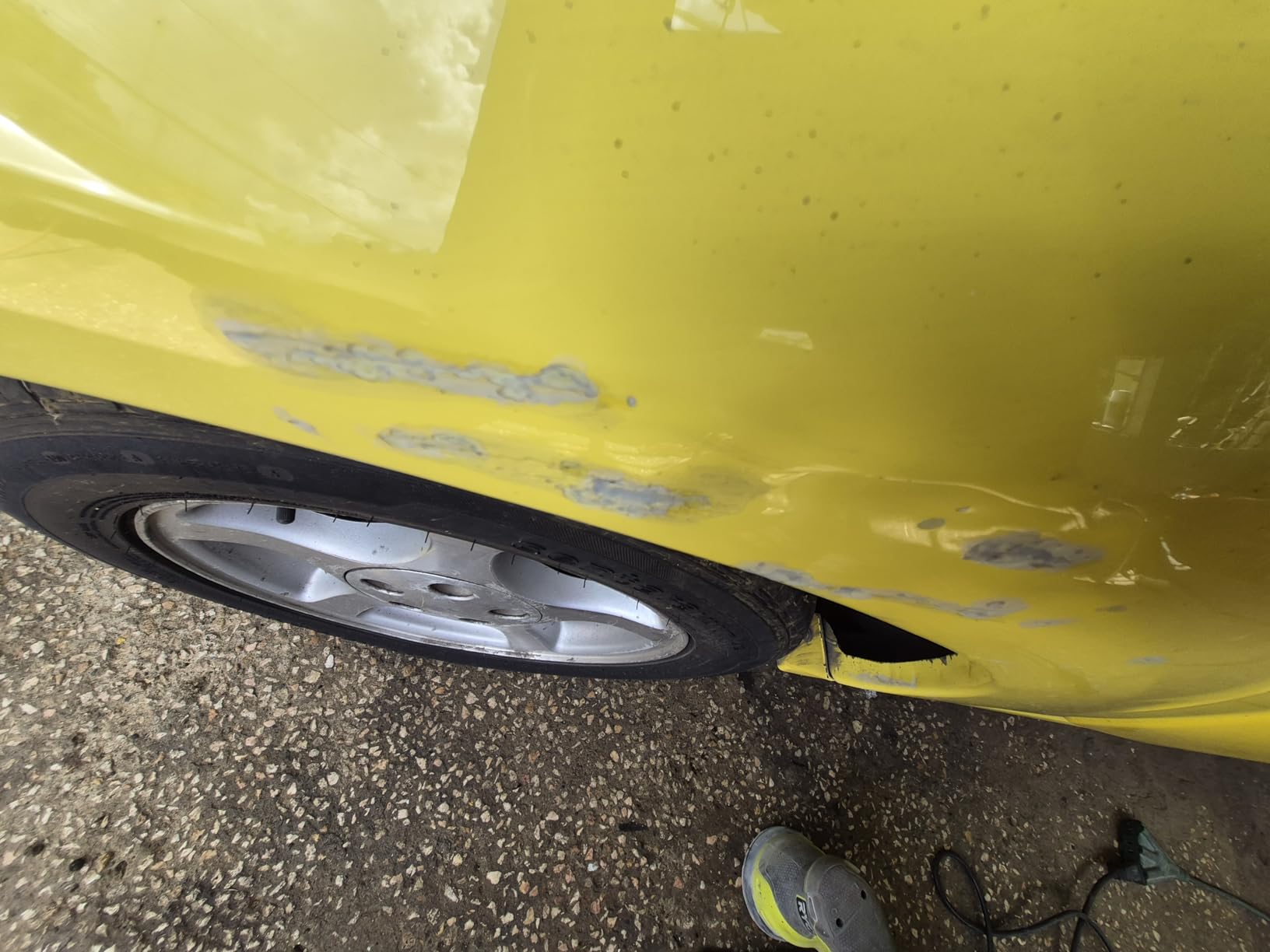
Owners report genuinely successful results on real damage, including straightening a rear quarter panel dent on an early-model Mustang. The overheat alarm stops the machine until the transformer cools and then resumes, which supports the long grind of a multi-panel job better than a machine that simply trips and stays dead until you find the plug.
Two practical notes from the review history. A Spanish-language reviewer and several others recommend manual mode because automatic mode pulls weakly on this machine. And the machine needs a properly rated 10 gauge extension cord to deliver its full output, which is the same voltage-drop issue we flagged with the DN-100E and is worth taking seriously.
One shipment arrived without accessories, which tells you to inventory the box on delivery day rather than when the job is half done. The manufacturer listing also specifies iron materials only, so aluminum panels are out of scope, and we would not treat that as a soft limitation.
Does the 0.6 to 1.5 mm range really matter in practice?
It is the difference between a machine you grow into and one you outgrow. On 0.8 mm to 1.0 mm cosmetic sheet, the upper half of that range is wasted capacity. On floor pans and structural repairs it is the reason the machine earns its place, because those panels will not respond to a machine rated to a thinner maximum.
Buyers also report low consumable use on the single-sided modes, which compounds over a year of panel work. Studs are the running cost of a dent puller, and a mode that attaches with less material per weld is a mode that costs less per repair.
Who should pass on the DUOYI Puller-12?
Pass if you only ever work on aluminum. The listing is explicit about iron materials, and forcing an aluminium panel with this machine risks a hole and a ruined part. There are dedicated dual-process machines for alloy work and they are worth the extra money.
Pass if you cannot supply a 10 gauge extension cord and a dedicated outlet close to the work. This is a 3800A machine asking for current delivery, and a thin cord will produce a welder that appears underpowered for reasons that have nothing to do with the welder.
5. GRAUTOSPOT F98ES 3KW Dent Puller – Best for Fine Weld-Time Control
GRAUTOSPOT F98ES 110V Spot Welder Dent Puller,3KW Panel Spot Welder Puller,Stud Welder Machine,9 Models Spot Welding Machine for Car Body Dent Repair,Car Repair Shops
3KW at 110V
Weld time 0.01s to 9.99s
Power 20 to 99 percent in 79 steps
49.9 lb
Pros
- Highest average rating in the group at 4.8 out of 5 with 88 percent five-star feedback
- 0.01 second weld time control gives very small precise spots
- 79 step power adjustment handles light dings and deep pulls
- Back-fire stopping control designed to protect finish-side paint
- Nine welding modes cover different panel conditions in one machine
Cons
- Only 15 reviews so it is the least proven machine here
- At 49.9 lb it needs a cart or a fixed bench position
- Less established parts support than VEVOR or Stark
- Some users prefer manual mode because automatic can pull weakly
The F98ES is the most interesting control design in this roundup. Instead of a handful of fixed modes, it offers welding time adjustment from 0.01 to 9.99 seconds and power adjustment from 20 to 99 percent across 79 gear steps. On cosmetic panels, being able to make a short, low-energy weld instead of the one setting a cheaper kit gives you is the difference between a clean repair and a burn-through.
Back-fire stopping control is included, and the manufacturer has designed it to avoid damaging finish-side paint. Combined with small welding spots that protect anti-rust coating on the back of the panel, that is the same single-sided philosophy the 90E is built around, implemented through timing control rather than a separate mode.
Nine welding modes including triangular and round meson pull and OT meson pull cover the common stud shapes. The stepless adjustment is claimed to deliver 70 percent more pulling tension than traditional stepped models, and owners who work on deeper pulls report that the additional tension shortens the number of hits needed to move the metal.
Is 0.01 second weld time control worth anything on a body panel?
Yes, mainly on thin cosmetic steel where a fixed-timer machine gives you two choices, weld long enough to hold or stay short and risk nothing holding. Very short cycles let you place a stud on 0.8 mm sheet without cooking the surrounding panel, which is exactly the situation that burns a door skin.
The finer power steps help in the same direction. Instead of stepping from a setting that is too weak to a setting that is too strong, you can land close to the value that works and then trim the weld time. On a first-time user that granularity is the difference between a successful first pull and a ruined practice panel.
Why should you hesitate over a 15-review sample?
Because a 4.8 average over 15 reviews is encouraging rather than conclusive. No one- and two-star ratings appear in the sample at all, which usually means either a genuinely consistent machine or a young listing that has not been tested hard by owners yet. The 12 percent three-star feedback does mention weaker-than-expected pulling in automatic mode, which is a real setting preference to know about.
Brand support is the other consideration. GRAUTOSPOT is the label and WANBANG is the manufacturer, so parts and service are less established than the VEVOR and Stark ecosystems. If you run a shop and downtime costs you money, factor that in. If you are a hobbyist who will read the manual carefully, the control design makes this the most interesting machine to learn on.
6. VEVOR 5500 Stud Welder Kit – Best for First-Time Dent Pullers
VEVOR Stud Welder Kit, 5500 Stud Welder Dent Repair Kit, 800VA Spot Welder Stud, 110V Welder Stud Kit, Stud Gun Dent Puller Kit with Complete Accessories, Dent Welder Repair for Auto Body Repairing
800VA stud output
Thermal cutout at 203F
1000 nails plus pad assortment
28.5 lb
Pros
- Most complete consumable bundle in the class with 1000 nails plus meson and straight pads
- Thermal protection allows long sessions without transformer damage
- ABS shell and pure copper electrode hold up under repeated heat
- One-handed touch trigger makes stud and hammer switching fast
- 28.5 lb is light enough to carry to the vehicle
Cons
- 800VA output is the lowest here so stud attachment needs care on thicker panels
- Quick-release chuck grip takes practice to master
- 16 percent one-star share is the highest among the well-reviewed kits
At 333 reviews this kit has the largest owner base of anything in the roundup, which makes its review distribution unusually informative. Sixty-six percent of buyers rate it five stars, and the recurring theme in positive reviews is not welding performance so much as completeness: studs, pads, puller and everything else arrive in one toolbox.
For a first dent puller, that matters. You can pull a dent, find you need a different stud shape, and have it in the box rather than on an order. The bundle includes 2.5 mm and 2.0 mm nails in quantity plus meson and straight pads, and the multi-function pulling hammer has a quick-release chuck so you can swap between welding and pulling with one hand on the trigger.
Thermal protection trips when the transformer reaches 95 degrees Celsius, 203 degrees Fahrenheit, which is a sensible design for a machine that will get pushed hard in a long session. The ABS shell is rated stable from 93 to 118 degrees, and the electrode movement is pure copper, which is the part that carries current into the stud.
At 28.5 pounds it is the second lightest machine in this list and the only stud welder that is genuinely easy to carry. That changes how you work. You can go to the dent instead of dragging a transformer to it, which on a car means working at your own pace rather than planning your body around the machine.
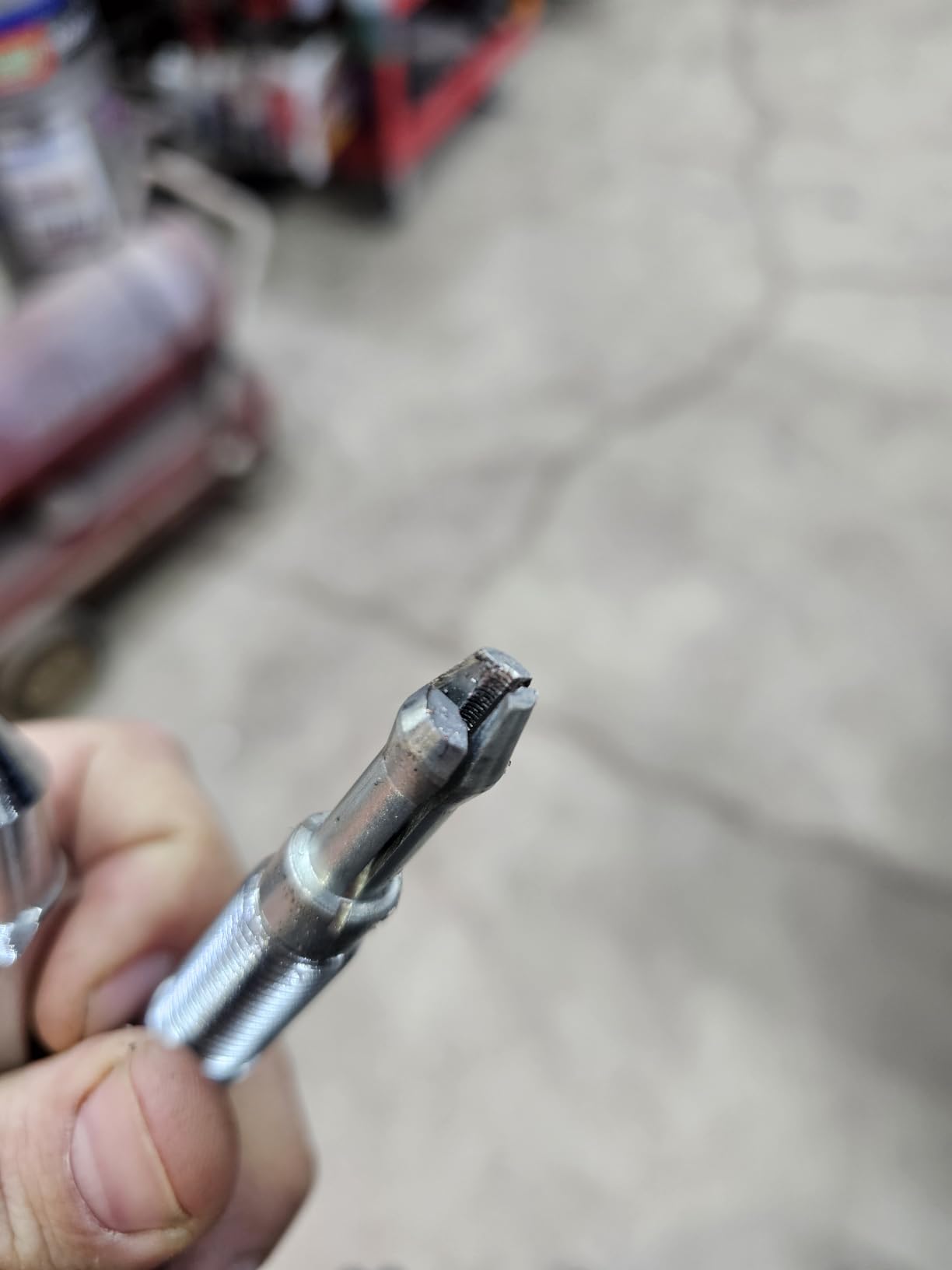
The 800VA output is the honest limitation. It is enough output for cosmetic panel work on thinner sheet, and owners are candid that thicker panels need more care because the stud attachment is less certain. The sixteen percent one-star share reflects real unit-to-unit variation rather than a design flaw, so inspect the machine on arrival and test it on scrap before the job.
The quick-release chuck also takes practice. Learners report grabbing it wrong for the first few sessions, so expect the hammer to surprise you once or twice. Practice the swap on the ground before you are leaning over a panel with a car jack under it.
Is 800VA enough output for real dent work?
For cosmetic sheet, yes. Thin body panels do not need a lot of energy to attach a stud, and the ones that suffer are the ones where the paint is thick, the seam is tight or the metal has been work-hardened. Keep the studs on flat areas away from the crease, clean to bare metal, and start at low power with a second weld to increase the hold.
What 800VA will not do is hold a stud on heavy structural metal. If you are pulling deep hail damage in a thicker panel, step up to a 3000W or 3800A machine. Buying the bigger machine to run at 800VA settings is a real option if you expect that work, but it is a large amount of extra weight for capability you may never use.
Who should buy the 5500 kit?
Buy it if you are learning dent pulling, you work mostly on thin cosmetic panels, and you want to be able to practice without ordering consumables between every attempt. The accessory bundle removes the single most common beginner frustration, which is running out of studs halfway through learning hammer technique.
Skip it if you already own a working kit and want more power, or if your work is structural. Also weigh the sixteen percent one-star share against the 333-review base: the average is good, but the spread is wide enough that you should budget for the possibility of a replacement.
7. VEVOR PL-80M 3KW Stud Welder – Best for Mixed Metal Panels
VEVOR Stud Welder Dent Repair Kit, 3KW Spot Welder Dent Puller with 6 Welding Modes, Auto Body Spot Welding Dent Puller Machine & 16 Types of Welding Accessories for Car, Truck, Motorcycle Dent Repair
3KW output
Automatic contact weld timing
Up to 1.2 mm single side
50.6 lb
Pros
- Automatic contact welding picks the timing for the selected mode and power
- Six modes cover pointed shapes
- deep dents
- curves and flat areas
- Overheat protection at 203F with side vents supports continuous work
- Handles carbon steel
- stainless
- iron and galvanized sheet
- 16 accessory types in a compact 7.7 x 13.8 x 7.9 in case
Cons
- Lowest average rating of the VEVOR kits here at 3.9 out of 5
- 19 percent one-star share is the weakest consensus in the roundup
- 1.2 mm single-side limit is thinner than the 1.5 mm kits
- Owners report it will not hold a stud reliably on automotive panels
The PL-80M is the most capable machine here for mixed metal work. The manufacturer specification covers carbon steel, stainless steel, iron and galvanized sheet metal, and the sixteen included accessory types cover most of the stud and puller shapes you would otherwise order separately. If you work on a mix of modern vehicles, that combination of materials is not a rare edge case.
Automatic contact welding is the feature that separates it from cheaper kits. You set the mode and power, close the gun on the panel and the machine determines the weld timing for you. Six functional modes cover pointed shapes, deep dents, curves and flat areas, and the case measures 7.7 by 13.8 by 7.9 inches, so it is compact for a 3KW unit.
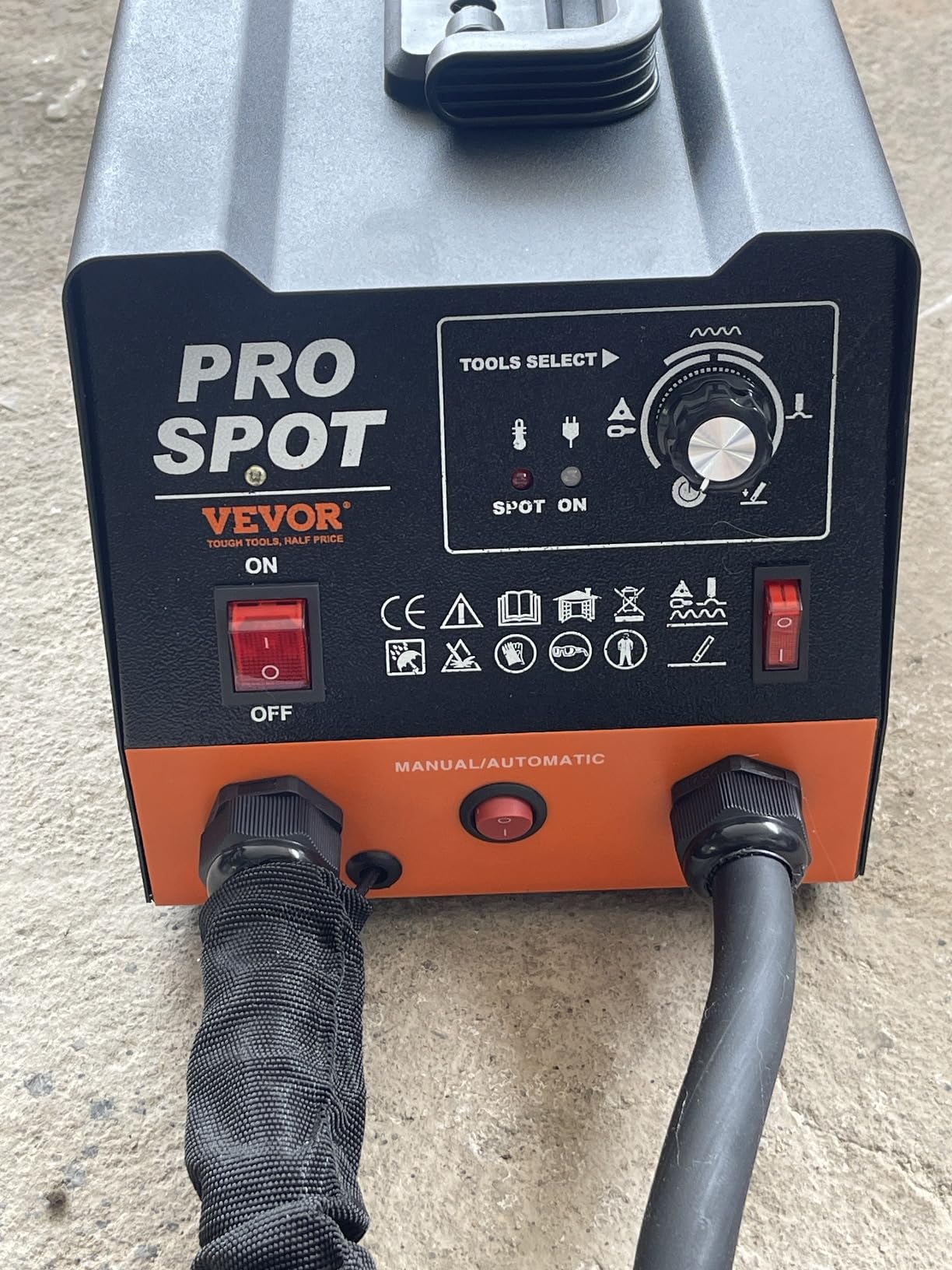
Overheat protection trips at 203 degrees Fahrenheit with side vents for heat dissipation, which supports sustained work on a full panel. The machine is not light at 50.6 pounds, so it wants a cart, and the short leads make positioning awkward in tight areas, which is a complaint shared by several 3KW kits in this category.
The 1.2 mm single-side limit is thinner than the DUOYI and CMTOOL kits here. It covers cosmetic body sheet and most replacement panels, and runs out of headroom on floor pans and older structural material. For a full restoration you will end up plug welding those, which means owning a MIG as well.
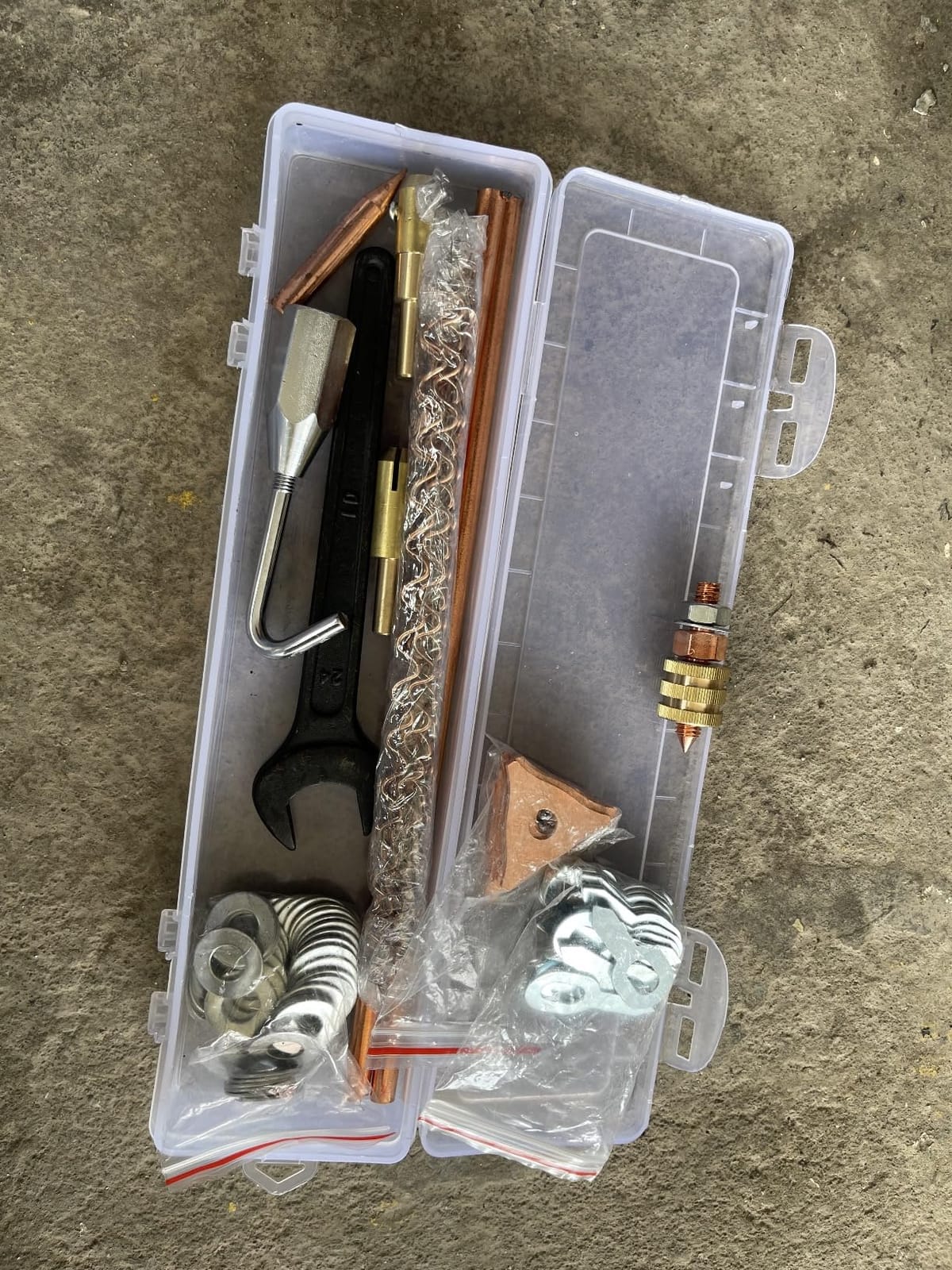
The consensus is the problem here. Sixty percent of buyers rate it five stars, and nineteen percent rate it one star, which is the widest split in the roundup. Owners in the critical group say the same thing in different words: it will not hold a stud reliably on vehicle panels, and some recommend glue-based paintless dent repair instead.
Our read is that the automatic timing occasionally lands short of a solid attachment on automotive steel. Turn off auto mode, weld manually with a longer pulse, and add a second stud where the pull direction demands it. Owners who adopt that habit rate it much higher than the average suggests.
Can it really handle stainless and galvanized sheet?
The specification says so, and no buyer we found contradicts it. Stainless and galvanized coatings are more resistant to the contact weld than painted carbon steel, so the surface preparation is easier in one sense and the material is more work-hardening in another. Clean to bright metal, keep the copper tips clean, and expect to use slightly longer weld times.
Aluminum is still not on the list, and it is the material where buyers most often wish these kits went further. Aluminum needs different tip care, different current control and often a dedicated machine, and we would not spend stud money testing the boundaries of a kit that does not claim the capability.
When is the PL-80M the wrong buy?
It is the wrong buy if consistency is your priority. A machine where a fifth of owners report complete failure on the core task is a gamble on unit quality, and that gamble is hard to justify when the DUOYI or the 90E covers the same 1.2 mm range with far better consensus.
It is also the wrong buy for a single shop, where a 50.6 pound transformer with short leads will be moved constantly. If your work is scattered across several vehicles, weight and cord reach matter more than the mode count, and a lighter kit will make you faster overall.
8. CMTOOL AQ-41 3000W Dent Puller – Best for Wide Power Adjustment
CMTOOL Dent Puller Welder, 3000W Stud Welder Dent Repair Kit, 3800A Car Pro Spot Puller Machine with 17 Types of Accessories, 6 Welding Modes, Adjustable Welding Power, Automatic and Manual Welding
3000W rated, 2300A working, 3800A peak
1.8KW to 13KW power range
0.6 to 1.5 mm single side
6 modes
Pros
- Knob-adjustable power from 1.8KW to 13KW covers everything from light dings to deep pulls
- Working professionals with 30+ years report performance like far costlier machines
- One owner says it matches a high-end puller and paid for itself on the first job
- Stainless steel body with thick pure copper wire
- Both welding gun and dent puller included plus 17 accessory types
- Overheat alarm at 95C with automatic resume supports continuous work
Cons
- Some buyers report heating up without a satisfactory weld at any setting
- At least one owner returned the unit after bench testing failed
- 17 percent one-star share indicates real unit variance
- Weighs 43.6 lb so it needs a cart for sustained work
The AQ-41 is the widest-adjustment machine here. Power is settable by knob from 1.8KW up to 13KW, with a 2300A working current and 3800A instantaneous current, and six welding modes covering the standard meson pull and single-sided spot options. For an experienced technician that range means one machine covers a thin fender and a thick structural pull without a second tool on the bench.
Some of the strongest praise in this entire roundup comes from this machine. Professionals with more than thirty years in auto body describe it as performing like units costing several times more, and one owner states a professional technician judged it equal to a high-end puller and that it paid for itself on the first job. Those are the endorsements we trust most, because they come from people who own the alternatives.
Against that, the critical reviews are equally direct. Some buyers report the machine heating up without producing a satisfactory weld at any setting, and at least one returned it after bench testing failed to produce usable results. A 17 percent one-star share across 44 reviews is a small sample with a wide spread, which is the signature of unit variance rather than a bad design.
Does a 1.8KW to 13KW power range actually help?
For someone who already knows where to set it, yes. The wide range means the machine can be dialed in for a light ding and then pushed properly for a deep pull without switching machines, and the single-sided 0.6 to 1.5 mm specification means the same machine handles panel joining as well as dent work.
For a beginner, wide range is less useful than it sounds, because you have no reference for what the number should be. A machine with a smaller, well-documented range plus a sensible default is easier to learn on. If you are buying your first dent puller, come back to the 90E or the 5500 kit.
Is the AQ-41 a safe first machine?
Not as a first machine, for one reason: you cannot tell a bad unit from a bad setting until you have experience. When the review history splits 17 percent one-star against multiple five-star reports from working technicians, the sensible response is to buy from a seller with easy returns and test on scrap metal before the job.
If you are an experienced shop that wants a single machine for both joining and pulling with a wide power window, the capability is genuinely there and the returns on it are good when the unit works. The 43.6 pound weight is manageable, and overheat protection with automatic resume supports a full day of work.
How to Spot Weld Sheet Metal Without Burning Through
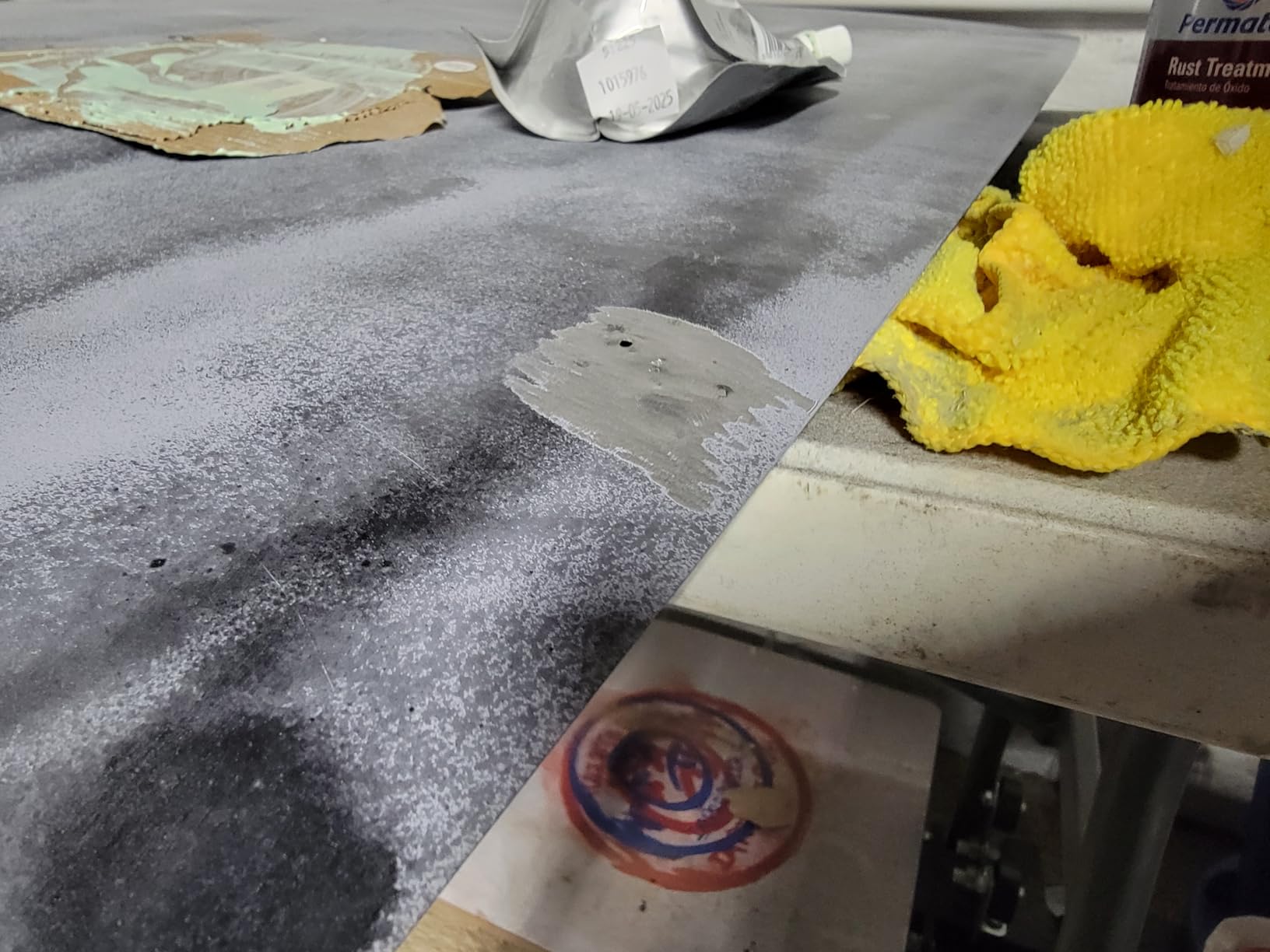
Most failed sheet metal welds are process failures, not machine failures. Clean the contact area to bare bright metal, overlap the panels so the seam sits near the middle of the joint, and never weld through paint, rust, seam sealer or undercoating. A spot welder will not burn through contamination; it will just refuse to make a joint and heat the panel instead.
Order of operations matters too. Clamp first, then power the machine, then squeeze the trigger. The electrode pressure has to be on the stack before current flows, because contact resistance is what creates the nugget. Releasing the clamp before the cycle ends pulls a torn stud or an incomplete joint.
Understand that gauge runs backwards. A higher gauge number means thinner metal, so 18 gauge is heavier than 26 gauge. This trips up a lot of buyers who set power by gauge intuition instead of by measurement, and it is the fastest route to a burn-through on a thin panel.
Starting settings by sheet gauge
Use these as a starting point for mild steel, then adjust on scrap of the same thickness and finish. The key variable is the electrode face area, and the useful rule is to keep the working face to roughly 3 mm across, dressed with a file rather than sandpaper, which smears the copper. This guidance comes from long-running advice on the weldingweb forum, where the consensus is to reduce the tip face area and use copper only, never brass.
- 16 gauge mild steel: high energy setting, longer weld time, and firm electrode pressure. Expect to dwell rather than pulse.
- 18 gauge mild steel: a common first test for a new machine, with a moderate time setting and a slightly longer dwell than a thin panel needs.
- 20 gauge mild steel: the most common body panel gauge on older cars. Mid-range power, short-to-medium time.
- 22 gauge mild steel: lighter power, shorter time, and check the joint by peel test after every weld until you know the machine.
- 24 gauge mild steel: low power, short time, clean bright metal only. Any hesitation burns through.
- 26 gauge and lighter: the hardest job on a spot welder. Work on a scrap panel first, and consider a stud puller or adhesive repair instead.
- Aluminum: use a machine rated for aluminum. A brass or copper tip on an alloy panel with an ordinary kit is how you get a hole and a scrapped panel.
Check every joint mechanically rather than by eye. Put a flat bar behind the lap and try to peel the two layers apart; a sound weld resists cleanly and leaves the electrodes marked, a weak one peels or tears. A cheap flat bar and five minutes of testing will save you a panel.
How to Remove Old Spot Welds Before a Panel Change
Removing factory spot welds is the step most guides skip, and it is where panels get damaged. You have three practical methods, and the right one depends on whether you can reach both sides of the joint, whether the panel underneath is worth protecting, and how much access the factory spot pattern left you.
The first method is drilling. Run a spot weld cutter or a carbide burr the diameter of the weld dimple through the top layer only, at a shallow angle, and stop the moment you break through into the gap. You are aiming to remove the top sheet, not to cut a hole in the structure below, and a backing plate placed behind the work is close to mandatory.
The second method is splitting. Slide an air chisel or a body hammer with a panel knife between the two layers and drive the seam apart along the weld line. It is fast, it keeps both layers intact for reuse, and it needs a solid backing plate and controlled hammer technique to avoid driving a crease into the panel underneath.
The third method is peeling with a stud. Spot weld a threaded stud or glue puller to the centre of the old weld dimple, wait for the stud to cool, and use a slide hammer to pull the sheet away. Because the pull is concentrated at one point, the stud eventually tears through, and you are left with a small hole in the scrapped panel rather than a scar in the one underneath. Some technicians deliberately place the pull point slightly off the original dimple to spread the damage.
On a restoration, the stud method is the one that protects the inner panel, and it pairs naturally with any of the stud welder kits in this list. Drill and split when both layers need to survive, and use a backing plate either way. Wear eye protection for the drill and chisel method, because the removed top sheet can let go suddenly and travel.
Common Spot Welding Mistakes and How to Fix Them
Almost every complaint about budget spot welders reduces to one of a small number of process errors. Working through this list before blaming the machine is cheaper than returning it.
- No nugget at all: the contact point is dirty, the electrode pressure is too light, or the power is set too low. Clean to bright metal, increase force, then step power up in small increments.
- Burn-through: power too high for the gauge, or welding an edge where there is less metal to absorb heat. Move the weld in from the edge, drop the power, and shorten the cycle.
- Electrode sticking or smearing: tips are dirty, dull or no longer copper at the contact face. Stop the machine, dress the tips with a file, and never use a tip that has been ground down to a sliver.
- Panel warping: too much heat in one place, usually long welds on unsupported thin sheet. Clamp the panel, back it with a copper or steel backup bar, and move the weld position along the seam.
- Paint burned on the back: single-sided welding was not used, or the power was too high for one-sided work. Drop the power and switch to the single-sided mode on kits that have it.
- Stud pulls out with no resistance: paint or rust under the stud, insufficient weld time, or a stud that cooled before pulling. Grind the contact area, add a second weld, and let the stud cool before hammering.
- Machine keeps tripping or stops: thermal protection is doing its job. Stop for several minutes, clear the side vents, and check whether a thin extension cord is starving the input.
Two of those deserve emphasis. A copper backup bar behind the joint is the single most effective way to stop burn-through, because it absorbs heat before the panel does. And a proper 10 gauge extension cord solves a surprising share of what looks like an underpowered machine, since voltage drop under load mimics a weak welder.
Buying Guide: Choosing a Spot Welder for Sheet Metal Repair
Start by deciding which family you need. If you are joining overlapping sheet, buying a panel, or fabricating in duct or cabinet work, you want a resistance spot welder. If you are reshaping a dent, pulling a crease or lifting a panel back toward alignment, you want a stud welder dent puller. Several kits here do both through a single-sided spot mode, and they are the sensible compromise when a garage does mixed work.
Next decide your voltage. A 110V machine plugs into an ordinary outlet and is right for a home garage or an apartment workshop. A 220V machine draws less current for the same output and runs cooler, which forum users regularly report makes it easier to control on thin material. If your panel work is mostly 22 gauge and thinner, or you are welding finished surfaces where burn-through is costly, 220V is the better tool if you have the circuit.
Read the current figures carefully, because vendors quote them inconsistently. Rated input capacity in kVA tells you what the machine can pull from the circuit. Maximum output current tells you the peak. Working current tells you what it delivers under load. A 1.5KVA machine quoting 5500A is not more powerful than a 3KW machine quoting 2300A working current, it is a different way of measuring the same class of capability.
Single-sided thickness is the number that decides panel work. A 1.2 mm ceiling covers most cosmetic sheet. A 1.5 mm ceiling adds floor pans and structural material. Below 0.6 mm you should be on a stud puller or a different process entirely, because no resistance spot welder holds metal that thin reliably.
Duty cycle and thermal protection decide whether the machine survives a long day. A machine rated at 50 percent duty means five minutes of welding then five minutes of cooling. Machines that trip at 203 degrees and resume automatically let you keep working; machines that shut off and stay off make you wait. Vented housings and side cooling matter for the same reason.
Throat depth tells you how deep into a structure you can reach. A 6 inch throat will let you work inside a body shell that a 4 inch gun cannot. Check it against the tightest job you can imagine, not the most common one.
Electrode tips are the recurring running cost, and the rules are simple. Use copper only, never brass, because brass melts and contaminates the joint. Keep the working face to roughly 3 mm and dress it with a file. Budget for replacement tips as a normal consumable, and expect a tip to need dressing long before it needs replacing.
By budget tier, the shape of the list is consistent. Entry machines are handheld resistance spot welders that handle light to medium gauge sheet and cost almost nothing to run. Mid-tier kits add stud attachment, multiple modes and thermal protection. Upper mid-range machines add fine weld-time control, a wider power range and a wider single-sided thickness ceiling. True professional aluminum-capable resistance machines sit in a different category entirely, and none of the eight in this list include one.
Finally, plan the work area before you buy. A dedicated outlet, a heavy-gauge extension cord if you must use one, a welding cart for anything over 40 pounds, a backup bar, a bench grinder or file for tip dressing, and fume extraction. A machine that has to be dragged to the vehicle will be used less than one that stays put, and the least used machine in the shop is the one that seemed like a mistake the day it arrived.
Frequently Asked Questions
What type of welder is best for sheet metal?
For joining overlapping sheet, a resistance spot welder is the right machine because it clamps the panels between copper electrodes and forms a nugget from one side in under a second. For reshaping a dent, you need a stud welder dent puller with a slide hammer. A MIG welder is the general-purpose answer for butt and corner joints, but it adds heat and distortion to thin cosmetic panel work.
What is the best spot welder for sheet metal repair overall?
The VEVOR 90E 3000W kit is our overall pick, rated 4.6 out of 5 across 281 reviews. Seven welding modes and single-sided welding up to 0.6 plus 1.2 mm let it join panels without burning off the coating on the back, and automatic timing removes the guesswork from stud attachment.
What is the best spot welding machine for home use?
For a home garage joining sheet on a standard circuit, the Stark USA 55009 is the most straightforward option, with 1.5KVA input, 5500A maximum output and a 6 inch throat for working inside a body shell. If your garage circuit is 20 amp and you only work thin material, the lighter VEVOR DN-100E is a cheaper entry point.
What is the best portable spot welder?
The VEVOR DN-100E at 26.5 pounds is the lightest machine in our roundup and welds steel sheet up to 1/8 inch with 6500A maximum output, so you can carry it to the far side of a vehicle rather than dragging a transformer. The VEVOR 5500 stud kit at 28.5 pounds is the lightest option if you also want dent pulling.
Are 110V spot welders any good?
Yes, for most home garage work. The limitation is sustained output on thicker material rather than quality, because a 110V circuit cannot deliver the current a 220V machine of similar size does. For thin gauge, many users actually find 110V easier to control, since the lower power ceiling leaves less room to burn through a panel.
What is the best welder for thin sheet metal?
A resistance spot welder with adjustable power is the right tool, because fixed-output machines give you only the weld time as a variable. Keep the electrode face to roughly 3 mm, use copper tips rather than brass, and clean the contact point to bright metal. Below 0.6 mm, use a stud puller or adhesive repair instead.
What are the optimal settings for spot welding?
There is no single setting, because heat input is the product of current and time and both vary by machine. Start at the middle of the power range, hold firm electrode pressure, and work outward from a short weld time. Verify every joint by trying to peel the layers apart with a flat bar rather than judging by eye.
What is the best tool for removing spot welds?
A spot weld cutter or carbide burr in a drill removes the top layer cleanly when backed by a plate. For protecting the panel underneath, spot weld a stud to the dimple and pull it with a slide hammer so the tear happens in the panel you are discarding. An air chisel with a panel knife is fastest when both layers can be reused.
What are common spot welding mistakes?
The most frequent errors are welding through paint or rust, too little electrode pressure before the trigger is squeezed, power set too high for the gauge, welding directly on a panel edge, and dull or brass tips. A copper or steel backup bar behind the joint prevents most burn-through, and a 10 gauge extension cord solves many apparent underpower problems.
Can a spot welder weld aluminum?
Not the machines in this roundup. Their single-sided thickness figures are steel ratings, and an alloy panel needs different tip care and current control to avoid a hole. Buy a dedicated dual-process or aluminum-rated resistance machine for alloy body panels, and expect a very different price bracket from the units reviewed here.
Conclusion: Where to Start in 2026
Start with the family, then the machine. Joining overlapping sheet in a home garage means a resistance spot welder, and the Stark USA 55009 gives you the most capability for the least complexity. Pulling dents and joining panels in the same shop means a stud welder, and the VEVOR 90E is the strongest-reviewed option in 2026 with the single-sided welding spec that protects inner panels. Learning dent repair on a budget means the VEVOR 5500 kit, because the consumables are already in the box.
Buy the lightest machine that does the job, plan a dedicated outlet and a copper backup bar before delivery day, and practice every technique on scrap panel until it is boring. Whoever you buy from, check the current button on the best spot welders for sheet metal repair against the gauge and material you actually work on, then order a spare set of copper tips at the same time.