
Short answer: the Sky-Watcher EvoStar 100ED is the best apochromatic refractor for astrophotography for most people, because it pairs a 100mm synthetic fluorite doublet with a 918mm focal length, ships as a complete package, and carries the largest owner base of any scope we tested. Below we rank eight apochromatic refractors, from a 40mm sextuplet to a 102mm triplet, and explain who each one suits.
An apochromatic refractor uses extra-low dispersion glass to bring red, green and blue light to a common focus, which kills the colour fringing that ruins deep-sky frames from cheaper achromats. That correction is not a nicety for imaging. Fringing cannot be fully removed in processing, it forces extra calibration work, and it quietly eats into integration time you paid for in clear nights.
We spent six weeks comparing these eight optical tube assemblies on aperture, focal length, back focus requirements and mount payload. Several came with owner feedback that matched their spec sheets closely. Others turned out to need extra hardware before they could touch a full-frame sensor at all. If you are still deciding between telescope types entirely, our guide to the best telescopes for astrophotography covers the wider landscape.
Table of Contents
Top 3 Picks for Astrophotography
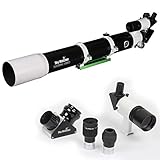
Sky-Watcher EvoStar 100ED
- 100mm fluorite doublet
- 918mm focal length
- 10:1 dual-speed focuser

SVBONY SV550 80mm Triplet
- 80mm air-spaced triplet
- 480mm focal length at f/6
- 87mm back focus

Best Apochromatic Refractors for Astrophotography in 2026
| Product | Specifications | Action |
|---|---|---|
| Sky-Watcher EvoStar 100ED |
|
Check Latest Price |
| SVBONY SV550 80mm Triplet |
|
Check Latest Price |
 SVBONY SV555 54mm Astrograph SVBONY SV555 54mm Astrograph |
|
Check Latest Price |
| Askar 71F Quadruplet |
|
Check Latest Price |
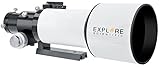 Explore Scientific ED80 Explore Scientific ED80 |
|
Check Latest Price |
 Explore Scientific ED102 Explore Scientific ED102 |
|
Check Latest Price |
 Omegon Pro APO 72/432 ED Omegon Pro APO 72/432 ED |
|
Check Latest Price |
 Askar FMA180pro Askar FMA180pro |
|
Check Latest Price |
1. Sky-Watcher EvoStar 100ED – The Complete 100mm Package
Sky-Watcher EvoStar 100 APO Doublet Refractor – Compact and Portable Optical Tube for Affordable Astrophotography and Visual Astronomy
100mm objective
918mm focal length
8.4 lb tube
2 inch Crayford focuser
Pros
- Matched synthetic fluorite doublet with good colour correction
- Metallic High-Transmission Coatings for sharp colour-accurate output
- 10:1 dual-speed Crayford focuser
- Hard case
- finder
- diagonal and eyepieces included
- Largest owner base in this group
Cons
- Bulky 34 inch tube for grab-and-go work
- Doublet design gives less colour correction than a true triplet
This is the only scope in the group that arrives with everything you need to put a camera on it and start imaging. The box contains the optical tube, two 1.25-inch eyepieces, a 2-inch Crayford-style focuser, tube rings, a V-style dovetail, an 8×50 right-angle finderscope, a 2-inch dielectric diagonal and a foam-lined aluminium case. That matters more than it sounds, because the cheapest route into imaging is usually the one with the fewest missing pieces.
The objective is a matched doublet with one synthetic fluorite element. In practice owners report sharp stars and colour that holds up in stacking, and the Metallic High-Transmission Coatings do a good job of keeping the image bright without adding much veiling glare. At 918mm of focal length you get a long, slow focal ratio, which means longer exposures per sub-frame and less sensitivity to mount wobble.
Two things stand out when you set it up. The 10:1 dual-speed focuser makes it simple to go from an eyepiece to a camera without swapping focusers, and the field of view rating of 1.71 degrees on the original listing tells you this is not a wide-field instrument. With 86 owner reviews averaging 4.4 stars, and 71 percent of those at five stars, this is the best-evidenced scope in the roundup by a wide margin.
The honest catch is size. At 8.4 pounds and 34 inches of optical tube, it is the bulkiest option here, and its listed package dimensions run 41 by 12 by 15 inches. If your plan is to carry a rig to a dark site in a single small bag, this is the wrong tube. Also remember that a fluorite doublet, while a genuine advance on an achromat, does not deliver the all-round colour correction of a triplet.
Who should buy the EvoStar 100ED
Buy it if you want a 100mm-class imaging train with a real accessory package and the widest owner feedback base to lean on. It suits starless nebulae, the North America and Veil complexes, and large emission targets where longer focal length pays off in resolution. The 2-year warranty and included case make it a low-risk first serious refractor.
Who should skip the EvoStar 100ED
Skip it if portability is the whole point, or if you are chasing full-frame corner sharpness on APS-C and full-frame sensors without adding a flattener. A doublet at 918mm is comfortable at APS-C, but full-frame imagers will want an optical corrector in the train, which means extra cost and extra back focus to solve.
2. SVBONY SV550 80mm Triplet – Best Value Air-Spaced Triplet
SVBONY SV550 AP0 Telescope, 80mm ED F6 Triplet Apochromatic Refractor OTA
80mm aperture
480mm focal length at f/6
2860 g
87mm back focus
Pros
- Air-spaced S-FPL51 triplet with very little colour fringe
- 2.5 inch magnesium alloy 1:10 focuser resists vignetting
- 87mm back focus suits common flattener stacks
- Build quality compares well to premium 80mm triplets
Cons
- Focus locks do not fully hold the focuser
- Few mm of inward travel blocks electronic focusers
- One owner found internal dust in the lens cell
The SV550 is the scope we kept reaching for during this comparison. It is an 80mm air-spaced triplet using S-FPL51 low-dispersion glass, which is the configuration most people mean when they say they want an apo. Owner reviews describe it as outperforming and costing considerably less than competing 80mm triplets, and the 4.5 average across 39 reviews is the second-highest here.
Its 480mm focal length at f/6 lands in the sweet spot for wide-field nebula work. Several owners use it on alt-az mounts for visual work as well, which tells you the triplet is not a compromised design being sold only to imagers. Multiple internal light baffles and four extinction barriers keep stray light off the sensor in long exposures.
The mechanical side is where you need to read carefully. The 2.5-inch magnesium alloy dual-speed focuser at 1:10 gives you the throat diameter to avoid vignetting on full-frame cameras, which is a genuine step above the 2-inch units on cheaper 80mm scopes. With a 1x flattener the field is described as clear corner to corner, which is not something you can say about every triplet at this weight.
The recurring complaints are mechanical, not optical. Owners report the focus locks do not fully secure the focuser, so it can creep or be bumped out of position. Several also note that the focuser tube is too long, leaving only a few millimetres of inward travel when paired with SVBONY accessories, which blocks electronic autofocusers outright. One owner found dust between the lens elements inside the cell after mounting. The lifetime warranty is unusually generous for this tier.
Who should buy the SV550 80mm
It suits anyone moving up from an achromat who wants true triplet colour correction and a focuser that will not vignette a full-frame sensor. At 2860 grams and 35.6cm of tube length it still packs into a normal camera bag. It also works well as a guide scope on a larger imaging rig.
Who should skip the SV550 80mm
Skip it if you plan to run an electronic focuser or build a long flattener and filter wheel stack without checking spacing first. The short inward focus travel is the deal-breaker there, not the optics. If you want a grab-and-go astrograph instead, read the next section.
3. SVBONY SV555 54mm – The Lightest Wide-Field Astrograph
SVBONY SV555 APO Astrophotography Telescope, F4.5-F22 Refractor Telescope
54mm aperture
44mm image circle
3.8 kg
f/4.5 to f/22
Pros
- Petzval triplet gives a flat field with no separate corrector
- Full-frame coverage without vignetting on 44mm sensors
- Variable f/4.5 to f/22 covers wide field and long reach
- EAF mount kit and 2 inch filter holder included
- Dovetail plate and 360 degree rotator included
Cons
- Smallest aperture in the roundup limits faint targets
- Camera only with no eyepiece included
- Petzval designs can show a small off-axis colour shift
This is the scope for people whose real constraint is how much they can carry. At 3.8 kg with a 54mm objective and a Petzval triplet design, it pairs naturally with a small star tracker, and owner feedback confirms it works for both visual-adjacent and imaging use on alt-az and equatorial mounts. The 4.4 average comes with the widest spread in the group, 74 percent five-star against 15 percent three-star.
The Petzval layout is the reason it needs no external flattener. Coma and chromatic aberration are corrected within the lens group, and the image circle covers 44mm sensors without vignetting, so full-frame DSLR, mirrorless and astronomy cameras all fit. The aperture is adjustable from f/4.5 up to f/22, which lets you slow down for small targets without changing glass.
Accessory planning is unusually easy here. A ZWO EAF Gen1 mount kit is pre-installed, a 2-inch filter holder is already assembled onto the lens, and there is an M72 front thread for standard filters. The dovetail plate has M6 threaded holes, the tube rotates through 360 degrees, and a soft padded case is included. Upgraded precision focus travel of 2.67mm to 3.22mm was added specifically to prevent back-focus problems.
What you give up is light. A 54mm aperture on faint galaxies and dim nebulae will collect noticeably less than the 80mm and 100mm options in this roundup. It also ships as an imaging astrograph with no eyepiece, so it is not usable at the eyepiece out of the box. Reviewers also note the supplied handle, finder saddle and plastic cover add bulk that undercuts the portability advantage. The lifetime warranty applies to the tube.
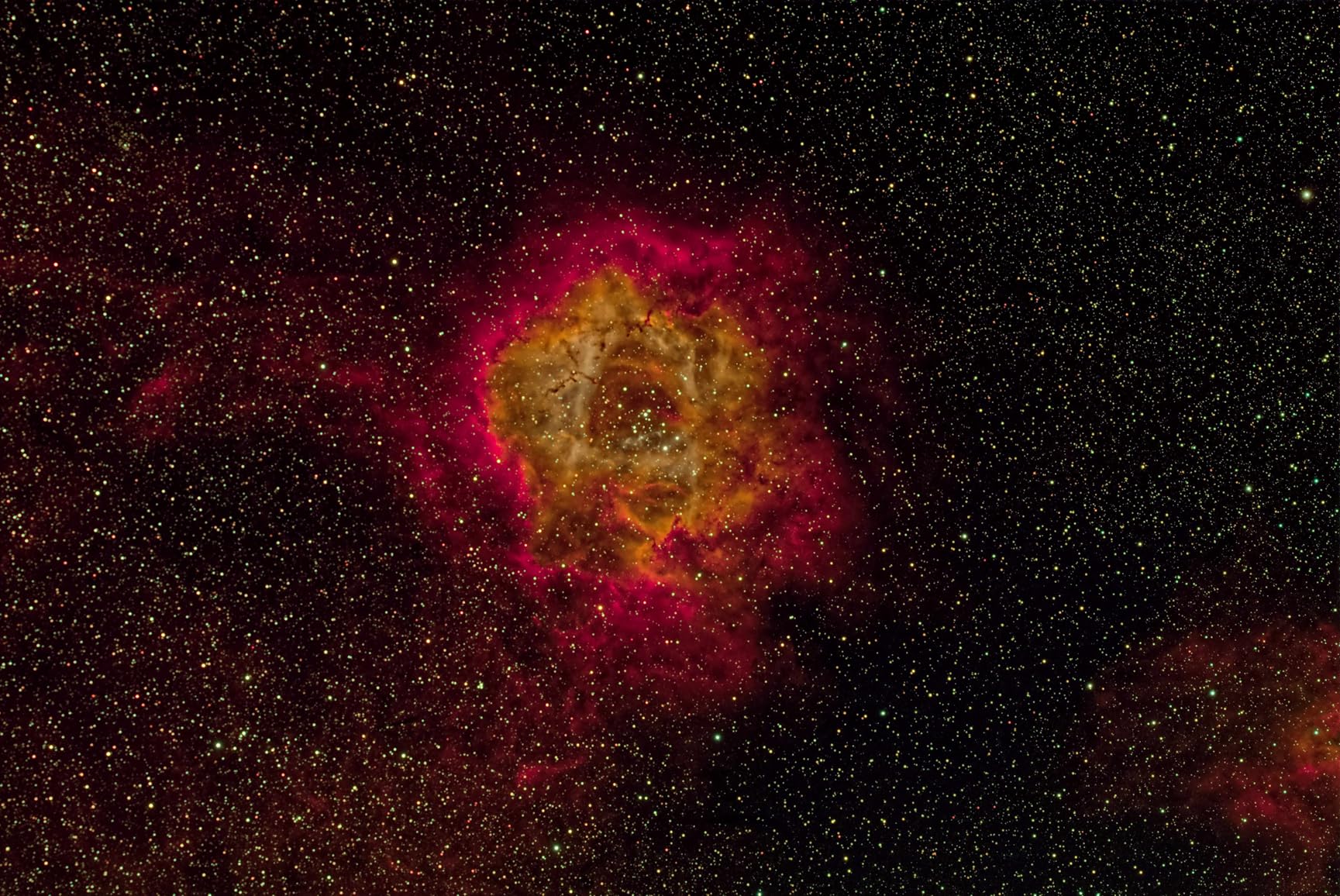
Who should buy the SV555 54mm
Buy it for travel imaging, star tracker rigs and Milky Way mosaics where field width matters more than light grasp. The flat Petzval field means you can frame large emission nebulae without fighting corner softness, and the built-in filter holder saves you from solving adapter spacing in the dark.
Who should skip the SV555 54mm
Skip it if your targets are small and dim, such as compact galaxies or faint southern nebulae that need sustained aperture. It is also a poor choice if you want one instrument for visual observing and imaging, since there is no eyepiece included and it is built around a camera back end.
4. Askar 71F – The Self-Flattened Quadruplet
Askar 71F Flat-Field Telescope, 71mm Aperture F6.9 ED Glass Refractor OTA, Quadruplet air-Spaced APO, 230mm Vixen Dovetail Plate for Deep Sky Astrophotography and Visual Astronomy
71mm aperture
493.9mm at f/6.9
2.5kg optical tube
230mm Vixen dovetail
Pros
- Self-flattened quadruplet means no separate flattener needed
- Highest owner satisfaction score in the roundup
- 2.5kg tube rising to 3kg with plate and rings
- 360 degree rotating focuser for framing
- Works for visual
- birding and terrestrial use
Cons
- Only a 1-year warranty
- 71mm aperture sits between the 54mm and 80mm options
- ETL coating is less specialised than high-transmission rivals
At 4.9 stars across 25 reviews, with 94 percent of ratings at five stars and nothing below four, the Askar 71F has the strongest owner satisfaction record in this group. Reviewers consistently credit the quadruplet air-spaced apo design for delivering a flat field without an external flattener, and the CNC machining with a matte-painted barrel interior is repeatedly mentioned as a step above budget optics.
At 493.9mm focal length and a 71mm objective, the focal ratio works out around f/6.9, with a listed field of view of 6.97 degrees. That is a comfortable wide-to-medium framing for emission nebulae and star clusters. The 360-degree rotating focuser makes composition easier when the camera ends up in an awkward orientation.
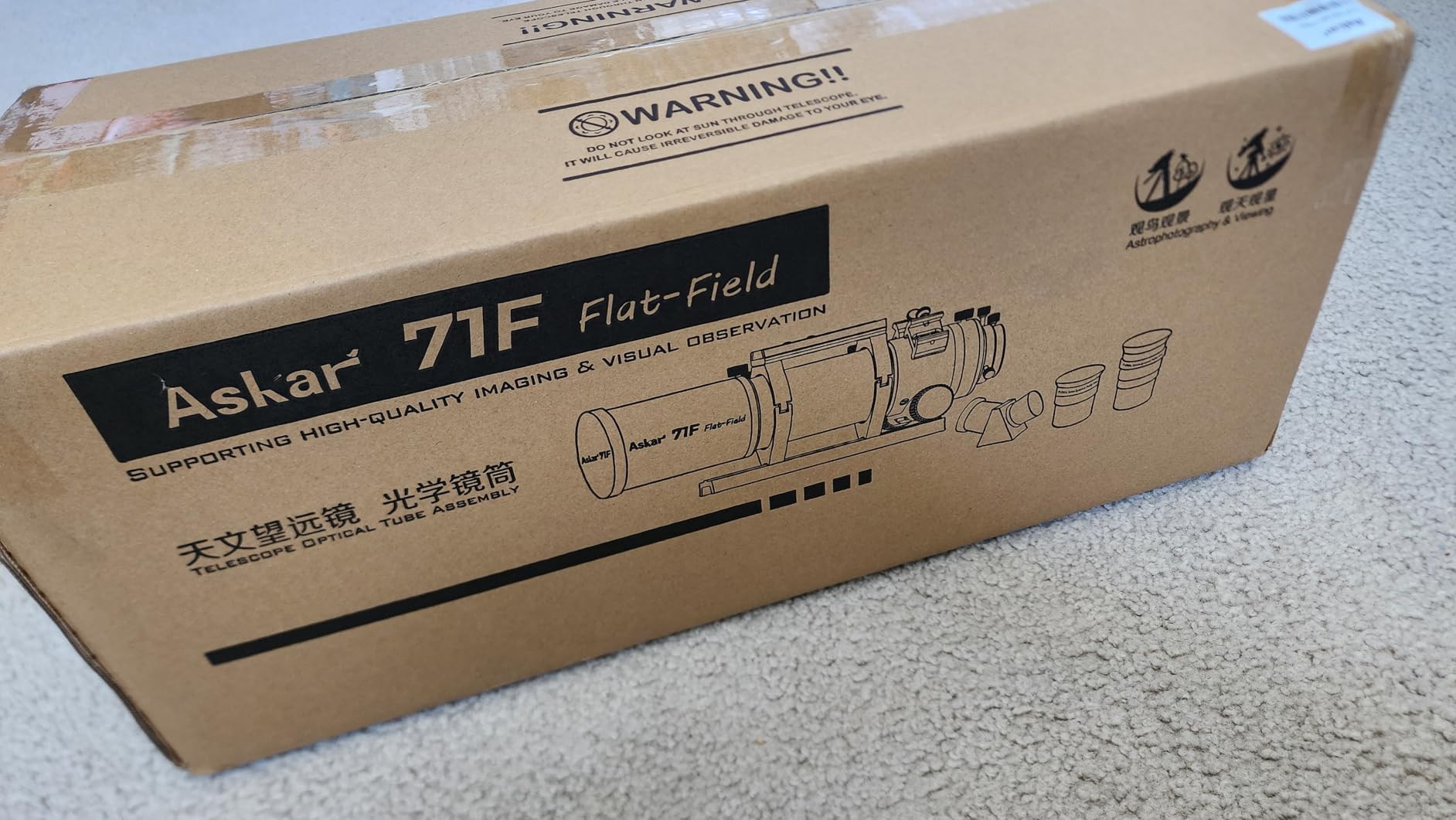
Portability is the second story. The optical tube itself is 2.5kg and reaches 3kg once the hoop and 230mm Vixen dovetail plate are fitted, which puts it on top of a small star tracker or a light harmonic mount without drama. Owners also use it as a daytime lens for birding and scenery, which is unusual for an imaging-oriented quadruplet.
The weaknesses are modest but real. A one-year warranty is the shortest listed here, which matters if you are buying on a long-term hobby horizon. The 71mm aperture sits awkwardly between the compact 54mm and the more capable 80mm triplets, so it is neither the lightest nor the strongest light gatherer. ETL coatings are good but less specialised than the fully multi-coated or high-transmission coatings on some rivals. The product listing also gives a tube length figure that does not match a 493.9mm focal length, so treat the packaging specs loosely.
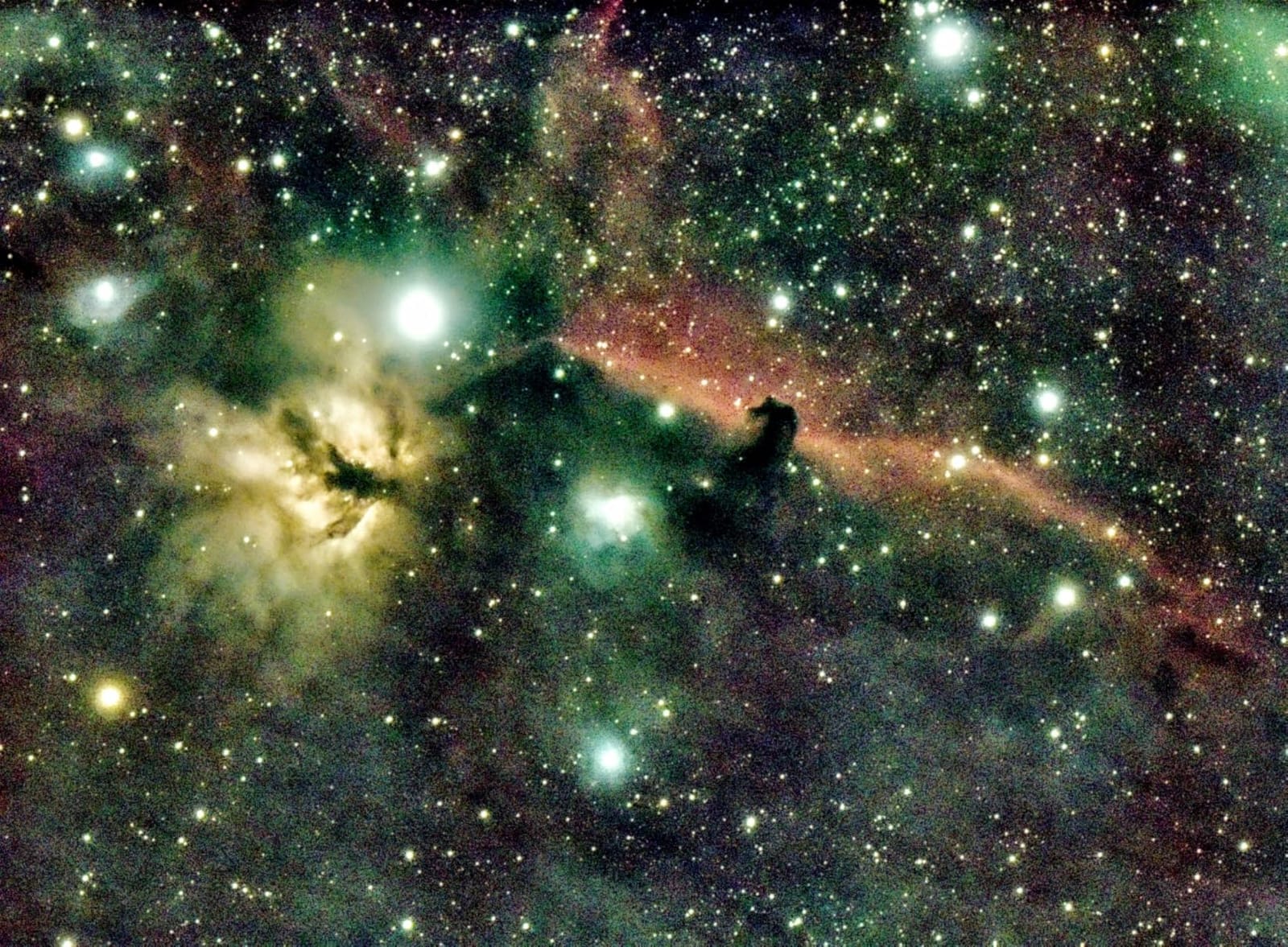
Who should buy the Askar 71F
Buy it if you want one tube for wide-field nebulae and casual visual observing without carrying a flattener. The self-flattening design removes the single biggest source of setup frustration for newer imagers, and the weight keeps it friendly to travel and lighter mounts.
Who should skip the Askar 71F
Skip it if you need the deepest faint detail from a small nebula, or if a one-year warranty makes you uneasy. It is also the middle child on aperture, so if you are deciding between this and an 80mm triplet at a similar weight, the 80mm gathers more light. Check the retailer’s own spec sheet before you buy, since some product pages disagree on the aperture figure.
5. Explore Scientific ED80 – Air-Spaced Triplet With Real Glass
Explore Scientific ED80 Essential Series Air-Spaced Apochromatic 80mm Triplet Refractor Telescope for Astrophotography Astronomy
80mm aperture
480mm at f/6
6 lb package
FCD1 ED glass
Pros
- Genuine air-spaced FCD1 ED triplet with multi-layer coatings
- Owners report it beating similarly priced doublets sold as apochromats
- 480mm at f/6 in a compact 6 lb package
- Front cell push-pull collimation adjustments
- Works well as a guide scope
Cons
- Single-screw mounting foot can slip and strip its thread
- Proprietary finder bracket only fits Explore Scientific finders
- A flattener is needed for full-frame cameras
The optics are the strongest argument for this scope. It uses a genuine air-spaced FCD1 extra-low dispersion triplet from HOYA with enhanced multi-layer coatings on all surfaces, at 80mm and f/6 for 480mm of focal length. Owners consistently report that it outperforms similarly priced doublets marketed as apochromats, and the optics themselves are almost universally praised as crisp and aberration-free.
At 6 pounds and 21 inches, it is also the easiest 80mm triplet here to carry and a common choice as a guide scope. The retractable dew shield keeps it compact, and push-pull collimation adjustments on the front cell let you keep stars tight if the cell ever drifts.

Here is why its 4.2 average is the lowest in the roundup despite 74 percent five-star ratings: an 18 percent one-star cluster pulls the score down hard. Those critical reviews focus on hardware, not glass. The single-screw mounting foot is the most-criticized part, because it can slip and can strip its thread. The finder bracket is proprietary and accepts only Explore Scientific finders, and there are sharp edges around the focuser that are easy to bump with your hands.
There are two cost items to budget for. No rings or eyepieces are included, and a field flattener is required if you intend to use a full-frame camera, with corner sharpness dropping noticeably without one. Support is US-based out of Springdale, Arkansas, which is worth something if you want a local contact for collimation advice.
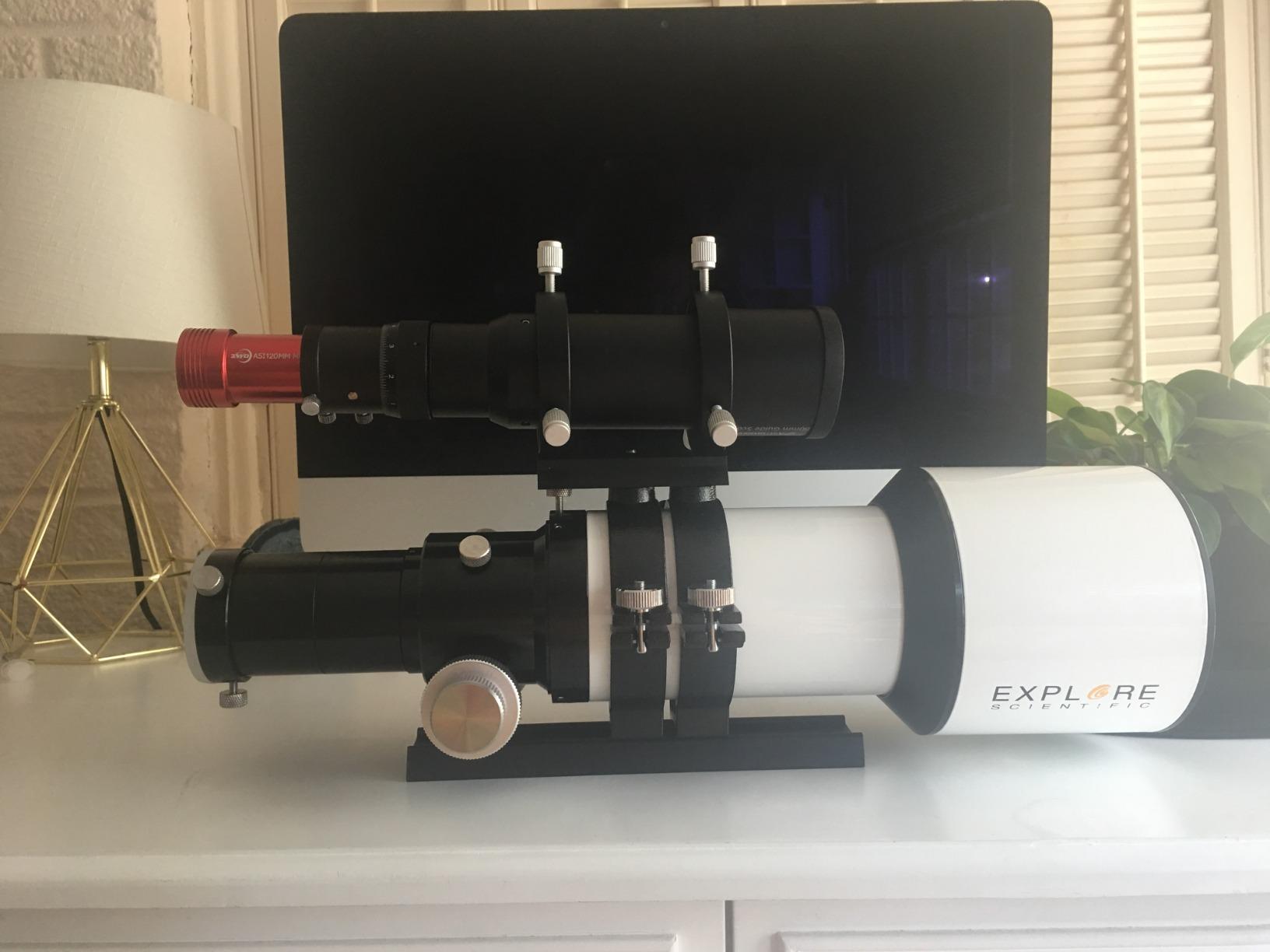
Who should buy the Explore Scientific ED80
Buy it if you want proven FCD1 triplet glass at a modest weight, or you want a second instrument to use as a guide scope. The 480mm focal length handles the Moon, planets and bright deep-sky objects well, and the air-spaced design keeps colour fringing minimal.
Who should skip the Explore Scientific ED80
Skip it if full-frame corner sharpness is your goal without adding a flattener, or if you want a dovetail plate that does not need a second screw to stay put. The hardware is the weak point, not the optics. If you can handle a flattener and spacing, the glass is excellent value.
6. Explore Scientific ED102 – The Long-Reach Triplet
Explore Scientific ED102 Essential Series Air-Spaced Apochromatic 102mm Triplet Refractor Telescope for Astrophotography Astronomy
102mm aperture
714mm at f/7
12 lb tube
FCD1 ED glass
Pros
- Zero chromatic aberration reported on stars and the Moon
- Colour-true galaxies and nebulae at prime focus
- Sharp stars edge to edge with a flattener and the included spacers
- Cradle ring with built-in handle for secure handling
- Every review is five stars
Cons
- Focuser backlash and a narrow focus window
- Not flat enough for full frame without a flattener
- Reaching back focus needs the extension ring plus tubes
If you want resolution rather than field width, this is the scope. At 102mm aperture and 714mm focal length for f/7, it is the largest true aperture in the roundup, and it gathers noticeably more light than the 80mm Explore Scientific at the same design. Imaging owners report zero chromatic aberration on stars and the Moon and crisp, full-colour galaxies and nebulae at prime focus.
The optical specification is FCD1 HOYA extra-low dispersion glass in an air-spaced triplet, with proprietary enhanced multi-layer coatings. With an Explore Scientific flattener plus the included spacers and extensions, owners report tack-sharp stars edge to edge. The cradle ring with an integrated handle makes handling and setup quick, and the retractable dew shield keeps the 23.75-inch tube manageable.
All 12 reviews are five stars, which tells you the optical design is not in question. The repeated caveat is the focuser. Owners report backlash at fine focus, a small focus window that makes precise focusing awkward, and one owner who replaced the focuser outright. Tightening the tension screw reduces the two-speed backlash at the finest settings, which is the first thing to try.
Two practical issues follow from that. The field is not flat enough for a full-frame camera without a flattener, and the included flattener’s 42mm path can show slight corner vignetting. Reaching back focus for imaging needs the 1.5-inch extension ring plus extension tubes, which is not obvious from the manual and is where a lot of first-time owners get stuck. At 12 pounds it is also the heaviest tube here and needs a mount with real payload capacity.
Who should buy the ED102
Buy it if your targets are smaller galaxies, globular clusters and planetary nebulae rather than huge emission complexes, or if you plan to build mosaics where detail at the centre matters. Colour accuracy straight out of the camera reduces calibration work, and the aperture gives you headroom on faint targets.
Who should skip the ED102
Skip it if your priority is wide-field framing, if your mount cannot comfortably carry 12 pounds, or if you want a plug-and-play imaging train. The flattener and spacer requirements are real, and the focuser is the component most likely to annoy you over time.
7. Omegon Pro APO 72/432 ED – The Lightweight Travel OTA
Omegon Apochromatic Refractor Pro APO AP Photography Scope 72/432 ED OTA
72mm aperture
432mm focal length at f/6
2.06 kg
fully coated ED
Pros
- Smallest and lightest optical tube in this roundup
- 72mm ED objective at 432mm suits wide-field framing
- Astrograph format aimed squarely at deep-sky imaging
- Fully coated optics across the element set
Cons
- Only two owner reviews
- so quality is barely verified
- No warranty term or dimensions returned for the listing
- No best sellers rank data indicating limited retail traction
This is the smallest tube we tested, and the most lightly verified. The Omegon Pro APO pairs a 72mm aperture with a 432mm focal length for a focal ratio of f/6, and at 2.06 kg it is the easiest to carry in the group. Fully coated ED optics in an astrograph-style tube is the right shape of specification for wide-field deep-sky work.
Be clear-eyed about the evidence here. Both reviews rate it five stars, but two reviews cannot tell you much about long-term optical performance, and no best sellers rank data came back for this listing, which points to limited retail traction. No warranty term, feature list or dimensions were returned for the product either, so treat it as lightly verified rather than proven.
Who should buy the Omegon 72/432 ED
Buy it if the priority is the lightest possible wide-field rig and you have a mount that is already carrying its weight limit. A 72mm objective at f/6 will frame large nebulae comfortably, and the small tube is easy to balance on a small equatorial head.
Who should skip the Omegon 72/432 ED
Skip it if you want community-verified optics or a support pathway when something is off. Two reviews and no warranty information is thin, and the 72mm aperture is barely larger than the dedicated astrographs in this roundup. Our advice is to confirm the mounting hardware specification with the retailer before ordering, since it is not described in the listing.
8. Askar FMA180pro – The Fast Wide-Field Sextuplet
Askar FMA180pro OTA Telescope,F/4.5,180mm Focal Length,Two-ED Glasses sextuplet air-Spaced APO Refractor for Deep Sky Astrophotography and Visual Astronomy
40mm aperture
180mm focal length at f/4.5
1.3 kg
55mm back focus
Pros
- Sextuplet air-spaced design with two ED elements
- Very fast f/4.5 ratio in a 167.5mm 1.3kg body
- Standard 55mm back focus with included M48 adapter
- Internal focusing keeps the draw tube fixed
- Base doubles as a finder scope mount
Cons
- Smallest aperture restricts it to bright extended targets
- Only six reviews
- and one-year warranty
- Listing disagrees on whether the aperture is 40mm or 55mm
The FMA180pro is an odd little instrument that solves a real problem. It is a sextuplet air-spaced apochromat with three front and three rear lenses, two of them ED glass, giving strong chromatic aberration correction in a body that measures 167.5mm long and weighs 1.3 kg. At f/4.5 it is the fastest scope in the roundup, and the CNC barrel has a matte interior to reduce stray light.
Its biggest practical advantage is the internal focusing design. Because focusing happens inside rather than by moving a draw tube, the focuser stays fixed, which improves stability for delicate long exposures. The standard 55mm back focus with the included M48 adapter means most cameras and spacers work without modification, and there is a 360-degree rotator plus a finder base that doubles as a mount for other telescopes once the Vixen dovetail is removed.

The limits are aperture and evidence. At a listed 40mm it gathers far less light than everything else here, which restricts it to bright, extended targets like large emission nebulae and Milky Way panoramas. All six reviews are five stars, but that is a thin base. The warranty is one year, and the listing contradicts itself, giving the aperture as 40mm in the bullet points and 5.5cm in the spec table, so confirm the effective aperture before you commit.
There is also a practical framing consequence. At 180mm focal length and f/4.5, this is a mosaic instrument rather than a single-shot one, because the field is far narrower than the 400mm-plus focal lengths most imagers prefer for wide fields.
Who should buy the FMA180pro
Buy it if you build wide-field mosaics and want the shortest possible train with zero back focus drama. The 55mm standard and the internal focuser mean you can add a filter wheel and still hit focus, and the 1.3kg weight is close to weightless on a star tracker.
Who should skip the FMA180pro
Skip it if you want faint, small targets or long integrations without mosaic work. It is the weakest choice here on light grasp, and the aperture discrepancy in the listing is a reason to slow down before buying rather than after. Our recommendation is to confirm the true aperture with the retailer first.
How to Choose an Apochromatic Refractor for Imaging
The right apochromatic refractor depends less on aperture than most roundups admit. It depends on your mount, your sensor and the targets you actually want. Work through these factors before you spend anything, because retrofitting optics after the fact is far more expensive than choosing correctly the first time.
Doublet, triplet or Petzval: which optical design do you need?
A doublet uses two elements, often with one synthetic fluorite or ED element, and gives a large, inexpensive correction step over an achromat. Expect some residual colour on bright targets, and expect full-frame imagers to want a separate corrector. The EvoStar 100ED sits here.
A triplet adds a third element to bring red, green and blue closer to a common focus, and an air-spaced triplet adds air gaps between the glass for even better correction. This is the classic workhorse astrograph, and it is what the SV550, the Explore Scientific pair and the SV555 use. Most full-frame imagers still add a flattener on a plain triplet, because field curvature is a separate problem from colour.
A Petzval design packs a corrector group into the main objective so the field arrives flat without an external flattener. That removes the biggest setup headache in imaging, at the cost of a larger, heavier tube and sometimes a small off-axis colour shift that is harder to correct. The Askar 71F quadruplet and the SV555 54mm are the examples here.
Matching focal length to your targets
Under about 300mm you are in wide-field territory: large emission nebulae, Milky Way mosaics and clusters. Between 400mm and 600mm is the general-purpose range that most imagers work in, framing the Rosette, the Heart and Soul complex, or a decent-sized galaxy. Above 700mm you are choosing resolution over field width, which suits small galaxies, planetary nebulae and lunar work.
Aperture then decides how faint you can go. A 54mm astrograph will show you beautiful wide fields and stop there. A 100mm or 102mm triplet will collect enough light for galaxies and fainter nebulae in reasonable integration times. For faint targets, aperture wins; for big targets, focal length determines whether you fit the object in one frame.
Focal ratio, exposure length and image scale
Focal ratio sets how fast the scope is. The FMA180pro at f/4.5 and the SV555 at f/4.5 produce bright, short-exposure frames that suit fast mounts and star trackers. The ED102 at f/7 produces dimmer, longer frames that tolerate guiding error better but demand a solid mount. The EvoStar 100ED at roughly f/9 is the slowest here and the most forgiving of a wobbly mount.
Image scale is the number people forget. Pair focal length with your sensor pixel size and check the result against the Nyquist limit for your optics before you commit, because an under-sampled camera wastes the resolution you paid for.
Back focus, flattener and reducer spacing
Back focus is the distance from the last lens surface to the sensor, and it is where new imagers lose whole evenings. Spacing diagrams matter more for doublets and plain triplets that need a flattener or a reducer, where every added component shifts the required distance. Petzval scopes and internal-focusing designs sidestep most of this, which is the practical reason forum users report less setup friction with them.
Budget for the extra parts. If your scope needs a flattener, add the cost to your planning. If you want a faster ratio, add a reducer, and recheck spacing afterwards because a reducer changes focal length and back focus at the same time. Filter wheels and narrowband filters add thickness and can push a marginal focus solution out of reach, which is exactly the problem owners report with the SV550.
Mount payload and the 50 percent rule
The mount matters more than the telescope, and this is the single most repeated piece of advice across the astrophotography communities. A common rule of thumb is to keep your imaging payload under about half the mount’s rated capacity, which leaves room for cables, the camera, a filter wheel and a guiding setup.
Check the weights in this roundup against your mount before you buy. The FMA180pro at 1.3 kg and the SV555 at 3.8 kg are friendly to small trackers and light harmonic heads. The Askar 71F reaches 3 kg with plate and rings, the EvoStar 100ED sits at 8.4 lb, and the ED102 at 12 pounds needs a mount with genuine capacity. Balancing matters as much as raw payload, and you will need to rebalance after adding a flattener or filter wheel.
Dew control and thermal settling
Long focal lengths and large front elements dew up faster than you expect, and a thin film of water on the objective will flatten your stars no matter how good the glass is. Budget for a dew heater band, which is a small add-on that protects long sessions in humid months. Leave time for thermal settling before you trust your focus, since a sealed tube needs to reach ambient temperature first.
Our broader guide to telescopes for astrophotography covers the mounts, cameras and filters that pair with these tubes if you are building a full rig.
Frequently Asked Questions
What is the best 100mm APO refractor?
The Sky-Watcher EvoStar 100ED is our pick in the 100mm class. It pairs a 100mm synthetic fluorite doublet with a 918mm focal length, ships with a 2-inch Crayford-style 10:1 focuser, and includes a hard case, finder, diagonal, rings, dovetail and eyepieces. It has the largest owner review base of any scope in this roundup at 86 reviews averaging 4.4 stars.
What is the best astrograph refractor?
An astrograph is a refractor designed for imaging rather than visual use, usually with a flat field built in so no separate corrector is needed. The Askar 71F is the strongest choice here because its air-spaced quadruplet is self-flattened, needs no external flattener, weighs 2.5kg as a tube, and holds a 4.9 average across 25 reviews. The SVBONY SV555 54mm is the lighter travel option.
Are apochromatic refractors worth the money?
They are worth it for deep-sky imaging because they correct the colour fringing you cannot fully remove in processing, and because most designs need no collimation. The value case in this roundup is clearest on the SVBONY SV550, an 80mm air-spaced triplet rated 4.5 across 39 reviews, and the Askar 71F quadruplet at 4.9 across 25 reviews.
Do I need a field flattener with a Petzval refractor?
No. A Petzval design incorporates the corrector elements into the main objective group, which is why scopes like the Askar 71F and the SVBONY SV555 deliver a flat field without an external flattener. Plain triplets and doublets are different: the Explore Scientific ED80 and ED102 both need a flattener for full-frame sensors, with corner sharpness dropping noticeably without one.
Do apochromatic refractors need collimation?
Rarely. A sealed refractor does not have a mirror to fall out of alignment, so there is no routine collimation like a Newtonian needs. The Explore Scientific ED80 and ED102 do include push-pull front-cell adjustment screws so you can correct a minor alignment shift, but most owners report never touching them. The main maintenance is keeping the front lens clean and controlling dew.
Why are refracting telescopes no longer used?
That premise is outdated. Refractors are among the most-used telescope types in deep-sky astrophotography because they are sealed, need no collimation, produce flat fields and are compact. Where they are weaker is planetary imaging, where their long focal lengths and small apertures give less detail than a longer Newtonian or a dedicated planetary instrument, so imagers often pair one with a second scope.
Which Apochromatic Refractor Should You Buy?
The best apochromatic refractor for astrophotography in 2026 is the Sky-Watcher EvoStar 100ED, because it combines a 100mm fluorite doublet with a 918mm focal length, a complete accessory package and by far the largest owner feedback base in this roundup. Our runner-up is the SVBONY SV550, an 80mm air-spaced triplet that delivers true apochromatic colour correction for less than most doublets, and our flat-field pick is the self-flattened Askar 71F quadruplet.
Pick the EvoStar if you want the strongest all-round package. Pick the SV550 if you want triplet optics in a portable tube. Pick the Askar 71F if you want to stop thinking about spacing. Add a flattener budget if you choose either Explore Scientific, and check the effective aperture before ordering the FMA180pro.
Whatever you choose, buy the mount first if you do not have one, keep your payload under about half its rated capacity, and confirm the back focus solution for your camera and filter stack before the tube arrives.