
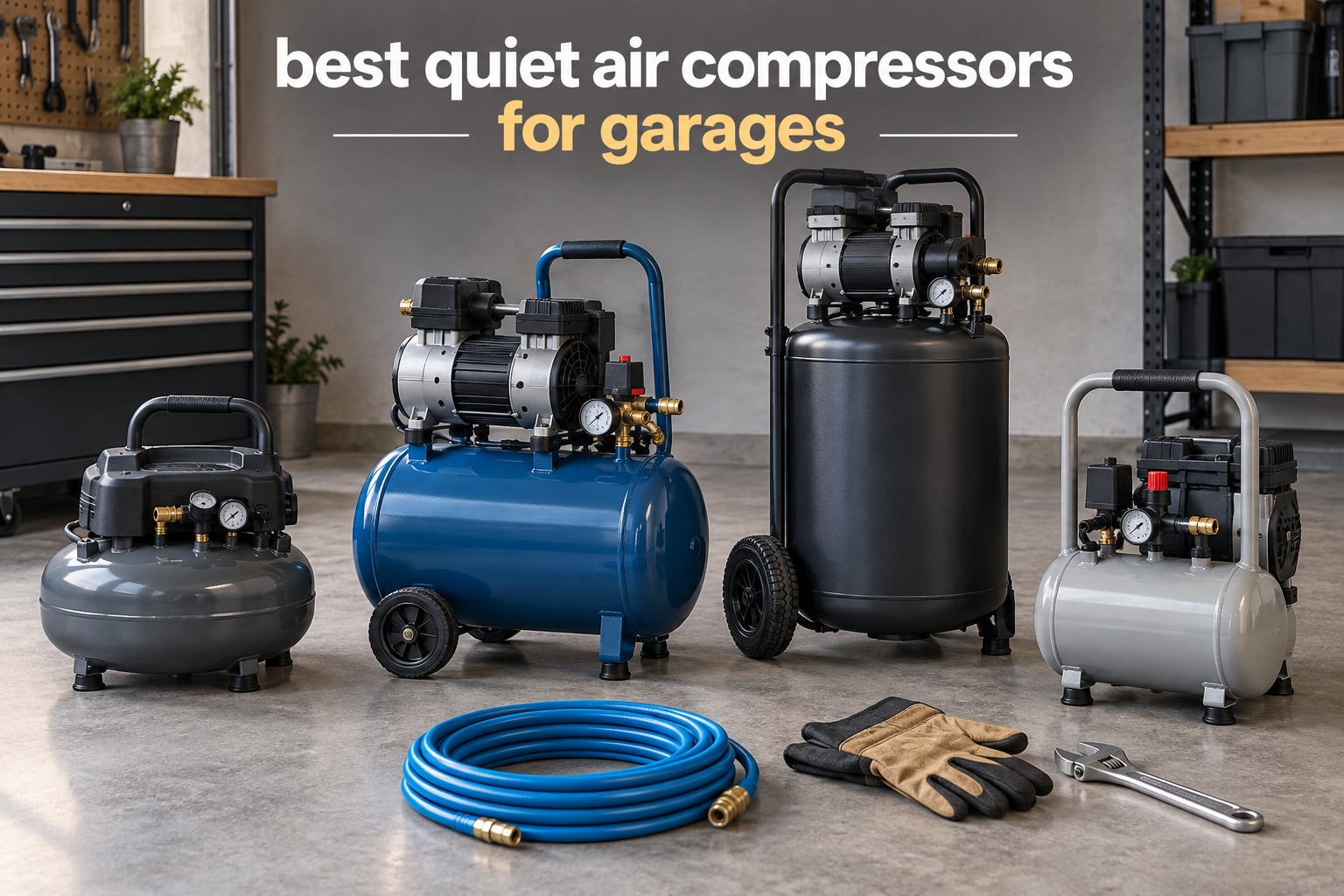
If you want the shortest answer, the California Air Tools 1P1060S is the quietest air compressor we found for a garage at 56 dBA, and it carries the largest review base of any unit on this list. Its 1.2 CFM at 90 PSI and 1 gallon tank are the tradeoff: it is built for nailers, airbrushes and tire inflation, not for sanders or spray guns. If your garage work goes past trim, the 8 gallon California Air Tools 8010A at 60 dBA is the more useful daily driver.
Noise is the number garage owners argue about most, and it is the least honest number on any spec sheet. Manufacturers rarely state the distance a decibel figure was measured at, so a 60 dBA unit and a 68 dBA unit can sound identical in your garage, or reversed. That is the trap this roundup is built to avoid. We read every manufacturer and retailer listing we could find, cross-checked the noise claim against the reviews, and ranked the ten strongest candidates on three things you can actually verify.
Noise level in dBA — the real limiter on where you can run the unit and whether you can talk over it. Below 60 dBA you can hold a normal conversation next to the compressor; 68 dBA and above starts to compete with a washing machine.
CFM at 90 PSI — this is the number that decides which tools you can run. A finish nailer needs roughly 1 CFM, an orbital sounder 2 to 3 CFM, and a paint sprayer 4 CFM or more.
Amp draw against a 15-amp garage circuit — anything under about 9 amps can share a circuit with lights and small tools. A 14 amp compressor needs the circuit to itself or a dedicated run.
We also track two things competitors skip: whether a unit is quiet at startup or only quiet under load, and whether the tank is big enough that the pump stops cycling constantly, because a compressor that turns on and off every ten seconds is its own kind of noise. Our broader compressor coverage lives in our best air compressors roundup, and if your floor space is tight the pancake-style units are covered in our pancake compressor picks.
Table of Contents
Top 3 Quiet Air Compressors for Garages in 2026

California Air Tools 1P1060S
- 56 dBA noise level
- 1.2 CFM at 90 PSI
- 1 gallon steel tank
- 4.5 amp draw

California Air Tools 8010A
- 60 dBA noise level
- 2.2 CFM at 90 PSI
- 8 gallon aluminum tank
- 8.5 amp draw

Limodot 5 Gallon Quiet Kit
- 68 dB operation
- 2.8 CFM at 90 PSI
- 5 gallon tank
- 25 ft hose and accessory kit
Best Quiet Air Compressors for Garages (October 2026)
| Product | Specifications | Action |
|---|---|---|
| California Air Tools 1P1060S |
|
Check Latest Price |
 Makita MAC100Q Quiet Series Makita MAC100Q Quiet Series |
|
Check Latest Price |
 California Air Tools 10020C California Air Tools 10020C |
|
Check Latest Price |
| California Air Tools 8010A |
|
Check Latest Price |
| Limodot 5 Gallon Quiet Compressor |
|
Check Latest Price |
 DEWALT DWFP55130 Trim Compressor DEWALT DWFP55130 Trim Compressor |
|
Check Latest Price |
 Metabo HPT EC28M Metabo HPT EC28M |
|
Check Latest Price |
 VEVOR 15 Gallon Compressor VEVOR 15 Gallon Compressor |
|
Check Latest Price |
 Makita MAC320Q Quiet Series Makita MAC320Q Quiet Series |
|
Check Latest Price |
 Stealth 20 Gallon Ultra Quiet Stealth 20 Gallon Ultra Quiet |
|
Check Latest Price |
1. California Air Tools 1P1060S — Editor’s Choice Pick for Any Garage
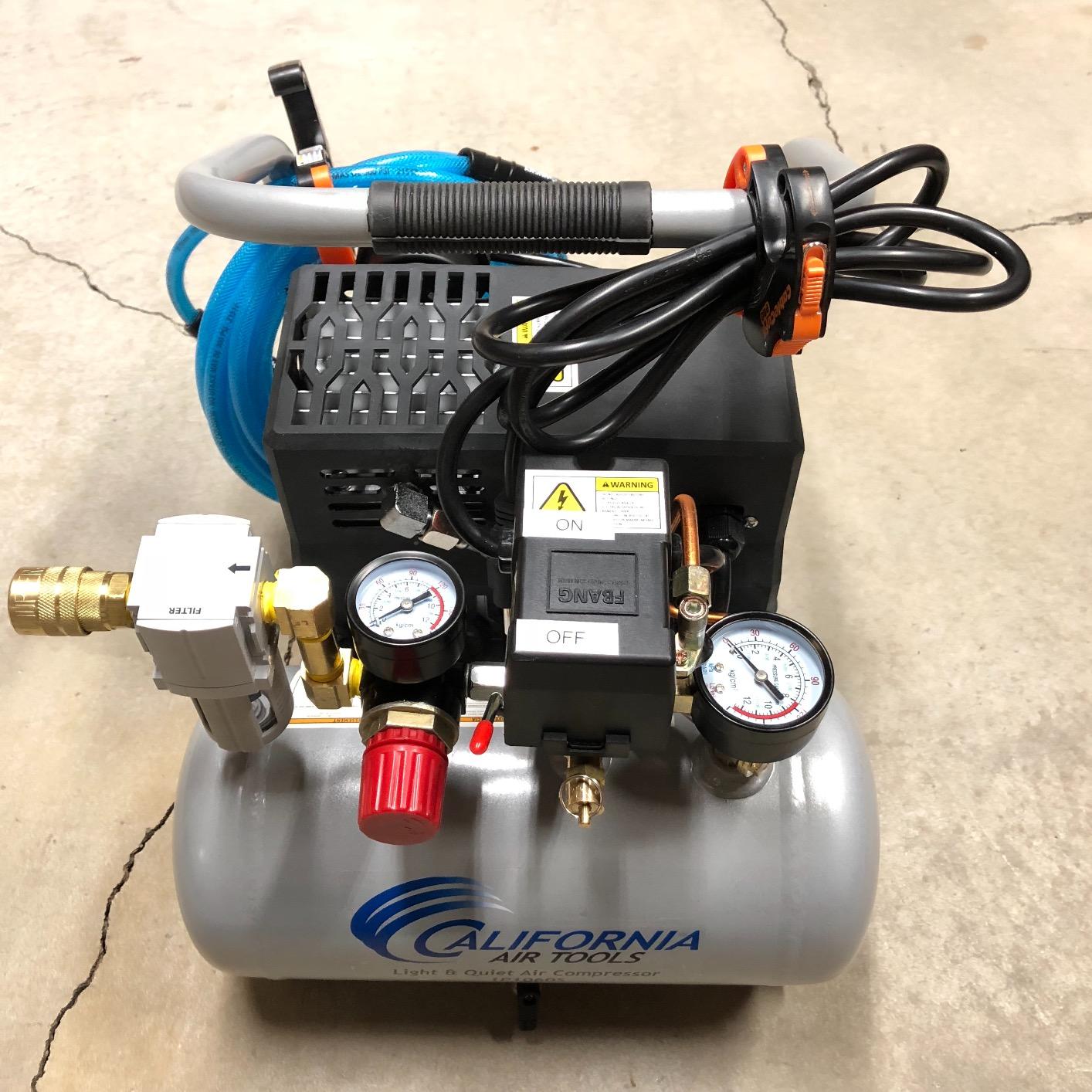
California Air Tools CAT-1P1060S Light & Quiet Portable Air Compressor, Lightweight, Ultra Quiet, Oil-Free, 1 Gallon Steel Tank, .6 HP, 56 dBA Noise Level, Silver
56 dBA
1.2 CFM @ 90 PSI
1 gallon steel tank
4.5 A
29 lbs
Pros
- 56 dBA is the lowest figure in this roundup
- 1680 RPM motor cuts noise and wear
- Oil-free single piston rated past 3000 hours
- 29 lbs so it moves anywhere in the garage
- Cold-weather starts with no oil changes
Cons
- 1.2 CFM and a 1 gallon tank cap it at trim work
- 120 PSI is low for heavier pneumatic use
- Not built for continuous duty cycles
This is the unit we recommend first, and the reason is straightforward: at 56 dBA it is the quietest compressor in the group by a wide margin, and 79% of the 2665 reviews are five star. Owners describe it as about as loud as a refrigerator running in the corner of the room, which means you can hold a full conversation on the other side of a workbench while it cycles.
The engineering behind that quiet is not a gimmick. The motor turns at 1680 RPM rather than the 3400 RPM used by typical budget pumps, and the pump is a single-piston oil-free design rated past 3000 hours. Slower motor speed means fewer pressure pulses per second, which is where most of the noise in a small compressor comes from.
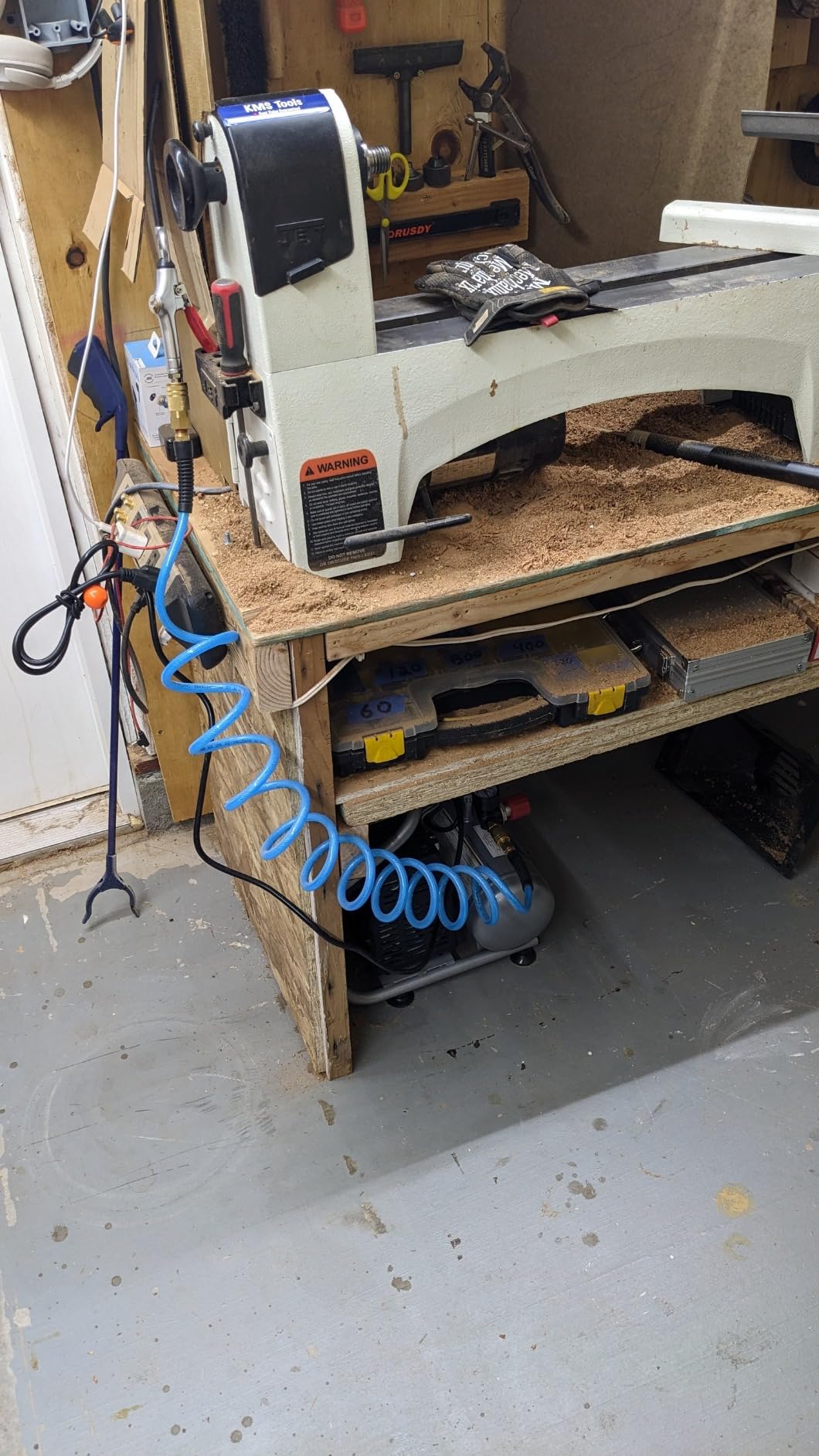
The 1 gallon alloy steel tank holds 1.2 CFM at 90 PSI and 1.60 CFM at 40 PSI, topping out at 120 PSI. In practice that covers brad and finish nailers, staple guns, airbrushes, blow guns and tire inflation. It recovers fast enough for detail work because the tank is small, which is the one advantage small compressors actually have.
At 29 lbs with a carry handle, it is genuinely portable, and reviewers mention running it on uneven ground and in cold conditions without complaint. If you own a house with a shared wall to a bedroom, this is the compressor most likely to be tolerated by the rest of your household.
Who this compressor suits
Trim carpenters, woodworkers and anyone who runs finish or brad nailers indoors, or who just wants to inflate tires and blow dust out of an engine bay. At 4.5 amps it can share a 15-amp circuit with lights and a small saw without any risk of nuisance tripping, which is the single most practical thing about it.
Who should skip it
Anyone running a framing nailer for hours, an orbital sounder, a paint sprayer or an impact wrench. The 120 PSI ceiling and 1.2 CFM simply will not keep up, and the constant cycling that follows is both slow and hard on the motor. Buy the 8010A at number 4 or the 10020C at number 3 instead.
2. Makita MAC100Q — Quiet Series Pick for Indoor Trim Work
Makita MAC100Q Quiet Series, 1/2 HP, 1 Gallon Compact, Oil-Free, Electric Air Compressor
58 dB
0.7 CFM @ 90 PSI
1 gallon tank
135 PSI max
27.6 lbs
Pros
- 58 dB Quiet Series build for indoor use
- 1750 RPM motor extends pump and motor life
- Full roll cage for transport and storage
- Oil-free dual piston pump
- Lightweight at 27.6 lbs with induction motor
Cons
- 0.7 CFM and a 1 gallon tank restrict output
- Premium pricing for the output it delivers
- No hose included beyond a universal quick coupler
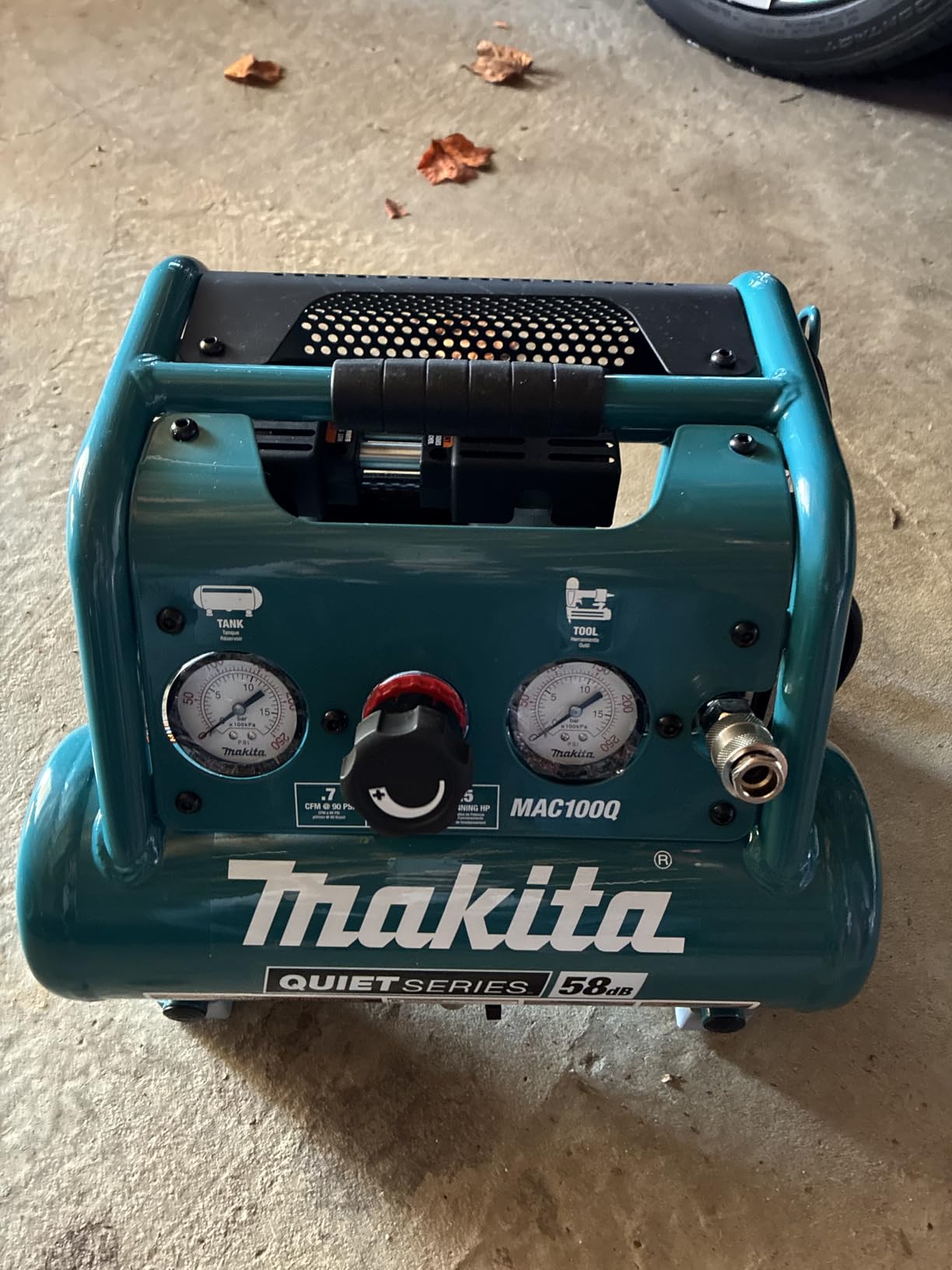
Makita’s Quiet Series name is earned here rather than borrowed. At 58 dB the MAC100Q sits just behind the California Air Tools 1P1060S, and owners buying it for interior millwork report that they can run it in a finished room without interrupting conversations. Eighty percent of its 1523 reviews are five star.
The 1750 RPM motor is the mechanism behind the low noise and the longer component life Makita claims. The unit is wrapped in a complete roll cage, which matters more than it sounds for anyone moving a compressor between a truck and a shop floor, and the oil-free dual-piston pump removes oil changes from the maintenance list entirely.
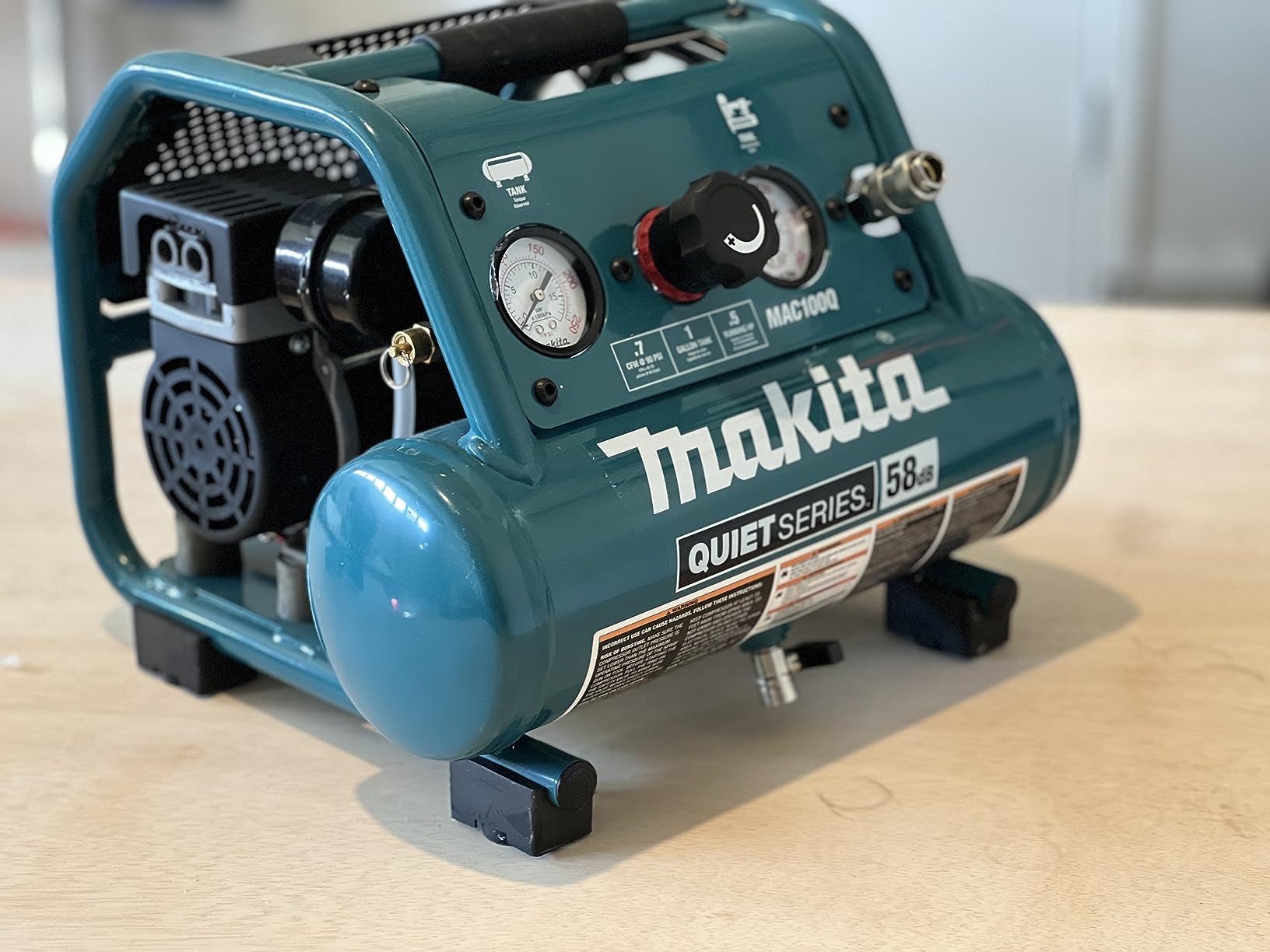
Where it thins out is output. The published figure is 0.7 CFM at 90 PSI with a 135 PSI ceiling on a 1 gallon tank, which is the lowest flow number on this list. It is fine for trim, spraying and inflating. It is not a tool for anything that asks for sustained airflow, and reviewers repeatedly mention recovery waits between small jobs.
At 27.6 lbs it is one of the two lightest compressors here, and it includes a 1/4 inch universal quick coupler rather than a hose, so budget for a hose if you do not already own a long one.
Who this compressor suits
Interior finish carpenters and owners who already own Makita tools, especially anyone running a cordless nailer alongside it. The roll cage and low weight make it the easiest unit here to carry up stairs or move between rooms, and 58 dB is low enough to work indoors.
Who should skip it
Owners who need more than about 1 CFM. Paying a premium for 0.7 CFM is a hard sell when a compressor twice the size sits a few places down this list for less, and the missing hose is a small but real annoyance on day one.
3. California Air Tools 10020C — Best for Impact Wrenches and Spray Guns
California Air Tools 10020C 2.0 HP Ultra Quiet and Oil-Free Air Compressor, 10 Gallon Steel Tank with Wheels, 70 dBA Noise Level
70 dBA
5.3 CFM @ 90 PSI
10 gallon vertical tank
14 A
82.5 lbs
Pros
- Quiet for a 10 gallon compressor
- 5.3 CFM at 90 PSI covers nailing and light impact tools
- Vertical tank frees up floor space
- Fills quickly and holds pressure while running
- Oil-free dual piston rated past 3000 hours
Cons
- Thermal protection cuts out after sustained runs
- 82.5 lbs makes the wheels essential
- Some models arrive without an automatic tank drain
- Gauge red zone is printed too low
This is the pick for a garage where noise matters but so does output. At 70 dBA it is not the quietest unit here, yet owners repeatedly report that neighbours cannot hear it from an adjacent room, because 70 dBA against a closed garage door behaves very differently from 70 dBA in an open workshop.
The numbers underneath are what justify the badge. A 2.0 HP motor running at 1680 RPM delivers 6.40 CFM at 40 PSI and 5.30 CFM at 90 PSI into a 10 gallon steel tank, which covers nailing, stapling, inflating, cleaning and paint spraying without stopping. The vertical layout stands 35.9 inches tall and 16 inches wide, so it takes up almost no floor area for its capacity.
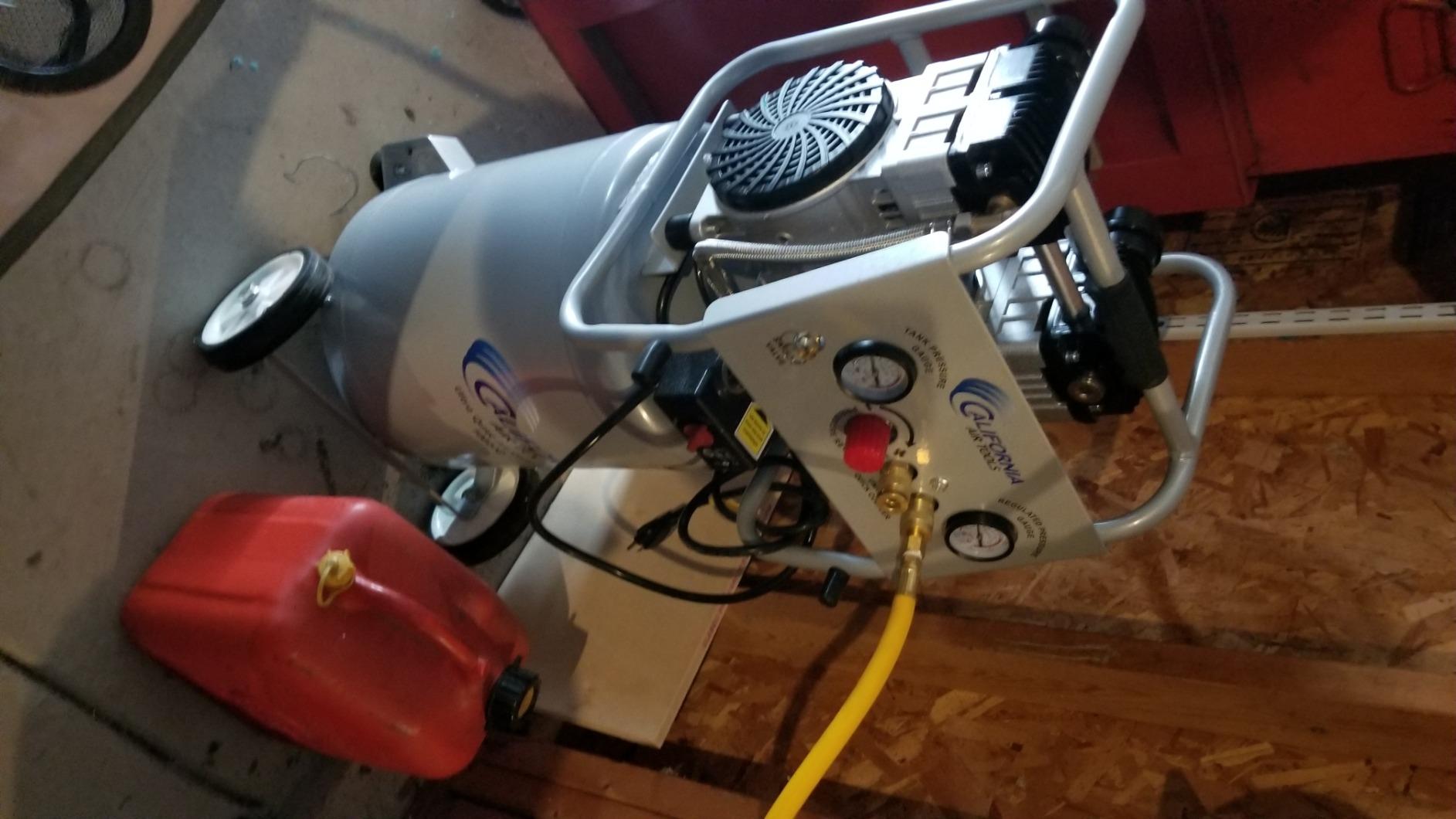
California Air Tools shows up more than any other brand in quiet compressor discussions on r/Tools, r/Construction and woodworkingtalk, and the 10020C is usually the one named when owners move up from a 1 gallon unit. The common thread in those threads is that the brand is described as quiet like a fridge and lighter than expected for its size.
Two honest caveats come up repeatedly in the reviews. First, the thermal overload protection cuts out after roughly 30 to 45 minutes of sustained running and needs a long cool-down, so it is not a sandblaster compressor. Second, at 82.5 lbs the wheel kit is not optional in practice.
Who this compressor suits
Owners of a two-car garage who run impact wrenches, spray guns or occasional sanding alongside nailers, and who want a unit that can sit in a corner rather than take over a workbench. Vertical storage in a tight bay is the single biggest practical advantage here.
Who should skip it
Anyone on a shared 15-amp circuit, because the 14 amp draw leaves almost nothing for lights or another tool. Anyone doing continuous blasting or grinding also should look elsewhere, since the duty cycle ceiling is real and well documented.
4. California Air Tools 8010A — Top Rated for Everyday Garage Use
California Air Tools 8010A 1.0 HP Ultra Quiet and Oil-Free Air Compressor, 8 Gallon Aluminum Tank, Lightweight with Wheels, 60 dBA Noise Level
60 dBA
2.2 CFM @ 90 PSI
8 gallon aluminum tank
8.5 A
37.3 lbs
Pros
- Highest rated compressor in the group at 4.7
- 60 dBA with 84% five star reviews
- 8 gallon tank avoids long waits on trim jobs
- 37.3 lbs with a wheel kit
- Recovers from 90 to 120 PSI in about 60 seconds
Cons
- 120 PSI maximum is modest
- 2.2 CFM is light for continuous sanding or spraying
- Aluminum tank and wheel kit need assembly
The 8010A is the highest rated compressor on this list at 4.7 out of 5 across 1115 reviews, and it is the one we would tell most two-car garage owners to buy. Sixty dBA is quiet enough to work next to, and the 8 gallon aluminum tank means the pump stops cycling every thirty seconds while you run a nailer.
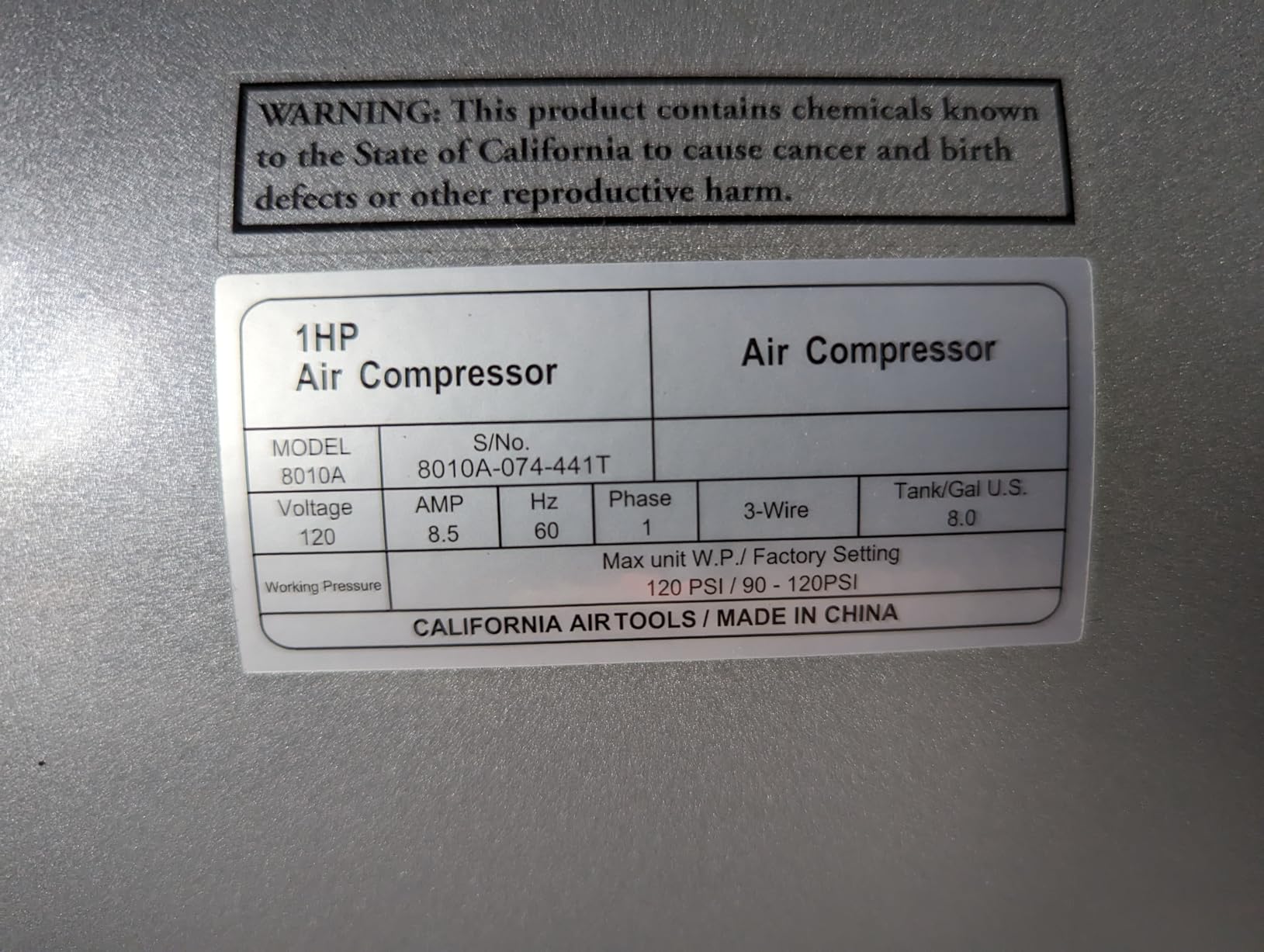
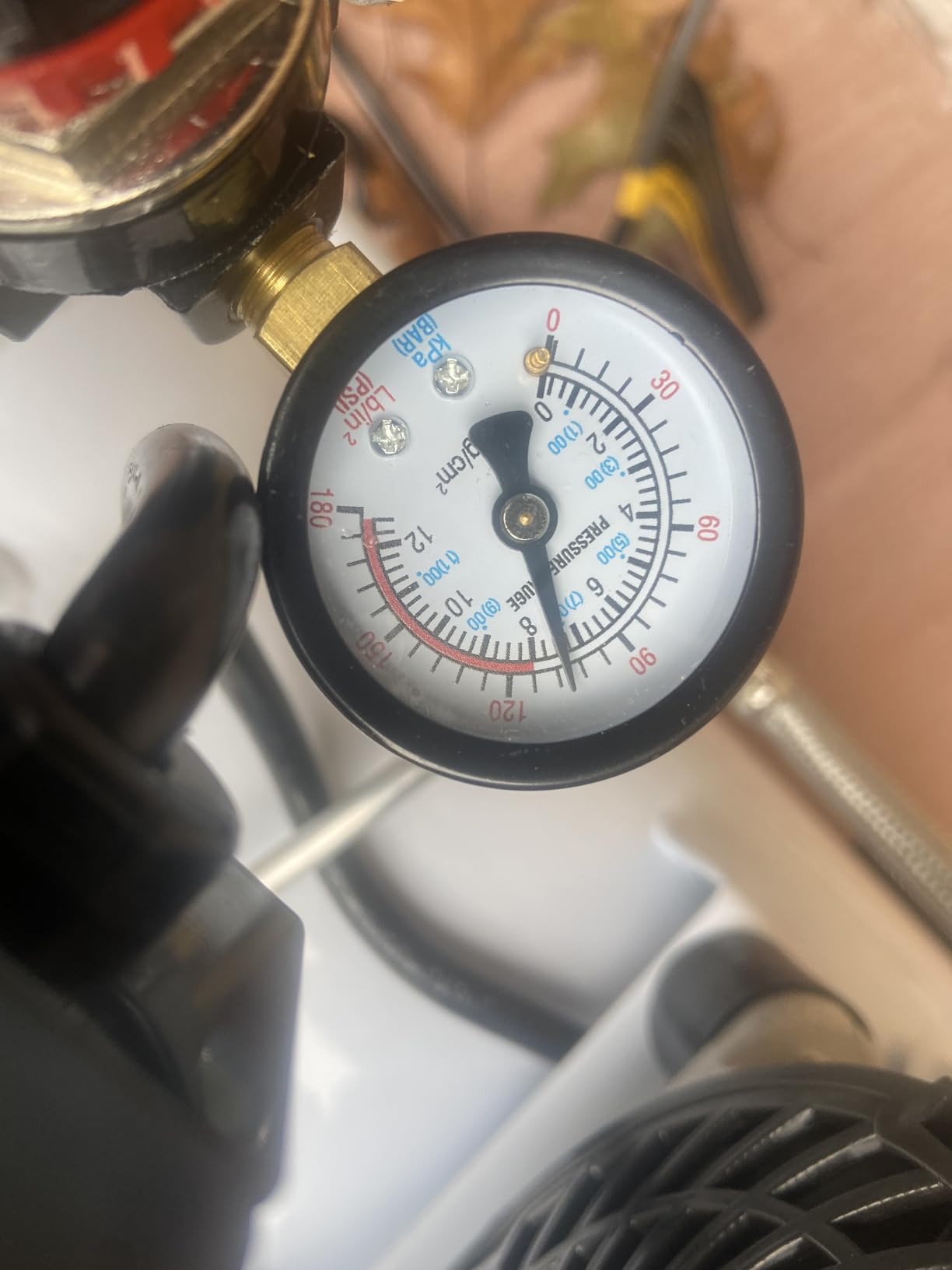
Output is 3.10 CFM at 40 PSI and 2.20 CFM at 90 PSI on a 1.0 HP motor turning at 1680 RPM. The tank fills from empty in about 165 seconds and recovers from 90 back to 120 PSI in roughly 60 seconds, which is fast enough that a brad nailer never notices it.
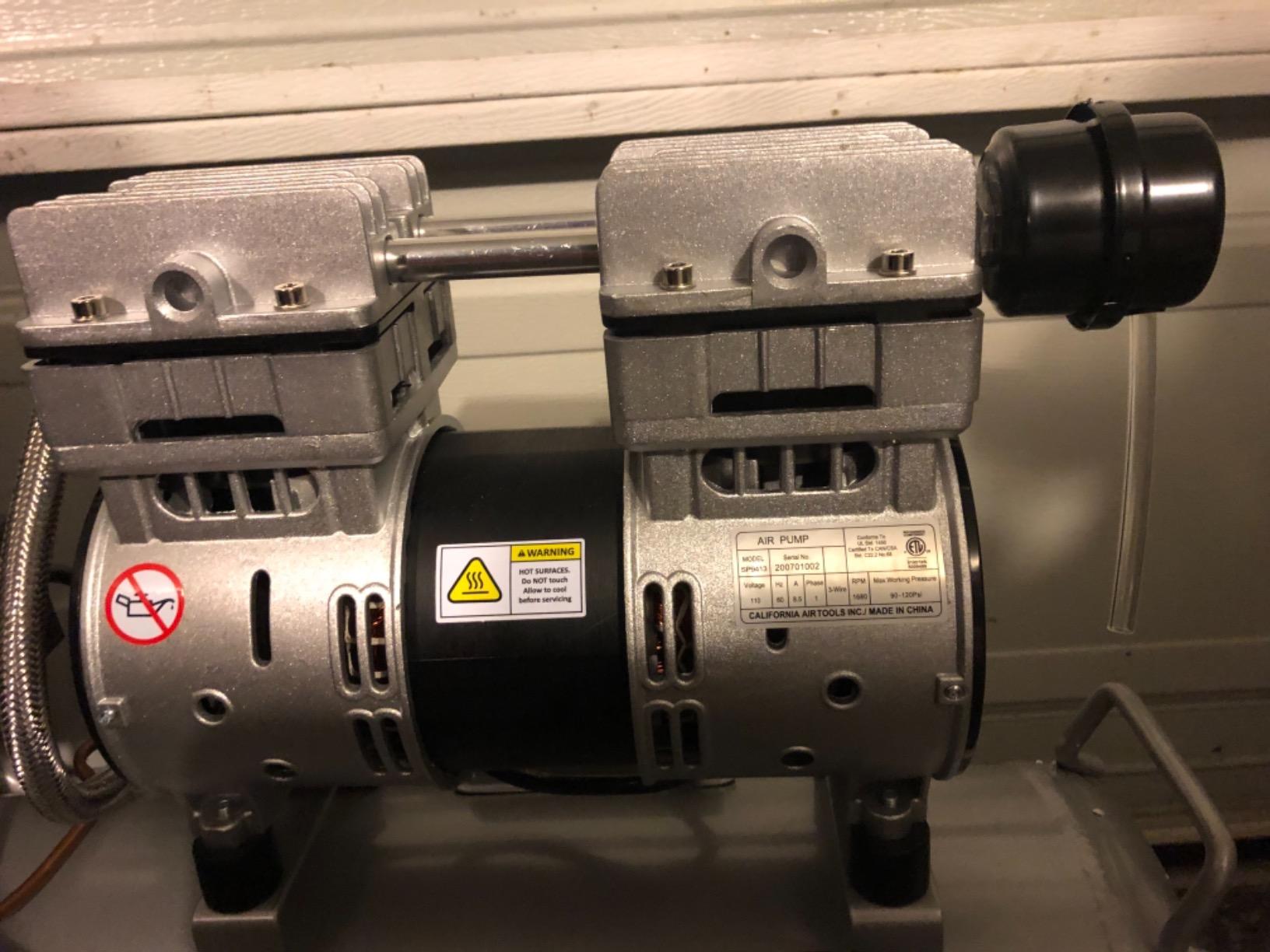
Owners use it for finish and brad nailing, inflating, airbrushing and the occasional spray job, and the reviews are unusually free of complaints beyond the two real limits: the 120 PSI ceiling and the 2.2 CFM output. At 37.3 lbs with a wheel kit, it moves around a garage more easily than any 8 gallon unit we found.
The oil-free dual piston pump is rated past 3000 hours and needs no maintenance, which is why this unit sits so high on owner longevity discussions. It is also one of the few compressors here that can sit on a 15-amp circuit with a few lights on, because it draws 8.5 amps.
Who this compressor suits
Homeowners doing trim work, cabinetry, tire inflation and light sanding who want one unit that covers everything without being loud. It also suits renters and shared-wall homes where the 8.5 amp draw matters as much as the decibel rating.
Who should skip it
Anyone planning to run a paint sprayer or continuous sanding for hours. The 2.2 CFM will not sustain those jobs, and an aluminum tank is not built for continuous duty. For that work, the 10020C at number 3 or the Stealth at number 10 make more sense.
5. Limodot 5 Gallon Quiet Compressor — Best Value Complete Package
Quiet Oil-Free Air Compressor, 68 dB, 2.8 CFM @ 90 PSI, 5 Gallon Air Tank
68 dB
2.8 CFM @ 90 PSI
5 gallon tank
1.2 HP
120 PSI max
Pros
- 68 dB is quiet enough to run indoors
- Includes a 25 ft hose and 13 piece accessory kit
- Refills empty to full in about 80 seconds
- 2.8 CFM at 90 PSI covers nailers and spray guns
- Oil-free design starts reliably in cold weather
Cons
- Brand is unfamiliar with less proven longevity
- 120 PSI maximum pressure
- Oil-free pump is not for continuous duty
Compressors at this spec level often arrive as a bare machine and a manual. This one arrives complete: a 25 foot PVC air hose, a 13 piece air tool accessory kit, the tank and a wheels kit. For a first garage compressor that removes about as much friction as any single feature can.
The numbers are respectable too. The 1.2 HP induction motor produces 4 CFM at 40 PSI and 2.8 CFM at 90 PSI into a 5 gallon alloy steel tank, refilling in about 80 seconds with 25 second recovery. Owners use it for staple guns, brad and roofing nailers, airbrushes and light spray work.
At 68 dB it is quiet enough for a house, workshop or shared space, though it sits closer to a washing machine than to a fridge. The oil-free pump needs no oil purchases and starts reliably in cold weather, which matters if your garage is unheated in winter.
The honest drawback is the brand. Limodot is not a name that appears in ten-year ownership stories, and reviewers who love the value of the package flag the same uncertainty we would: an unfamiliar oil-free design is harder to plan around for longevity than an established brand.
Who this compressor suits
First-time garage owners who want everything they need in one box and do not want to shop for a hose and fittings separately. It also suits anyone needing to keep moving between a nailer and a spray gun without waiting on a tank refill.
Who should skip it
Anyone planning to keep the compressor for many years and who cares about parts availability and service. If long-term reliability matters more than included accessories, the California Air Tools units offer a much longer ownership track record.
6. DEWALT DWFP55130 — Best for High-Pressure Dual-Nailer Work
DEWALT Air Compressor for Trim, 200-PSI Max, Quiet Operation (DWFP55130)
71.5 dBA
3.0 SCFM @ 90 PSI
200 PSI max
12 A
2.5 gal tank
Pros
- 200 PSI is the highest maximum pressure here
- Quiet at 71.5 dBA tested to ISO3744
- 12 amp motor starts easily on shared circuits
- Dual quick couplers run two nailers at once
- Stores flat or upright at only 12.5 inches thick
Cons
- 2.5 gallon tank refills often during sustained nailing
- 3.0 SCFM is modest for sanding or painting
- Oil-free pump has no continuous duty rating
- One year limited warranty only
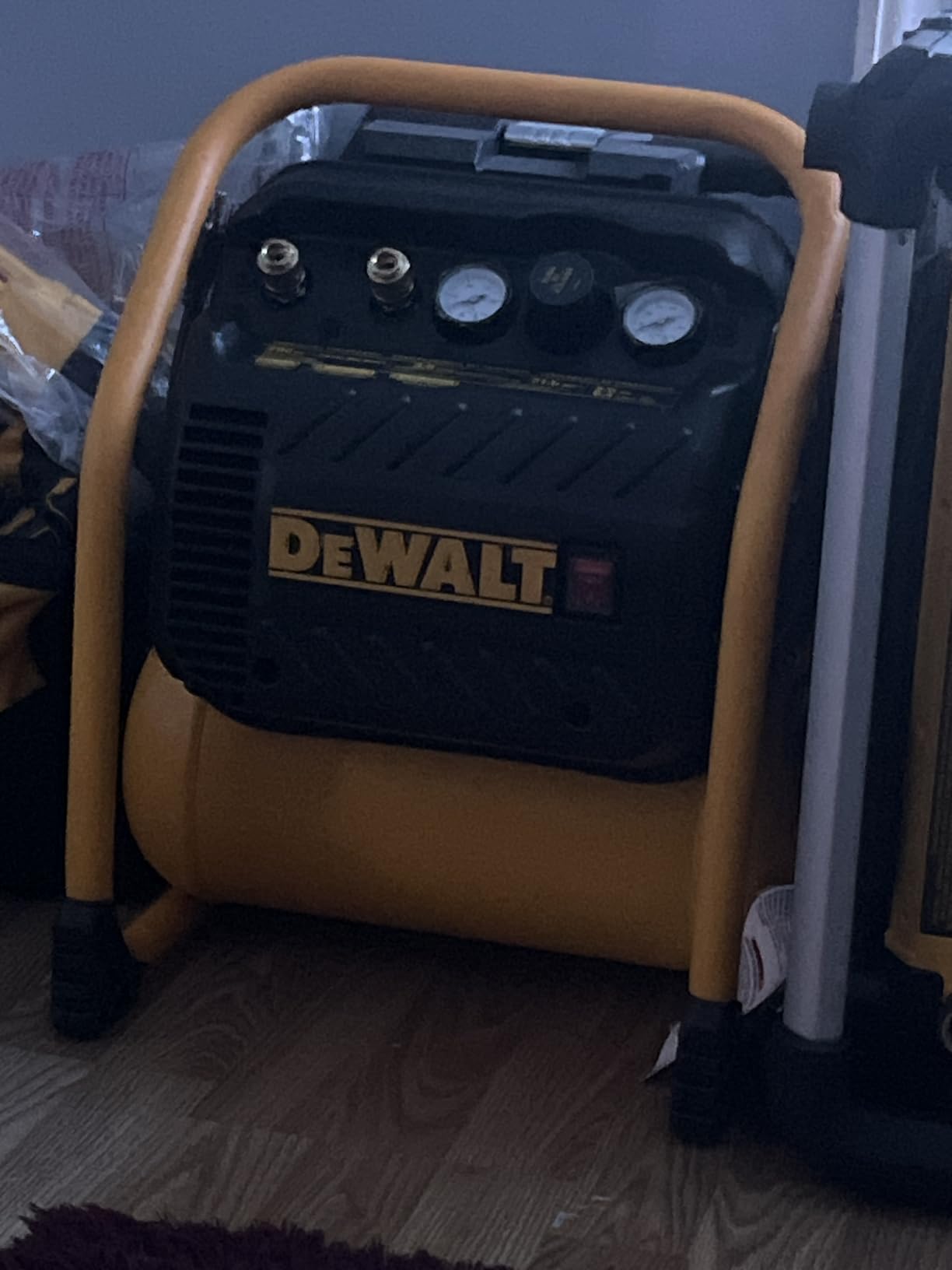
The DEWALT stands apart on one number: 200 PSI maximum, the highest on this list. That matters more than it sounds for trim carpentry, where a finish nailer set to 120 PSI still needs headroom to drive fasteners consistently without the pressure dropping mid-burst.
It also carries a figure most manufacturers avoid. The 71.5 dBA rating is stated as tested to ISO3744, a recognised measurement standard, which makes it more trustworthy than a bare number. In use, owners find it quiet enough for indoor finish work.
The 1.1 HP, 1440 watt motor draws 12 amps, low enough to start without tripping a shared breaker. Two universal quick couplers mean two nailers can run at once without a splitter, and at just 12.5 inches thick the unit can be stored flat in a cabinet or stood upright on a shelf.
The recurring complaint in the reviews is the 2.5 gallon tank. On a long run of finish nilling it refills often, and 3.0 SCFM at 90 PSI leaves little room for sanding or spray painting. It is a trim compressor that happens to be very good at trim.
Who this compressor suits
Interior finish carpenters and trim installers who want pressure headroom, two tools running at once, and a unit they can carry up stairs or store on a shelf. The low amp draw is a real advantage in a garage circuit shared with a saw or a welder.
Who should skip it
Owners of full-size framing nailers, sanders or sprayers. The 2.5 gallon tank will fight you on long nailing runs, and the oil-free pump has no continuous duty rating to fall back on.
7. Metabo HPT EC28M — Lightest Unit to Carry Around
Metabo HPT Quiet Air Compressor, Portable 1 Gallon Oil-Free, EC28M
59 dB
1 gallon tank
0.5 HP
125 PSI max
25.2 lbs
Pros
- 59 dB allows normal conversation while it cycles
- Lightest full unit here at 25.2 lbs
- Rubber carry handle with steel roll cage
- Integrated control panel for accurate PSI control
- Oil-free with overload protection circuit
Cons
- Very short run times from the 1 gallon tank
- No wheels so it is hand carry only
- No published airflow figure to compare
- 125 PSI maximum is on the low side
At 25.2 lbs this is the lightest full compressor on the list, just over two pounds below the next smallest. If your garage involves stairs, a loft, or carrying a compressor out to a car in the driveway, that difference is felt every single time.
The 59 dB rating holds up in practice. Owners report that a normal conversation is possible while the pump cycles, which places it with the 1P1060S and the Makita MAC100Q at the quiet end of the range. Seventy-three percent of its 845 reviews are five star.
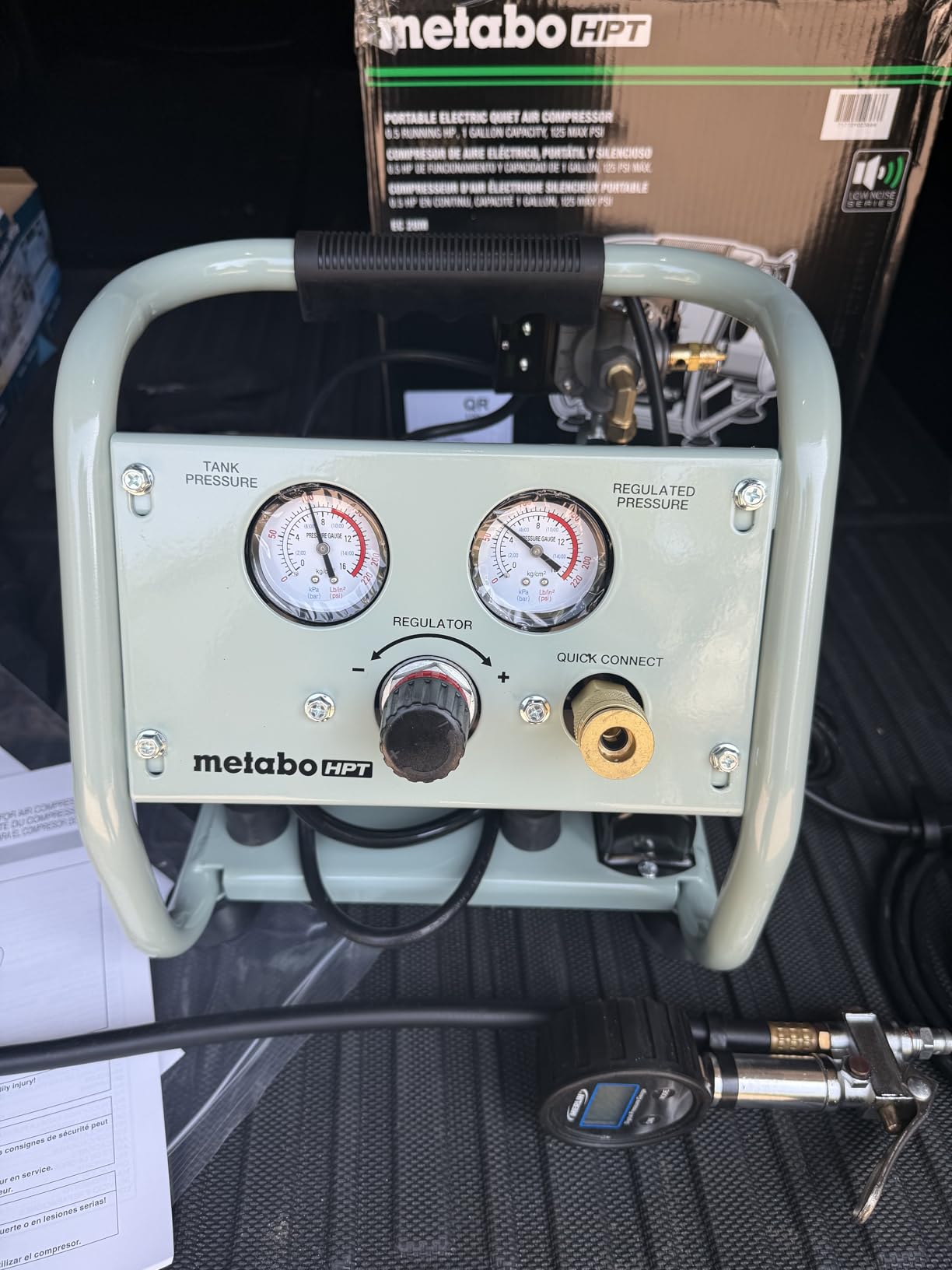
The universal quick coupler makes tool changes fast, which is the practical benefit for someone switching between framing, siding, finish and roofing nailers. The integrated control panel allows accurate PSI adjustment, and the steel roll cage protects the tank during transport.
Two things work against it. The 1 gallon tank and 0.5 HP motor give very short run times, so this is an intermittent detail tool rather than a workhorse. Metabo also publishes no airflow figure, which makes direct comparison against every other compressor on this list impossible.
Who this compressor suits
Owners who need a quiet companion unit for the car or a small job away from the main bench, and anyone who carries their compressor more than they roll it. The integrated pressure control is genuinely useful when moving between different nailers.
Who should skip it
Anyone doing sustained work of any kind. Short run times mean constant cycling, which is both slower and harder on the motor over time, and the lack of a published CFM figure makes it hard to plan around.
8. VEVOR 15 Gallon — Best for Spray Painting and Impact Tools on a Budget
VEVOR Air Compressor, 15 Gallon Steel Tank, 2HP 5.3 CFM@90 PSI Oil Free Air Compressor & Max. 125PSI Pressure, 78dB Ultra Quiet Portable Compressor, for Auto Repair, Tire Inflation, Spray Painting
78 dB
5.3 CFM @ 90 PSI
15 gallon steel tank
2 HP
125 PSI max
Pros
- 5.3 CFM at 90 PSI from a 2 HP motor
- 15 gallon steel tank with three layer coating
- Silencer assembly cuts real world noise
- Fast refill keeps up with impact and spray work
- Dual outlets and automatic overheat protection
Cons
- 78 dB is the loudest figure in this roundup
- Short power cord limits where you can place it
- Wheels and handle are lower quality
- Will not start reliably through an extension cord
Be clear about what this unit is: the loudest compressor on this list at 78 dB. It appears here because 78 dB sounds genuinely quiet compared with a conventional 80 to 90 dB workshop compressor, and because the rest of the package is unusually capable for the money.
A 1.32 kW oil-free motor running at 1680 RPM delivers 5.3 CFM at 90 PSI into a 15 gallon steel tank built from Q235B structural steel with a three layer rust-resistant coating. In practice that covers nail guns, impact wrenches, spray guns and pneumatic screwdrivers without pausing.
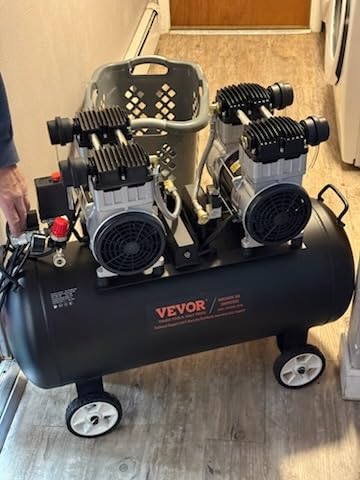
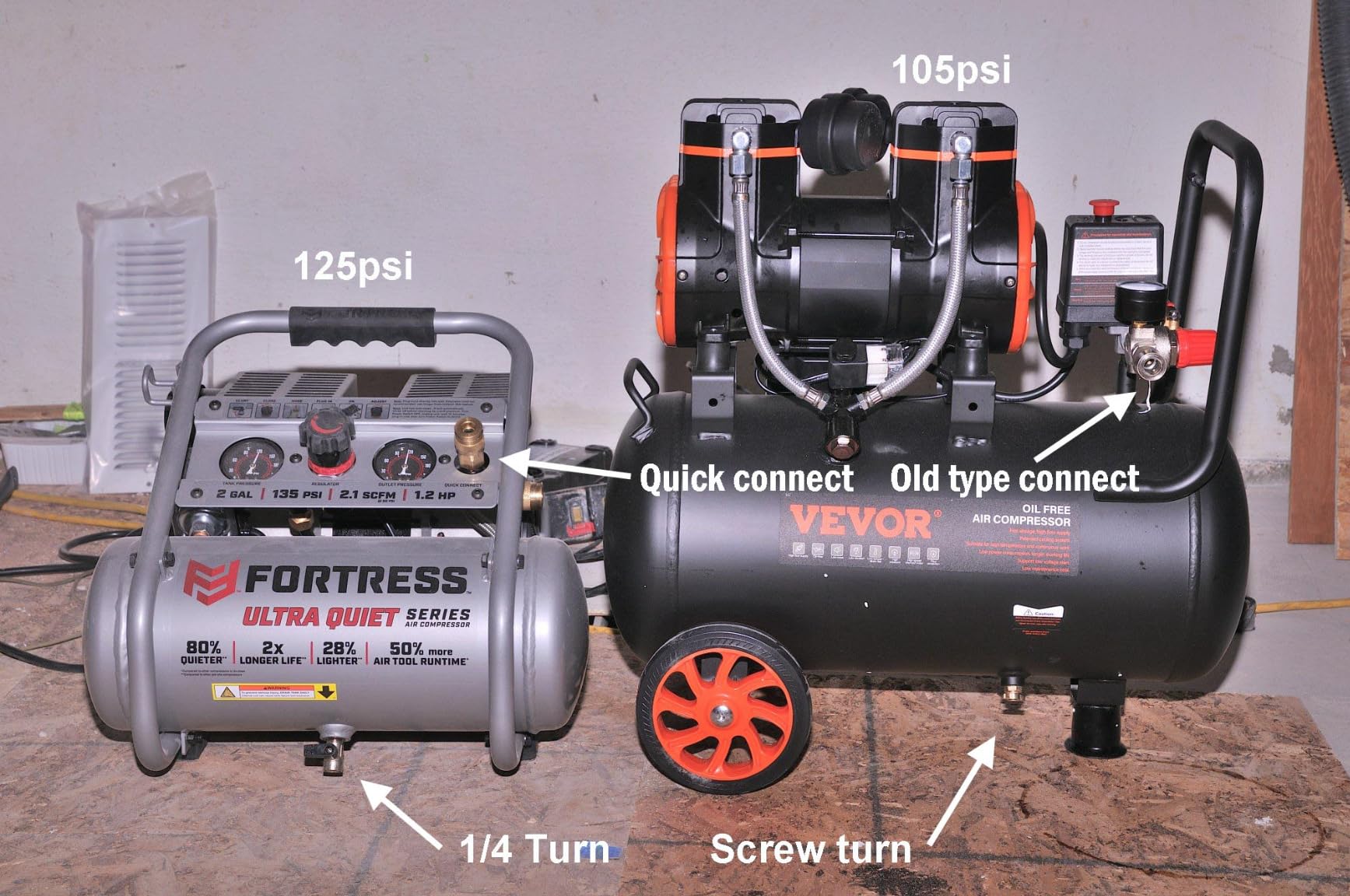
The silencer assembly is a thickened cover, rubber muffler pipe and filter cotton, and owners report real-world quietness well below what a typical pancake or hot-dog compressor produces. One of the recurring owner modifications we found in the reviews is swapping in higher-flow quick connects and a quarter-turn water bleeder.
Where owners complain, it is physical and electrical. The power cord is short, so placement near an outlet matters. The wheels and handle are weaker than the compressor itself and can tip when rolled. And it is voltage picky, so running it through an extension cord can stop it starting at all.
Who this compressor suits
Detailers and garage owners who need spray painting, impact wrenches or inflating capacity and care more about CFM and tank size than about being the quietest thing in the room. The automatic overheat and over-pressure protection also suit regular working use.
Who should skip it
Anyone in a shared-wall home or an attached garage where noise is the deciding factor, and anyone whose outlet is far from where the compressor needs to sit. At 81.6 lbs it also needs the handle and wheels to move.
9. Makita MAC320Q — Best 3 Gallon Unit for Continuous Trim Work
Makita MAC320Q Quiet Series 1-1/2 HP, 3 Gallon, Oil-Free, Electric Air Compressor
60 dB
3 gallon tank
1.5 HP
135 PSI max
8.5 A
Pros
- 60 dB Quiet Series output works indoors
- Recovers so fast it refills while you work
- 3 gallon tank sustains continuous low to medium pressure work
- Two outlets with separate tank and tool gauges
- Does not walk across the floor while running
Cons
- Heaviest 3 gallon unit at roughly 57 lbs
- No wheels or handle included
- Listed dimensions are inaccurate
- Quick connect fittings can be fiddly to seat
This is the compressor for someone who has outgrown the 1 gallon class but does not need 10 gallons. The 3 gallon tank with 2.6 SCFM sustains continuous low to medium pressure work, which is exactly the range that powder coating, spray guns and sustained finish nailing fall into.
At 60 dBA it matches the 8010A for quietness, and 85% of its 574 reviews are five star. Professional finish carpenters dominate those reviews, and the recurring word is recovery: it refills fast enough that work never pauses, which is the feature that separates a 3 gallon unit from a 2 gallon unit.
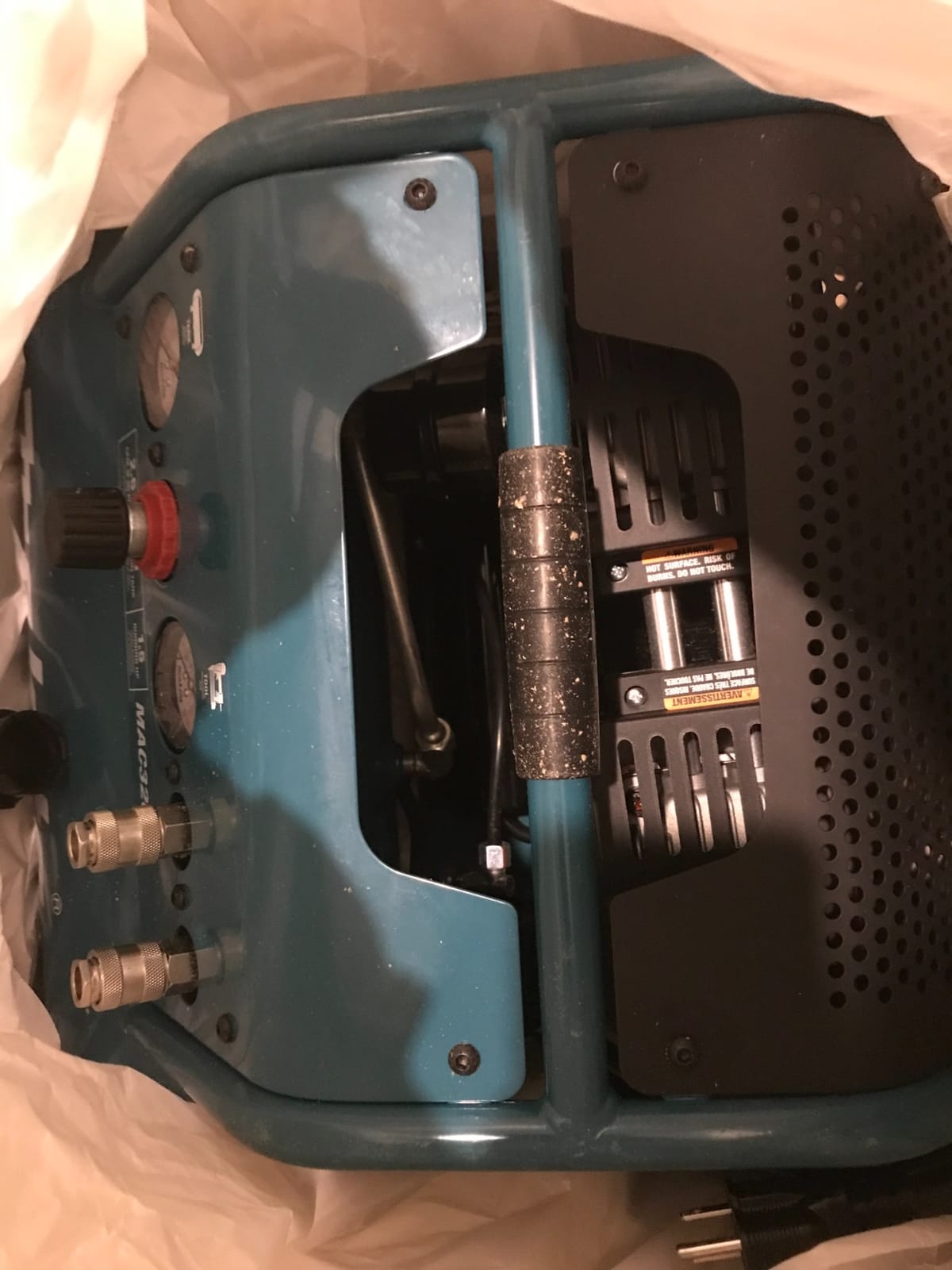
Two quick outlets plus separate tank and tool pressure gauges let you set each tool independently, which saves time when moving between a nailer and a spray gun. The roll cage and padded feet reduce vibration and stop the compressor walking across the floor while it runs.
The honest negatives are weight and wheels. At roughly 57 lbs it needs two hands to carry and no wheels are included. Owners also report that the listed 12 by 12 by 12 inch dimensions are wrong, and that the quick-connect fittings can need a jiggle to seat properly.
Who this compressor suits
Finish carpenters and serious hobbyists running a spray gun, powder coat job or long nailing session indoors. The twin gauges and twin outlets matter here because different tools need different pressures at the same time.
Who should skip it
Anyone who needs to move their compressor regularly. Without wheels and at roughly 57 lbs it is a carry-only unit, and the 135 PSI ceiling makes it cycle more often than a 150 PSI compressor of the same size.
10. Stealth 20 Gallon Ultra Quiet — Best for a Two-Car Garage with High Demand
Stealth 20 Gallon Ultra Quiet Air Compressor,1.8 HP Oil-Free Peak 150 PSI 68 Decibel, 5.5 CFM @ 40 PSI 5 CFM @ 90 PSI Silent Long Life Electric Air Compressor W/Wheel for Garage
68 dB claimed
5 CFM @ 90 PSI
20 gallon vertical tank
150 PSI peak
121.4 lbs
Pros
- Largest tank here at 20 gallons for long tool runs
- Soft low tone with low grating quality
- 150 PSI peak with 5 CFM at 90 PSI gives quick recovery
- Good rubber wheels for a heavy machine
- Oil-free design holds air well between uses
Cons
- 121.4 lbs is very hard to move and load
- Will not restart with air still in the tank on thin wiring
- Difficult customer service contact
- 12 percent one star reviews which is the highest share here
For a two-car garage running several tools in a week, tank capacity is the constraint that matters most, and this is the biggest tank we found: 20 vertical gallons at 150 PSI peak with 5 CFM at 90 PSI. That combination means a full tank holds air through a long afternoon without the pump running constantly.
The noise story here is more nuanced than the label suggests. One owner measured 78 dB point blank and 65 dB at 8 to 10 feet, and reported a much softer, less grating tone than a typical compressor. Distance and a closed door change the perceived result more than the raw number does.
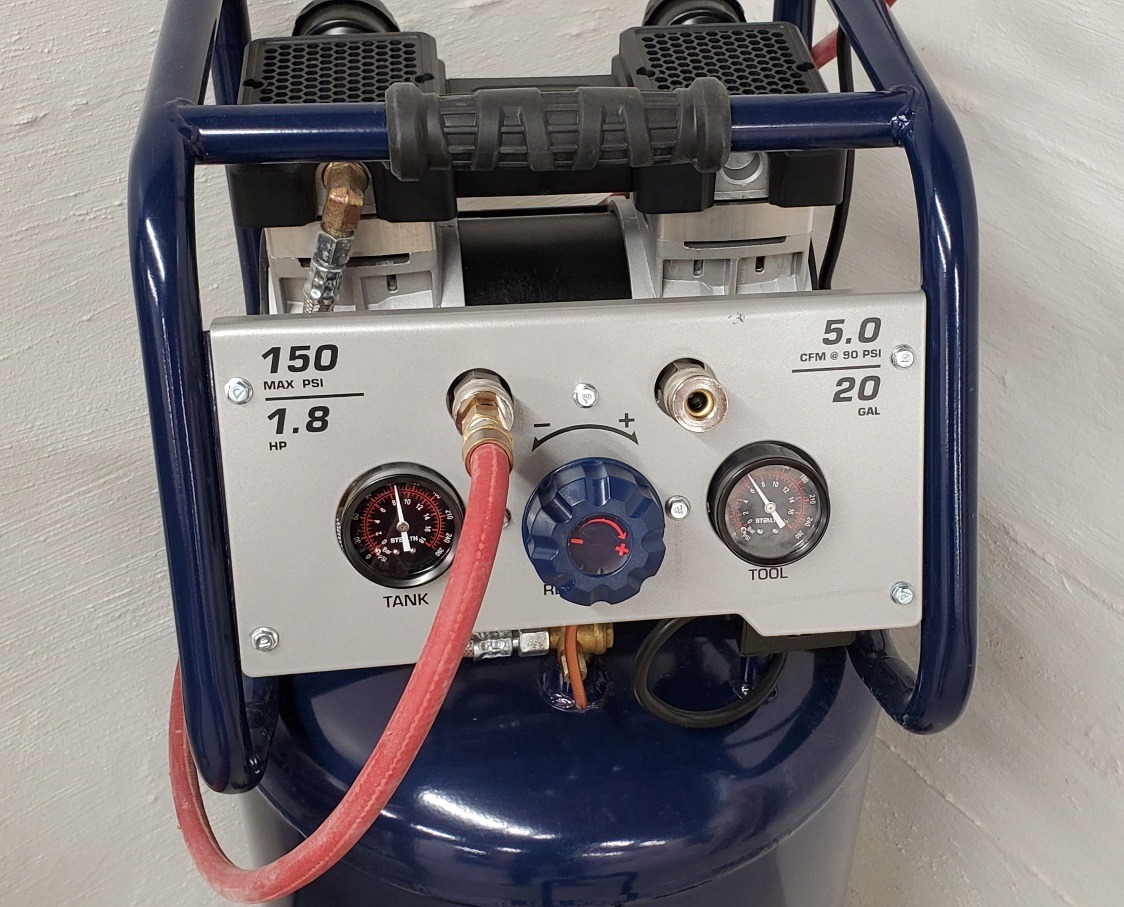
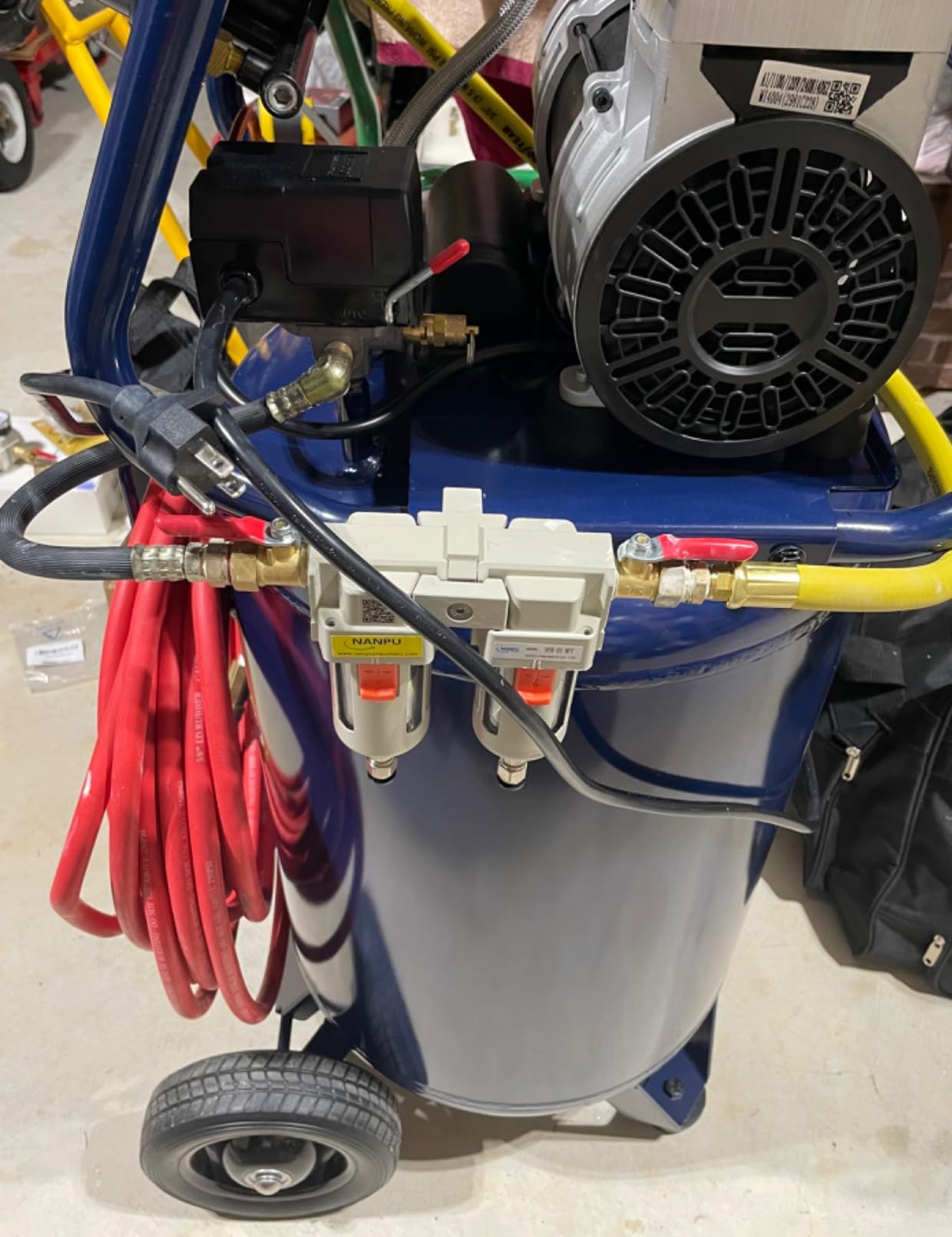
Owners replacing a loud old compressor frequently report a dramatic improvement. At 121.4 lbs with 8 inch rubber wheels, it rolls well across a garage floor but cannot be lifted into a truck bed by one person, and two quick couplers make tool switching fast.
The recurring negatives are electrical and physical. Several owners report it will not restart until the tank is fully emptied, so continuous operation such as sandblasting is not possible on thin wiring. Twelve percent of reviews are one star, the highest share in this roundup, and customer service is described as difficult to reach.
Who this compressor suits
Owners of a two-car garage who cycle through impact wrenches, inflators and spray guns across many sessions and have a dedicated outlet. If you mostly air up tires and run occasional nailers, 20 gallons is more than the job requires.
Who should skip it
Anyone who moves the compressor regularly, lives in an older building with thin wiring, or needs continuous-duty operation. It is also the loudest of our large-tank picks once you are standing next to it, so shared-wall homes should look elsewhere.
How to Choose a Quiet Air Compressor for a Garage
How loud is quiet? Decibel tiers for a garage
Decibels are logarithmic, so 70 dB is not slightly louder than 60 dB, it is roughly twice as loud. That is why the gap between a 60 dBA trim compressor and a 78 dBA workshop compressor is so much more noticeable than the numbers suggest.
56 to 59 dBA — quieter than normal conversation. The 1P1060S, Makita MAC100Q and Metabo HPT EC28M live here. Indoor trim work and tire inflation only.
60 to 68 dBA — about as loud as a normal conversation or a washing machine. The 8010A, Makita MAC320Q, Limodot and Stealth sit here. Nailers, light sanders and inflators.
68 to 72 dBA — clearly audible in an attached garage but workable behind a closed door. The DEWALT and California Air Tools 10020C sit here. Spray guns and light impact tools.
Above 75 dBA — back in conventional compressor territory. The VEVOR at 78 dBA is quieter than most of its class but not quiet in absolute terms.
Seventy dB is also the level owners on enthusiast forums repeatedly flag as the threshold for long-term hearing concern. If you will be standing next to the machine for hours, aim below it.
Match CFM at 90 PSI to the tools you actually own
CFM is the number that decides whether a compressor can run your tools. A finish or brad nailer needs about 1 CFM, a framing nailer around 2 to 3 CFM, an orbital sander 2 to 3 CFM, an air impact wrench 3 to 4 CFM, and a paint sprayer 4 CFM or more. A sandblaster wants 6 CFM and above, which is beyond every unit on this list.
Buy on your heaviest tool, not your most common one. The quietest units on this list cluster between 0.7 and 2.8 CFM, which is exactly the nailer and detailing range, and that is the core trade-off of this whole category. If you also need to spray or run impact wrenches, you are choosing between the 10020C, the VEVOR and the Stealth.
Tank size, PSI and recovery time
Tank capacity decides how long you can work before the pump kicks back in. One gallon covers a nailer and then stops. Five to eight gallons covers a full trim session. Ten to twenty gallons covers intermittent impact and spraying work without constant cycling.
Maximum PSI is the second half of the reserve question. Several models here cap out at 120 PSI, which is fine for nailing and inflating but leaves less headroom for spray work. The DEWALT at 200 PSI and the Stealth at 150 PSI peak give noticeably more reserve, and the Makita MAC320Q at 135 PSI sits in the middle.
Amp draw and the 15-amp garage circuit
A standard residential garage circuit is 15 amps, and that single number eliminates options before you start. The 1P1060S at 4.5 amps, the Makita MAC320Q at 8.5 amps and the 8010A at 8.5 amps can share a circuit with lights and small tools. The DEWALT at 12 amps is workable but tight. The California Air Tools 10020C at 14 amps effectively needs the circuit to itself.
Five signs your garage circuit cannot take a bigger compressor: the breaker trips when it starts, the saw dims when the pump kicks in, the compressor will not restart until the tank is fully emptied, you already run a welder or a large saw on that circuit, or you have had to add extension cords to reach an outlet. If two or more of those apply, a more efficient lower-amp compressor is the better purchase, not a bigger one.
Oil-free pumps, tank layout and duty cycle
Oil-free pumps need no oil changes and run cooler, which is where much of the low noise comes from. The cost is shorter service life than an oil-lubricated pump, an issue several owners raise on forums. Layout matters too: pancake and hot-dog tanks save floor space, twin-stack aluminium tanks are portable, and vertical tanks give the most capacity per square foot of floor.
Duty cycle is the limit nobody tests until it matters. None of the oil-free models here are rated for continuous duty, and several cut out under thermal protection after 30 to 45 minutes of sustained running. Plan on working in bursts rather than expecting a workshop-grade duty rating.
Where to place it, and how to quiet what you already own
Perceived noise in a garage is mostly a placement problem. Put the compressor on the far wall from your bench, not beside it. Run a long hose rather than moving the machine, because hose noise is lower than pump noise at the source. Set the tank on a rubber mat or folded moving pad, since vibration transmits through the slab and up through a parked vehicle. And keep it off bare concrete in a bare room, where reflections make a 60 dBA unit sound like 70.
For an existing loud compressor, five changes help in order of impact: replace the intake filter with a baffled or foam element, add an intake silencer, isolate the tank on vibration pads, move it to the far corner or another room with a long hose, and build a plywood enclosure lined with acoustic foam around the pump. Owners on woodworking forums consistently report that distance and isolation deliver more real quietening than any single part swap.
One more piece of garage-specific context: a closed garage door changes the noise picture completely, and a compressor that seems loud in testing often becomes acceptable once the door is shut. Our garage climate picks cover the ventilation side of a working garage, and our quiet dehumidifier guide covers the moisture side, which matters in a garage where a compressor sits year round.
Frequently Asked Questions
What type of air compressor is the quietest?
Rotary screw compressors are quietest in absolute terms because compression happens continuously and evenly rather than in piston slams, but they cost far more than a residential garage can justify. Among piston units, a low-RPM oil-free or brushless motor is the deciding factor. The California Air Tools 1P1060S at 56 dBA and the Metabo HPT EC28M at 59 dBA are the quietest units in our roundup, both using motors that turn far slower than a typical budget pump.
What is the best air compressor for a garage?
For most home garages the California Air Tools 8010A is the best balance: 60 dBA, an 8 gallon aluminum tank, 2.2 CFM at 90 PSI and an 8.5 amp draw that will not trip a shared circuit. If your work is heavier, the 10 gallon 10020C gives 5.3 CFM at 90 PSI for spray guns and impact wrenches. If you only run trim tools indoors, the quieter 1P1060S is the right call.
How many decibels is considered a quiet air compressor?
For a home garage, 60 to 70 dBA is the target range. Below 60 dBA is quiet enough to hold a conversation while the machine runs and usually means a 1 to 3 gallon tank. 60 to 68 dBA covers all nailers and light sanders. 68 to 72 dBA buys you 4 CFM or more for spray guns and impact wrenches. Above 75 dBA you are back in conventional compressor territory.
Is 78 dB loud for an air compressor?
For an air compressor, 78 dB is at the loud end. It sounds quiet next to a conventional 80 to 90 dB workshop unit, which is why the VEVOR in our roundup earns its place, but it is not quiet in absolute terms. Owners also point out that decibel figures are rarely measured at a stated distance, so the same compressor can measure very differently at point blank range and at 10 feet.
What size air compressor is best for a home garage?
A 5 to 8 gallon tank suits most home garages, covering nailers, inflating and light sanding without constant cycling. One gallon works for trim and detail work only. Ten gallons or more is worth it if you run impact wrenches or spray guns regularly, since the extra reserve means the pump runs less often. Tank size matters less than CFM at 90 PSI, which is what actually determines which tools will run.
Will a 2 HP air compressor trip a 15 amp breaker?
A 2 HP compressor drawing 14 amps, such as the California Air Tools 10020C, is close to the limit of a 15 amp circuit and can trip it if lights or another tool are running. Compressors under 9 amps, including the 8010A and the Makita MAC320Q at 8.5 amps, share a circuit comfortably. If you see the breaker trip on startup, the fix is a dedicated circuit or a more efficient lower-amp unit, not a longer extension cord.
Quiet Air Compressors for Garages: The Bottom Line
There is no quietest compressor that is also the most powerful one, and the best quiet air compressors for garages are really a set of trade-offs you size to your tools. Start with the California Air Tools 1P1060S at 56 dBA if trim and inflating are the job, move to the 8010A at 60 dBA if you want one unit for everyday garage work, and step up to the 10020C at 5.3 CFM only when spray guns or impact wrenches enter the picture.
Check the amp draw against your circuit before anything else, because a compressor that trips the breaker every time it starts will drive you back to the loud unit anyway. And give any compressor placement thought before you blame the decibel rating. Updated for 2026, our ten picks cover the range from a 29 lb nailer companion to a 20 gallon two-car garage workhorse.