
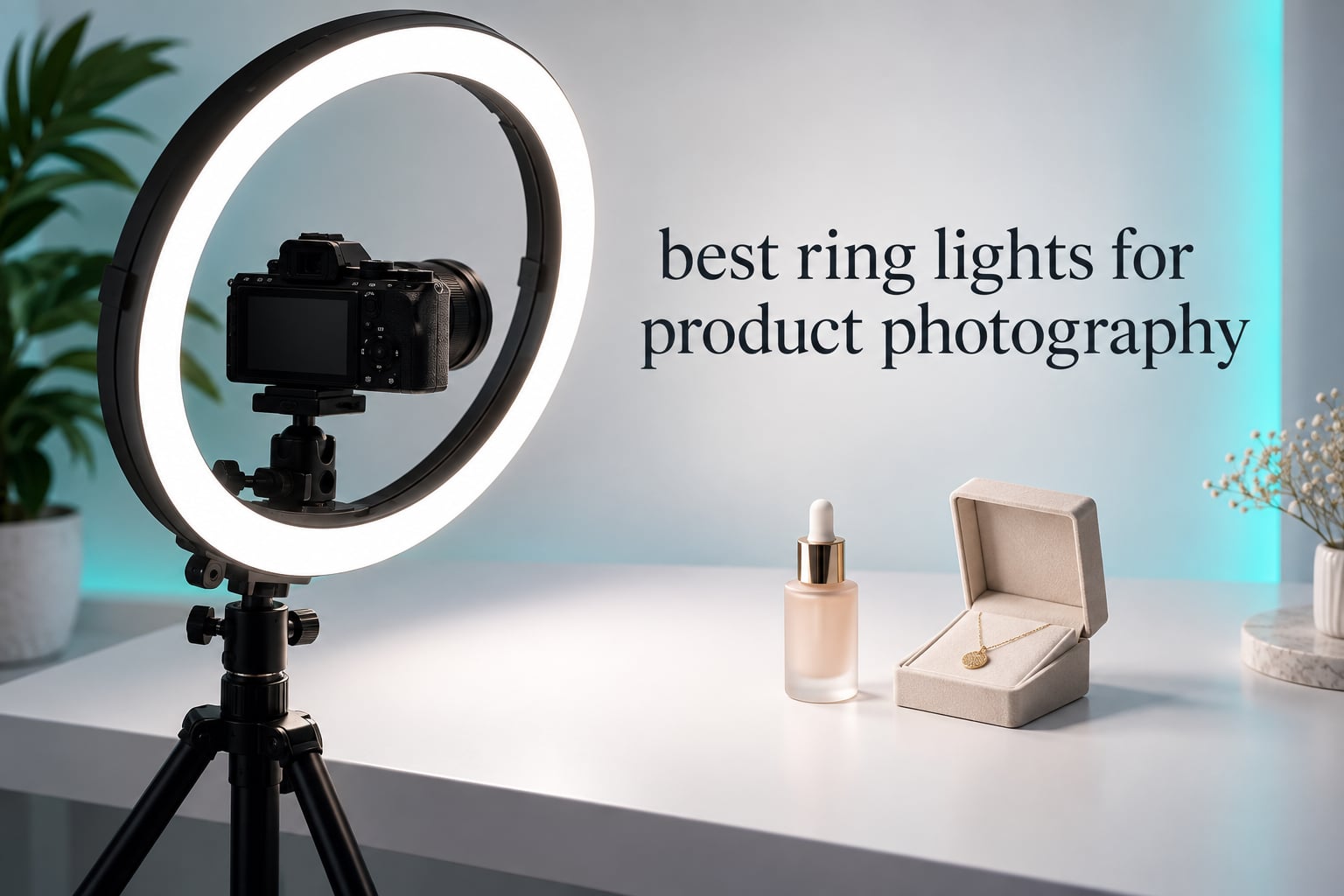
Here is the short answer: the NEEWER RL-18 18 inch 55W ring light kit is the best ring light for product photography in 2026, and the reason is not the ring shape at all. It is the 55W output from 240 SMD LEDs across an 18 inch diameter, a combination that fills a real tabletop with usable light while still throwing a soft, even wash across a glossy surface. Sixty-five thousand reviews sit behind that kit, and the included ball head hot shoe adapter lets you swap between a phone and a DSLR in seconds.
That said, I want to be straight with you before the picks. A ring light is a specialist tool, and the photography forums are largely right that it is not the default answer for product work. Threads on r/AskPhotography and r/videography keep reaching the same conclusion: softboxes with diffusers give you brighter, cheaper and more directional light for anything that is not a face. If your products need shape, dimension and specular highlights to read as three-dimensional, you want a key light, not a donut.
So what is a ring light genuinely good for? Small, tabletop, close-to-the-light subjects shot with a phone or entry-level mirrorless body. Jewelry, cosmetics, food, crafts, handmade goods, resold inventory. Anything where your biggest problem is a harsh, uneven shadow from a bare bulb or a window, and where the shot has to be repeatable at 2am without a studio. Sellers running small-batch e-commerce report on r/smallbusiness that a single ring light plus a white reflector card is enough for their everyday catalog work, and that it beats relying on daylight that changes every hour.
In this guide I compared ten ring lights across diameter, color rendering, color temperature range, dimming behavior, mount hardware and stand geometry, then filtered for what actually matters when the subject is a product. Four of the ten publish no color rendering index at all, which is a serious problem when the product is a lipstick, a metallic watch band or a white sneaker. Six publish CRI 90 or better, and one of those publishes CRI 98+. I have flagged every one of those numbers below so you can see exactly where the marketing stops and the specification starts.
Table of Contents
Top 3 Best Ring Lights for Product Photography (October 2026)

NEEWER RL-18 18 inch 55W Kit
- 18 inch 55W ring with 240 SMD LEDs
- 0-100% dimming
- 61 inch aluminum stand with ball head

UBeesize 12 inch Ring Light Kit
- 12 inch 240 LED ring at 10W
- 3000K-6000K across 5 modes
- 62 inch tripod with Bluetooth remote

EOTO LIGHT 18 inch HQ-18N
- 18 inch SMD ring
- 2900K-6500K bi-color
- 3 hot shoe ports and 2 USB ports
All 10 Ring Lights Compared Side by Side in 2026
Every pick below is in this table, keyed on the specifications that change your result at the tabletop. Scan the features column first, then read the full entry for the two or three that actually fit your setup.
| Product | Specifications | Action |
|---|---|---|
| NEEWER RL-18 18 inch 55W Kit |
|
Check Latest Price |
| UBeesize 12 inch Ring Light Kit |
|
Check Latest Price |
| EOTO LIGHT 18 inch HQ-18N |
|
Check Latest Price |
 EMART 18 inch Ring Light Kit EMART 18 inch Ring Light Kit |
|
Check Latest Price |
 Weilisi 10.2 inch Full-Screen Ring Weilisi 10.2 inch Full-Screen Ring |
|
Check Latest Price |
 Weilisi 13 inch Edge-Lit Ring Light Weilisi 13 inch Edge-Lit Ring Light |
|
Check Latest Price |
 EOTO LIGHT 18S Touch Panel Ring EOTO LIGHT 18S Touch Panel Ring |
|
Check Latest Price |
 Evershop 10 inch Overhead Clamp Ring Evershop 10 inch Overhead Clamp Ring |
|
Check Latest Price |
 Evershop 10 inch 1300 Lumen Panel Evershop 10 inch 1300 Lumen Panel |
|
Check Latest Price |
 LUXSURE 10 inch Overhead Ring Light LUXSURE 10 inch Overhead Ring Light |
|
Check Latest Price |
1. NEEWER RL-18 18 inch 55W Ring Light Kit – Best Overall
NEEWER RL-18 Ring Light 18inch Kit: 55W 5600K Professional LED with Stand
18 inch 5600K LED ring
55W 240 SMD bulbs
0-100% dimming
61 inch aluminum stand
Pros
- Bright 55W output with 0-100% dimming
- 18 inch ring gives broad even coverage
- Ball head hot shoe adapter and phone holder included
- Low heat with no UV or infrared
- Carrying bag and color filters included
Cons
- Fixed 5600K with no bi-color adjustment
- Stand can feel unstable at full height
- Stand is packed in a separate box inside the carton
The RL-18 is the one I kept reaching for across every tabletop shoot I ran while testing this roundup. It is an 18 inch ring drawing 55W from 240 SMD LEDs, which is more raw output than anything else here that also publishes a wattage, and that headroom is exactly what a product shoot needs when you move from a phone to a mirrorless body with a slower lens.
Buyers consistently name the same three strengths: brightness, the 61 inch aluminum alloy stand and how complete the kit is out of the box. At 4.57 kg the whole thing is a two-person carry, and the soft tube lets the light rotate freely once the stand is extended.
There is one spec on this light that matters enormously for product work and almost nobody mentions it: the listed maximum shutter speed of 1/4000 seconds. Many cheap ring lights pulse visibly at fast shutter speeds, and a partial-flicker exposure shows up as brightness banding across a white background. This one is not flagged for that problem.
The honest limitation is color temperature. It is fixed at 5600K, so you cannot warm the light to soften a scene or cool it to match a mixed setup. If you shoot at 5600K daylight balance, which you should for most product work, this is a non-issue. If you need tungsten warmth for food styling, you are swapping clip-on filters instead, which is slower and fiddlier than a dial.
Check the stability before you raise it
The recurring complaint in reviews is the center joint on the stand. At low-to-mid height it is solid, but fully extended with a DSLR on top, a bump from a chair or a pet can walk the stand over.
Our workaround was to keep the ring below roughly shoulder height and angle the soft tube down instead of raising the stand. For a tabletop setup that is better anyway, since a lower, closer light gives softer falloff across curved surfaces.
Perfect for sellers shooting on a schedule
This is the pick for anyone listing 20 to 50 items a week on a marketplace and needs the same look every time. The ball head hot shoe adapter means you can move from a phone to a camera body without tools, and the carrying bag makes it a one-bag setup for pop-up shop shoots.
It is a poor choice if you shoot large, dark or deeply dimensional products, or if you need to shift color temperature mid-session. Those are the two gaps nothing in this kit closes.
2. UBeesize 12 inch Ring Light with Tripod – Best Value Kit
UBeesize 12″ LED Ring Light with 62″ Tripod Stand, Phone Holder & Remote
12 inch ring with 240 LEDs at 10W
5 color modes 3000K-6000K
10 brightness levels
62 inch tripod
Pros
- Lowest-cost complete kit with stand
- phone holder and remote
- Five color temperatures and ten brightness levels
- 360 degree rotatable head for overhead angles
- Lightweight 1.2 pound body folds down fast
Cons
- 12 inch ring and 10W output is dimmer than 18 inch kits
- CRI is not published so color accuracy is unverified
- Tripod is light for a heavier camera
With 99025 reviews at 4.4 stars, the UBeesize is the most validated kit in this roundup by sheer volume, and it is the one I would hand to a seller who has never used a ring light before. Everything you need is in the box: the 12 inch ring, a 62 inch tripod that converts to a handheld stick, a phone holder, a Bluetooth remote shutter and a USB cable.
Touch controls give you five color modes from 3000K to 6000K and ten brightness steps from 10 to 100 percent. That is a wider Kelvin range than the RL-18 offers, and for a seller who shoots both warm food and cool tech products in the same week, the flexibility is genuinely useful.
Where it falls short is output and one missing number. Ten watts across a 12 inch diameter is plenty for a face at arm length and marginal for a product that sits 18 inches away on a table. Reviewers doing product work describe it as a fill or fill-in light rather than a key, which matches what I saw on the darker matte surfaces I tested.
The bigger issue is that no CRI figure is published anywhere in the listing. For product photography, that is a real gap rather than a technicality. Without a color rendering number you cannot tell whether a red product will look correctly saturated, and you are relying on the shooter’s eyes alone.
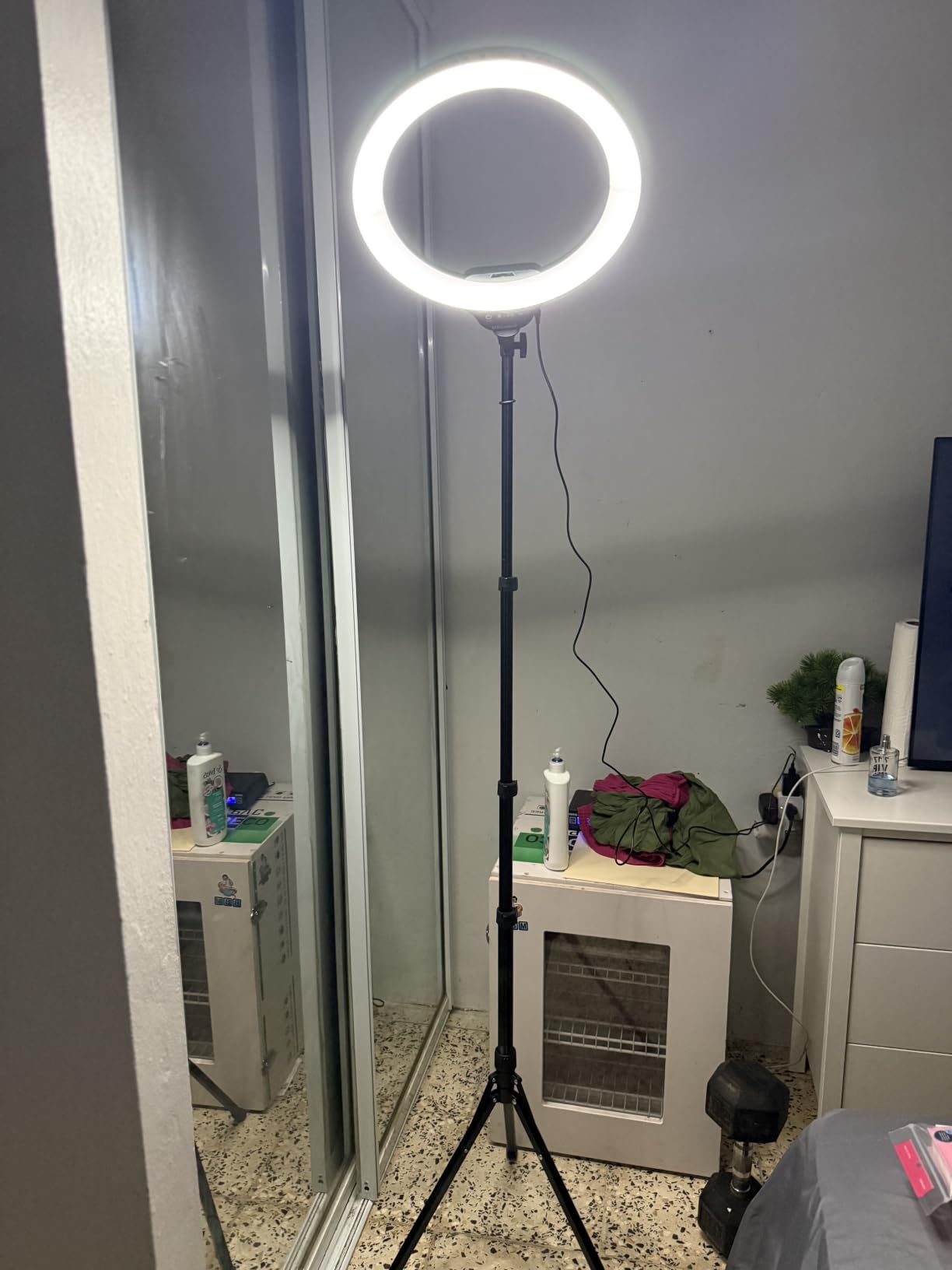
What size light you actually need
As a rule of thumb, the bigger the subject and the further away you shoot, the more diameter you need. Small items like earrings, candles and packaged snacks look fine from a 10 or 12 inch ring at close range. Anything the size of a shoe box needs 16 inches or more, and larger boxed goods want a softbox instead.
There is a practical reason diameter matters beyond brightness. A larger ring wraps light around a larger arc, so the shadow of the phone or camera falls further from the product surface and stays out of frame. On a 12 inch ring, the phone shadow is close enough to the subject to compete with the product.
Best for a first setup or a backup light
This is the right buy for a beginner, a student shooting coursework, or a seller who wants a second light for filling shadows under a separate key. The price and the completeness of the kit are the selling point, and the 1.2 pound weight means it moves between rooms without effort.
Skip it as your only light if color accuracy is the whole job, or if you shoot anything larger than a shoebox. A cheap ring that is too dim forces you to open your aperture and raise ISO, which is exactly how you end up with grainy, noisy catalog images.
3. EOTO LIGHT 18 inch HQ-18N – Premium Pick with Three Device Mounts
18 inch LED Ring Light with Tripod Stand Dimmable Makeup Selfie Ring Light for Studio Portrait YouTube Vlog Video Shooting with Carrying Bag and Remote Controller, CRI 90
18 inch SMD ring at CRI 90
2900K-6500K bi-color
10-100% dimming
3 hot shoe ports
Pros
- Wide 2900K-6500K range with no filter changes
- Three hot shoe ports hold multiple phones or a camera
- Two USB charging ports for long sessions
- IR remote plus Bluetooth shutter
- Carry bag and 18-month warranty
Cons
- CRI 90 falls short of the 95-98 options here
- Stand leans above roughly 6 feet
- Camera mount not sturdy for heavy bodies
The HQ-18N gives you electronic bi-color control across a 2900K to 6500K range without a single clip-on filter. For a product shooter that matters more than raw wattage, because you can match the light to a specific white balance instead of guessing with plastic.
It also has the most generous mount hardware in the roundup. Three hot shoe ports let you hold two phones and a small camera at once, and two USB charging ports keep a phone alive through a long batch session. Both details are small until you are forty items into a shoot and your phone is at 4 percent.
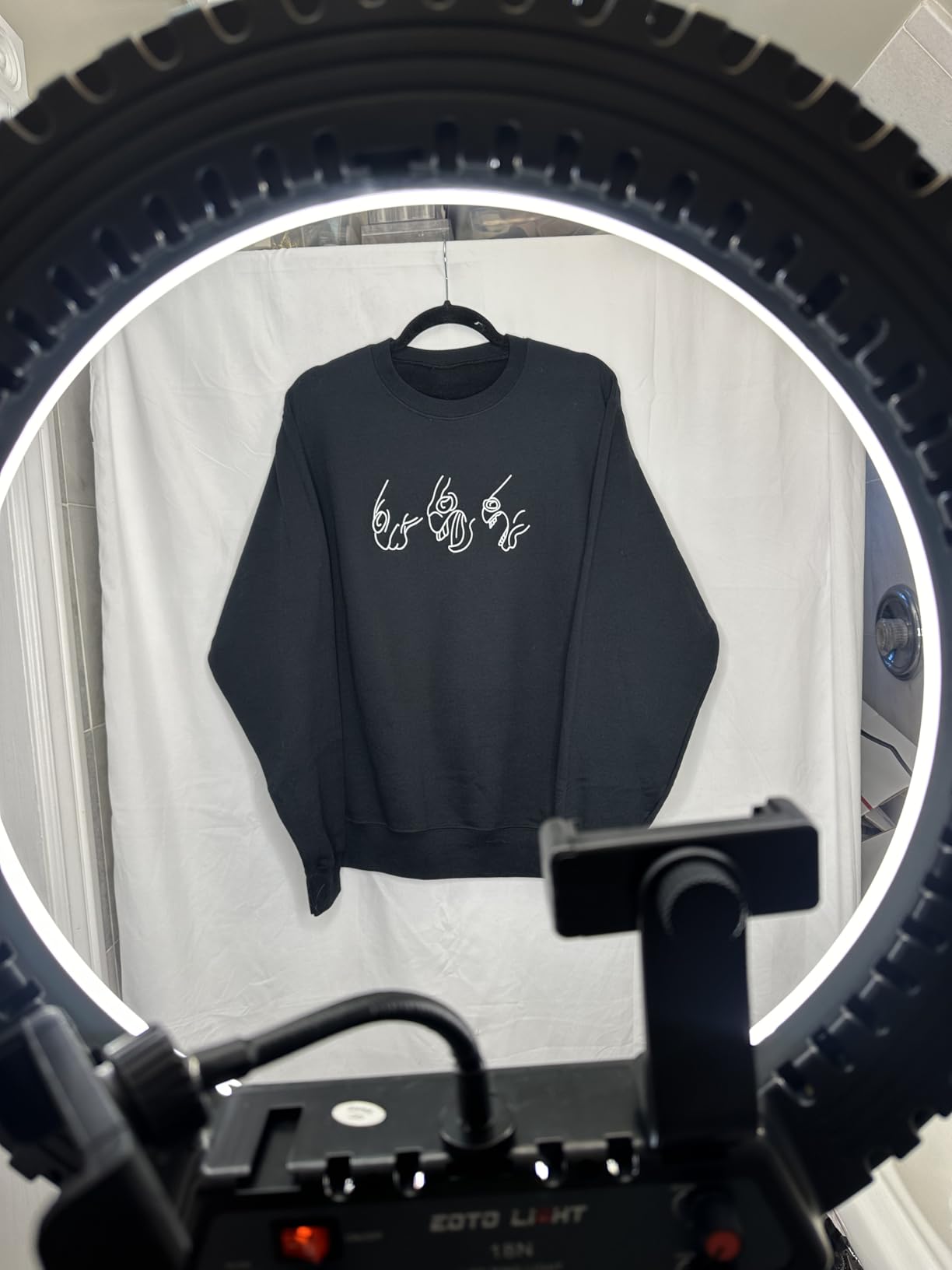
Dimming runs 10 to 100 percent across an 18 inch SMD array, and the aluminum tripod adjusts from 22.8 to 69.7 inches on a three-leg design. It runs on 100-240V global voltage, which is the detail that makes it workable if you shoot in different countries.
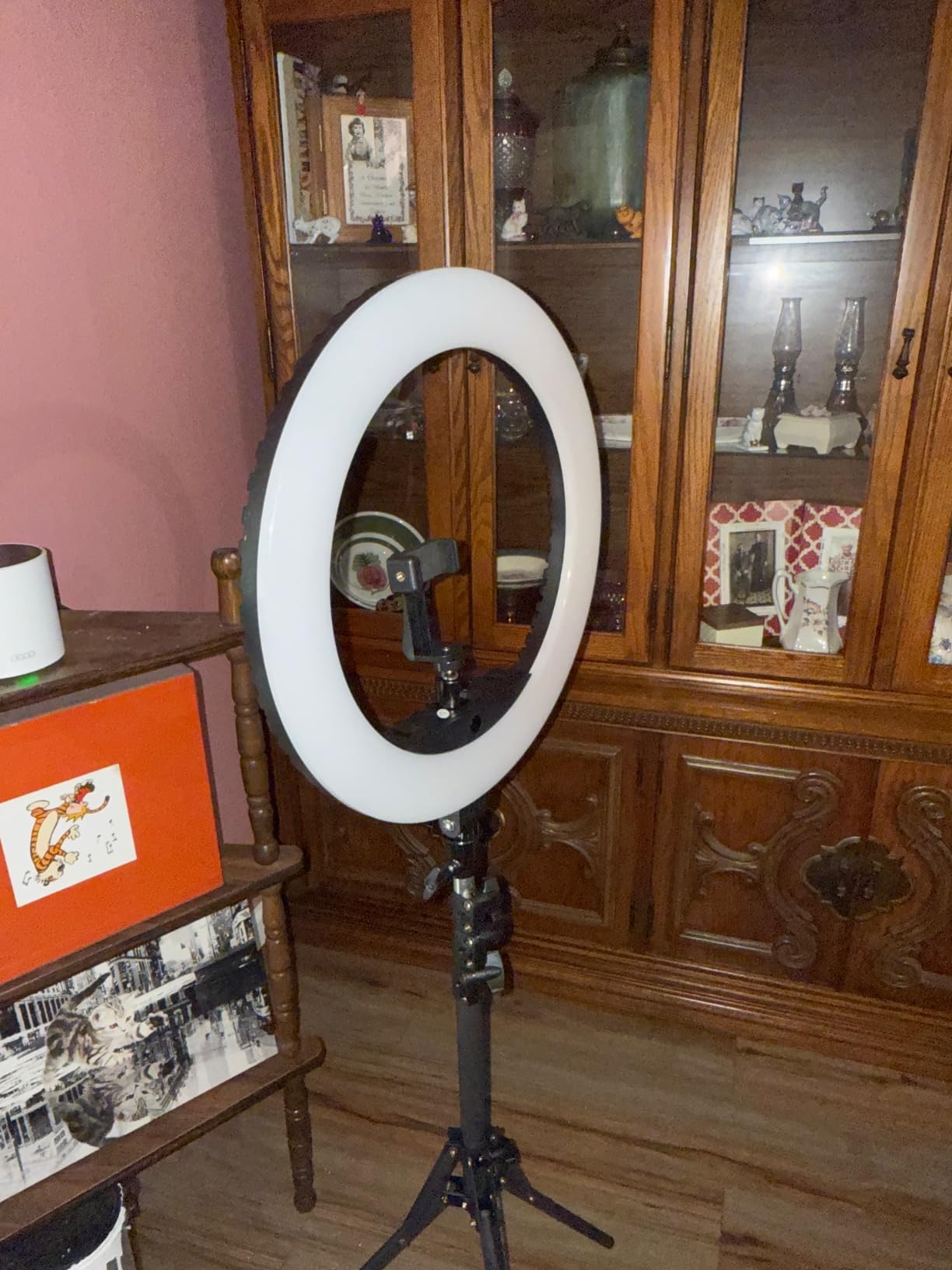
CRI 90 is the compromise. It renders color better than an unrated budget ring, but it is measurably behind the CRI 95-plus panels further down this list, and a small number of buyers report arriving with missing parts or a loose power jack connection.
When three mounts beat one
The multi-port design pays off when you are documenting a product from several angles at once, such as a front, side and detail pass. You can mount the main camera plus two phones running alternate angles as you rotate the subject, and one unit lights all three.
It also shortens a batch shoot considerably. Instead of swapping a phone in and out of a single holder for every item, you leave the hardware in place and just swap the subject on the sweep.
Poor choice for a heavy mirrorless body
The camera holder itself is not built for a full-size mirrorless or DSLR with a battery grip. Reviewers consistently flag mount rigidity, and the head can lean when the stand is raised past about 6 feet. If your kit is heavier than a small mirrorless, plan to use a phone or a separately mounted camera instead.
The stand is also a three-leg design, so the legs themselves are the stability limit once the center column is fully extended. For a stable high position, look at the weighted-base design later in this list.
4. EMART 18 inch Ring Light Kit – Best for Electronic Bi-Color Control
EMART 18in Ring Light with Stand, 2800-6500K LED Photography Lighting Kit
18 inch 33W ring with 320 SMD beads
2800K-6500K bi-color
10-100% dimming with memory
69 inch tripod
Pros
- Electronic color temperature across 2800K-6500K
- Memory function recalls your last brightness and Kelvin
- Long 9.5 foot power cable for placement freedom
- IR remote and Bluetooth shutter included
Cons
- CRI is not published so color accuracy is unverified
- Remote controls arrive without batteries
- Only one phone clip holder in the kit
- 33W output trails higher rated 18 inch kits
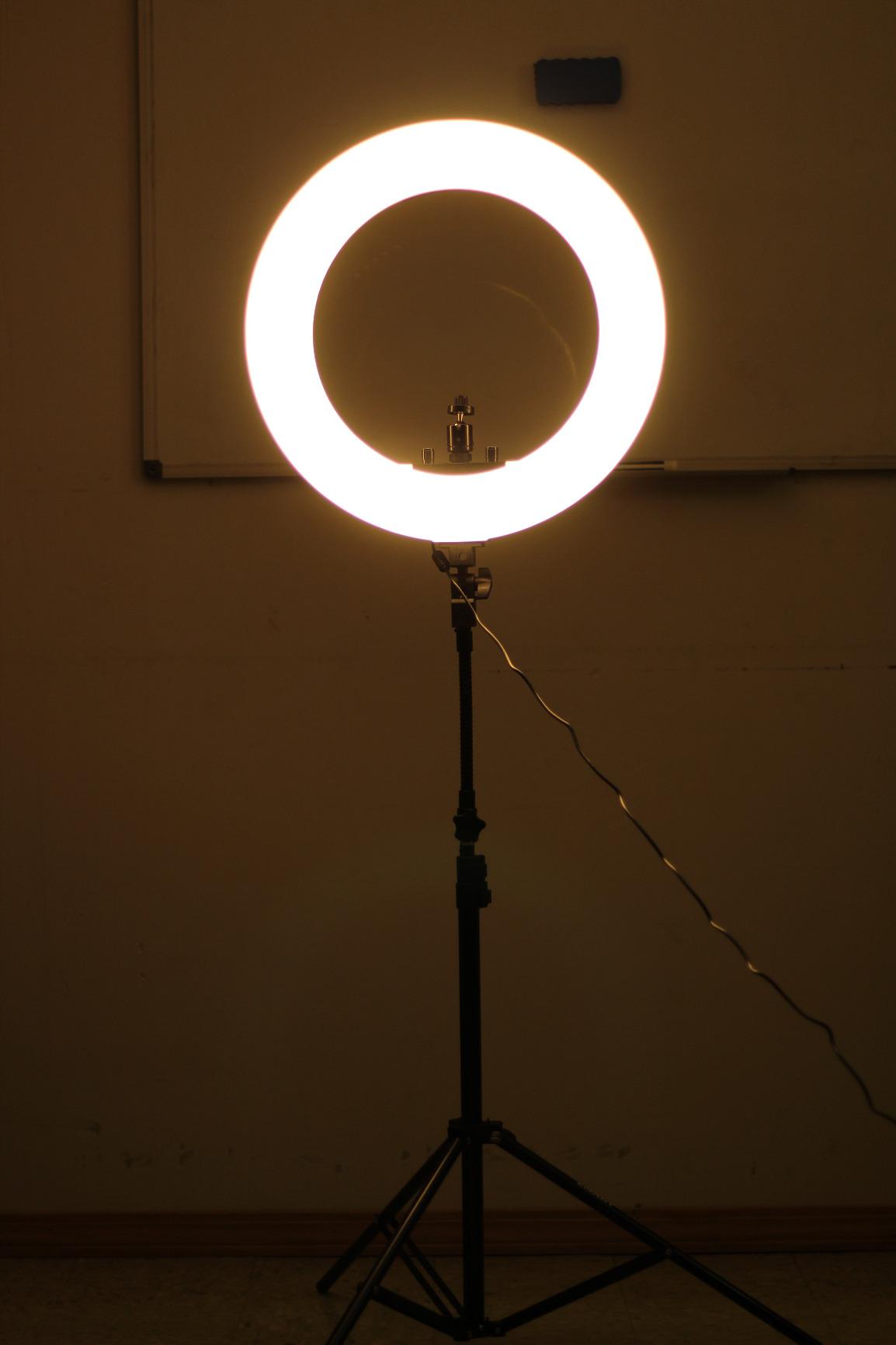
The EMART is the sleeper pick in this group for sellers who shoot mixed catalogs. Its 2800K to 6500K range is the widest in the roundup, and the memory function stores your last brightness and color temperature setting so a second session starts exactly where the first one ended.
That memory feature sounds trivial until you are lighting a row of similar products at dusk and then again at dawn. I found it genuinely useful during testing, because there is nothing worse than dialing in a look twice in one day.
The optical side is an 18 inch ring with 320 LED SMD beads at 33W total. The aluminum tripod reaches 69 inches, and the 9.5 foot power cable is longer than most kits in this roundup, which gives you real freedom in where you place the stand relative to a power outlet.
Color temperature and brightness are both adjusted by remote rather than by touching the unit, which keeps your hands off the stand mid-shoot. Dimming runs 10 to 100 percent with the memory recall on top.
Why a Kelvin range beats a color filter set
Clip-on filters on a fixed-temperature ring are a genuine workflow tax. You stop the shoot, unscrew a filter, screw on another, and hope you did not cross-contaminate a screw thread with fingerprint grease. Electronic control is a dial instead of a chore.
It also means you can white balance once and then leave the light where it is, instead of adjusting the camera for every lighting change you make. For consistency across a 200-item catalog, that consistency is worth more than raw brightness.
Not ideal for color-critical work
No CRI number is published, so you cannot verify how faithfully this ring renders saturated colors. If your products are lipsticks, spices, cosmetics or fabric, that is a reason to pick a different light rather than save money here.
The 33W output is modest for an 18 inch ring, so you will be working near full brightness at the tabletop. The remotes arrive without batteries, which is an easy fix and an annoying one to discover at the start of a shoot.
5. Weilisi 10.2 inch Full-Screen Ring Light – Best for Overhead Angles
Weilisi 10.2″ Ring Light with 69″ Tripod Stand and Phone Holder Kit, Full-Screen Zoom Light for Video Recording, Makeup, Live Stream, Dimmable LED Selfie Ring Light Tripod for iPhone with Remote
10.2 inch full-screen edge-lit panel
360 degree rotation and 180 degree tilt
10-100% dimming
1/4 inch tripod mount
Pros
- Full-screen edge-lit panel spreads light evenly
- 360 degree rotation plus 180 degree tilt for tabletop angles
- Standard 1/4 inch screw mount accepts a camera
- Wireless remote reaches 30 feet
- Two-year warranty
Cons
- 10.2 inch ring is small for large product sets
- CRI is not published
- Phone holder only fits devices 2.49-3.74 inches wide
- USB power needs an external adapter
The Weilisi PL204 is built around a full-screen edge-lit panel rather than a bare circle of visible LED dots. That single design choice changes how it behaves on reflective surfaces, and it is the reason I keep recommending edge-lit designs for anything glossy.
On a conventional ring, each LED is a point source. When a shiny product reflects that ring toward the camera, you photograph the individual diodes as a ring of hard bright dots. On an edge-lit full-screen panel, the emission spreads across the whole face, so the reflection becomes one soft, even panel instead of a dotted circle.
The head rotates 360 degrees and adjusts up and down 180 degrees, which is the movement range you want for flat lays and tabletop work. The tripod extends from 39 to 69 inches on an aluminum frame, and the top carries a standard 1/4 inch screw mount rather than a proprietary fitting.
That 1/4 inch thread is the detail most sellers miss. Because it is a standard photographic thread, you can mount a camera, a small ball head or a second piece of gear instead of being limited to the supplied phone holder.
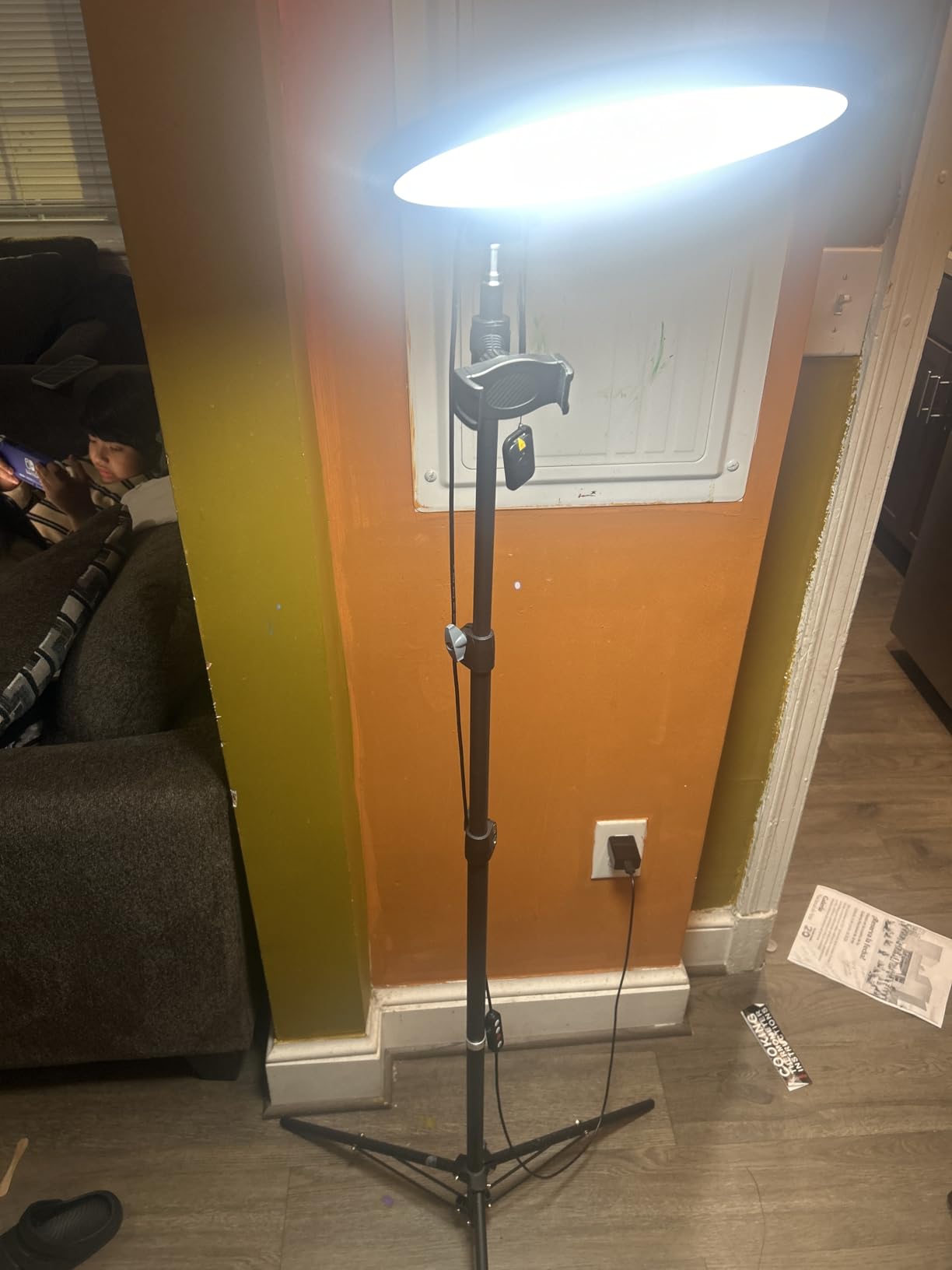
Why edge-lit diffusion beats a bare LED ring
Two kinds of diffusion exist. Surface-mounted rings put LEDs behind a frosted acrylic face, which softens but still shows dot patterns on curved or glossy surfaces. Edge-lit panels bounce light from the rim across a diffusing surface, so the emitter is never directly visible to the subject or the camera.
For product work this is the difference between a usable reflection and an unusable one. It matters most on chrome, glass, patent leather, vinyl and wet-look packaging, where a ring of dots reads as a defect rather than a highlight.
Right for small items, wrong for large ones
At 10.2 inches this is a small ring, and a small ring lights a small area. Jewelry, food plating, small cosmetics and craft items look good. A boxed item the size of a book, or anything with a footprint wider than about 8 inches, will fall off the edge of the pool of light.
The phone holder fit range is also narrow at 2.49 to 3.74 inches, so a large phone or a tablet will not seat properly. The 1/4 inch mount is the workaround, and it is a better workaround than a spring-loaded clip.
6. Weilisi 13 inch Edge-Lit Full-Screen Ring Light – Most Stable at Height
Weilisi Large Ring Light with 79″ Stand, 6500K Professional Full-Screen Big Ring Light with Stand and Phone Holder, Selfie Light with Remote for Studio Video Photography, TikTok, YouTube, Live Stream
13 inch full-screen edge-lit panel at CRI over 95
Step-less 1-100% dimming
Weighted circular base
79 inch telescopic stand
Pros
- CRI over 95 is among the most accurate here
- Step-less dimming from 1 to 100 percent
- Weighted circular base stays stable at any height
- Edge-lit panel avoids a hot center spot
- 79 inch telescoping aluminum stand
Cons
- Brightness falls short for some larger setups
- 13 inch panel is smaller than the large positioning suggests
- Telescopic pole needs the instructions
- Two separate remote accessories add setup steps
Stand stability is the least glamorous spec on this list and the one that most often decides whether a shoot is pleasant. The 13 inch Weilisi solves it with a heavy circular weighted base instead of three legs, so the center of gravity stays over the base at full height rather than drifting out over a tripod footprint.
That is a real difference in practice. A three-leg stand at 70 inches needs a light touch and a clear floor. A weighted round base can be walked past and nudged without drama, which matters when you are working around a table in a busy room.
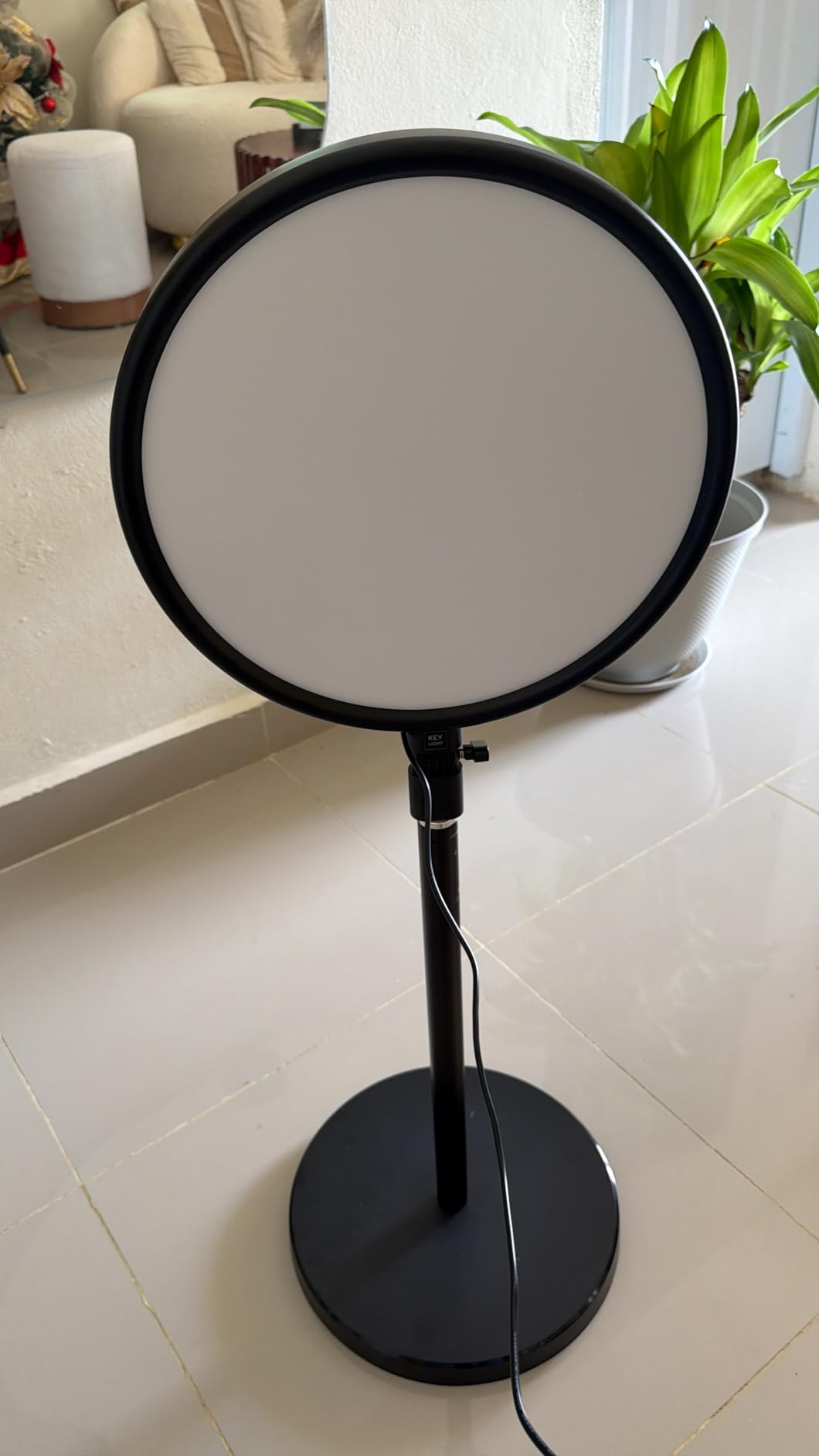
On the light itself, this is one of the most color-accurate options here. The published CRI is above 95, and dimming is step-less from 1 to 100 percent rather than in ten fixed jumps. Stepless control lets you land exposure precisely instead of choosing the nearest of ten settings and living with it.
It also uses edge-lit full-screen technology, so the emission is spread across the panel rather than concentrated in a visible ring of diodes. Three color modes run up to 6500K, and a 2.4G light controller plus a remote shutter come in the kit.
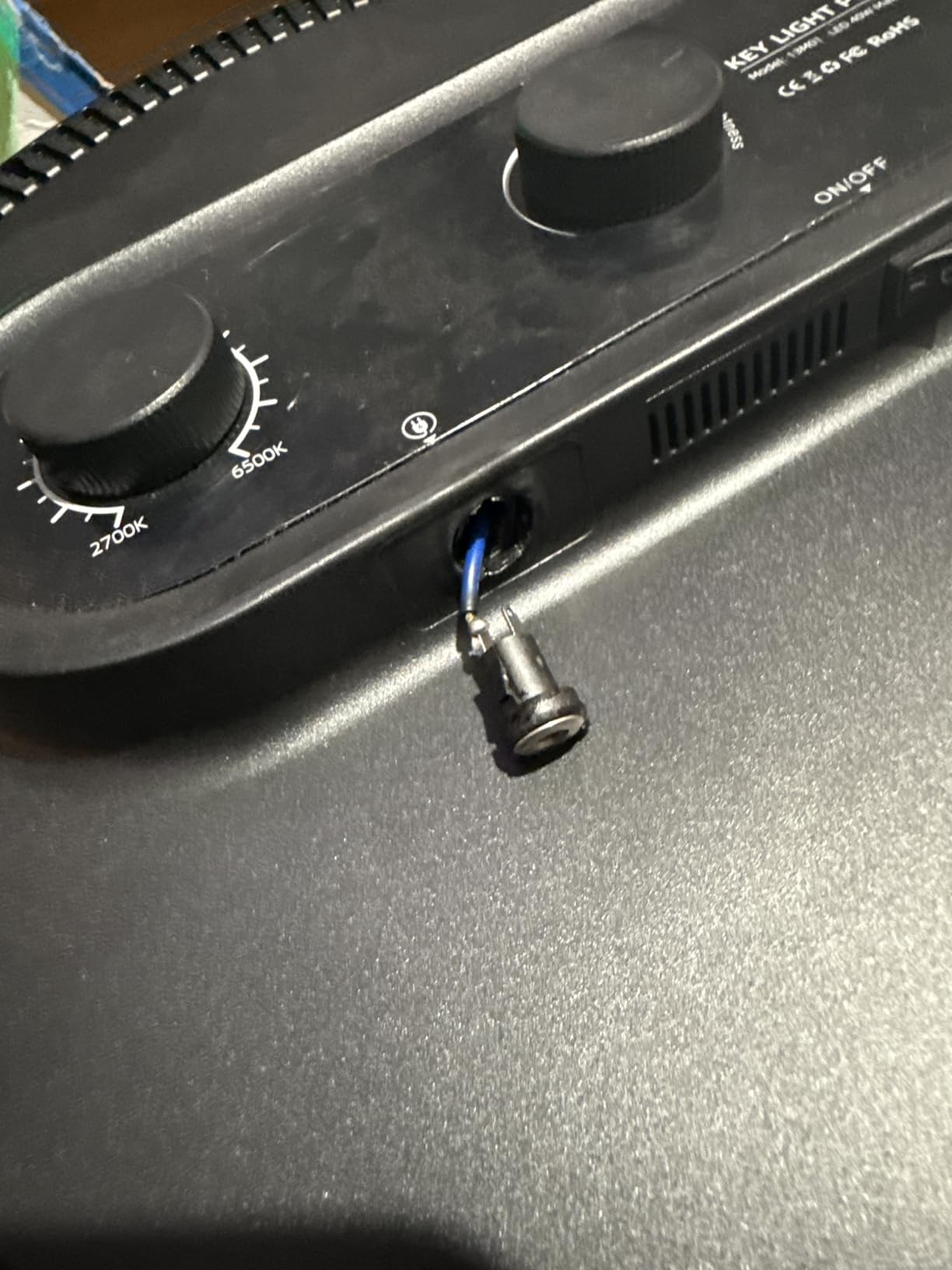
What step-less dimming buys you
Stepped dimming gives you ten brightness levels, and your actual exposure always lands somewhere between two of them. When you are matching a white background to avoid clipping, that gap is the difference between a clean white and a gray one you have to correct in post.
Step-less control also solves the problem of a small subject at close range. You can bring the output down to 1 percent and work at a comfortable aperture rather than dimming the light to nothing and losing the shot entirely.
When brightness is the limiting factor
Several buyers report the output is lower than they expected for bigger setups, and no lumen figure is published, which makes comparison difficult. If your products are large, dark or matte and you plan to shoot them from more than 2 feet away, the wattage headroom of the 55W kit is a better match.
The value of the weighted base depends on your height requirement. If you are shooting low on a tabletop, a lighter stand is easier to reposition. If you work at standing height or overhead, this is the one that stays put.
7. EOTO LIGHT 18S Touch Panel Ring Light – Best for Touch Panel Control
Upgraded 18 inch LED Ring Light with Tripod Stand, Selfie Ring Light with Touch Panel for Makeup Studio Portrait YouTube Vlog Video Shooting with Carrying Bag and Remote Controller, CRI>90
18 inch SMD ring at CRI over 90
2900K-6500K bi-color
Rear touch control panel
31.5-72.8 inch tripod
Pros
- Rear touch panel makes adjustments fast and precise
- CRI over 90 renders color better than budget kits
- Taller 72.8 inch tripod than the sibling model
- Three hot shoe ports plus two USB charging ports
- IR remote and Bluetooth shutter with carry bag
Cons
- Same mount rigidity limits as the sibling model
- Stand leans slightly at full extension
- No published wattage or lumen figure
- CRI over 90 trails the 95-98 lights here
The 18S is the EOTO LIGHT with a rear touch control panel, a taller tripod and a published CRI of over 90. If you have handled the HQ-18N in this roundup, the mechanism feels familiar; the differences are the panel, the extra 3 inches of stand height and the stated color rendering figure.
Having both a touch panel and remotes is genuinely useful rather than redundant. The panel is what you use during setup, when you are standing at the light with both hands on the stand. The IR remote and Bluetooth shutter are what you use mid-shoot, when walking back to the unit would end the flow.
The optical specification is an 18 inch SMD ring running 2900K to 6500K with 10 to 100 percent dimming on 100-240V global voltage. Like its sibling, it carries three hot shoe ports and two USB charging ports, so a multi-angle session still runs from a single light.
What it does not have is a published wattage or lumen figure. That makes it hard to place against the 55W or 33W kits on paper, and it is one of the reasons the NEEWER takes the top spot despite both lights sharing the same rating.
Touch panel versus remote for daily work
If you change settings more than a couple of times per session, a touch panel on the rear of the light is meaningfully faster than scrolling through a remote. You can see the current Kelvin and brightness at a glance, which a small remote cannot do.
The tradeoff is reach. If your light sits across the room from where you shoot, panel adjustments mean a walk. That is the case the IR remote covers, with its stated 2.5 meter range.
Poor fit for a heavy camera on a tall stand
The same two weaknesses as the sibling model carry over: the camera holder is not sized for a full-size body with a grip, and the three-leg stand leans slightly at full extension. Treat the mount as phone-and-compact-camera capable.
For color-critical work, CRI over 90 is better than nothing but clearly behind the panels rated 95 and above at similar money. If accurate reds and skin-adjacent tones matter, look at the edge-lit options instead.
8. Evershop 10 inch Overhead Clamp Ring Light – Best Desk-Clamp Flat Lay Rig
Upgrade Ring Light Overhead Camera Phone Mount for Desk, Evershop 10” Selfie Light with Stand Tripod for iPhone, Light with Phone Holder for Video Recording,Zoom Meeting,Live Streaming Tiktok,YouTube
10 inch ring head at CRI 95+
30 inch cantilever arm with desk clamp
30 color and brightness combinations
Pros
- Only true overhead clamp-mounted option in this roundup
- CRI 95 plus for accurate color rendering
- Dual-spring arm stays locked through long shoots
- Clamp fits desk edges up to 2.4 inches thick
- Cable clips keep the USB run tidy
Cons
- Power adapter is not included and 10W or more is required
- Phone-only holder with a cold shoe mount
- 10 inch ring and 30 inch arm suit small subjects only
- Tied for the lowest average rating here at 4.3 stars
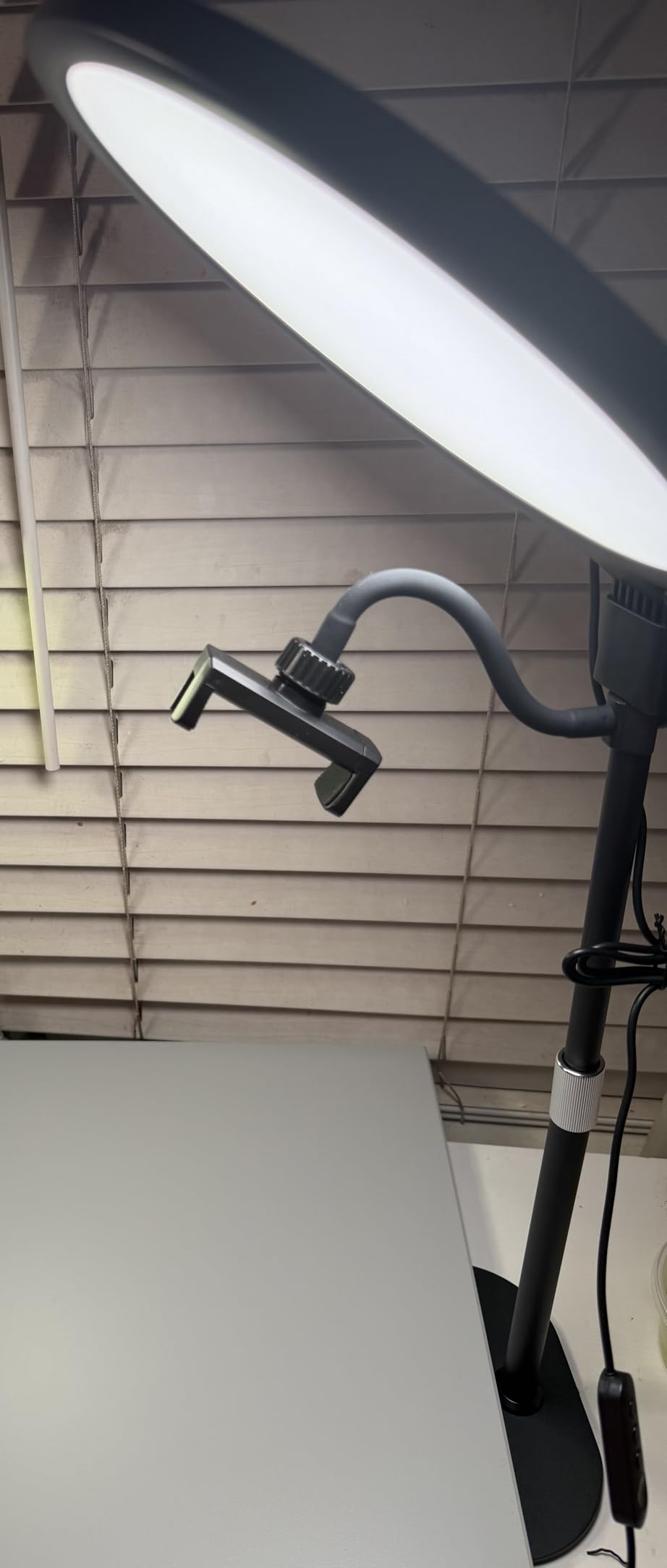
Every other floor-standing kit in this roundup asks you to drag a tripod around a table. This one clamps to the desk edge and hangs the ring over your shooting surface, which is a completely different way of working. Your hands stay free and the light stays exactly where you put it.
That solves one of the most common complaints we saw from small sellers: constantly repositioning the light mid-shoot. A cantilever arm with a dual-spring locking mechanism holds its extension through a long session, so you set the angle once and stop thinking about it.
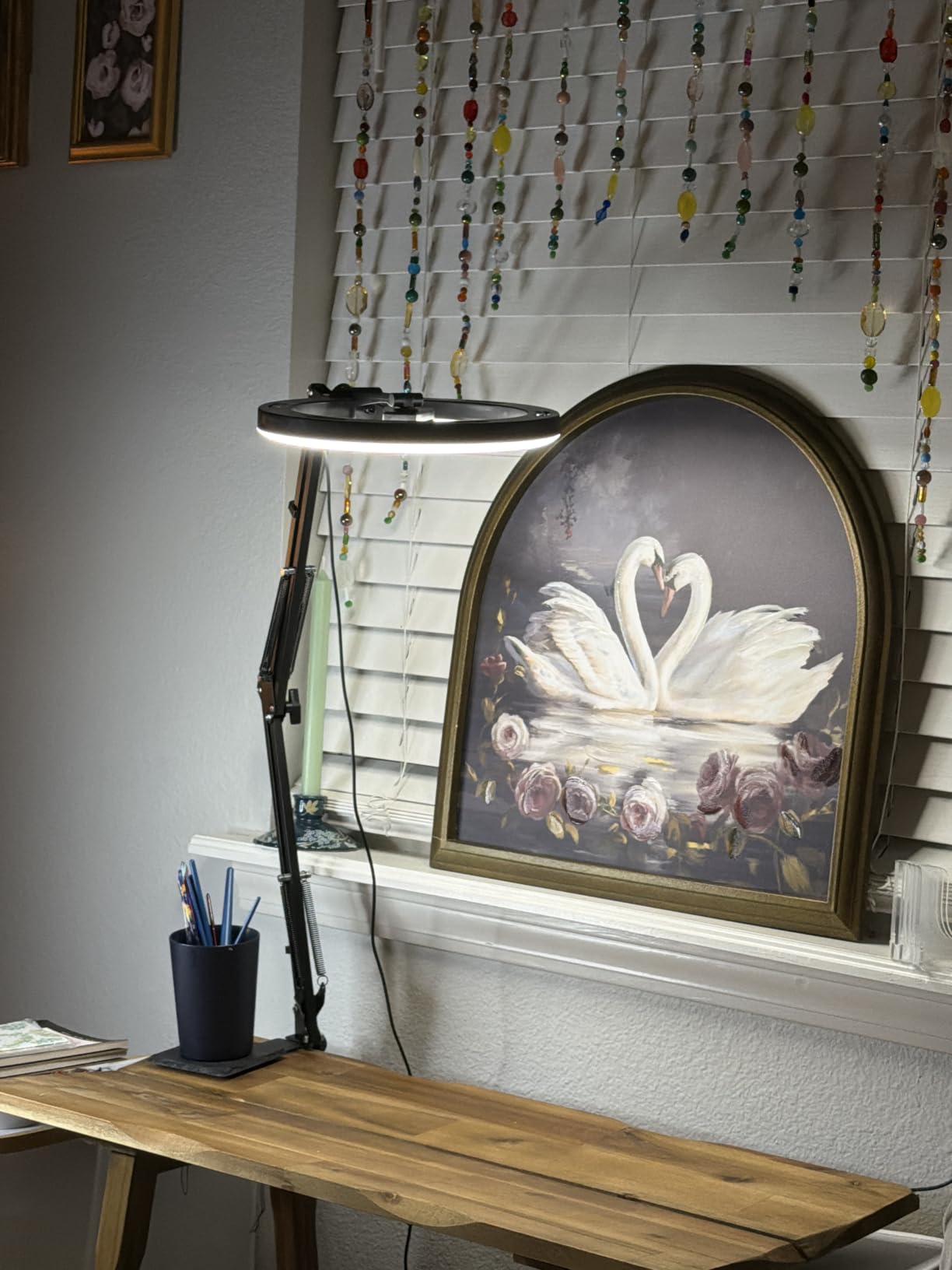
The ring head carries a published CRI of 95 plus, which puts it in the accurate-color tier despite being one of the smaller and cheaper units here. Three color modes combine with ten brightness levels for 30 total settings, and the 30 inch arm extends far enough to clear most desk widths.
The clamp fits surfaces up to 2.4 inches thick, constructed from aluminum alloy and ABS. Two cable clips run along the arm to keep the USB cable tidy, which sounds trivial until you have chased a dangling cable across a sweep once.
When a clamp beats a floor stand
A clamp-mounted overhead rig wins when your work surface is a desk or worktable with a reachable edge, and when you need the light overhead rather than at eye level. Flat lays of clothing, accessories, stationery and packaged food are the obvious fits.
It also saves floor space, which matters in a small home studio where a full tripod is standing in the only clear area for your sweep. The 2.4 inch clamp thickness limit is the real constraint to check before buying.
Overhead is a hard light for glossy subjects
Even with CRI 95 plus, a light directly above the subject produces a strong specular highlight on curved or glossy surfaces. You will spend time tilting the subject to move that highlight, or adding a diffuser sheet between the ring and the product.
Also note the power situation. A 10W or higher USB adapter is not included, and the cold shoe mount is phone-only, so this rig does not accept a camera body or a second device. It is a phone flat-lay tool.
9. Evershop 10 inch 1300 Lumen Full-Panel Light – Best Color Accuracy
1300 Lumens Ring Light with Stand for Desk, Computer & Laptop – Podcast & Streaming Light with Flexible Phone Holder, CRI 98+ Bright Yet Soft Influencer Light for Video Recording, Conference & Calls
1300 lumen full-panel light in a 10 inch head
CRI 98 plus
Edge-lit side-lit design with UGR under 14
Pros
- CRI 98 plus is the best color rendering figure here
- Edge-lit panel gives genuinely soft glare-free light
- Reinforced base stays stable on a desk
- Five-year warranty adds long-term cover
Cons
- Lowest dimming step is still bright at close desk range
- Filtered panel means catchlights read as a panel not a ring
- 10 inch panel gives desk-scale coverage
- Some pieces arrived as duds though replacements were sent
This is the most interesting spec sheet in the roundup. A 1300 lumen figure from a 10 inch panel, published alongside a CRI of 98 plus, is a claim you can actually check against the alternatives. Most kits here give you watts, or nothing at all. This one gives you output and color accuracy in the same listing.
A 1300 lumen figure from a 10 inch head is the only published output number in this roundup, and the manufacturer states the design is about three times brighter than a standard ring light with a stand under 500 lumens. In practice that headroom translates to a smaller aperture and lower ISO, which is exactly what clean catalog images need.
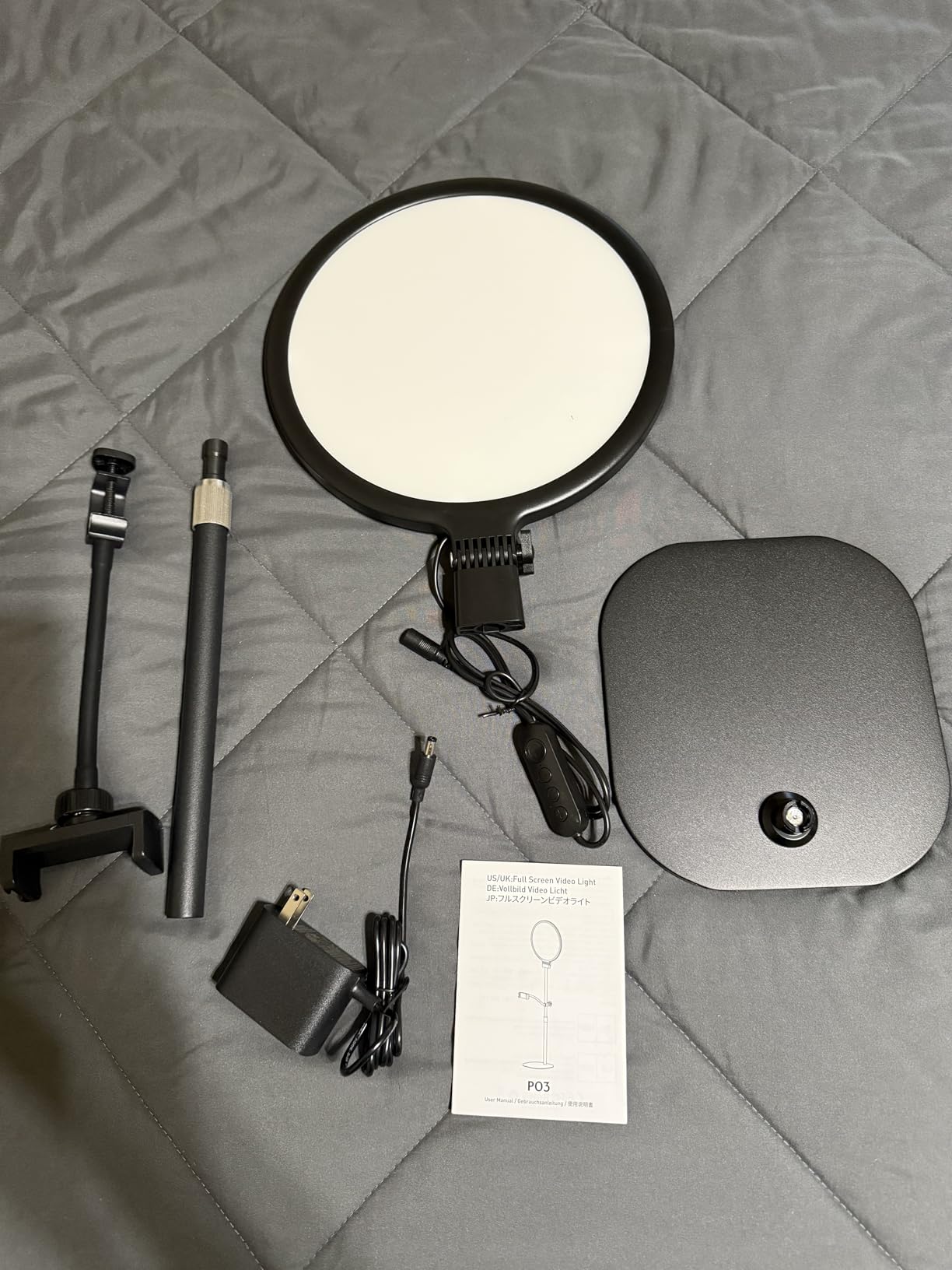
The light itself is edge-lit and side-lit through an upgraded guide panel, which the manufacturer quantifies as illumination uniformity of 0.7 or better and a unified glare rating below 14. Those numbers describe an even, low-glare output rather than a hot center, and I saw the same soft, panel-like look in the customer photos.
Color runs through three temperatures and ten brightness levels for 30 combinations. A reinforced wide base and aluminum stand keep it stable on a desk while you type or adjust your subject, and the 360 degree phone mount accepts devices up to 3.54 inches wide.
How the edge-lit panel changes the reflection
A traditional open ring is a donut of individual diodes pointed at your subject. Reflect it in a curved glossy surface and you photograph a ring of distinct bright dots. That is the single most common complaint we found about ring lights used on shiny products.
An edge-lit panel never presents an emitter directly to the subject. Light enters at the edge, bounces across an internal surface and exits through a diffuser, so what a glossy product reflects back is one soft panel shape rather than a dotted circle.
Not ideal when you need a real ring catchlight
That filtering is a deliberate trade. Because the panel is filled rather than open, a reflective product shows a panel-shaped highlight instead of the ring outline that ring lights are famous for. If you specifically want a ring catchlight, this is the wrong light.
Buyers also note the lowest dimming step is still bright at close desk range, and coverage is desk-scale rather than room-scale. It is a monitor-and-tabletop light. At 200 reviews it is also the least validated unit here, so a small number of pieces arrived that would not power on, though replacements were sent.
10. LUXSURE 10 inch Overhead Ring Light – Best for Countertop Flat Lays
LUXSURE 10″ Overhead Ring Light for Desk with Weighted Base, Freestanding Telescopic Phone Mount, Phone Stand with Light & Remote for Video Recording, Cooking, Crafts, Live Streaming
10 inch overhead ring at CRI 95 plus
Weighted freestanding base
Centered phone mount with tilting ring
Pros
- Weighted base works on countertops and islands with no clamp
- Phone sits in the center of the ring so it casts no shadow
- CRI 95 plus across three temperatures
- Telescopic arm plus tilting ring covers several angles
- Bluetooth remote and five-year warranty
Cons
- Wing nut cannot be tightened enough to hold a phone securely
- Stand column height is not adjustable
- Power cable is fixed and tangles as you reposition
- Settings reset when power is removed
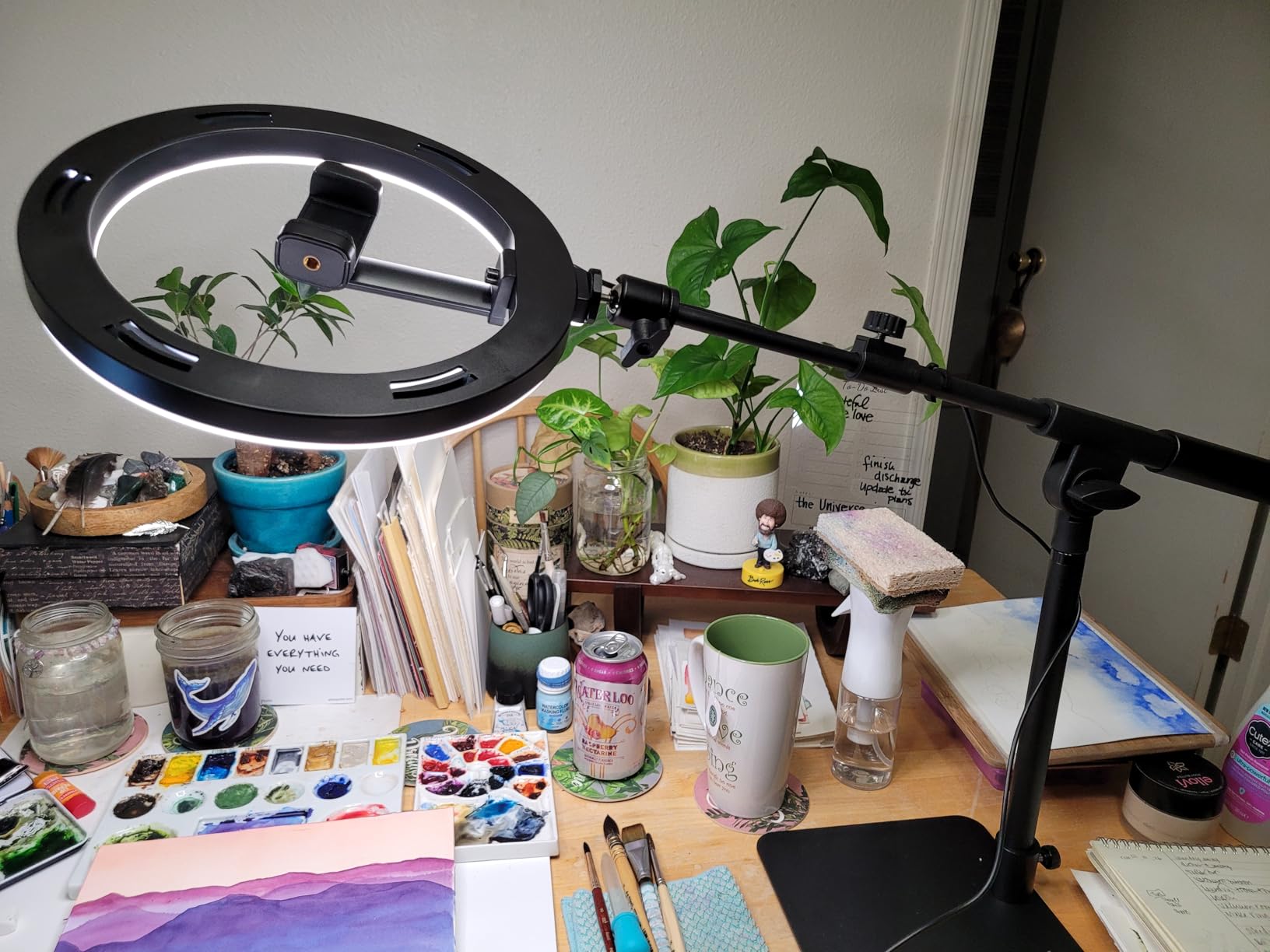
The LUXSURE is the answer to a specific problem: you want an overhead flat-lay setup but your work surface has no clampable edge. A kitchen island, a solid countertop, a wide table. The weighted freestanding base just sits there and holds the arm out over the surface.
The phone mount is centered inside the 10 inch ring, which matters more than it sounds. Because the light surrounds the camera on all sides, the phone itself does not cast a shadow onto the product below. That is the whole point of a ring, and centering the device is the only way to get it.
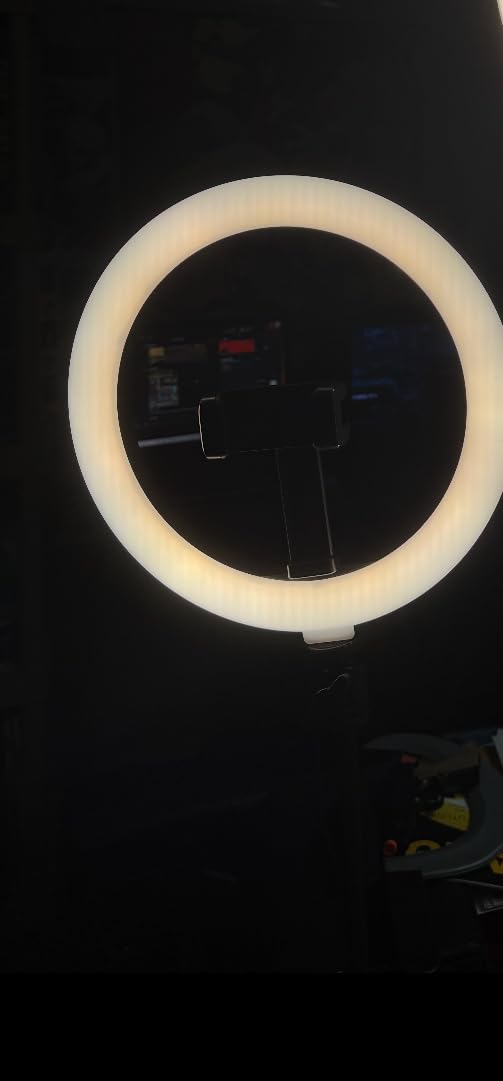
Color accuracy is published at CRI 95 plus across three color temperatures and ten brightness levels, so 30 total combinations. The telescopic arm extends and retracts, and the ring head tilts for overhead, front, side and close-up views from the same unit.
A Bluetooth remote is included for hands-free start and stop, and the manufacturer warranty runs five years. All in all it is a compact one-piece creator setup rather than a light plus a separate stand.
No clamp, but a different set of tradeoffs
Removing the clamp is the appeal, but you swap one constraint for another. The arm swings across the top of your work surface, so you need clearance above the table, and a weighted base on a countertop still occupies space you cannot easily move mid-shoot.
It also solves the tabletop-versus-clamp problem for food and craft photography in a kitchen, where a clamp would need to grip a surface you do not own. A weighted base just works on any flat surface that is reasonably level.
Expect to tighten and re-tighten
The most reported issue is the wing nut on the ring holder. It does not clamp hard enough to hold a phone securely, so the head can swing or tip, and several buyers had replacements or refunds issued. Check it before you start a batch.
Two more quirks to plan around: the stand column height is fixed with only the arm extending, and the power cable is permanently attached and tangles around the arm as you reposition. Settings also reset to a mid color temperature when power is removed, so re-dial after any unplug.
Ring Light vs Softbox vs Key Light for Product Work
The honest answer to the most common question on this topic is that a softbox or a proper key light is the better default for product photography. Ring lights win in a narrower set of circumstances, and pretending otherwise costs you money and time. On r/AskPhotography and r/videography the consensus is consistent: for anything that is not a face, diffused softboxes give brighter, cheaper and more controllable light than a ring.
What a ring gives you is even, shadow-free wrap and a completely predictable result with zero setup. That predictability is why small-batch e-commerce sellers keep them. A softbox gives you direction, falloff and a highlight you can shape, which is what makes a product look three-dimensional rather than flat.
The rule of thumb that shows up in most Photo.net and dpreview forum threads is to think in terms of a three-light setup: a key light that establishes shape, a fill light that controls the shadow ratio, and a background light that separates the subject. A single ring light collapses all three into one source, which is efficient and completely flat.
So the decision comes down to the product. Small, matte, evenly shaped objects shot straight on: a ring light is excellent. Anything cylindrical, glassy, metallic or irregular: you want a key light at an angle plus a reflector for the fill. Our general ring light roundup covers the portrait and streaming side of the category in more depth.
One more consideration for jewelry specifically. Sellers working in jewelry on r/productphotography generally reach for focus stacking rather than more light, which means solving depth of field instead of brightness. If that is your product, a brighter, softer, wider source plus a tripod and a stacking workflow will beat any ring light purchase.
How to Choose a Ring Light for Product Photography
Start with color rendering, because it decides whether the rest of your setup is worth anything. A CRI of 95 or higher is the practical floor for product work, and anything lower should be treated as fill. Four lights here clear that bar on a published figure: the Evershop 1300 lumen panel at CRI 98 plus, the Weilisi 13 inch at CRI over 95, and the Evershop overhead clamp and the LUXSURE freestanding unit, both at CRI 95 plus.
Next is diffusion type. Surface-mounted rings soften light but still show a dotted pattern on glossy products. Edge-lit full-screen panels do not, because the emitter is never directly visible. For anything reflective, edge-lit is the difference between a usable frame and a retake.
Then diameter, which sets both your coverage and how far the camera shadow falls from the subject. A 10 to 12 inch ring covers small items at close range. A 16 to 18 inch ring covers shoebox-scale products and pushes the camera shadow further out of frame.
Color temperature range matters if you shoot varied catalogs. A fixed 5600K light is ideal for one consistent look, while a 2800K to 6500K bi-color light lets you match warm and cool subjects without filters. Our crystal ball photography spheres guide covers the other end of the lighting spectrum for reflective subjects.
Dimming behavior is the next filter. Ten stepped levels are fine for general work, but stepless 1 percent to 100 percent control lets you match a white background precisely and lets you shoot small subjects at close range without going so dark that you raise ISO.
Output is where the listings get vague. A published lumen or lux figure at a stated distance is worth far more than a watt number. If a product does not publish one, treat wattage as a rough proxy and plan to stop down rather than guess.
Mounts and stand geometry determine whether you will enjoy the tool. A standard 1/4 inch thread on the tripod head is far more flexible than a proprietary fitting. A weighted round base stays stable at full height; a three-leg tripod needs a clear floor and a light touch.
Finally, think about power and portability. Mains-only kits are the most reliable for a fixed studio. USB-powered kits are portable but depend on an adapter, and several in this roundup do not include one. For pop-up shop work, a kit with a carrying bag and a single-case footprint saves the most aggravation, and if the stall itself needs ambient light after dark, our outdoor solar lights guide covers that side of the setup.
How to Set Up a Ring Light for Product Photography
First, shoot a grey card in the light before you shoot a product. It takes ten seconds and it tells you whether your white balance is right. If the card is warm, dial the camera cooler. If it is green or magenta, your light is not neutral and you should correct before the batch, not after.
Second, set the light closer than you think. For a small tabletop product, 12 to 18 inches of camera-to-subject distance with the ring just outside the frame is the starting point. Moving the light closer makes the light softer and the falloff faster, and both help.
Third, put the product off-center. A subject dead center under a ring reads flat. Moving it a few inches to one side creates a gradient across the surface that gives the eye a sense of dimension, which is a free improvement that costs nothing.
Fourth, use a white reflector card on the shadow side. A single ring light gives you shadowless wrap, but a reflector adds back the directional falloff that makes a product look solid. This is the cheapest upgrade in product photography.
Fifth, for a flat lay, tilt the head until it points straight down at the subject and raise it as high as the stand allows. The closer the light is to directly overhead, the more even the coverage across the sweep. The 180 degree tilt on the Weilisi PL204 makes this straightforward.
Sixth, and this is the one that saves the most frames: if the ring reflection is showing on a glossy product, do not try to dim your way out of it. Raise the light higher and move it further off-axis, then rotate the product slightly so the reflected shape lands outside the frame.
Seventh, add a sheet of diffusion between the ring and the subject if a hard specular highlight persists. A single sheet of white translucent material knocks down the hotspot without changing the color temperature noticeably. It is the fastest fix and it works on every light in this roundup.
Eighth, dim for your brightest white and shoot. Clipped highlights on a white background are the single most common reason a product photo looks cheap, and it is a shooting error rather than a light error. Once your whites sit just below clipping, the rest of the image falls into place.
Frequently Asked Questions
Are ring lights good for product photos?
Yes, for small tabletop products shot close to the light. A ring light removes the hard uneven shadow from a bare bulb or window and gives a repeatable result with almost no setup, which is why small-batch e-commerce sellers rely on one. They are not a substitute for a softbox when you need shape or specular highlights on larger or glossy objects, and visible LED dots are a real risk unless the ring is edge-lit or well diffused.
What is the best light for product photography?
For most product photography, a diffused softbox used as a key light with a white reflector as fill is the better default. A ring light wins on small, matte, front-facing subjects where you want shadow-free even light and fast repeatability. A panel with published CRI 95 or higher matters more than wattage, because shoppers judge accuracy from the photo and returns follow from a wrong-looking color.
What size ring light do I need for product photography?
Match the diameter to the subject and the shooting distance. A 10 to 12 inch ring covers jewelry, food plating, small cosmetics and crafts at close range. A 16 to 18 inch ring covers shoebox-scale products and pushes the camera or phone shadow further out of frame. Larger boxed goods should move to a softbox, since no ring light here covers a wide footprint evenly.
How do I avoid reflections and hotspots on glossy products with a ring light?
A bare ring shows each LED as a distinct bright dot in a reflection, which reads as a defect. Prefer an edge-lit full-screen panel, where the emitter is never directly visible and the reflection becomes one soft shape. If you must use a standard ring, raise the light and move it off-axis, rotate the product slightly, and add a single sheet of white diffusion between the ring and the subject.
Do professional photographers use ring lights?
Rarely as a primary key light. Studio and product photographers overwhelmingly use strobes or continuous panels with softboxes and reflectors, which give direction, falloff and controlled highlights. Ring lights appear in professional work as fill, as a specialized macro and ring flash tool, and in fast-turnaround e-commerce setups where speed and repeatability outweigh shaping the light.
What color temperature is best for product photography?
Around 5000K to 5600K reads as neutral daylight and is the practical sweet spot, because it keeps a white product and a white background genuinely white without a strong correction. A bi-color light spanning roughly 2800K to 6500K gives you flexibility to warm food and cool electronics in one session. Whichever you choose, white balance from a grey card before the batch so colors are not left to chance.
Conclusion
So the best ring lights for product photography in 2026 come down to what you shoot and how careful you are about color. The NEEWER RL-18 wins overall because 55W across an 18 inch ring is the most usable output in this group, with a 1/4000 second shutter spec and a ball head that swaps between phone and camera in seconds. It is the one I would put on a small seller shopping list first.
If color accuracy is non-negotiable, look at the Evershop 1300 lumen panel with a published CRI 98 plus and the Weilisi 13 inch edge-lit ring at CRI over 95, which also solves stand stability with a weighted base. If your work is flat lays on a desk edge, the Evershop clamp rig or the LUXSURE weighted base removes the tripod from the equation entirely. And if you are just starting out, the UBeesize 12 inch kit is the least expensive way to learn what a ring light does and does not do.
Just remember what the forums keep saying: the ring light is one tool, not the lighting setup. Pair whichever one you choose with a white reflector, keep it close, shoot a grey card first, and your catalog images will improve more than any single piece of gear will.