
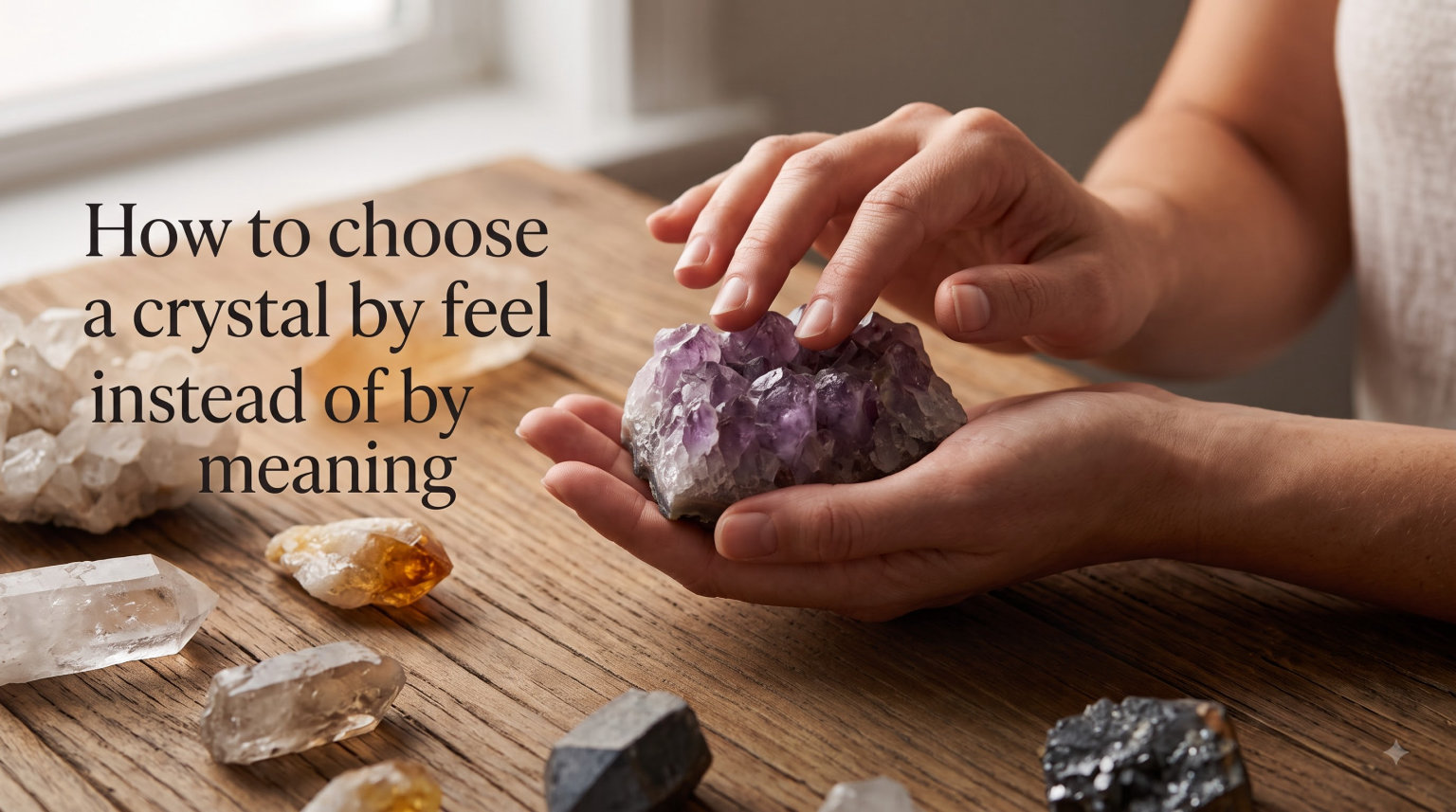
Choosing a crystal doesn’t have to mean memorizing lists of properties and meanings. In fact, some of the most experienced collectors I’ve talked to never consult a reference book at all. They simply let their body and intuition guide them.
For years, I bought crystals based on what a chart told me they were “good for.” Rose quartz for love, amethyst for calm, citrine for abundance. Half the time, those stones ended up in a drawer, forgotten within a week.
The ones I actually kept using were the ones that caught my eye for no logical reason. That’s when I started learning how to choose a crystal by feel instead of by meaning, and it changed everything about my collection.
Feel-based selection taps into something deeper than a keyword match. Your body responds to a stone’s energy before your mind can label it. You might feel warmth, a pull, a sense of calm, or even a slight aversion that tells you something isn’t right for you right now.
In this guide, I’ll walk you through the exact methods I use and the techniques I’ve gathered from crystal communities, healers, and my own trial and error. Whether you’re standing in a crystal shop or scrolling an online store, you’ll know how to trust yourself.
Table of Contents
How to Choose a Crystal by Feel Instead of by Meaning: The Foundation
The core idea is simple: your body already knows which crystal you need, even when your mind doesn’t. Meaning charts are helpful reference tools, but they can’t account for where you are right now emotionally, physically, or energetically.
When you choose by feel, you’re reading your own resonance with a stone. Think of it like meeting people at a party. You don’t need a personality profile to know who you click with. You just sense it.
Crystal energy operates on vibration, and every person carries their own frequency too. The stones that feel right to you today might not feel right six months from now. That’s not a failure of the method. It’s proof that it’s working.
Your needs shift, and feel-based selection adjusts with them. This is why two people can hold the same piece of black tourmaline and have completely different reactions. One feels grounded and safe, the other feels heavy and resistant.
Learning to trust those reactions takes practice, but the process itself is straightforward. Let’s break it down.
The Step-by-Step Intuition Method for Choosing Crystals
Here’s the process I use every time, whether I’m in a shop or browsing online. Follow these seven steps in order.
Step 1: Ground yourself first. Take three slow breaths. Let go of what you think you should pick. If you walked in wanting amethyst for sleep, set that intention aside for now.
Step 2: Soften your focus. Don’t scan every shelf methodically. Let your eyes wander. Notice which stone your gaze keeps returning to without forcing it.
Step 3: Pick it up or focus on the photo. If you’re in person, hold it in your receiving hand, which is usually your non-dominant hand. If you’re online, look at the image and imagine holding it.
Step 4: Close your eyes and notice. What do you feel in your body? Warmth, tingling, a sense of expansion, calm, or even a slight pressure? Pay attention to subtle shifts.
Step 5: Wait at least 10 seconds. Many people rush this step. The first sensation might be subtle. Give it time to build before you judge.
Step 6: Compare two or three stones. Hold one, then another. The contrast makes the right choice obvious. The stone you need usually feels distinctly different from the others.
Step 7: Trust the first answer. If you keep second-guessing, you’ll talk yourself out of the right pick. Your gut reaction is usually the most accurate one.
This method works because it bypasses the analytical brain and taps directly into your body’s response system. The more you practice, the faster and clearer the signals become.
Physical Sensations That Signal a Crystal Is Right for You
Your body communicates through sensations, and crystals tend to produce some recognizable ones. Here’s what to look for.
Warmth is the most common sign. The stone might feel warmer in your hand than it should, or you might feel heat spreading up your arm. This usually indicates an active energetic connection.
Tingling or pulsing is another frequent response. Some people describe it like a mild electric current or a fizzing sensation in their palm. This often happens with high-vibration stones like clear quartz or selenite.
A sense of calm or settling is subtle but powerful. You might notice your shoulders drop, your breathing slow, or mental chatter quiet down. This is common with grounding stones like smoky quartz or hematite.
Magnetism or pull happens when you feel drawn to keep holding the stone or when your hand doesn’t want to put it down. That resistance to letting go is a strong indicator.
Clarity or lightness can feel like a fog lifting. Some people report a sudden sense of focus or an emotional shift toward positivity when they hold the right stone.
Nausea or aversion is also information. If a stone makes you feel slightly off, heavy, or uncomfortable, it’s probably not the right match right now. Trust that signal just as much as the positive ones.
Not everyone feels all of these, and some people feel none at first. That’s completely normal, and something we’ll address in detail shortly.
The Leaning Forward Method: A Body-Response Test
This is one of the most under-discussed techniques in crystal selection, and it’s also one of the most reliable. I consider it a secret weapon when nothing else gives me a clear answer.
I first heard about the leaning forward method from a Reddit thread in r/Crystals where someone described how their body physically responded to the right stone. I was skeptical. But I tested it in a shop the next week and was surprised by how clear the signal was.
Here’s how it works. Hold a crystal in your hand and stand in a relaxed, neutral position. Close your eyes and pay attention to your body’s subtle lean.
When a crystal is right for you, your body tends to lean slightly forward, toward it. It’s an involuntary micro-movement. When a crystal isn’t a match, you might lean back or feel a subtle resistance, like your body is pushing away.
The movement is small, sometimes barely noticeable on its own. But when you compare two stones side by side, the difference becomes obvious. One pulls you forward, the other doesn’t.
I’ve used this method dozens of times now. It’s especially helpful when you’re torn between two similar-looking stones and your mind can’t decide. Your body already knows the answer.
Some people also feel this as a sensation of the crystal pulling them, almost like a gentle magnetic tug in the hand or chest. Trust that tug. It’s your inner knowing showing up as physical movement.
If you’re new to this, practice with stones you already own. Hold one you love and notice your body’s response. Then hold one you feel neutral about. The contrast trains you to recognize the signal.
The First Sight Technique
Before you even touch a crystal, your eyes are already gathering information. The first sight technique uses that automatic response.
The principle is simple: the stone you notice first is often the one you need most. When you walk into a crystal shop or scroll through an online catalog, notice which piece grabs your attention before you start analyzing.
It might be across the room on a shelf you weren’t even looking at. It might be a stone you’ve never heard of in a color you don’t usually like. That’s exactly the point. Your subconscious recognized it before your conscious mind could categorize it.
I once walked into a shop looking for a grounding stone and couldn’t stop staring at a piece of blue lace agate. I didn’t know anything about it at the time. I didn’t think I needed calm communication energy that day, or so I told myself. But I bought it, and it became one of the most-used stones in my collection.
The key with first sight is to not overthink it. Notice, then act. If you talk yourself out of it because it’s not on your shopping list, you’re right back to choosing by meaning.
Online, this technique works too. Scroll through a category quickly without stopping. Notice which image made you pause or scroll back. That pause is your first sight signal, even through a screen.
What to Do When You Feel Nothing at All
This is the question that comes up most in crystal communities, and it’s where a lot of beginners give up. If you hold a crystal and feel absolutely nothing, you are not broken. You are not doing it wrong.
Many experienced collectors felt nothing for months or even years before they started sensing energy. The ability to feel crystal energy is not a special gift. It’s a skill that develops with practice and relaxation.
There are several reasons you might feel nothing. You could be overthinking, trying so hard to feel something that you’ve tensed up and blocked subtle signals. You might be distracted or not grounded. Or you might simply be someone who processes energy differently, through emotion or thought rather than physical sensation.
Here’s what to try instead of forcing it. Stop trying to feel energy and just notice your mood. Hold the stone for a full minute, then put it down and walk away. Did you want to come back to it? That desire is a signal, even without a physical sensation.
Another approach: hold the crystal while doing something else, like watching a show or listening to music. Remove the pressure of the test entirely. Sometimes the sensation appears only when you stop looking for it.
Try different stones. Not every crystal will resonate with you, and that’s normal. If you feel nothing from ten different stones but something from the eleventh, you’ve just learned what a match feels like for you.
Pay attention to dreams too. Some people don’t feel energy while awake but notice that a certain crystal shows up in their dreams or that they sleep differently with it nearby. That’s your intuition working through a different channel.
And remember that no feeling is also information. If a stone gives you nothing after repeated tries on different days, it’s probably not the right one for you right now. Move on without guilt. Another stone is waiting.
Choosing Crystals Online vs In Person
In-person selection is ideal because you can hold the stone, feel its weight, and test your body’s response directly. But online shopping is increasingly common, and it absolutely works if you adjust your approach.
When shopping online, use the photo method. Look at the image and imagine holding it in your hand. Notice if your body responds even slightly. Some people feel warmth or a pull just from looking at a clear, well-lit photo.
Trust your eye, which is the online version of first sight. The piece that keeps drawing your attention across multiple visits to the site is worth considering seriously. If you keep coming back to the same listing, that’s your answer.
Read the seller’s description for energy clues, but don’t let it override your gut. If a description says a stone is for confidence but you feel drawn to it for a completely different reason, trust your reason over the label.
One advantage of online shopping is that you avoid the overwhelm of a physical shop with hundreds of stones competing for your attention. You can browse slowly, save favorites, and revisit them the next day with fresh eyes.
The downside is that photos can be misleading. Colors and sizes often look different in person, and you can’t test the leaning forward method through a screen. Buy from sellers with clear return policies so you can test the stone when it arrives and send it back if the connection isn’t there.
A hybrid approach works well for many people. Browse online to narrow down your options, then visit a local shop to test the shortlist in person. You get the best of both methods.
How to Choose a Crystal When You Feel Overwhelmed?
Walk into a large crystal shop and it’s easy to freeze. Hundreds of stones, every color and shape, and your body is getting mixed signals from all of them at once.
Overwhelm is real, and it shuts down your intuition fast. Here’s how I handle it when the sensory input gets to be too much.
Start with a grounding practice before you even enter the shop. Stand outside for a minute, feel your feet on the ground, take a few deep breaths. Enter the space already settled rather than scattered.
Narrow your scope physically. Don’t try to take in the whole store at once. Pick one section or one display case and start there. Hold two or three stones, compare them, and only move on when you’ve made a decision or ruled them out.
Set a limit before you start. Tell yourself you’re looking for one stone today, not ten. This reduces decision fatigue and keeps you focused on quality of connection rather than quantity.
Take breaks. If you start feeling fuzzy, headachy, or emotionally drained, step outside for fresh air. Crystal shops are dense energetic environments, and sensory overload is common even for experienced shoppers.
And if nothing calls to you after twenty solid minutes of relaxed browsing, leave without buying. Sometimes the right shop or the right day is elsewhere. Forcing a choice under overwhelm almost always leads to a stone you won’t use.
Combining Methods to Build Your Own Process
No single technique works perfectly every time. The best approach is to combine several methods into a personal system that plays to your strengths.
I use first sight to identify candidates, the holding method to narrow down, and the leaning forward test to confirm. If I’m shopping online, I swap the holding method for the photo method and rely more on repeated visits to see if my interest holds.
You might find that pendulum dowsing works better for you than body-response testing. Or you might discover that your strongest signal is emotional, a sudden shift in mood rather than a physical sensation in your hand.
The goal isn’t to follow a rigid formula. It’s to learn your own language of resonance and trust it more each time you practice.
Pendulum Dowsing as a Backup Method
If body sensations aren’t working for you, a pendulum can be a useful backup tool. It gives your intuition a visible, physical form of expression.
Hold a pendulum over a crystal and ask a clear yes-or-no question like, “Is this crystal right for me right now?” Most people program their pendulum so that a clockwise swing means yes and a counterclockwise swing means no.
The movement comes from your own subtle muscle responses, which means your subconscious is doing the answering. The pendulum is simply translating your inner knowing into visible motion.
Pendulum dowsing takes practice, and it works best when you’re relaxed and genuinely open to any answer. It’s a good option for people who want a more structured, almost mechanical way to read their intuition.
Keep in mind that the pendulum is reading you, not the crystal independently. It’s a mirror for what you already sense but can’t quite articulate yet.
Color and Shape Energy Basics
Color and shape can offer gentle guidance, but treat them as starting points rather than hard rules. Your personal experience always overrides general guidelines.
Warm colors like red, orange, and yellow tend to carry activating, energizing energy. Stones like carnelian and citrine often feel stimulating and motivating. Cool colors like blue, green, and purple tend to be calming and soothing. Think aquamarine, green aventurine, and amethyst.
Earthy colors like brown, black, and deep red usually ground and protect. Hematite, black tourmaline, and red jasper fall into this category. But again, these are tendencies, not guarantees.
Shape matters too. Points direct energy outward and are good for intention work and focus. Spheres radiate energy evenly in all directions. Raw, unpolished stones often feel more intense and direct. Tumbled stones tend to feel gentler and more approachable for beginners.
Use these as context, not commandments. A red stone might calm you. A tumbled piece might feel more powerful than a raw one in your hand. What you experience matters more than any chart or guideline, including this one.
FAQs
How do I know which crystal is right for me?
The right crystal for you is the one that creates a noticeable response in your body or mood when you hold it or focus on it. You might feel warmth, calm, a magnetic pull, or simply a strong desire to keep holding it. Trust that response over any meaning chart.
How do I pick a crystal for me using intuition?
Ground yourself with a few deep breaths, then let your eyes wander without forcing a choice. Pick up the stone that draws your attention, hold it in your non-dominant hand, and notice any physical or emotional shift. Compare two or three options and trust your first reaction.
What does it feel like when a crystal is right for you?
Common sensations include warmth in the hand, tingling or pulsing, a sense of calm or settling, a magnetic pull toward the stone, or a feeling of clarity and lightness. Some people also notice their body leaning slightly forward. The exact feeling varies from person to person.
What if I feel nothing when holding crystals?
Feeling nothing is completely normal and does not mean you are doing it wrong. Stop trying to force a sensation and instead notice your mood. Hold a stone for a minute, set it down, and see if you want to pick it back up. That desire is a valid signal even without physical energy sensations.
How do I choose a crystal that resonates with me?
Resonance shows up as a sense of connection or rightness with a stone. Use the first sight technique to notice which crystal grabs your attention, then confirm with the holding method. The stone you keep coming back to, in person or online, is the one that resonates with you.
Conclusion
Learning how to choose a crystal by feel instead of by meaning is a practice, not a one-time skill you master on your first try. Each time you trust your body’s response over a chart, you strengthen that connection a little more.
Start with the step-by-step method, experiment with the leaning forward test, and give yourself permission to feel nothing sometimes. The stones that are right for you will make themselves known in their own way and their own time.
Your collection should feel personal. If a crystal on your shelf has a story about how it found you, not just what a book says it does, you’re doing it exactly right.