
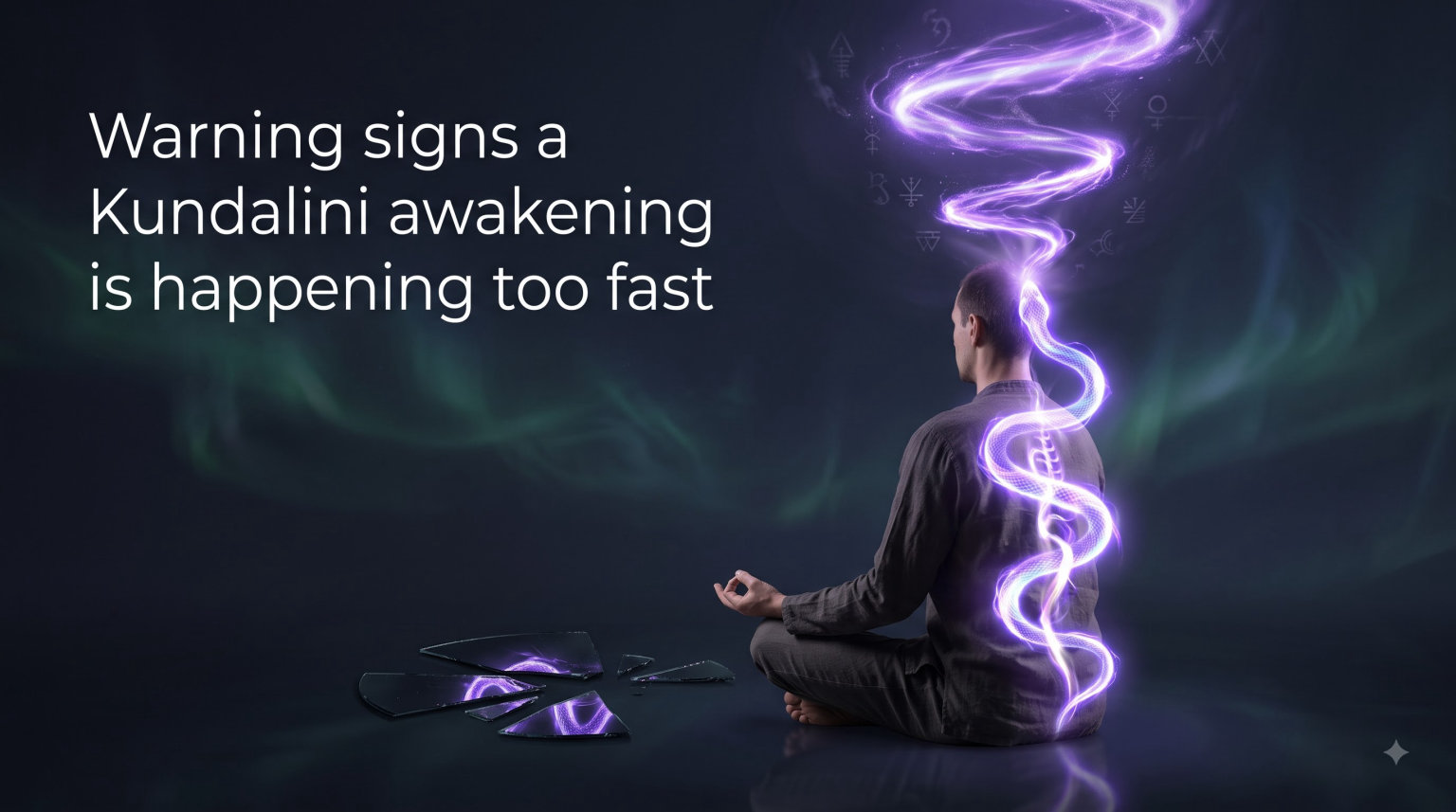
I have worked with people going through Kundalini awakenings for years, and I can tell you one thing with certainty: a fast rising is not the same as a deep one. Many seekers push hard in meditation, breathwork, or intensive retreats hoping to accelerate their spiritual growth, only to find their body and mind struggling to keep up. That mismatch is where suffering begins.
Kundalini awakening is the rise of dormant energy at the base of the spine, traditionally called Kundalini Shakti, moving upward through the sushumna nadi and the chakra system. When this rise happens smoothly, it tends to unfold gently, with periods of insight followed by integration. When it happens too fast, the nervous system, the emotional body, and even daily functioning get overwhelmed.
This guide covers the warning signs a Kundalini awakening is happening too fast. You will learn which physical, emotional, and energetic symptoms signal that your system is overloaded, what differentiates an intense but normal awakening from a real spiritual emergency, and the self-pacing techniques our community uses to slow the process safely. If something you read here matches what you are feeling, you are not broken. You are simply moving faster than your body can integrate.
Table of Contents
What Happens if Kundalini Rises Too Fast?
If Kundalini rises too fast, the body and mind cannot integrate the energy surge, producing intense heat up the spine, shaking or vibrations, anxiety, fear, headaches, insomnia, and involuntary movements. The nervous system becomes overloaded, emotions spike unpredictably, and ordinary daily life feels impossible to maintain.
When Kundalini energy rises faster than your nervous system can process, the symptoms become intense and disruptive rather than expansive. People often describe a feeling of being “wired open” with too much electricity in the body, paired with insomnia, emotional flooding, and the inability to settle into ordinary routines. The next sections break down each of these warning signs in detail so you can recognize them early.
Physical Warning Signs Your Kundalini Is Rising Too Fast
The first place most people notice an accelerated awakening is in the body. Heat along the spine, sudden shaking, and pressure in the head are common physical warning signs your Kundalini is rising too fast.
Heat waves rolling up the spine are one of the most reported signs. You may feel like a warm current is moving from the base of your spine toward the crown of your head, sometimes so intensely that your skin flushes or you sweat without exertion. In a gentle awakening this feels like a pleasant current. In a fast one it can feel like a fever that never breaks.
Vibrations and tingling in the hands, feet, crown of the head, or third eye are another common physical sign. These sensations range from a subtle humming to a buzzing strong enough to keep you from sleeping. When the buzzing is constant rather than intermittent, it is a strong signal that energy is moving faster than your body can discharge.
Involuntary movements, sometimes called kriyas, are another clear physical warning. You may notice your head turning on its own, your spine twisting, your body rocking, or spontaneous yoga postures. Light kriyas during meditation are normal. Strong kriyas that happen throughout the day, jerk you awake, or make it hard to hold a conversation are not.
Other physical signs include headaches and pressure in the skull, ringing in the ears, heart palpitations, shortness of breath, chest tightness, digestive disruption, and lower back pain. Insomnia is one of the most common complaints on Kundalini forums, with users describing being unable to sleep for days despite exhaustion. If several of these show up at once, your system is likely telling you to slow down.
Spotting the Difference: Strong Awakening vs Overload
A strong awakening still allows you to sleep, eat, and function, even if you feel tired. An overload stops you from doing these things. If your symptoms are keeping you from rest, food, or basic self-care, the energy is moving faster than your container.
Emotional and Psychological Warning Signs of an Accelerated Awakening
Emotional and psychological warning signs of an accelerated awakening include sudden waves of fear or anxiety, emotional flooding, mood swings, panic attacks, and a dark night of the soul that feels deeper than you can hold.
Fear and anxiety that comes out of nowhere is one of the most common emotional signs. Many people describe waking at 3 a.m. with a sense of dread, chest tightness, or a feeling that something terrible is about to happen, even though their life circumstances are stable. This is often the energy rising through the heart and throat chakras faster than emotions can be processed.
Emotional flooding is another warning. Old grief, anger, shame, or trauma that you thought was resolved can resurface with vivid intensity. In a measured awakening this release is gradual. In a fast one it can feel like every unresolved emotion from your life arrives in a single week.
Mood swings, irritability, and sudden crying are also signs of energy overload. So is the experience of feeling emotionally numb one moment and overwhelmed the next. Many people describe feeling like they have lost their personality or their ability to relate to others. If you find yourself isolating because emotions feel too raw to share, that is a meaningful signal to slow down.
The dark night of the soul is a recognized phase of awakening, but in a fast Kundalini rising it can become extreme. People report suicidal thoughts, dissociation, depersonalization, or the conviction that reality itself is falling apart. These are not signs of weakness. They are signs that your system is moving faster than it can integrate. The next sections cover when this crosses into territory that needs professional support.
Real Experience From the Community
One member of our community shared that she spent three weeks unable to sleep more than two hours a night, cried without knowing why, and felt a buzzing so strong in her chest she checked herself into the ER twice. Her heart was fine. Her energy system was not. Slowing her practice and grounding daily made the difference over the following two months.
Energy Overload Signs That the Awakening Is Moving Too Quickly
Energy overload signs that the awakening is moving too quickly include chakra overstimulation, constant energy surges, sensitivity to light and sound, and the feeling of being plugged into an electrical current.
Chakra overstimulation happens when energy hits a chakra center before the body is ready. Each chakra can become hot, throbbing, or painfully sensitive. The heart chakra in particular often becomes so tender that being touched, hugged, or even near other people feels unbearable. The third eye may throb with light flashes or pressure that mimics a migraine.
Constant energy surges feel like waves crashing through your body. Some people describe being hit by a wave of electricity several times an hour. In a gentle awakening these surges come and go. In an accelerated one they can become continuous, leaving no space for rest or integration.
Sensory sensitivity often rises sharply during fast awakenings. Bright lights, fluorescent lighting, screens, loud noises, crowds, and even strong smells can become overwhelming. People often retreat from normal life because the world feels too loud. This sensitivity is a clear sign that the nervous system is in overdrive.
The feeling of being plugged into an electrical current is something many people describe without a clear word for it. You may feel like your body is vibrating, humming, or buzzing at a frequency you cannot turn off. If this is constant rather than occasional, you are likely moving faster than your system can discharge safely.
Kundalini Sickness: When the Body Cannot Keep Up?
Kundalini sickness is the cluster of physical and psychological symptoms that appear when Kundalini energy rises faster than the body and nervous system can integrate. It is the body’s clear signal that the awakening is happening too fast.
The term kundalini sickness describes a state where the body behaves as though it is ill, even when medical tests come back normal. Symptoms include chronic fatigue, weakness in the limbs, nausea, loss of appetite, persistent low-grade fever, joint pain, and mental fog. People often visit doctors repeatedly before realizing the cause is energetic rather than medical.
The traditional yogic literature and modern teachers like Gopi Krishna both describe kundalini sickness as a real and well-documented phase. It is not a punishment and it is not a sign that something has gone wrong. It is simply the cost of moving faster than the body can integrate.
How long kundalini sickness lasts varies widely. For some it resolves in a few weeks once they slow their practice. For others it lasts months or even years, especially if the awakening was triggered by intensive practice or trauma and the person continues pushing. The duration depends on how quickly the person recognizes the warning signs and begins to pace the process.
The recovery timeline is shorter when you stop pushing. Reducing intense meditation, dropping breathwork intensities, simplifying your spiritual routine, and grounding daily often shorten the sickness phase significantly. Continuing to push usually extends it.
Spiritual Emergency vs Normal Intense Awakening: How to Tell
The difference between a normal intense awakening and a spiritual emergency comes down to function. A normal intense awakening still allows you to eat, sleep, work, and relate, even if you are uncomfortable. A spiritual emergency disrupts these basic functions and may include psychotic-level symptoms.
Spiritual emergency is a term coined by psychiatrist Stanislav Grof to describe acute episodes of psychological crisis that emerge through spiritual practice. It includes psychotic breaks, dissociation, depersonalization, manic episodes, and severe panic that lasts for days or weeks. The key marker is loss of contact with ordinary reality and an inability to care for yourself.
Here is a quick comparison to help you tell the difference:
Normal intense awakening: You can still sleep, eat, work, and recognize reality, even if symptoms are uncomfortable.
Spiritual emergency: You cannot sleep for multiple nights, you lose contact with reality, you hear voices, or you have thoughts of harming yourself or others.
If your awakening is intense but you can still function and ground yourself, you are likely in a normal but accelerated process. If you cannot function or you feel you might harm yourself, please reach out to a qualified professional immediately. The section on when to seek help below covers this in more detail.
How to Slow Down a Kundalini Awakening: Self-Pacing and Grounding
To slow down a Kundalini awakening that is happening too fast, reduce intense practices, focus on grounding, eat heavy grounding foods, spend time in nature, and prioritize rest over more stimulation. Self-pacing is the single most effective response to an accelerated awakening.
The principle behind self-pacing is simple. If energy is rising faster than your body can integrate, you give your body more integration time and less stimulation. You do not try to force the energy down. You simply stop pouring more in.
Here are the self-pacing steps our community uses most often:
Reduce meditation length. Cut your sits in half for two to four weeks and see if symptoms ease.
Skip intense breathwork. Drop pranayama, holotropic breathwork, or any practice that floods the system with prana until symptoms settle.
Eat grounding foods. Root vegetables, cooked grains, beans, eggs, meat if you eat it, and warm cooked meals help anchor the energy downward.
Spend time in nature. Walking barefoot on grass, sitting by water, gardening, or simply being outdoors draws energy down through the body.
Prioritize sleep. Sleep is one of the fastest ways to integrate energy. Go to bed earlier, protect your sleep, and nap when you can.
Avoid stimulants. Caffeine, alcohol, recreational drugs, and intense screen exposure all amplify energy surges.
Move the body gently. Walking, swimming, slow yoga, or light stretching helps discharge excess energy without adding more.
Grounding techniques specifically work by drawing awareness out of the head and crown chakra and back into the body and the earth. You can do this by pressing your feet into the floor, holding ice cubes, taking cold showers, eating something salty or sour, or visualizing roots growing from your base into the ground.
Most people who apply these techniques consistently see meaningful improvement within two to six weeks. If you are not improving after six weeks of focused grounding, that is a signal that professional support may be useful.
When to Seek Professional Help for Kundalini Symptoms?
Seek professional help for Kundalini symptoms when you cannot sleep for more than two nights, when symptoms interfere with basic self-care, when you have thoughts of harming yourself, when you lose contact with reality, or when grounding techniques are not helping after six weeks of consistent practice.
Many people on Kundalini forums describe delaying medical help because they assumed their symptoms were purely spiritual. In some cases that delay made things worse. A good rule of thumb is this: if a symptom would send you to a doctor without any spiritual context, go to the doctor.
There are three categories of professional support worth knowing about. A medical doctor can rule out cardiac, neurological, and hormonal causes for symptoms like heart palpitations, headaches, or insomnia. A transpersonal or spiritually-informed therapist can help you process the emotional and psychological content of an accelerated awakening without pathologizing it. An experienced Kundalini teacher or energy worker can offer practices specific to your stage.
You do not have to choose one type of support. The most effective path often combines all three, especially during the first few months of a fast awakening.
Frequently Asked Questions About Kundalini Rising Too Fast
What happens if Kundalini rises too fast?
When Kundalini rises too fast, the body and mind cannot integrate the energy surge. This produces intense heat up the spine, shaking, vibrations, anxiety, fear, headaches, insomnia, and involuntary movements. The nervous system becomes overloaded and ordinary daily life becomes difficult to maintain.
What does a Kundalini surge feel like?
A Kundalini surge feels like a wave of heat, electricity, or pressure rising from the base of the spine toward the crown of the head. It can be accompanied by tingling in the hands and feet, buzzing under the skin, throbbing in the chakras, shaking, and a rush of emotion. Gentle surges pass quickly, while fast awakenings produce repeated surges that do not fully resolve.
How long does kundalini sickness last?
Kundalini sickness can last a few weeks for some people and several months or longer for others. The duration depends on how fast the awakening is moving and how quickly the person reduces stimulation and increases grounding. Most people who apply consistent self-pacing techniques see meaningful improvement within two to six weeks.
Is my kundalini awakening dangerous?
A normal Kundalini awakening is not dangerous, but one that moves too fast can become a spiritual emergency. If you cannot sleep, eat, or care for yourself, if you lose contact with reality, or if you have thoughts of harming yourself, seek professional help immediately. With proper pacing and grounding, most accelerated awakenings resolve safely.
How do I know if my symptoms are kundalini or anxiety?
Kundalini symptoms often come in waves tied to meditation, breathwork, or spontaneous energy surges, and they shift location as energy moves through the chakras. Generalized anxiety tends to be more constant and tied to thought patterns. If your symptoms intensify during or after spiritual practice and shift through the body, kundalini is more likely. A qualified professional can help you tell the difference.
Honoring the Pace of Your Awakening
The warning signs a Kundalini awakening is happening too fast are not failures. They are signals from a body that is doing exactly what it is designed to do, asking for more time, more rest, and more grounding. The most important thing our community has learned over the years is that depth always wins over speed.
If you recognize yourself in the symptoms above, start with one change today. Reduce your meditation time, eat a grounding meal, walk barefoot outside, and protect your sleep for the next two weeks. Small, consistent steps move the awakening back toward a pace your system can hold. And if anything you read here feels urgent or unsafe, please reach out to a qualified professional without delay. Your awakening is meant to free you, not to overwhelm you.