
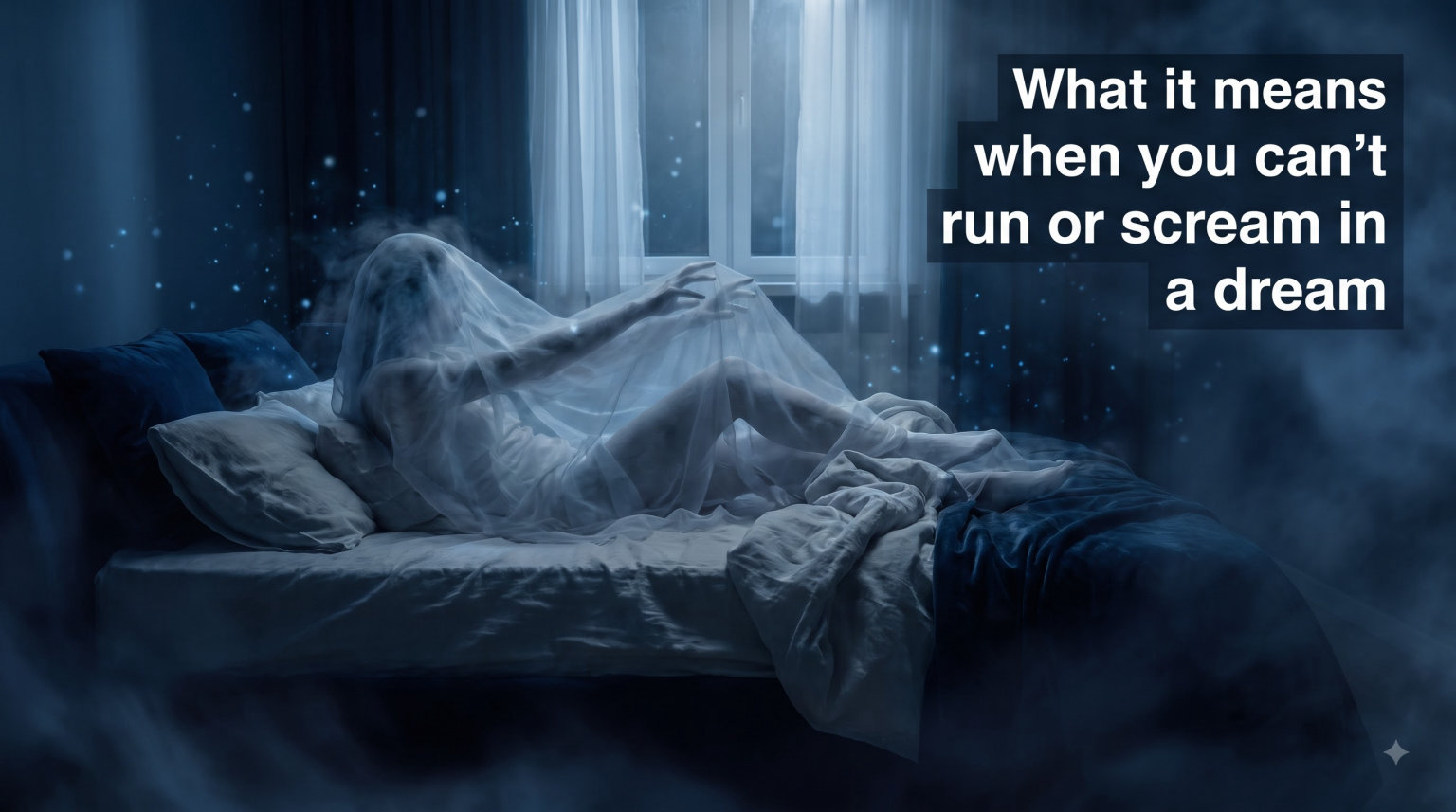
When you can’t run or scream in a dream, it usually means your subconscious is working through feelings of helplessness, being unheard, or powerlessness in your waking life. At the same time, there’s a very real biological reason behind the experience: your body’s REM sleep cycle temporarily paralyzes your voluntary muscles, including your vocal cords and legs.
If you’ve ever tried to scream in a nightmare and no sound came out, or tried to flee and felt glued to the ground, you’re far from alone. This is one of the most common dream patterns people report. Thousands share this exact experience in online dream communities every single year.
Our team has spent years researching dream psychology and sleep science, and these silent-scream dreams come up more than almost any other recurring nightmare. The good news is that once you understand what’s happening, both physically and emotionally, these dreams lose much of their power over you.
In this guide, we’ll break down what it means when you can’t run or scream in a dream. We’ll cover the science behind it, the psychological interpretations, spiritual perspectives, and practical steps you can take to reduce how often these dreams occur.
Table of Contents
The Science: Why Your Body Locks Up During Dreams?
The short answer is a biological process called REM atonia. During REM (rapid eye movement) sleep, your brainstem sends a signal that essentially switches off your voluntary muscles. This natural paralysis protects you from physically acting out your dreams and potentially injuring yourself while asleep.
Your vocal cords are voluntary muscles too. When your dreaming brain tries to generate a scream, your sleeping body simply can’t comply. The signal gets sent, but the muscles refuse to fire. That disconnect between what your dream-self wants and what your body will allow creates that deeply frustrating sensation of a soundless shout.
The same mechanism explains why running feels impossible in dreams. Your legs are locked in muscle paralysis, so your brain invents explanations for the sluggishness. You feel like you’re running through water, through mud, or your legs simply refuse to move at all.
Many dreamers describe it as “running in place” or feeling “glued to the spot.” One Reddit user captured the experience perfectly: “It’s either I run in place or I become glued to the spot where I’m sitting down.” Another noted feeling the literal weight of their comforter pressing down, making escape feel impossible.
This muscle paralysis happens every single night during healthy REM sleep. You just don’t usually notice it because you’re not consciously aware of the paralysis itself. It only becomes disturbing when a nightmare makes you want to move, and your body says no.
What It Means When You Can’t Scream in a Dream?
Psychologically, the inability to scream in a dream often points to feeling silenced or voiceless in your waking life. Your subconscious mind takes that waking frustration and dramatizes it into a nightmare scenario where you literally cannot make a sound.
Dream analysts consistently connect silent scream dreams to communication breakdowns. You might be holding back something you desperately need to say. Maybe you’re in a relationship where your opinions get dismissed, or a work environment where speaking up feels dangerous.
The dream is essentially screaming that you are silent. It reflects situations where your habitual way of expressing yourself has stopped working, and your mind is pushing you to find a new approach.
Suppressed emotions play a big role here too. Anger, fear, and frustration that you swallow down during the day don’t just disappear. They resurface at night as that powerless, voiceless panic. The dream becomes a pressure valve for everything you haven’t processed.
Social anxiety can trigger these dreams as well. If you regularly feel like you can’t find the right words in social situations, that insecurity translates directly into dreams where your voice fails you completely.
What It Means When You Can’t Run in a Dream?
Dreams where you can’t run often reflect a feeling of being stuck or unable to escape something in your real life. Your mind takes that emotional stuckness and turns it into a literal physical inability to move.
Think about what you’re trying to run from in the dream. Is it a pursuer, a monster, or an unnamed threat? Whatever it represents, your subconscious is telling you that avoidance isn’t working. You can’t outrun this particular problem.
There’s also a survival instinct angle worth understanding. The human fear response includes not just fight or flight, but also freeze. When a threat feels too overwhelming to fight or escape, your nervous system defaults to freezing in place. Running paralysis in dreams may be your mind rehearsing or processing that freeze response.
Some researchers believe these dreams reflect a deeper conflict: your dream-self wants to flee (fight-or-flight activation) but your body is in REM paralysis (freeze mode). The resulting sensation of helpless immobility feels terrifying precisely because it mirrors real situations where you felt trapped with no good options.
If you’re going through a period where you feel powerless to change your circumstances, whether that’s a dead-end job, a difficult living situation, or a relationship you can’t leave, these running dreams may show up more frequently.
The Sleep Paralysis Connection
Sleep paralysis is closely related to the experience of being unable to move in dreams, but it’s not exactly the same thing. Sleep paralysis happens when your mind wakes up from REM sleep but your body’s muscle paralysis hasn’t fully worn off yet.
You find yourself conscious but unable to move, sometimes for several seconds or even minutes. People who experience sleep paralysis frequently report trying to kick, scream, or call for help with zero success. The paralysis is identical to REM atonia, but you’re aware of it happening.
If you deal with sleep paralysis, you’re more likely to also have dreams where you can’t run or scream. The two experiences share the same underlying mechanism, and recurring sleep paralysis tends to intensify dream recall of paralysis themes.
Sleep paralysis is not dangerous, though it can feel terrifying in the moment. It affects roughly 8% of the general population, with higher rates among people with anxiety disorders, PTSD, or irregular sleep schedules. Knowing that it’s a known, harmless phenomenon helps reduce the fear when it happens.
Spiritual and Cultural Interpretations
Beyond the science and psychology, many cultures and spiritual traditions offer their own interpretations of dreams where you can’t scream or run. These perspectives have shaped how people understand these dreams for centuries.
In Islamic dream interpretation, being unable to speak or cry out in a dream can symbolize a test of patience or a period where you’re being asked to endure silently. Some Islamic scholars connect these dreams to suppressed prayer, suggesting your soul is trying to communicate something your conscious mind has been ignoring.
Christian and broader spiritual traditions sometimes frame these dreams as potential warnings. The idea that God might be communicating through dreams has deep roots. However, most modern spiritual teachers caution against reading every nightmare as a divine message. Instead, they suggest looking at whether the dream points to a real-life situation that needs your attention.
Folklore from multiple cultures describes nighttime paralysis spirits. The Scandinavian “Mare” (the source of the word nightmare), the Newfoundland “Old Hag,” and similar figures across Europe were all explanations for the sensation of being pinned down and voiceless during sleep. These legends arose because people experienced this phenomenon long before we understood REM atonia.
You don’t have to hold any particular belief system to find value in these perspectives. Sometimes viewing a dream through a spiritual or symbolic lens reveals meanings that a purely clinical explanation misses.
Real-Life Triggers Behind These Dreams
Understanding what it means when you can’t run or scream in a dream becomes much easier when you connect the dream to your daily life. These nightmares rarely come out of nowhere; they usually have identifiable triggers.
High stress is the most common one. When your nervous system is overloaded, your dreaming mind processes that overflow through intense, powerless-feeling scenarios. If you’ve been running on fumes at work, dealing with financial pressure, or managing family conflict, your brain has plenty of material to build these dreams from.
Toxic or emotionally draining relationships are another major trigger. If someone in your life consistently makes you feel small, ignored, or trapped, your subconscious will often dramatize that dynamic into a dream where you literally cannot escape or make yourself heard.
Past trauma can also surface in these dreams. The feeling of being unable to move or call for help mirrors the helplessness many people experience during traumatic events. Your brain may revisit that feeling as part of processing unresolved emotions.
Try asking yourself a few questions: Where in my life do I feel voiceless? What am I trying to escape but can’t? Who or what makes me feel powerless? The answers often point directly to the source of these dreams.
How to Reduce and Overcome These Dreams
You can’t eliminate these dreams entirely since REM atonia is a built-in feature of healthy sleep. But you can reduce how often they happen and how much they bother you. Here’s what works based on sleep research and dream psychology.
Improve your sleep hygiene first. Go to bed and wake up at consistent times, keep your bedroom cool and dark, and avoid screens for at least an hour before sleep. Irregular sleep schedules are one of the biggest triggers for both sleep paralysis and intense nightmares.
Start a dream journal. Write down your dreams as soon as you wake up, even if you only remember fragments. Over time, this practice helps you identify patterns and triggers. Many people find that simply acknowledging and writing about these dreams reduces their emotional intensity.
Address the waking-life root causes. If your dreams point to feeling unheard, take small steps toward expressing yourself more directly. If they reflect a situation you feel trapped in, start exploring options for change, even tiny ones. Your subconscious will often calm down once it sees you taking action.
Try lucid dreaming techniques. Lucid dreaming, where you become aware you’re dreaming while still asleep, can transform these nightmares. Once you realize you’re in a dream, you can remind yourself that the paralysis isn’t real and the threat isn’t dangerous. Reality checks during the day (like looking at your hands or reading text twice) can train your mind to recognize dream states.
Manage stress and anxiety actively. Exercise, meditation, journaling, and limiting caffeine all help regulate your nervous system. If anxiety feels overwhelming, consider talking to a therapist. Chronic stress feeds directly into nightmare frequency.
If these dreams happen frequently and cause significant daytime distress, talk to a healthcare provider. Recurring nightmares can sometimes point to an underlying sleep disorder, anxiety condition, or trauma response that benefits from professional support.
FAQs
What does it mean when you dream about being unable to scream?
Dreaming that you can’t scream usually reflects feeling silenced, unheard, or unable to express yourself in your waking life. It can also stem from REM atonia, the natural muscle paralysis that prevents your body from acting out dreams during sleep.
What does it mean if you dream that you can’t run?
Dreams where you can’t run often symbolize feeling stuck or unable to escape a situation in your real life. The paralysis may also reflect your body’s freeze response, where the nervous system shuts down movement when a threat feels overwhelming.
What is it called when you can’t scream in your sleep?
The inability to move or speak during sleep is related to REM atonia, the natural muscle paralysis of REM sleep. When this paralysis lingers after you partially wake up, it’s called sleep paralysis, a harmless but unsettling experience.
How to know if God is warning you in a dream?
Many spiritual traditions hold that dreams can carry divine messages, but most teachers suggest looking for practical connections first. If a dream points to a real situation that needs your attention or change, it may serve as a meaningful wake-up call regardless of its source.
Wrapping Up
Understanding what it means when you can’t run or scream in a dream comes down to two pieces: biology and emotion. Your body paralyzes its muscles during REM sleep to keep you safe, and your mind fills that physical helplessness with whatever emotional struggles you’re carrying during the day.
These dreams are not a sign that something is wrong with you. They’re incredibly common, and they’re actually your brain doing exactly what it’s supposed to do: processing emotions while protecting your body from harm.
The most productive next step is self-reflection. Look at where you feel stuck, silenced, or overwhelmed in your waking life. When you address those root causes, the dreams often fade on their own. And if they don’t, the tips in this guide can help you reduce their frequency and reclaim a more peaceful night’s sleep.