
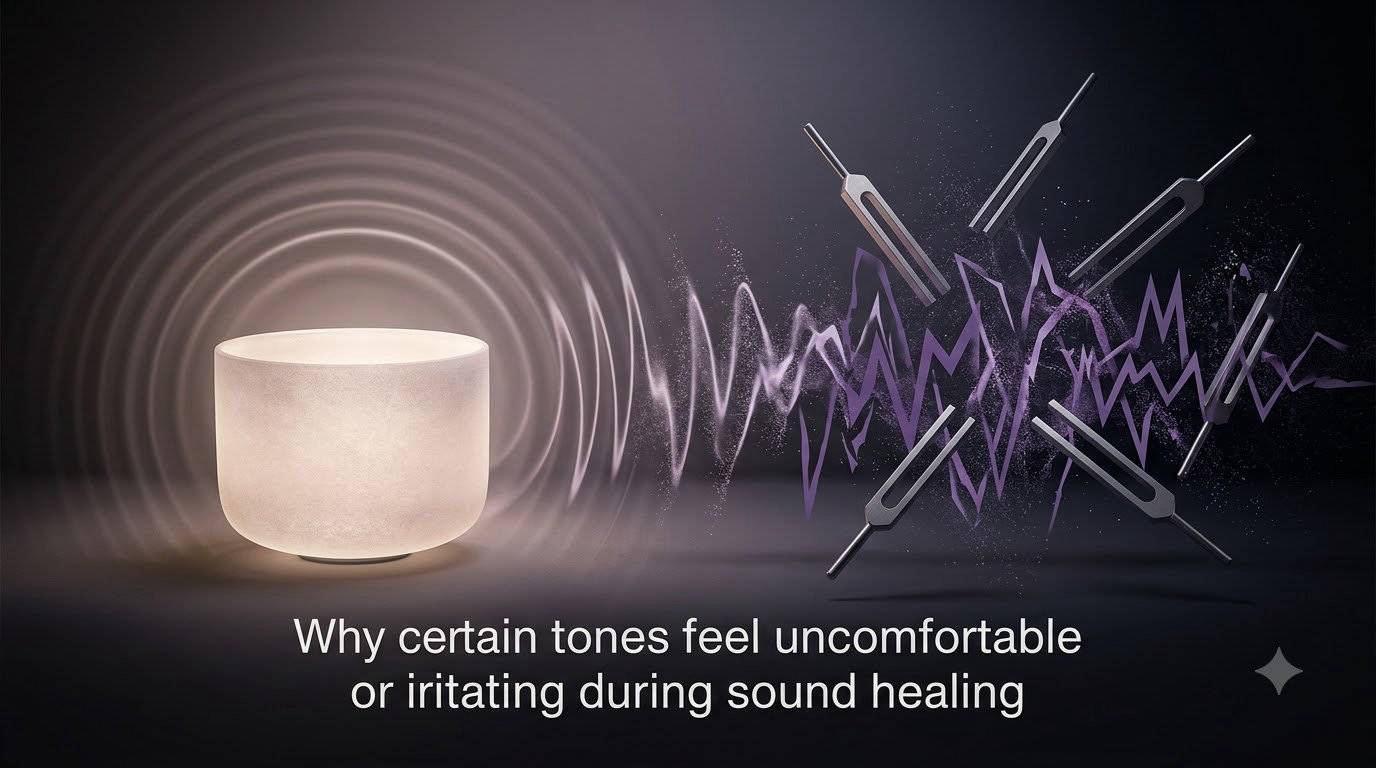
If you have ever lying in a sound bath and felt a sharp, piercing tone cut through your skull like a needle, you are far from alone. Many people experience discomfort during sound healing sessions, and some walk away wondering whether something is wrong with them. The truth is that understanding why certain tones feel uncomfortable or irritating during sound healing comes down to biology, neurology, and personal history.
Your ears and brain process sound in deeply individual ways. What feels like a blissful vibration to one person can trigger headaches, nausea, anxiety, or even anger in another. This does not mean sound healing is broken or that you are doing it wrong.
In this guide, we explore the science behind frequency sensitivity, the specific tones most likely to cause discomfort, and how to tell the difference between a productive healing response and a sign that you should step back. Whether you are new to sound baths or a seasoned practitioner who keeps hitting a wall, this information will help you navigate your experience with more confidence.
Table of Contents
Why Certain Tones Feel Uncomfortable or Irritating During Sound Healing?
Certain tones feel uncomfortable or irritating during sound healing because of individual frequency sensitivity, neurological responses, and personal trauma associations. Sound frequencies interact directly with the vestibular system, the autonomic nervous system, and brainwave patterns, creating responses that range from deep relaxation to physical distress.
The human ear is not a uniform receiver. It has natural peaks and valleys in sensitivity across the frequency spectrum. Some frequencies hit those sensitive peaks with enough intensity to feel genuinely painful, even at moderate volume levels.
Beyond pure mechanics, your brain attaches emotional meaning to sound. If a particular tone reminds your nervous system of a past experience, even unconsciously, your body can react with a stress response. This is why two people hearing the exact same crystal bowl can have completely opposite experiences.
Understanding these mechanisms takes the mystery out of the discomfort. Once you know what is happening inside your body, you can make informed decisions about which sessions, instruments, and frequencies work for you.
The Science of Frequency Sensitivity
Sound healing works on a simple physical principle: everything vibrates, and vibrations travel through matter. When a singing bowl, gong, or tuning fork produces a tone, those vibrations move through air and into your body, affecting cells, tissues, and fluid-filled spaces.
But not all vibrations feel the same. The science of why certain frequencies cause discomfort starts with how your ear is built.
How Your Ear Processes Frequencies
The human ear is most sensitive to frequencies between 2,000 and 5,000 hertz. This is the range where human speech carries critical information, so evolution tuned our hearing to pay close attention here. The problem is that many sound healing instruments, especially crystal singing bowls, produce strong overtones right in this hypersensitive range.
When a crystal bowl sings at 4,000 hertz, your ear amplifies that signal more than a lower tone at 200 hertz. The result can feel like a needle boring into your ear canal, even though the actual volume is not dangerous. Your ear is doing exactly what it evolved to do, which happens to be exactly what makes high tones uncomfortable.
The Vestibular System Connection
Your inner ear does more than hear sound. It also houses the vestibular system, the sensory apparatus that controls balance and spatial orientation. This system uses the same fluid-filled canals that detect sound vibrations.
Low frequencies from gongs and large Tibetan bowls can stimulate the vestibular system directly, creating a sense of movement even when you are lying perfectly still. This is why deep gong tones can trigger dizziness, vertigo, and nausea. Your brain receives conflicting signals about whether your body is moving, and that mismatch produces physical symptoms.
People with existing vestibular conditions, inner ear issues, or even sinus congestion are more vulnerable to this effect. The pressure changes from a congested sinus can alter how vibrations pass through your skull, amplifying discomfort.
The Nervous System Response
Sound healing aims to activate the parasympathetic nervous system, the rest-and-digest mode that promotes healing. Binaural beats and sustained tones can encourage brainwave entrainment, gently guiding your brain from alert beta waves into relaxed alpha or theta states.
But this process does not work the same way for everyone. If your nervous system is already in a heightened state, certain frequencies can push you the wrong direction. Instead of relaxing, your body interprets the sound as a threat and triggers a sympathetic response. Your heart rate increases, your muscles tense, and you may feel anxious or irritable.
This is particularly common for people with trauma histories, chronic stress, or anxiety disorders. Their nervous systems are primed to detect danger, and an unfamiliar, intense sound can register as a threat before the conscious mind has time to evaluate it.
One person in a Reddit thread on sound healing described the experience perfectly: the sounds felt like they were physically piercing the ears, making relaxation impossible. That is the nervous system doing its job, just not in a helpful way for that individual in that moment.
Common Uncomfortable Tones and Why They Occur
Not all sounds in a healing session cause discomfort equally. Certain instruments and frequency ranges come up again and again in discussions about irritation. Here is what makes each one potentially difficult.
Crystal Singing Bowls and High-Pitched Piercing
Crystal singing bowls are the most frequently cited source of discomfort in sound healing. They produce pure, sustained tones with strong harmonics in the 2,000 to 5,000 hertz range, right in the ear’s peak sensitivity zone.
When a practitioner strikes or rims a crystal bowl near your head, that pure tone hits your most sensitive hearing receptors at full intensity. Many people describe the sensation as needles in the ears or a sharp pressure behind the temples. The purity of the tone, which is exactly what makes crystal bowls so powerful, is also what makes them potentially overwhelming.
Quartz crystal bowls can also produce unexpected resonant peaks depending on room acoustics. A bowl that sounds gentle at one end of a room may feel piercing at another, depending on how sound waves bounce and reinforce each other.
Gongs and Low-Frequency Pressure
Gongs produce a broad spectrum of frequencies, from deep sub-bass tones to shimmering high overtones. The low frequencies create physical pressure that you feel in your chest and gut rather than hear with your ears.
This physical pressure can trigger the vestibular system, leading to dizziness and nausea. Some people describe the sensation as being pushed or compressed by the sound. Others feel a wave of anxiety as the low tones stimulate the body’s alarm systems.
Gongs also produce unpredictable volume dynamics. A gentle build can suddenly swell into a overwhelming crash of sound, catching your nervous system off guard. For people with startle sensitivities, this unpredictability is itself a source of stress.
Binaural Beats and Brainwave Mismatch
Binaural beats work by playing slightly different frequencies into each ear, creating a perceived third tone that your brain synchronizes with. This is supposed to encourage brainwave entrainment toward relaxed states.
But if the target brainwave state conflicts with what your nervous system needs, the result can be agitation rather than relaxation. For example, if you are already in an anxious, high-beta state and listen to theta binaural beats, the mismatch can feel jarring rather than soothing.
Some people also experience headaches from binaural beats, possibly because the brain is working harder than expected to process the conflicting signals. If you have ever felt worse after a binaural meditation, this may be why.
Solfeggio Frequencies and Individual Reactions
Solfeggio frequencies like 528 hertz and 432 hertz are widely promoted as healing tones. While many people find them deeply relaxing, others experience discomfort or no effect at all.
The discomfort some people feel with solfeggio tones highlights an important point: there is no universally healing frequency. Your response depends on your individual neurology, your current state, and your history with sound. A frequency that calms one person may irritate another, and both responses are valid.
Why the Same Instrument Feels Different to Different People
The variation in how people experience the same sound comes down to several factors. Your individual hearing profile, shaped by genetics and lifetime noise exposure, determines which frequencies feel comfortable or harsh. Your current stress level affects how your nervous system interprets incoming sound. And your personal history, including any trauma associations with particular sounds, adds an emotional layer that pure physics cannot explain.
This is why a sound bath can leave one person in tears of release and another person in tears of distress. The sound is the same. The listener is not.
Physical Responses to Sound During Healing
Sound healing triggers real, measurable physical responses in the body. Some of these are signs that the therapy is working. Others are signals that you may need to adjust your experience. Knowing the difference matters.
Headaches and Pressure Sensations
Headaches are one of the most common physical complaints after sound healing. They typically result from sustained exposure to loud or high-frequency tones that overload the auditory system. The muscles around the jaw and neck can also tense involuntarily in response to intense sound, creating tension headaches.
If you notice a headache developing during a session, it may indicate that the volume or frequency is too intense for your system. This is useful information, not a failure on your part.
Nausea and Dizziness
Nausea and dizziness during sound healing usually trace back to vestibular system stimulation. Low-frequency tones from gongs and large bowls can create a sense of movement that confuses your brain’s balance centers. This is the same mechanism behind motion sickness.
People with sinus congestion, inner ear issues, or a history of vertigo are more susceptible. If you feel nauseous during a session, it does not necessarily mean the session is harmful. But it does mean your body is asking for a gentler approach.
Tingling, Vibrations, and Somatic Sensations
Tingling, warmth, and a sense of vibration in the body are generally considered positive signs during sound healing. These sensations indicate that the nervous system is responding to the sound and that energy is moving through the body.
Many practitioners interpret these sensations as blocked energy releasing or as the body attuning to the healing frequencies. Whether you view this through a scientific or spiritual lens, these physical responses show that the sound is reaching you on a deep level.
Heart Rate and Blood Pressure Changes
Sustained tones and binaural beats can measurably affect heart rate variability and blood pressure. In most cases, the effect is a calming one, as the parasympathetic nervous system takes over. But for some people, the shift happens too quickly or too intensely, creating a racing heart or a sudden drop in blood pressure that causes lightheadedness.
If you feel your heart racing or experience chest discomfort, that is your body signaling that something needs to change. This is not a normal healing response and should be taken seriously.
Emotional Responses and Energy Release
Sound does not just affect the body. It reaches into stored emotions and memories, sometimes bringing them to the surface without warning. This is where sound healing gets both powerful and unpredictable.
Crying, Sadness, and Unexpected Grief
Crying during a sound bath is extremely common and is usually considered a healthy emotional release. Sound frequencies can bypass conscious defenses and access emotions that have been stored in the body, sometimes for years. A surge of sadness or loneliness during a session does not necessarily mean something is wrong. It often means something is being processed.
Many practitioners keep tissues available specifically because emotional releases are so common. If you find yourself crying without understanding why, that is often the sound doing exactly what it is meant to do.
Anger and Irritation as Stored Emotion
Some people feel angry or deeply irritated during sound healing, and this can be confusing. One person on Quora described listening to healing frequencies and feeling a surge of irritation and anger instead of peace.
From a somatic perspective, anger that surfaces during sound work is often suppressed emotion that has been held in the body. The sound vibrations loosen what has been stored, and it comes out as irritation. This does not feel pleasant in the moment, but it can be a productive release.
That said, persistent anger that does not resolve after the session may also signal that the particular frequency or approach is not right for your nervous system. Trust your own experience over any expectation of what should happen.
Anxiety, Fear, and Panic Responses
Sudden anxiety or fear during a sound bath can be unsettling, especially when everyone around you seems to be in bliss. For people with trauma histories, certain tones can trigger implicit memories, the body’s stored response to past danger, even without a conscious memory attached.
This is not a sign of weakness. It is a sign that the nervous system is doing what it was trained to do. If fear arises, grounding techniques like focusing on your breath, feeling the floor beneath you, or opening your eyes can help bring you back to safety.
Dissociation and Overwhelm
When the sensory input becomes too much, some people dissociate as a protective mechanism. You may feel fuzzy, disconnected, or as though you are floating outside your body. While mild dissociation can be part of a deep meditative state, feeling fragmented or disoriented is a signal that the session intensity exceeds what your system can integrate.
For neurodiverse individuals, this response can be particularly strong. The brain may process the complex sound environment as sensory overload, leading to a shutdown response rather than relaxation.
When Discomfort Signals a Healing Crisis vs Harmful Exposure
One of the most important distinctions in sound healing is telling the difference between a healing crisis and harmful exposure. Competitors rarely address this clearly, yet it is the question that causes the most anxiety for practitioners and participants alike.
A healing crisis is a temporary intensification of symptoms that occurs as the body processes and releases stored tension, emotion, or energy. Harmful exposure is when the sound is physically damaging or psychologically overwhelming in a way that serves no therapeutic purpose.
Signs of a Beneficial Healing Crisis
Discomfort that resolves within hours after the session often falls into the healing crisis category. Emotional releases like crying or sadness that leave you feeling lighter afterward suggest productive processing. Physical sensations like tingling, warmth, or temporary fatigue that pass on their own are typically signs that the body is integrating the work.
A healing crisis feels uncomfortable in the moment but leaves you feeling clearer, calmer, or more grounded within a day. The discomfort has a sense of movement to it, as though something is shifting rather than being damaged.
Warning Signs of Harmful Exposure
Pain that persists for more than 24 hours is not a healing crisis. Ringing in the ears (tinnitus) that does not go away suggests the volume was too high for too long. Headaches that worsen over days, hearing changes, or persistent dizziness all point to overexposure rather than therapeutic release.
Psychologically, if you feel worse for days after a session, more anxious, more dissociated, or more emotionally destabilized, that is a sign the session may have exceeded what your system could handle. Sound healing should not leave you worse off than when you started, at least not for extended periods.
How to Tell the Difference
The simplest guideline is duration and direction. If discomfort peaks during or shortly after the session and then improves over the next few hours, it is likely a healing response. If symptoms persist, worsen, or create a lasting sense of being overwhelmed, the approach needs to change.
Ask yourself: do I feel like something released, or do I feel like something broke? The answer tells you a lot about whether to continue, adjust, or seek a different approach.
When to Stop a Session Immediately
Certain responses warrant stopping immediately, not pushing through. Sharp ear pain, sudden hearing changes, chest pain, severe dizziness, or a panic attack are all signals to sit up, open your eyes, and communicate with the practitioner. No sound healing goal is worth risking your physical or psychological safety.
A skilled practitioner will never pressure you to continue if you are in distress. If yours does, that is a red flag about the practitioner, not about you.
Conditions That Increase Sound Sensitivity
Some people are wired to experience sound more intensely than others. Understanding your own sensitivity profile can help you make better decisions about whether and how to participate in sound healing.
Misophonia and Emotional Sound Triggers
Misophonia is a condition where specific sounds trigger strong emotional reactions, often anger or anxiety. Common triggers include chewing sounds, but certain tones and frequencies can also set off misophonic responses. If you have misophonia, some sound healing instruments may feel unbearable regardless of volume.
Hyperacusis and Volume Sensitivity
Hyperacusis is a hearing condition where everyday sounds seem unbearably loud. People with hyperacusis may find the volume of a sound bath physically painful even at levels that others find comfortable. This is a neurological condition, not a psychological preference, and it requires genuine accommodation rather than willpower.
Neurodiversity and Sensory Processing
Autistic individuals and people with ADHD often process sensory input differently. The complex, layered sound environment of a sound bath can lead to sensory overload, where the brain cannot filter and organize the incoming information. This can result in shutdown, agitation, or exhaustion rather than relaxation.
For neurodiverse individuals, shorter sessions, fewer instruments, and recordings at controllable volume may be far more effective than a full in-person sound bath.
Tinnitus and Pre-Existing Ear Conditions
If you already have tinnitus, certain frequencies can temporarily amplify the ringing. People with existing hearing loss or ear damage may find that specific tones are distorted or uncomfortable in ways that healthy ears do not experience. This does not mean sound healing is off-limits, but it does mean careful selection of instruments and volume levels.
PTSD and Trauma-Related Triggers
Sound is one of the most powerful triggers for trauma responses because the auditory system has direct pathways to the brain’s fear center, the amygdala. A tone that resembles a sound from a traumatic event can trigger a full fight-or-flight response before the conscious mind even identifies why.
If you have PTSD, working with a trauma-informed practitioner who understands how to pace sessions and check in with you is essential. Standard sound baths may not be the right starting point.
Tips for Managing Uncomfortable Sounds During Sound Healing
You do not have to choose between suffering through discomfort and abandoning sound healing entirely. There are practical strategies that can make sessions more comfortable and productive for sensitive individuals.
Talk to Your Practitioner Before the Session
The single most effective step is communication. Tell the practitioner about any sensitivities, medical conditions, or past experiences before the session begins. A skilled practitioner can adjust instrument selection, volume, and positioning based on your needs.
Experienced practitioners with hundreds or thousands of sessions understand that discomfort is common and will not dismiss your concerns. If a practitioner brushes off your sensitivity, find a different one.
Adjust Your Position in the Room
Sound intensity drops significantly with distance. Sitting or lying farther from the instruments, especially crystal bowls and gongs, can dramatically reduce the intensity you experience. The back of the room is not a lesser spot. It may be exactly right for your nervous system.
Avoid lying directly under or beside a speaker or instrument if you are sensitive to high frequencies. Position yourself where the sound reaches you diffusely rather than in a direct line.
Use Ear Protection Strategically
Earplugs reduce overall volume without eliminating the therapeutic vibrations. Many sound-sensitive practitioners and participants use musician-grade earplugs that lower decibel levels evenly across frequencies, preserving sound quality while reducing intensity. This allows you to receive the benefits of vibration without the auditory overload.
You can also partially cover your ears with your hands during particularly intense passages. This is completely normal and no one will judge you for it.
Start with Recordings Before In-Person Sessions
If you are new to sound healing or know you are sensitive, start with recordings at home. This gives you full control over volume, duration, and which instruments you expose yourself to. You can pause, adjust, or stop at any time without social pressure.
Once you understand which tones feel good and which feel uncomfortable, you can seek out practitioners whose style matches your needs. This is a much better approach than walking into a random group sound bath and hoping for the best.
Practice Grounding Techniques During Discomfort
If discomfort arises mid-session, grounding can help your nervous system stay regulated. Focus on slow, steady breathing. Feel the weight of your body on the floor. Notice physical sensations like the temperature of the air or the texture of the blanket beneath you. These simple anchors remind your nervous system that you are safe in the present moment.
Opening your eyes is also completely acceptable. You do not need to force yourself to lie still with your eyes closed if the experience is becoming overwhelming.
Choose the Right Practitioner
Not all sound healers are created equal. Look for practitioners who acknowledge that discomfort is possible, who check in with participants during sessions, and who create an environment where it feels safe to speak up. Trauma-informed practitioners are particularly skilled at reading the room and adjusting in real time.
Ask about their training, how long they have been practicing, and how they handle participants who experience discomfort. Their answers will tell you a lot about whether their sessions are right for you.
Who Should Avoid or Use Caution with Sound Healing?
Certain medical conditions warrant genuine caution with sound healing. This is not about fear. It is about making informed choices that protect your health.
People with epilepsy should avoid certain frequencies and binaural beats, as these can potentially trigger seizures. Individuals with pacemakers should consult their cardiologist, as some practitioners believe low-frequency vibrations could theoretically affect implanted devices. Pregnant women, particularly in the first trimester, should avoid sessions with intense gong work and should always inform the practitioner.
People experiencing active psychosis, severe untreated PTSD, or recent severe psychological trauma should work with mental health professionals before attempting sound healing. Those with severe vestibular disorders, active inner ear infections, or recent ear surgery should also use significant caution.
None of this means sound healing is dangerous in general. It means that like any therapeutic intervention, it is not one-size-fits-all. Consulting with your healthcare provider before starting is always wise if you have any underlying conditions.
Frequently Asked Questions
Why do certain sounds irritate me?
Certain sounds irritate you because of individual frequency sensitivity, neurological wiring, and emotional associations stored in the nervous system. Your ear is naturally most sensitive to frequencies between 2,000 and 5,000 hertz, and many sound healing instruments produce strong tones in this range. Conditions like misophonia and hyperacusis also make specific sounds feel unbearable regardless of volume.
What are the side effects of sound healing?
Common side effects of sound healing include temporary headaches, dizziness, nausea, tingling sensations, emotional releases like crying or sadness, fatigue, and occasionally anxiety or irritability. Most side effects resolve within hours of the session. Persistent symptoms like ringing in the ears, worsening headaches, or prolonged emotional destabilization may indicate overexposure and warrant medical attention.
Who should not have sound healing?
People with epilepsy, pacemakers, severe vestibular disorders, active psychosis, untreated severe PTSD, or recent ear surgery should avoid sound healing or consult their healthcare provider first. Pregnant women, particularly in the first trimester, should avoid intense gong sessions. Individuals with hyperacusis, severe misophonia, or sensory processing differences should approach sound healing with caution and start with recordings at controlled volume.
How should I feel after sound healing?
After sound healing, most people feel deeply relaxed, calm, and sometimes emotionally lighter. Some experience temporary fatigue, mild disorientation, or a sense of emotional release. These feelings typically settle within a few hours. If you feel significantly worse, more anxious, or physically unwell for more than a day, the session may have been too intense for your system.
Conclusion
Understanding why certain tones feel uncomfortable or irritating during sound healing transforms a confusing experience into actionable knowledge. Your discomfort has biological, neurological, and emotional roots that make complete sense once you understand them.
Frequency sensitivity is not a flaw. It is information. The piercing crystal bowl, the overwhelming gong, the binaural beat that triggers a headache, all of these responses tell you something important about how your unique nervous system processes sound.
The key is learning to work with your sensitivity rather than against it. Communicate with practitioners, adjust your position, use ear protection, start with recordings, and trust your body when it signals that something is too much. Sound healing can be profoundly beneficial, but only when it meets you where you actually are.
Discomfort during a session does not mean you failed at sound healing. It means you are paying attention. And that attention, more than any specific frequency or instrument, is what will guide you toward the practices that genuinely support your well-being.