
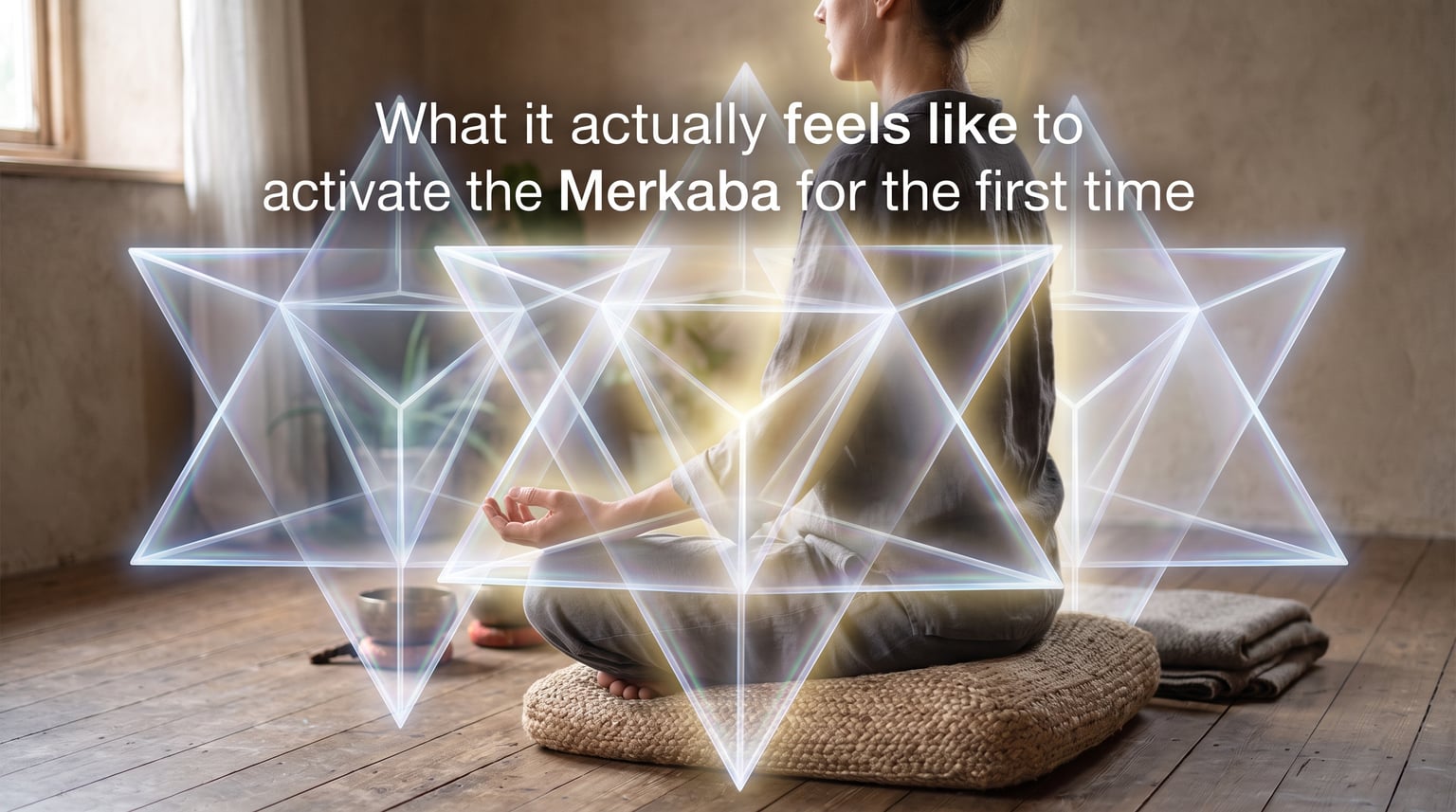
Most guides tell you how to activate your Merkaba. Almost none tell you what it actually feels like in the moment the field switches on. That gap matters, because people come to this practice expecting fireworks and instead meet something quieter, stranger, and more disorienting than any visualization can prepare you for.
I remember sitting cross-legged on my bedroom floor the first time the spinning started. I had read every step. I could picture both tetrahedrons perfectly. Nothing prepared me for the moment my chest went cold, my palms buzzed, and a faint hum filled the room like a tuning fork no one else could hear.
This article is the guide I wish I had that night. It covers what it feels like to activate the Merkaba for the first time, what happens physically and emotionally, how the experience differs from person to person, and how to come back down without feeling scattered for days afterward.
Table of Contents
What Is the Merkaba (and Why the Word Itself Matters)
The Merkaba is a vehicle of light, described in sacred geometry as two interlocking tetrahedrons — one pointing up, one pointing down — spinning in opposite directions around the body. Together they form a three-dimensional Star of David, sometimes called a star tetrahedron or Merkabah star.
The word itself carries three roots from ancient Hebrew: Mer means light, Ka means spirit, and Ba means body. So Merkaba literally translates as “light-spirit-body.” That is the whole point of the practice — to weave those three layers into one spinning field.
People often ask about the difference between Merkaba and Merkabah. There is no doctrinal difference. Merkaba is the more common modern spelling used in New Age and Flower of Life circles. Merkabah is the older Hebrew transliteration, used in Kabbalistic texts and in the study of Ezekiel’s throne-chariot vision. Same vehicle, two spellings, two lineages of interpretation.
The tradition taught by Drunvalo Melchizedek frames the Merkaba as a personal electromagnetic field, roughly 55 feet across when fully extended, that you can consciously activate through breath and intention. It is described as a bridge between third-dimensional awareness and higher states of consciousness — not a metaphor, but a felt structure you can sense once it is running.
Understanding the structure matters because what you feel during first activation is the field itself coming online. The sensations are not random. They map directly to the two tetrahedrons, the breath that powers them, and the nervous system’s response to an unfamiliar energy moving through it.
Merkaba Across Traditions
The Merkaba is not owned by one lineage. Several traditions describe a chariot, a light vehicle, or a spinning field around the human body. Knowing the differences helps explain why experiences vary so widely — each lineage activates the field through its own doorway.
| Tradition | Origin Text or Source | Core Practice | What the Field Is Called |
|---|---|---|---|
| Hebrew / Kabbalistic | Ezekiel 1, Ma’aseh Merkabah | Contemplation of the divine chariot, mystical ascent | Merkabah (the Chariot) |
| Ancient Egyptian | Temple breath schools, prana teachings | Spherical breathing through sun and earth tetrahedrons | Ka body, light vehicle |
| Flower of Life / Modern | Drunvalo Melchizedek’s workshops | The 17-breath activation with visualization | Merkaba (personal EM field) |
| Hermetic / Sacred Geometry | Pythagorean and Hermetic texts | Study of star tetrahedron as universal form | Star tetrahedron, vehicles of light |
Notice how each tradition approaches the same underlying idea from a different angle. The Hebrew lineage emphasizes contemplation and ascent. The Egyptian lineage emphasizes breath and the Ka. The modern Flower of Life lineage, which is the one most beginners in 2026 encounter first, fuses both — breath and visualization together — and that is the source of most first-time activation reports.
What It Actually Feels Like to Activate the Merkaba for the First Time
This is the section no competitor writes. So I am going to walk you through the felt experience phase by phase, the way practitioners describe it in forums, workshops, and private messages — not the way it reads in a textbook.
The most important thing to understand up front: there is no single “correct” sensation. People report wildly different first activations. Some feel almost nothing for weeks and then suddenly a quiet click. Others get a full-body event the first time they try. Both are valid. What follows is the most common sequence, drawn from forum accounts and my own experience.
Phase One: The Lead-Up (Minutes 1 to 5)
The first thing most people notice is not visual or energetic — it is breath. As you settle into the breathing pattern, your attention narrows. The room gets quieter even though nothing in it changed. You start to feel the edges of your body less and the center of your chest more.
A common early sign is warmth or tingling in the palms. Some people feel a gentle pressure at the third eye, like a fingertip resting between the eyebrows. Your heartbeat may slow. This is your nervous system downshifting to receive the practice, and it is a good sign.
One Reddit user in r/occult described it this way: “The first thing I noticed was a green aura, my aura, with indigo spots gushing over my closed eyes.” Color behind the eyelids, often green, indigo, or violet, is one of the most commonly reported early markers.
Phase Two: The Spin Begins (Around Breath 8 to 14)
This is where the experience stops being ordinary meditation and starts being something else. As the visualization of the two tetrahedrons locks in and the breath count advances, many people feel a distinct rotation — usually starting at the solar plexus and spreading outward.
The spin does not always feel smooth. Early on it can feel like a wobble, a click, or a sudden catch, as if a gear has engaged. You might feel the upward-pointing tetrahedron (the masculine, sun, electrical one) first, or the downward-pointing one (the feminine, earth, magnetic one) first. Which one arrives first seems to vary by person.
Physically, the spin often registers as a faint dizziness, a humming in the chest, or a low vibration in the bones. The vibration is what catches people off guard. It is not muscular. It feels like the body itself is humming at a frequency you can hear but not locate.
Phase Three: The Field Engages (Breath 15 to 17 and Beyond)
When the field stabilizes — usually around the fourteenth to seventeenth breath in the classic sequence — the experience shifts again. The spinning stops feeling like it is happening to you and starts feeling like it is happening around you, as if you are sitting inside a quiet gyroscope.
People describe this phase with strikingly similar language. The most common reports are:
A feeling of expansion, as if the body has become larger than its skin.
A stillness that is not empty but full, like standing inside a held breath.
A palpable sense of being held or supported by something impersonal and vast.
Colors behind the closed eyes intensifying, often shifting to gold, white, or deep violet.
A softening in the chest, sometimes described as the heart area literally warming.
In some cases, a clear sense of pillars or columns of light rising and moving past the body.
That last one appears in multiple forum accounts. One practitioner described “pillars rising and moving past my body, like I was inside a cathedral made of light.” Whether you read that literally or symbolically, the consistency of the imagery across people who have never spoken to each other is worth noting.
Phase Four: The Emotional Layer
Here is where the experience gets personal, and where the how-to guides fall silent. Once the field is running, emotion tends to surface — and not always the emotion you expect.
For some people, the first activation feels peaceful and expansive. They walk away saying they felt enlightened, lighter, more connected. For others, the field stirs up exactly what it is meant to stir: fear, grief, old tension held in the body. One forum account describes “my heart softening and my fears melting, but also tears I could not explain.”
This emotional layer is normal. The Merkaba is described as a vehicle of integration — it brings what is unconscious into the field of awareness. If you cry, shake, or feel sudden grief during your first activation, you are not doing it wrong. You are doing the work the practice is designed to do.
The danger zone is when someone interprets the emotional release as a sign the practice is harmful or “demonic” — a question that comes up in search results more often than you would think. The emotion is not evidence of something wrong. It is evidence that something long-held is finally moving.
Signs the Activation Is Actually Working
Because the experience varies so much, beginners often ask how to know if it is real or just imagination. Based on the consistent markers across accounts, here is what to look for:
A felt sense of spin or rotation, even subtle.
Vibration or humming in the body, not just in the mind’s eye.
Temperature shifts in the hands, chest, or face.
A clear, calm sense of expanded space around you.
Emotional movement — peace, tears, warmth, or release.
Afterward, a quiet clarity that lingers for hours.
If you have none of these after several honest attempts, the field may not be engaging yet. That is also normal. Most teachers say the first true activation takes weeks or months of consistent practice, not a single session.
The 17-Breath Activation, Step by Step
I will not pretend to teach the full technique here — Drunvalo Melchizedek’s method is detailed and best learned from a qualified teacher. But understanding the structure of the 17 breaths helps explain why the experience unfolds in phases.
The practice uses a specific spherical breath pattern combined with visualization of the two tetrahedrons. Each breath adds a layer: first the upward tetrahedron, then the downward, then the spin directions, then the speed, and finally the field extension. The breaths alternate in quality — some masculine, some feminine — to balance the two poles of the field.
In simplified form:
Breaths 1 to 6: Establish the two tetrahedrons, one above, one below, locked around the body.
Breaths 7 to 13: Begin the spin in both directions, accelerating to one-third and then two-thirds light speed.
Breath 14: The field stabilizes; the spin locks at full speed.
Breaths 15 to 17: Extend the field outward, sometimes to 55 feet, and seal it with intention.
The reason the felt experience arrives in waves is that each cluster of breaths activates a new layer of the field. You feel the tetrahedrons form first, then the spin engage, then the field extend. If you skip ahead or rush the count, you tend to feel nothing — which is why pacing matters more than intensity.
One quiet detail most guides skip: the practice assumes you already have some fluency with breathwork and visualization. If you have never held a stable mental image for more than ten seconds, the 17 breaths will feel like trying to drive a car you have never sat in. Build the basics first.
What Can Go Wrong (and How to Steady Yourself)
The forums are full of pain points, and they are worth naming honestly. The most common problems people report after a first activation attempt are not physical — they are psychological and energetic.
The first is dissociation. When the field engages strongly and the practitioner has no map for what is happening, the experience can feel like leaving the body rather than expanding it. One forum user described “feeling scattered or disconnected after trying to force the experience.” That scattered feeling is not activation — it is the nervous system overwhelmed. The fix is to slow down, shorten the session, and ground before standing up.
The second common problem is forcing. People want the fireworks, so they push the visualization harder, breathe more intensely, or hold the spin past the point of comfort. Forcing produces a tense, jittery field that collapses the moment attention slips. Real activation feels almost effortless once it engages — like a top that has found its balance.
The third is confusion about whether the experience is real. Beginners often doubt themselves because what they felt was quieter than expected. The doubting itself becomes a problem because it shuts the field back down. If you felt even one of the markers listed earlier, trust it. Refine the technique over time rather than dismissing the result.
Most teachers strongly recommend learning the 17-breath method with guidance rather than from a PDF or video alone. The practice is precise, and small errors in the breath pattern or spin direction can leave you with a field that wobbles instead of stabilizes. A teacher can also help you interpret what you are feeling, which is half the value.
One last warning worth stating directly. If you have a history of dissociation, panic, or trauma that lives in the body, approach this practice slowly. The Merkaba can surface material faster than an unprepared nervous system can integrate. Short sessions, grounding afterward, and ideally a guide are not optional extras — they are part of doing this safely.
Coming Back: Integration After First Activation
This is the section no competitor writes, and it might be the most important one. What you do in the hour after your first activation shapes whether the experience integrates cleanly or leaves you wired for days.
Integration is the process of returning to ordinary consciousness without losing what the field opened. Done well, you feel clear, calm, and unusually present. Done poorly, you feel spacey, forgetful, emotionally raw, or unable to sleep.
The basic sequence most teachers recommend:
Do not jump up. Sit for several minutes after the final breath. Let the spin slow on its own.
Ground through the body. Press your palms to the floor, feel your sitting bones, drink water, eat something.
Avoid screens for 20 to 30 minutes. The field is still settling and bright light can scatter it.
Move slowly. Walk, stretch, do ordinary physical tasks to anchor the energy in the body.
Write down what you felt. Memory fades fast after expanded states. A few notes help you recognize patterns across sessions.
Some people feel the afterglow of a first activation for hours; others feel it for days. If you feel noticeably more sensitive, more emotional, or more clear in the days following, that is the field still integrating. Rest, water, time in nature, and ordinary human contact help it settle. Trying to re-activate immediately to chase the feeling is the single most common mistake — it overloads a system that is still processing the first opening.
Think of integration as part of the practice, not the cooldown. The Merkaba is a vehicle of integration. Skipping that step is like taking off in a plane and never landing.
FAQ
How do you activate the Merkaba?
You activate the Merkaba through a sequence of about 17 breaths combined with visualization of two interlocking tetrahedrons spinning in opposite directions around the body. The breaths alternate in quality to balance the masculine and feminine poles of the field, and the spin accelerates in stages until the field stabilizes and extends outward.
What are the benefits of Merkaba activation?
Reported benefits include heightened awareness, deep inner peace, a stronger connection to higher consciousness, energetic protection, greater clarity, emotional release, and a felt sense of expanded space around the body. Practitioners also describe improved meditation depth and a more stable sense of presence in daily life.
Does Merkaba actually work?
Thousands of practitioners report consistent physical and emotional sensations during activation, including vibration, warmth, color behind the eyes, and a felt sense of spin. Whether you read the Merkaba as a literal energy field or a powerful meditative framework, the practice reliably produces measurable shifts in awareness, breath, and nervous system state.
What is the difference between Merkaba and Merkabah?
There is no doctrinal difference. Merkaba is the modern spelling common in New Age and Flower of Life circles. Merkabah is the older Hebrew transliteration used in Kabbalistic texts and in study of Ezekiel’s throne-chariot vision. Both refer to the same light-spirit-body vehicle.
How long does Merkaba activation take?
A single session of the 17-breath sequence takes roughly 15 to 30 minutes once you know the technique. Achieving a stable, repeatable first activation usually takes weeks or months of consistent practice. Most teachers caution against expecting a full field engagement on the first attempt.
Is Merkaba activation safe to do alone?
It can be safe for experienced meditators practicing slowly and with grounding. Beginners and anyone with a history of dissociation, panic, or trauma are strongly advised to learn the technique with a qualified teacher. Short sessions, integration afterward, and not forcing the experience keep the practice safe.
Final Thoughts on What It Actually Feels Like to Activate the Merkaba
If you take one thing from this guide, let it be this: what it feels like to activate the Merkaba for the first time is rarely what you expect, and almost never what the diagrams suggest. The fireworks are optional. The quiet hum, the softening in the chest, the strange sensation of sitting inside something larger than your body — those are the real markers.
Approach the practice with patience, ground yourself afterward, and let the field teach you at its own pace. The Merkaba is not something you switch on once and possess. It is a relationship you build over many sessions, and the first activation is just the handshake.
If you are serious about working with this field, find a teacher who can sit with you, watch your breath, and help you interpret what you feel. The technique is precise, the integration matters, and the experience deserves more respect than a single article — or a single PDF — can give it.