
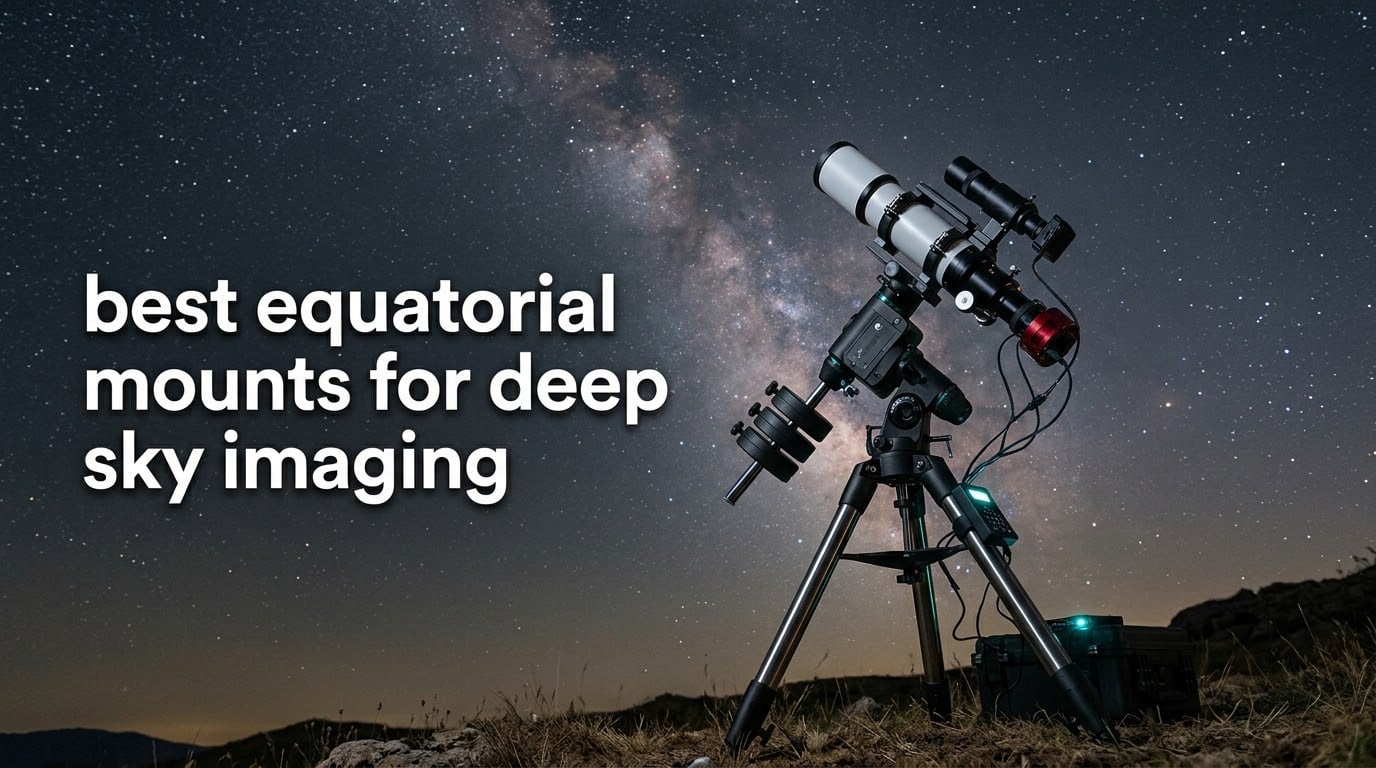
Most people shopping for a telescope start with the optics. For deep sky imaging, the mount is the piece that decides whether stars come out round or turn into short trails, and no amount of post-processing repairs a mount that cannot track. The best equatorial mounts for deep sky imaging share a few traits: they hold a payload without flexing, they track smoothly enough that a guide camera can clean up the remaining error, and they keep that performance steady for the three or four hours a typical session runs.
That last part matters more than raw specification sheets suggest. A mount that guides beautifully for twenty minutes and then drifts as its lubricants warm up, or that loses balance when the temperature drops and the tube contracts, will cost you an entire night of data. The picks below are the mounts that hold their alignment, in the weight classes people actually buy them in, from a three-pound travel tracker to a fifty-five-pound equatorial head that lives on a pier.
I spent 2026 reading owner reports across Reddit’s r/AskAstrophotography, r/telescopes and Cloudy Nights, then working through payload math for common optical tube and camera combinations. Seven mounts make the cut here. Three are portable tracking platforms for wide-field work, three are German equatorial designs for longer focal lengths, and one is the mid-size computerized workhorse that shows up most often as a first serious imaging rig.
One clarification before we start, because it trips up newcomers constantly: this roundup covers equatorial mounts and tracking platforms only. If you want the fastest route to a finished image, a tracker for a camera and short telephoto lens is usually enough, and the total weight stays under what you can carry to a dark site in one trip. If you already own an optical tube and a mono camera, the decision moves to German equatorial mounts, and payload capacity starts to be the number that matters most.
Table of Contents
Top 3 Picks for Deep Sky Imaging

Sky-Watcher Star Adventurer 2i
- Built-in Wi-Fi with SAM Console app
- Deluxe equatorial base
- Illuminated polar scope
- 7 lb pack weight

iOptron SkyGuider Pro
- 11 lb balanced payload
- All-metal body
- AccuAlign polar scope
- 20 hour internal battery

Sky-Watcher Star Adventurer GTi
- GoTo tracking head
- Illuminated polar scope
- Counterweight bar and 5 lb weight
- Built-in Wi-Fi
The Star Adventurer 2i Pro Pack takes the top slot because it has the largest body of owner feedback of any tracker here and the lowest complaint rate per session, at a weight you can carry with one hand. The SkyGuider Pro edges it on build quality and payload headroom for its size, and the Star Adventurer GTi bundle wins if you want pointing to the target without a hand controller in the cold.
Best Equatorial Mounts for Deep Sky Imaging in 2026
| Product | Specifications | Action |
|---|---|---|
| Sky-Watcher Star Adventurer 2i Pro Pack |
|
Check Latest Price |
| iOptron SkyGuider Pro |
|
Check Latest Price |
 Celestron Advanced VX 30lb Payload Celestron Advanced VX 30lb Payload |
|
Check Latest Price |
| Sky-Watcher Star Adventurer GTi Kit |
|
Check Latest Price |
 Sky-Watcher EQ6-R Pro Sky-Watcher EQ6-R Pro |
|
Check Latest Price |
 iOptron SkyTracker Pro iOptron SkyTracker Pro |
|
Check Latest Price |
 Celestron CGX 55lb Payload Celestron CGX 55lb Payload |
|
Check Latest Price |
1. Sky-Watcher Star Adventurer 2i Pro Pack – Best Overall Tracking Platform
Sky-Watcher Star Adventurer 2i Pro Pack (S20512)
7 lb pack weight
13.9 x 9.6 x 6.3 inch dimensions
Built-in Wi-Fi and SAM Console app
Pros
- Tracks accurately once polar aligned
- Lightweight and highly portable
- Integrated illuminated polar scope
- Long battery life on AA batteries
- Built-in autoguider port
Cons
- Steep polar alignment learning curve at first
- Flimsy red-light plastic polar illuminator adapter
- Needs a sturdy tripod rather than a light camera tripod
This is the tracker I recommend to people who want one mount to cover wide-field Milky Way work, nightscapes with a tracked foreground, and short telephoto deep sky targets. The Pro Pack bundles the head, the deluxe equatorial base and the polar scope into a package that weighs seven pounds in total, which is the difference between carrying your imaging rig to a dark site and imaging from your yard.
Owners consistently report that the head holds multi-minute exposures at moderate focal lengths once it is polar aligned and balanced, and the five-star share of ratings sits at seventy percent. The tracking quality is not exotic, but it is repeatable, and repeatability is what lets you stack a hundred subs without throwing half of them out.
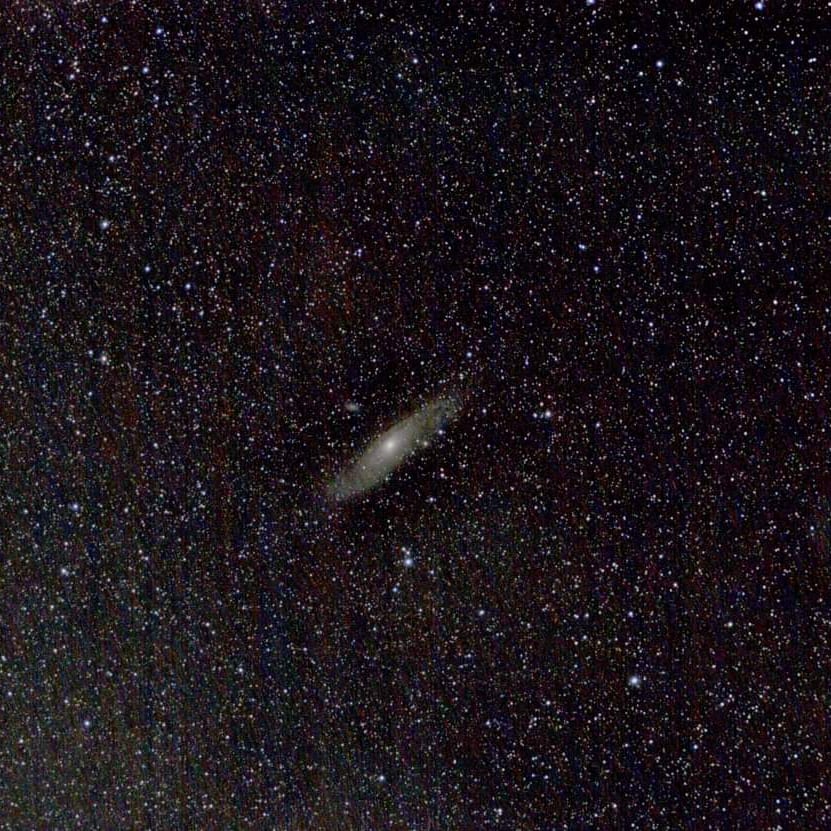
The deluxe equatorial base is the piece most people underrate. It angles the head to your latitude and takes the fine azimuth adjustment out of the equation, so polar alignment takes a few minutes rather than an evening of trial and error. The integrated illuminated polar scope gives you a reticle to centre, and that is the single biggest difference between two-minute subs and five-minute subs on this class of mount.
Two features sit slightly beyond the basics. Wi-Fi control through the free SAM Console app handles start, stop and exposure count from a phone, which is genuinely useful when the tracker is on the other side of the yard. There is also an autoguider port, so if you later add a guide scope you can push subexposures longer without changing mounts.
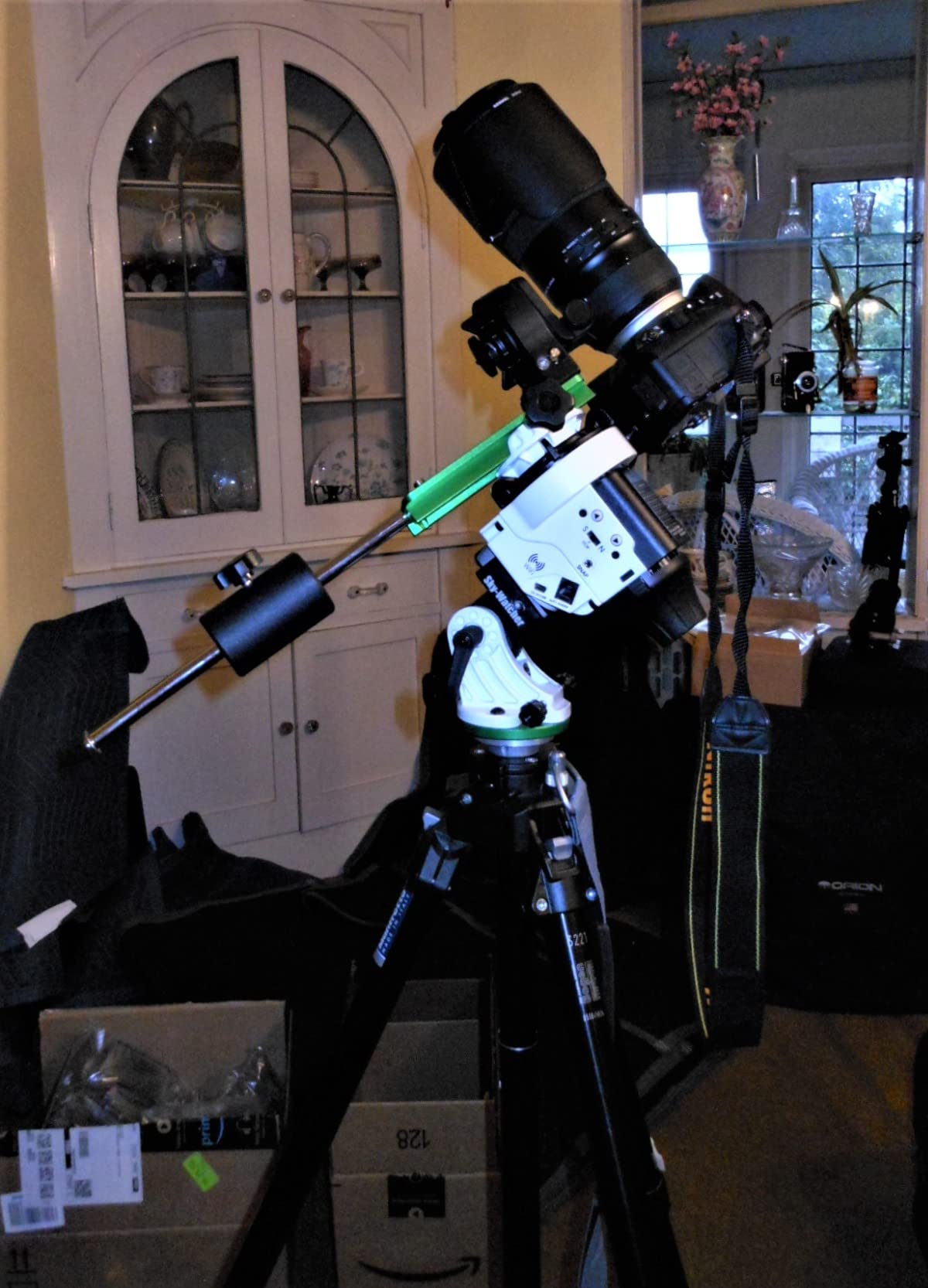
What you get once it is set up
Guiding on a well-balanced 2i setup at 200mm is routine, and the reviews describe three-minute exposures with no noticeable drift, with guided runs extending further. Battery life on one set of AA cells covers a full session, and the head’s low mass means wind is less of a problem than it would be on a heavier platform.
The practical limit is payload, not tracking. This is a camera-and-lens tracker, so pairing it with a heavy telescope and a long counterweight bar will undo any balance you set up. Keep the optical tube short and light, use a sturdy tripod, and it will produce clean data all night.
Where it falls short
The learning curve for polar alignment is the most reported complaint, and it is a real one: the first session is usually longer than you expect. The included red-light plastic illuminator adapter is thin and easy to lose, and a few of the small plastic parts are not stocked by the manufacturer when they eventually go missing.
The SAM Console app covers the basics and nothing more, so treat Wi-Fi control as a convenience rather than a capture tool. Many cameras also need a separate shutter release or intervalometer cable, which is not in the box. Budget for a solid tripod, since a light camera tripod will flex enough to soften every star in the frame.
2. iOptron SkyGuider Pro – Best Metal-Bodied Portable Tracker
iOptron SkyGuider Pro Camera Mount Full Package
11 lb balanced payload
2.2 lb mount head weight
AccuAlign illuminated polar scope
20 hour internal battery
Pros
- All-metal body with low vibration
- 11 lb balanced payload capacity
- Integrated illuminated polar scope
- Roughly 15-20 hours per charge
- Folds to 3.74 x 4.53 x 5.24 inch
Cons
- No GoTo so targets are found manually
- Short 8-inch counterweight bar
- Polar scope often needs collimation on arrival
The SkyGuider Pro is the pick for anyone who wants a tracker that feels machined rather than moulded. The all-metal body and four-bearing construction give it noticeably lower vibration than plastic trackers, and that difference shows up as tighter stars in short subexposures where vibration, not tracking error, sets the limit.
At 2.2 pounds for the head and a listed capacity of 11 pounds balanced, it is the most capable portable tracker here by a wide margin. That headroom is what lets you carry a mid-size telephoto, a small refractor or a camera with a fast wide-angle lens without fighting balance, which is why reviewers report 2-3 minute subexposures at 500mm from a package this small.
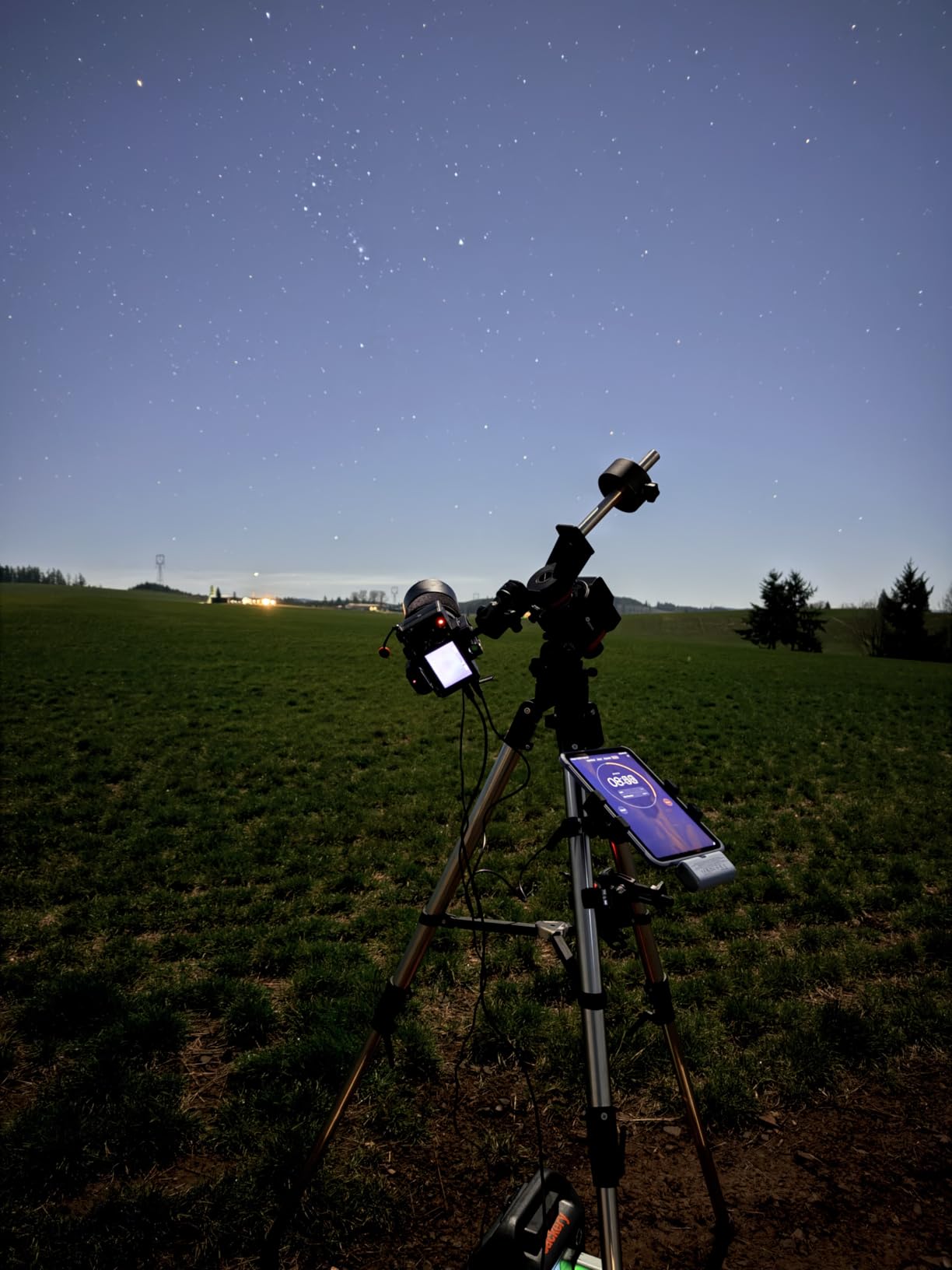
The integrated AccuAlign dark field illuminated polar scope is the standout feature for beginners, because a lit reticle in a dark field is exactly what you need to align quickly. The adjustable base covers latitudes from -30 to 65 degrees with plus or minus 5 degrees of azimuth adjustment, so the same mount works at a home latitude and at a dark site a few hundred miles away.
Power is internal. The rechargeable battery runs up to twenty hours at 20 degrees Celsius, and owners typically get fifteen to twenty hours in practice, which is longer than most sessions need. Siderial, lunar, solar and half-siderial rates are all available, and half-siderial is the one to use when you want a tracked landscape with some motion in it.
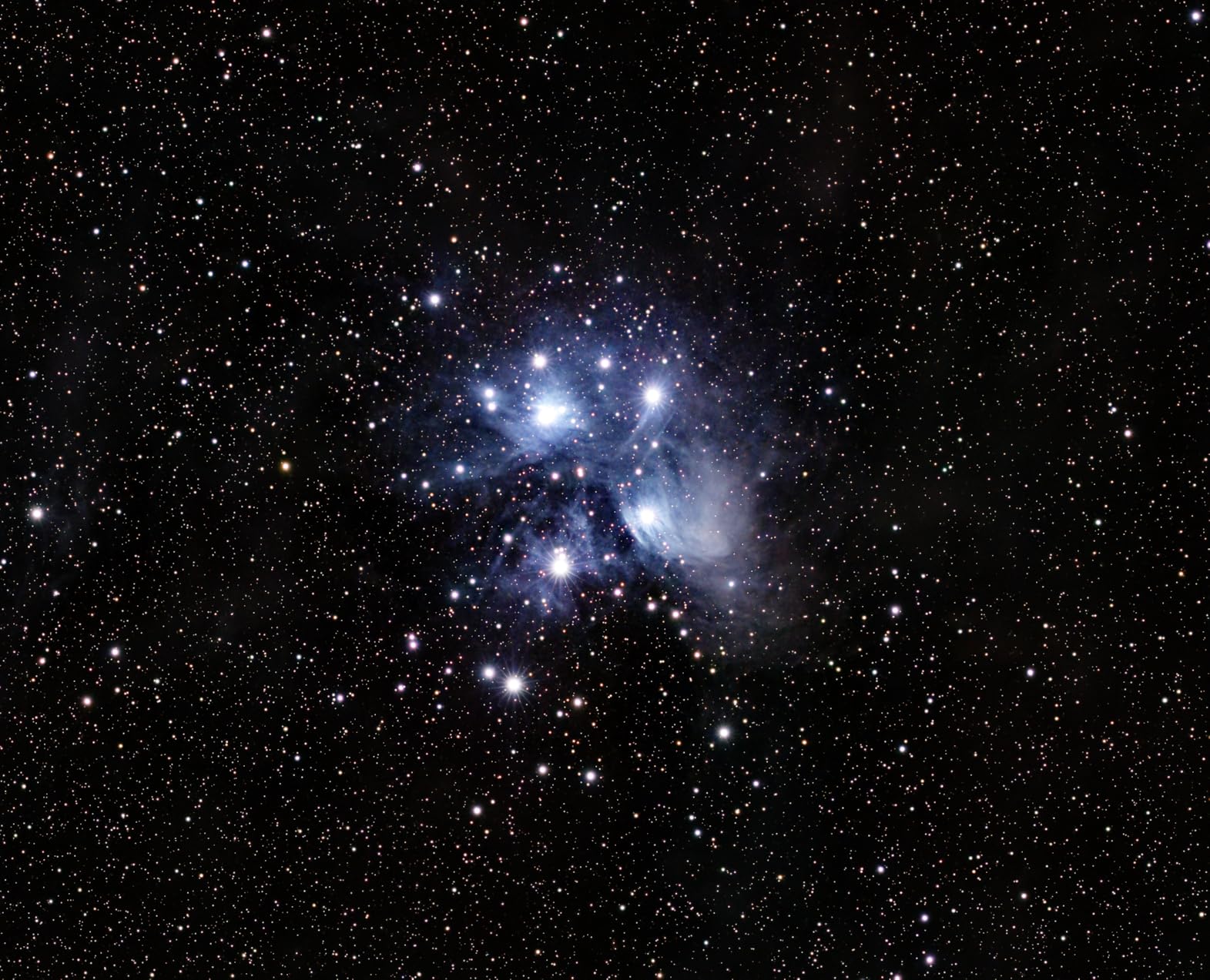
Why the metal body matters at imaging focal lengths
Vibration is what limits a light tracker with a heavier payload on it, and metal construction is the cheapest fix available. With a proper balance, this head holds stars tight through two- and three-minute subs at 500mm, which is well past the point where most compact trackers start to smear.
The counterweight and adjustable wedge add real capability for a DSLR plus telephoto combination, though the short eight-inch counterweight bar is a limit worth knowing about before you build a heavy rig around it.
What to know before you commit
There is no GoTo, so you find targets manually. That is a smaller problem than it sounds in 2026 because plate solving in most capture software solves the field and centres it for you, but it does mean a first session takes longer to set up.
The polar scope frequently arrives out of collimation with the right ascension axis and needs adjusting before first use, and a few button behaviours take double-checking while you are working in the dark. Counterweight and extension accessories are harder to source for this model, so plan the whole rig before you start.
3. Celestron Advanced VX – Best GoTo German Equatorial for a First GEM
Celestron Advanced VX Computerized German Equatorial Mount – 30lb Payload
30 lb payload capacity
50 lb item weight
NexStar+ controller with 40000+ objects
7 to 77 degree latitude range
Pros
- Computerized GoTo with 40000+ object database
- 30 lb payload covers mid-size imaging rigs
- 2-inch stainless steel tripod legs reduce vibration
- All-Star Polar Alignment and PPEC
Cons
- 50 lb kit weight is awkward to carry to dark sites
- Latitude adjustment stops at 77 degrees
- PPEC and PWI software adds setup complexity
The Advanced VX is where a lot of imagers make the jump from a camera tracker to a German equatorial mount, and it succeeds because the first computerized mount is genuinely beginner-operable. The NexStar+ hand controller carries a database of more than 40,000 objects and drives the mount through several alignment procedures without needing a computer running.
Thirty pounds of payload is the number that matters here. That covers a mid-size refractor, a mono camera, a guide scope and an off-axis guider with room to spare, which is the combination most people are building when they outgrow a tracker. The 2-inch stainless steel tripod legs are noticeably more rigid than the aluminium tripods on cheaper mounts, and that rigidity is what lets subexposures get short.
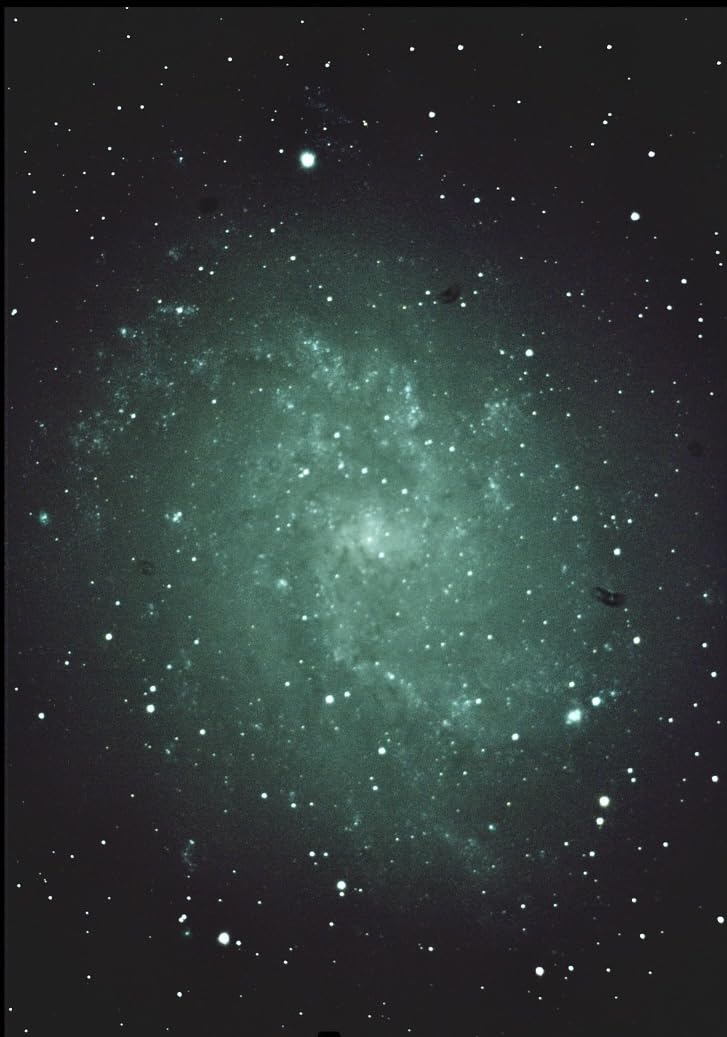
All-Star Polar Alignment is the feature regular users point to. It refines alignment using stars in the captured field, so it corrects a rough initial alignment and keeps working when you cannot see Polaris at all, which happens more often than beginners expect under trees, near a house, or at high latitude. PPEC, the mount’s permanent periodic error correction, and the Celestron PWI software extend that further for long guided runs.
Tracking modes cover sidereal, solar and lunar rates plus EQ North and EQ South operation, so the mount handles a southern hemisphere site without modification. Latitude adjustment spans 7 to 77 degrees, and the dual saddle plate accepts CG-5, CGE-style and Vixen format dovetails, which is a real convenience if your optical tube uses a plate from a different brand.
How it performs once a guide camera is attached
With a guide scope and an off-axis guider, the VX settles into a usable guiding error that is easily good enough for several-minute subframes on a mid-size refractor, and the stainless steel tripod keeps the jitter low enough that short subexposures stay clean. Most imagers in owner reports pair it with a small refractor and get consistent results within a session or two of setup.
The right ascension and declination axes are both driven, and the mount handles long sequences without the drift that shows up on entry-level mounts after a few hours. That makes it a good platform for narrowband work where three to ten minute subframes are the goal.
Where the weight and software get in the way
The kit weighs about 50 pounds assembled, and that is the main reason it is not higher on this list. It is a two-person carry at best, and if your dark site is more than a short drive from home, that weight gets tested every session.
PPEC and the PWI pointing model software add a real setup learning curve on top of the hand controller workflow. The latitude range also stops at 77 degrees, which limits very high northern latitudes. Reviewers note the software complexity is the thing that catches people out, not the hardware.
4. Sky-Watcher Star Adventurer GTi Kit – Best GoTo Tracker Bundle
Sky Watcher Sky-Watcher Star Adventurer GTI Mount Kit with Counterweight, CW bar, Tripod, and Pier Extension – Full GoTo EQ Tracking Mount for Portable and Lightweight Astrophotography
26 lb kit weight
Built-in illuminated polar scope
Counterweight bar and 5 lb weight
Built-in Wi-Fi smartphone control
Pros
- GoTo pointing in a portable tracker format
- Built-in illuminated polar scope
- Counterweight bar and pier extension aid balance
- Wi-Fi control without a hand controller
- Two-year limited warranty
Cons
- 26 lb kit is heavier than bare-bones trackers
- Not intended for long focal lengths or heavy payloads
The GTi is the answer when you have outgrown manual pointing but do not want to move up to a full German equatorial head. It is a GoTo tracking mount head, and the kit bundles it with the GTi tripod, a pier extension, an illuminated polar scope, a counterweight bar and a 5 lb counterweight, so the whole system is ready to image on arrival.
That completeness is the reason this bundle appeals. Most people buying a portable GoTo tracker end up sourcing a tripod, a counterweight bar and a polar scope separately, and the pier extension here is what keeps the head high enough to clear the tripod legs through a full polar alignment and meridian pass.
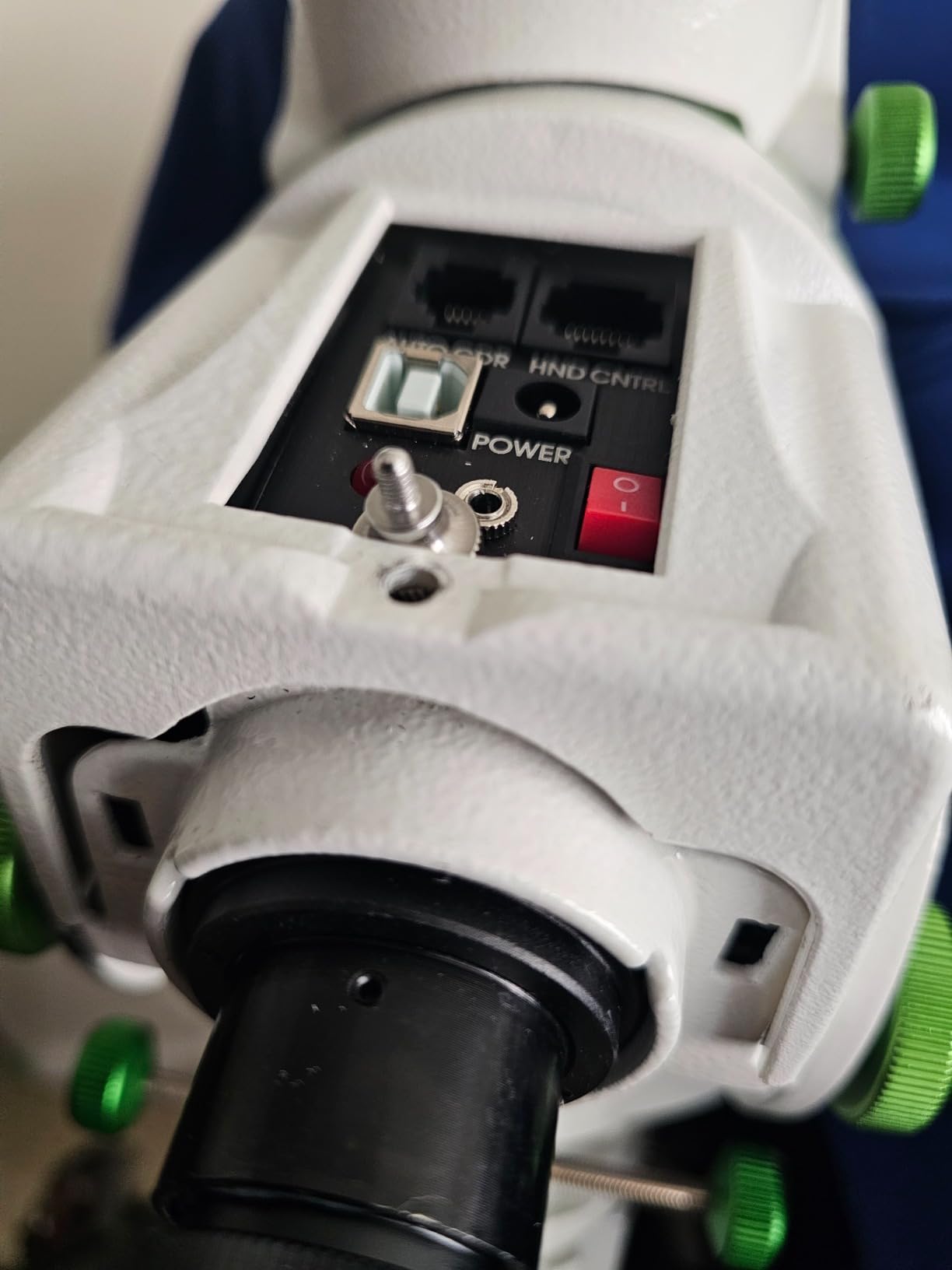
Pointing is handled over built-in Wi-Fi from a smartphone, with no separate hand controller to carry, lose or freeze. The illuminated polar scope does alignment the same way the 2i does, so the learning curve from one Sky-Watcher tracker to the next is close to zero if you already own the smaller one.
Owners rate it highly at 4.5 stars across 111 reviews, and the feedback centres on exactly what the bundle adds: a proper tripod, a pier extension and a counterweight, which together allow more balanced and slightly heavier rigs than a bare tracker head allows.
Where GoTo changes the night
For a beginner or anyone imaging alone, pointing to a target in the dark with a manual tracker is the part that kills sessions. The GTi removes that step, so a target can be acquired on a phone screen in seconds and the session starts on the first clear patch instead of the tenth.
Multiple tracking rates cover the usual cases, and the counterweight bar with its 5 lb weight lets you balance a slightly larger optical tube than the bare-head trackers take. For wide-field and moderate focal length work, that is the difference between a comfortable session and a compromised one.
What it will not do
At 26 pounds for the kit, this is no longer a one-hand carry, and the tripod and pier extension are the reason for most of that. It is still far lighter than any German equatorial mount here, but it sits in the middle ground rather than at the portable end.
It is not a long focal length or heavy payload mount. Owners are clear that pairing it with a long refractor or a heavy telescope train is outside what it was built for, and the counterweight bar here is for balance convenience, not for absorbing a large optical tube. Two-year limited warranty coverage is a plus compared with some of the smaller trackers.
5. Sky-Watcher EQ6-R Pro – Best for Long Focal Length Guided Imaging
Sky-Watcher EQ6-R – Fully Computerized GoTo German Equatorial Telescope Mount – Belt-driven, Motorized, Computerized Hand Controller with 42,900+ Celestial Object Database
44 lb payload capacity
Belt-driven stepper motors
SynScan controller with 42000+ objects
USB and ST-4 autoguide ports
Pros
- Belt-driven motors give quiet slewing and smooth tracking
- 44 lb payload handles 8-inch optical tubes
- Built-in illuminated polar finderscope
- PPEC training through encoders
- Works with PHD Guiding and NINA
Cons
- Very heavy assembled so field use takes effort
- Factory grease can cause stiction when balancing
- Base alt-azimuth adjustment screws feel awkward
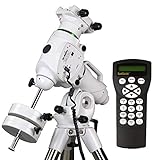
The EQ6-R Pro is the mount the community comes back to most often for mid-payload guided imaging, and the reason is straightforward: 44 pounds of payload, belt-driven stepper motors and a SynScan controller with more than 42,000 objects. It is a full German equatorial head, and it treats long guided sequences as its normal operating condition rather than something it tolerates.
Belt drive is the technical detail worth knowing. The belt between the motor and the worm gear removes most backlash, so when the right ascension axis reverses direction the mount does not take up slack and shake the frame. Owners describe slewing as quiet, which matters more than most people expect if you share an observatory or a driveway with neighbours.

The encoders in both axes enable PPEC, permanent periodic error correction. You train the mount through a full worm cycle once, and it replays that correction every session, which is how a worm-drive mount competes with harmonic drive designs in guiding performance. With a guide camera and off-axis guider, EQ6-R Pro users report sub-arcsecond total RMS guiding error in good conditions.
Connectivity covers what imaging software expects: USB for direct control and an ST-4 port for autoguiding, alongside pulse guiding through the same interface. The built-in illuminated polar finderscope gets you aligned fast, and the dual Vixen and Losmandy style saddle accepts the dovetail standards most optical tubes use.
What 44 pounds of payload actually buys
It is enough for an 8-inch optical tube with a mono camera, a guide scope, an off-axis guider and cabling. That is a genuinely capable narrowband rig, and it is the configuration where three to ten minute subframes start to be practical rather than theoretical.
Latitude adjustment runs to 65 degrees, and the 2-inch tripod legs are rigid enough to support that payload without introducing meaningful vibration. A built-in carry handle helps, and owners who break the kit down for transport find the head and tripod manageable separately even if the assembled system is not.
What the community complains about
Weight is the recurring theme. Assembled with the tripod and two 11 lb counterweights the system is well over 75 pounds, so field use means effort or partial disassembly. This is a mount that wants a backyard, a garage or a permanent pier rather than a dark site you drive to.
Factory-applied grease can leave the axes stiff on arrival, which makes balancing frustrating until the mount is worked in. Hypertuning by loosening and re-greasing the bearings is the standard fix, and it does void the warranty. The alt-azimuth adjustment screws at the base are also a commonly criticised touch point, and the hand controller display has been reported as failing in very cold conditions.
6. iOptron SkyTracker Pro – Budget Pick for Lightweight Glass
iOptron SkyTracker Pro Camera Mount with Polar Scope, Only
6.6 lb payload capacity
3.3 lb item weight
Folds to 115x115x95 mm
Integrated rechargeable battery
Pros
- Compact at just over 3 pounds with a padded bag
- Integrated rechargeable battery
- Four tracking rates including half-siderial
- Dimmable polar scope LED speeds alignment
- 4-5 minute exposures reported with no trailing
Cons
- 3 kg payload limit needs a counterweight for large zooms
- A separate ball head is usually required
- Dovetail base is not Arca-Swiss compatible
The SkyTracker Pro is the smallest complete answer in this roundup, and for a short telephoto lens on a full-frame or APS-C camera it is genuinely enough. At 3.3 pounds with a folded size of 115 by 115 by 95 mm, it fits into a normal camera bag and it is the mount most people here pair with a lightweight wide-to-short telephoto for Milky Way and larger deep sky targets.
It is a clear step up from the original SkyTracker, with better stability, a rechargeable internal battery and easier fine alignment. Owners report four- and five-minute exposures with no trailing in normal use, which at this weight class is a good result and enough to resolve detail in emission nebulae at moderate focal lengths.
Four tracking rates cover sidereal, half-siderial for landscapes, solar and lunar, and the jog forward and reverse button plus the dimmable polar scope LED are the two controls you will use most. The polar scope has enough fine adjustment knobs that alignment is quick once you know which knob does what, and the padded carrying bag is included.
Charging is over micro USB at 5V, reaching 80 percent in about five hours, and the four-piece bearing construction with a DC servo motor drive keeps the tracking quiet. The 600 second worm period is worth noting if you ever want to understand the periodic error you are seeing in a guide graph.
What fits and what does not
The 3 kg payload is the binding constraint. A body with a short telephoto sits comfortably inside it, and a fast wide-angle prime is effortless. Large heavy telephoto zooms exceed it, and owners of those glass add the optional counterweight to bring the balance back to zero, which is the standard workaround.
A separate ball head is normally required and is not included, so budget for one. That extra step is part of why the SkyGuider Pro is the stronger portable choice for a serious setup, but the SkyTracker Pro still wins on absolute portability and on price.
The parts that cause friction
The bundled dovetail base is not Arca-Swiss compatible, and owners of standard tripod heads report that it can be less stable than expected until tightened properly. The rubber cushion at the swivel head also slips when securing heavier loads, which is frustrating exactly when you have loaded the mount up to its limit.
There is another small issue worth knowing: the flat base will not index to tripods with a fixed north index mark, so alignment on those tripods is by eye and reticle rather than by reference mark. The one-year limited warranty is shorter than the GTi’s. None of these stop the mount doing its job with a light camera and a modest lens.
7. Celestron CGX – Best for Heavy Camera Trains and Fixed Installations
Celestron CGX Computerized German Equatorial Mount & Tripod, 55lb Payload
55 lb payload capacity
108 lb item weight
High-torque servo motors with belt drive
Internal cable management
Pros
- 55 lb payload handles heavy camera trains
- Flat guiding graphs over multi-hour subframe runs
- Quiet slewing with an easy-to-use hand controller
- Internal cable routing keeps imaging wiring tidy
Cons
- Very heavy at 108 lb for remote sites
- Optional polar scope can block the declination axis range
- Some owners report RA drive or controller failures
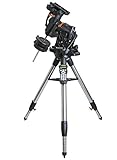
The CGX is the step up from the Advanced VX, and it is a mount to buy when you are done moving. Fifty-five pounds of payload covers optical tubes from 8 up to 11 inches with a full camera train, and the high-torque servo motors with belt drive handle that mass without the flex you would get from a lighter head rated the same way.
Experienced owners describe guiding graphs that stay flat through multi-hour runs of 30-minute subframes, which is exactly what narrowband and faint galaxy work needs. The slew is quiet, the NexStar+ hand controller is straightforward, and the alt-azimuth repositioning moves the heavy axis smoothly instead of requiring brute force.
Internal cable management is the detail that separates this from an entry-level GEM. Guiding, camera and power cables run inside the mount rather than draping across it, so nothing shifts as the axes move and nothing catches during a slew. Celestron PWI software with pointing models handles remote control, which pairs well with a fixed pier.
Guided tours, custom object filters and the 40,000-object database are the same platform as the smaller Celestron mounts, so a hand controller learned on an Advanced VX transfers directly.
Why the payload headroom changes your imaging plans
At 55 pounds you can carry a large optical tube, a big mono camera, a heavy filter wheel and a guide train without pushing the mount to its limit. That headroom is what makes long subframes viable, because a mount carrying a heavy train near capacity tracks less smoothly and shows more frame-to-frame error.
It is also the mount to buy if you expect to add a later generation camera or a larger format sensor. Owning the headroom now avoids buying again in two years, which is the future-proofing argument the Advanced VX cannot make.
What to plan around
At 108 pounds listed item weight, this does not move to a dark site. It wants a pier, a permanent column or a garage bay, and anyone who buys it for portable imaging will regret the decision quickly.
The optional CGX polar scope can interfere with the declination axis range and collide with the mount, which is a well-known complaint. The tripod is less rigid than the heavier CGX-L variant, so a pier is the better long-term home. A small number of owners report right ascension drive or hand controller failures over time, and belt and gear wear can degrade guiding after several years of use. At twenty reviews the sample is small, so treat the long-term reliability picture as less well documented than the payload figure suggests.
How to Choose: Payload Capacity and the 50 Percent Rule
Payload capacity is the number buyers underrate and the number that decides whether imaging is enjoyable. Add up everything that moves: optical tube, camera, guide scope, off-axis guider, filter wheel, adapters and cabling. Then stay at or below half the rated capacity. Half is not a conservative guess, it is the point where most mounts stop flexing and where dampening time stays short enough to shoot longer subframes.
Worked example, because a bare number is hard to act on. An 8-inch refractor at roughly 12 pounds, a mono camera around 3 pounds, a guide scope at 2 pounds and an off-axis guider at 1.5 pounds plus cables gives a total near 19 pounds. On a 30-pound mount you are at 63 percent, which will work but leaves little margin. On the EQ6-R Pro’s 44 pounds you are under 45 percent, which is where the tracking is at its best. On the CGX you are at a third of capacity, which is why that mount stays flat for half-hour subframes.
Two failure modes to avoid. Overloading a mount produces guiding errors that no software can fully correct, because the flex is mechanical rather than periodic. Underloading is not a problem for a German equatorial, but it is for the portable trackers, where a payload that is too light makes the internal belt and motor work harder than designed.
Balance matters as much as capacity. A perfectly balanced mount moves smoothly through the axes; an unbalanced one puts constant sideways force on the bearings, which wears them faster and produces guide graph drift that looks like bad alignment. Balance before every session, and re-check after a temperature change, because a metal tube contracts overnight and the balance shifts with it.
Counterweight placement is a further adjustment on conventional German equatorial designs. A center-balanced design needs no counterweight at all, and that removes both the extra mass and the balance drift. On a traditional head, spend a few minutes moving the counterweight position and the observing position forward rather than back, so the tube clears the tripod legs at high declination.
Tracking Accuracy, Periodic Error and Guiding
Periodic error is a repeating tracking mistake caused by imperfections in the worm gear, and it shows up in a guide graph as a repeating waveform with a period equal to the worm cycle. It is not the same as random error, which comes from balance, flex, polar alignment and seeing, and the two need different fixes.
Autoguiding handles random error. A guide camera watches a star and sends correction pulses back to the mount through the ST-4 port or over USB, averaging out whatever is making the field wander. The two protocols are ST-4, which sends pulses to move the mount, and pulse guiding, where software measures drift and tells the mount exactly how far and in which direction to move. Pulse guiding is generally the more precise of the two, and a mount that supports both gives you the better option.
Permanent periodic error correction is the persistent fix. On the EQ6-R Pro, the encoders in both axes let the mount record a training run and replay it, so a repeatable gear error stops being repeatable. The Advanced VX uses PPEC for the same purpose with its own alignment and hand controller workflow. Either way, training after a period of use and retraining when the season changes gives better results than a single training session.
What to aim for is worth being concrete about. Under one arcsecond total RMS guiding error is excellent and supports long subframes on a fast optical tube. One to two arcseconds is a normal working result and suits a mid-size refractor with a typical camera. Above three arcseconds usually points to a setup problem rather than a mount problem, so check balance, alignment and counterweight position before blaming the hardware.
Sub-arcsecond guiding is where belt drive and harmonic drive designs separate themselves from entry-level worm gear mounts. A belt removes backlash, so the mount does not shake the frame each time the right ascension axis reverses. Harmonic drive gearing goes further and removes the conventional worm entirely, using strain wave gearing instead, which is why those mounts reach low guiding error with less user correction. The cost is that harmonic drive units are less repairable and lose more on rough handling than a belt-driven worm.
Polar Alignment Methods and Tools
Polar alignment is what makes an equatorial mount worth owning, because the whole design exists to track around the celestial pole. The relationship is simple: the larger your image circle and the longer your subexposures, the more precisely you need to be aligned, because any alignment error shows up as field rotation, the slow rotation of the frame around the guide star.
A rough guide for subexposure length. At a 50 mm lens on a full-frame sensor, a few minutes of alignment error is tolerable for short subframes. At 200mm you want alignment within a couple of arcminutes. Past 400mm, with five-minute subframes on a wide sensor, sub-arcminute accuracy from a plate-solved alignment is the realistic target. The rule of thumb that helps most is that your allowed alignment error should be smaller than the field of view divided by your subexposure length.
Four methods cover almost every situation. The illuminated polar scope is the fastest physical method and it is why the 2i, the SkyGuider Pro and the GTi are strong beginner choices, because a lit reticle in a dark field is far easier than a dark reticle in a dark field. Plate-solved alignment through capture software takes three solved images and refines the alignment automatically, which is the most accurate method and needs no polar scope hardware. The drift method, where you watch a star near the meridian drift and adjust until it stops, uses no equipment at all beyond the finder. Electronic polar scopes from manufacturers like iOptron do the calculation internally.
Refining after a rough alignment is the part people skip. Once you have a workable alignment, run a plate-solved refinement and the mount re-centres and the field rotation largely disappears. This is the single highest-value fifteen minutes in the setup, and it costs nothing but time at the start of a session.
If you cannot see Polaris at all, which happens under trees or near a bright southern horizon, plate solving is the answer. It does not need the pole to be visible, only a few stars it can recognise. Every mount in this roundup works with software that can do it, including the ones without a polar scope, as long as the camera can reach focus and take a short exposure.
GoTo vs Manual: Which One Do You Actually Need?
GoTo is a pointing convenience, not an imaging feature, and that distinction should drive the decision. A GoTo mount knows where objects are. An imaging session needs a mount that points, tracks, accepts guide corrections and stays balanced. Any of the seven here can do the imaging part; only four can point for you.
The manual trackers win on weight and simplicity. Finding a target in a small finder scope takes a few minutes, and plate solving in most capture software will find and centre it for you automatically, which removes most of the reason to want GoTo. For a single tracked wide-field target at a known location, manual pointing costs you nothing that matters.
GoTo wins in three specific situations. Beginners benefit most, because pointing in the dark is genuinely hard and the first hour of a session is otherwise spent hunting. Photographers doing nightscapes with tracked landscapes benefit, because a controller can find and track several targets in sequence. And anyone working with multiple small targets in one session benefits, because slewing between them takes seconds rather than minutes.
For German equatorial mounts, GoTo also opens up the model-building workflow. SynScan on the EQ6-R Pro and the GTi, and NexStar+ on the Advanced VX and the CGX, all build a pointing model over a handful of alignments, after which slews land close enough that plate solving barely has to correct. That is a real efficiency gain on long sessions with many targets.
Watch for the cold factor with hand controllers. The EQ6-R Pro’s controller display has been reported as unreliable in very cold conditions, and cold also shortens internal battery life on the trackers. Phone-based control over Wi-Fi sidesteps the display entirely, which is one practical reason Wi-Fi models are worth a look if you image in autumn or winter at a cold site.
Software Workflows: SynScan, NexStar+, PHD2 and NINA
Where the hardware is similar, the software ecosystem is where these mounts really differ, and it is the part most comparison pages skip. The EQ6-R Pro and the Star Adventurer GTi run SynScan, and both are supported directly by PHD Guiding, NINA, ASIAIR and Stellarium. That means guiding, plate solving, sequence automation and mount control sit in the same workflow without a bridge.
The Advanced VX and the CGX run NexStar+, and Celestron’s PWI software provides pointing models for the CGX. NINA and PHD Guiding handle both, so the difference between a SynScan mount and a NexStar+ mount is mostly the hand controller and the model-building interface rather than the imaging workflow.
The manual trackers integrate differently, and this is the part that catches people. The SkyGuider Pro and the SkyTracker Pro speak through ASCOM or serial drivers, and the SkyTracker Pro’s micro USB charging port is not a control port. In practice, capture software reaches the mount through a driver layer, so confirm your software combination before you commit rather than assuming a USB port means control.
The Star Adventurer 2i is the exception that needs a note. It has built-in Wi-Fi and the SAM Console app for basic control, and the app is not a capture tool. If you want automated sequences on this mount, drive it through your capture software rather than the app, and treat the Wi-Fi as a convenient way to start and stop exposures.
One workflow decision worth making early is whether to guide with an off-axis guider or a separate guide scope. An off-axis guider sits between the imaging train and the mount, needs no extra guide scope, and does not flex a cheap guide scope. It does add weight to the imaging train, which is one more reason payload headroom matters.
Rig hygiene matters as much as the electronics. A cheap light tripod can flex enough to soften every star in the frame, which is the same failure mode our testers ran into with budget kits, and it is covered in detail in our comparison testing notes on that kind of hardware decision.
Frequently Asked Questions
Which EQ mount is best for astrophotography?
The Sky-Watcher EQ6-R Pro is the strongest all-round choice here, with 44 pounds of payload, belt-driven stepper motors, PPEC through encoders and USB and ST-4 autoguide connections that work with PHD Guiding and NINA. If you want something you can carry to a dark site instead, the iOptron SkyGuider Pro gives you 11 pounds of balanced payload in a 2.2 lb all-metal head.
What is a good equatorial mount for a beginner astronomer?
Start with what you already own. A camera and a short telephoto lens only need a tracker such as the iOptron SkyGuider Pro or the Sky-Watcher Star Adventurer GTi, and both include an illuminated polar scope so alignment is straightforward. Move up to a German equatorial mount such as the Celestron Advanced VX only when you own a telescope that needs one.
How much payload capacity do I need for deep sky imaging?
Add your optical tube, camera, guide scope, off-axis guider, filter wheel and cables, then stay under half the rated capacity. A typical 8-inch refractor rig lands near 19 pounds, which means a 30-pound mount is usable and a 44-pound mount leaves comfortable margin for better tracking.
How essential is a GoTo mount for astrophotography?
GoTo is a pointing convenience rather than an imaging feature. If you image one known wide-field target, manual pointing costs you almost nothing, and plate solving in capture software will find and centre the field. GoTo helps beginners, multi-target nights and tracked nightscape sequences, where a controller saves several minutes per target.
How important is polar alignment for deep sky imaging?
It decides how much field rotation you get during long subframes. The allowed alignment error should be smaller than your field of view divided by your subexposure length, so short subframes at short focal lengths tolerate rough alignment while long subframes at long focal lengths do not. Refining a rough alignment with a plate-solved routine fixes most of it in about fifteen minutes.
What makes your ideal equatorial mount?
Most owners we polled in the r/AskAstrophotography and Cloudy Nights discussions named the same three things: a payload rating that leaves real margin, a stiff tripod or pier, and a polar scope that works in a dark field. Portability and phone control come next. A mount that is quiet and has USB and ST-4 connections for guiding software finishes the list.
While you are comparing hardware, it helps to read our other tested buying guides in the same style, including our picks for the best hair steamers for deep conditioning and the best deep tissue massage guns for muscle recovery, both written with the same hands-on comparison method.
Conclusion: Which Equatorial Mount Should You Buy in 2026
If you want one recommendation from the best equatorial mounts for deep sky imaging, take the Sky-Watcher Star Adventurer 2i Pro Pack. It has the deepest owner feedback in this group, the highest share of five-star ratings among the well-reviewed options, a weight you can carry to a dark site, and an illuminated polar scope that makes alignment a five-minute job rather than an evening project.
Pick a different one only for a clear reason. Choose the iOptron SkyGuider Pro if you want metal construction and 11 pounds of payload in a small package. Choose the Star Adventurer GTi bundle if you want GoTo and the tripod and counterweight already in the box. Choose the Celestron Advanced VX as a first full German equatorial mount with a large object database and 30 pounds of capacity. Choose the EQ6-R Pro when you have a real optical tube and want sub-arcsecond guided imaging with long subframes. Choose the iOptron SkyTracker Pro when weight is the deciding factor and your glass is light. Choose the Celestron CGX when the rig is going on a pier and will not move again.
Whichever you pick, do the boring work first: total the payload, stay under half the rating, balance it properly, and refine your polar alignment with plate solving before you capture anything. The mount decides the ceiling on your data quality, but the setup decides how close to that ceiling you actually get.