
Short answer: if you are shopping for the best dehumidifiers for garages, you want a 50 to 80 pint per day compressor unit with a published auto-defrost rating and a built-in condensate pump, set to hold 50 to 60 percent relative humidity rather than chasing 40 percent. A standard indoor dehumidifier is the wrong tool for a garage, because the cold coil ices up and stops pulling water the moment the room temperature drops toward freezing.
That is the whole decision in one paragraph. Everything below, from the twelve units we compared down to the setup mistakes that waste a garage dehumidifier’s first winter, exists to help you match capacity to your floor area, your coldest expected temperature, and your drainage situation.
If you want the broader picture on the technology itself, our roundup of the best dehumidifiers tested and reviewed covers basement and bedroom models in depth. This page is scoped to garages, which behave differently enough to deserve their own list.
Table of Contents
Top 3 Garage Dehumidifiers in 2026
The three models below cover the most common garage situations: a large unconditioned space, a cold-climate garage, and a big shop or storage area where raw extraction matters more than quiet operation. We rated all twelve against published capacity, verified defrost temperature, drainage options, energy draw, warranty length, and the volume of owner feedback behind each listing.

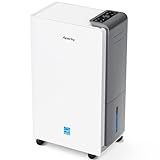
AEOCKY 80 Pint ENERGY STAR
- ENERGY STAR Most Efficient 2025
- defrost to 65F
- 44 dB
- 3-year coverage

All 12 Best Dehumidifiers for Garages in 2026
Every model in this roundup, side by side. Use the Key Features column to narrow the field first, then read the individual reviews below for the reasoning behind each pick.
| Product | Specifications | Action |
|---|---|---|
| Waykar 80 Pint 5000 Sq Ft Dehumidifier |
|
Check Latest Price |
| Yaufey 150 Pint Pump Dehumidifier |
|
Check Latest Price |
| AEOCKY 80 Pint ENERGY STAR Most Efficient |
|
Check Latest Price |
 Waykar 120 Pint 6000 Sq Ft Ultra Quiet Waykar 120 Pint 6000 Sq Ft Ultra Quiet |
|
Check Latest Price |
 ALORAIR Sentinel HD55S 120 Pint Metal Unit ALORAIR Sentinel HD55S 120 Pint Metal Unit |
|
Check Latest Price |
 AEOCKY 50 Pint Ultra Quiet 40 dB AEOCKY 50 Pint Ultra Quiet 40 dB |
|
Check Latest Price |
 AEOCKY 80 Pint with 16.5 ft Pump AEOCKY 80 Pint with 16.5 ft Pump |
|
Check Latest Price |
 Gasbye 115 Pint ENERGY STAR 2026 Gasbye 115 Pint ENERGY STAR 2026 |
|
Check Latest Price |
 Waykar 150 Pint Commercial with Pump Waykar 150 Pint Commercial with Pump |
|
Check Latest Price |
 ALORAIR 70 Pint Pump Crawlspace Unit ALORAIR 70 Pint Pump Crawlspace Unit |
|
Check Latest Price |
 avylo 90 Pint Pump Dehumidifier avylo 90 Pint Pump Dehumidifier |
|
Check Latest Price |
 Frigidaire 50 Pint with Wi-Fi Frigidaire 50 Pint with Wi-Fi |
|
Check Latest Price |
1. Waykar 80 Pint 5000 Sq Ft Dehumidifier for Basements and Garages
Waykar 80 Pints 5000 Sq. Ft 2025 Energy Star Dehumidifier for Basement
80 PPD
5000 sq ft
270 W
42 dB
1.14 gal tank
Pros
- 80 pints per day handles damp two-car garages and unfinished basements
- 42 dB is quiet enough for an attached space
- 270 watt draw keeps 24/7 running cost manageable
- ENERGY STAR certified
Cons
- Listing does not publish a minimum operating temperature
- Onboard humidity readout tends to run high versus an independent hygrometer
- Short thin drain hose included in the box
This is the model I keep coming back to for a normal two-car garage, and it tops our list of the best dehumidifiers for garages overall. It pulls 80 pints per day, covers up to 5000 square feet, and draws 270 watts, which is the sweet spot where capacity stops doubling but the electricity bill keeps climbing.
Owner feedback is the deepest in this roundup by a wide margin, with more than 22,000 ratings behind the listing, and the recurring theme is that it makes a visible difference in damp spaces within days. Setup is straightforward, the casters roll, and the 90 degree swing distributes air across a wide garage without you having to aim it.
My main reservation is the spec sheet silence. This listing does not publish a verified minimum operating temperature, and in a garage category that omission matters more than it does anywhere else. If your garage stays above roughly 50F in winter, that is not a problem. If it drops into the 30s on a cold night, you are relying on the auto-defrost logic without knowing its rated floor.
Two smaller things to plan for. The onboard humidity display tends to read higher than a separate hygrometer, so bring your own meter and trust that instead. And the 6.56 foot drain hose is thin, which works fine when properly seated but is not what you want for a permanent run to a floor drain.
Is the 80 pint size right for a two-car garage?
For a standard 400 to 600 square foot two-car garage, yes, and it leaves headroom for the wet-car and spring-thaw conditions that spike moisture load. A 50 pint machine is adequate for a single-car or small workshop bay under about 300 square feet, but you will see it cycling constantly during a wet week.
Watch the wattage more than the headline pints. Two 80 pint models on this list pull 270 and 280 watts, while 470 to 520 watt models deliver similar rated extraction. If the unit runs around the clock in a space nobody heats, the lower draw model usually wins on cost over its life.
What to check before buying in an unheated garage
Ask the manufacturer for the rated minimum operating temperature in writing, and if you cannot get it, treat that as a warning. A unit that ices up in February is a unit you will be carrying down the stairs.
Also plan the drainage before you buy. Gravity drainage needs a floor drain or a sloped run to a sink, and most garage slabs drain toward the door rather than into a pit. Owners running this model long term almost always move to continuous drainage within a season.
2. Yaufey 150 Pint Dehumidifier with Pump for 8500 Sq. Ft.
Yaufey 150 Pint Dehumidifier with Pump for Basement 8500 Sq. Ft.
150 PPD
8500 sq ft
500 W
1.85 gal tank
16.4 ft pump
Pros
- 150 pints per day across 8500 sq ft
- 16.4 ft upward pump lift
- 1.85 gallon tank with a full-tank alert
- 30 to 80 percent RH range in 5 percent steps
Cons
- 500 watt draw is high for a unit running unattended
- Large upright footprint compared with low-profile models
- Audible at higher fan settings in very quiet spaces
If your garage is oversized, open on one side, or doubles as shop space where you need the whole floor clear, this belongs at the top of your list. At 150 pints per day it sits at the top of the capacity range in this roundup, and its 8500 square foot coverage figure is the largest, which means it can pull a large moisture load down fast and then coast.
The drainage flexibility is the part that matters most here. You get upward pumping with a 16.4 foot pump hose, gravity drainage, and the 1.85 gallon tank, which means the install location is not dictated by where your low point happens to be.
The copper tubing and rotary compressor are a genuine step up in build quality compared with the plastic-bodied units at similar prices. Reviewers consistently mention effective humidity control and an easy-to-read digital display, with only occasional complaints about the bulky footprint and the power draw.
I would pair this with an independent hygrometer and set it between 50 and 60 percent in a storage garage. The 30 percent lower bound invites over-drying, and over-dried garages bring static, cracked wood, and brittle leather, which is a real problem for anyone storing car components or paper.
When the extra capacity pays off
Extra capacity earns its keep in a detached garage with no climate control, a workshop where you have a wet car under a cover creating a localized moisture pocket, or any space where the door stays open to a humid yard.
It does not pay off in a small closed garage that has already stabilized at the set point. Once the air is dry, the compressor cycles off regardless of how large the unit is, so a bigger tank here is a convenience feature and nothing more.
When to skip it instead
Skip this one if your garage is under 400 square feet, or if noise and power draw are the two things you care most about. At 500 watts it is the second highest draw in this group, and the upright body takes noticeably more floor space than the low-profile alternatives.
It is also the wrong shape of machine for a crawl space or under a raised floor. For those, a dedicated pump model with a compact footprint is a much better fit.
3. AEOCKY 5500 Sq. Ft. 80 Pint ENERGY STAR Most Efficient Dehumidifier
AEOCKY 5500 Sq.Ft Energy Star Most Efficient 2025 Dehumidifier Max 80Pint/D
80 PPD
5500 sq ft
280 W
44 dB
3-year coverage
Pros
- ENERGY STAR Most Efficient 2025 certification
- Published auto-defrost rating down to 65F
- 56 pints per day at the standard 86F and 80 percent RH test condition
- Very quiet at 44 dB on low fan
- 3-year coverage with ETL and RoHS certification
Cons
- Defrost rating of 65F is warmer than most cold-rated competitors
- Narrow tower body needs an upright drainage path
- Garden hose adapter needed for extended drain runs
This is the most spec-honest unit we found, and that is exactly why it made the top three. It publishes both capacity figures instead of only the flattering one: 80 pints per day at 95F and 95 percent RH, and 56 pints per day at the standard 86F and 80 percent RH test condition. That second number is the one that tells you what it does in a real garage.
It also states a minimum operating temperature, rated to 65F. Read that carefully, because it is a higher floor than some competitors publish. In a mild climate where the garage sits in the 50s and 60s, that is fine. In a northern winter, look at the Waykar 120 pint model rated to 42F instead.
ENERGY STAR Most Efficient is the top tier of the program, a small subset of ENERGY STAR models that clear a stricter efficiency bar, and this unit carries it for 2026. With a 280 watt draw and 56 pints of standard-condition extraction, that is a good efficiency ratio for a 24/7 garage install.
The 3-year coverage is longer than most units here offer, and the copper tubing with hydrophilic aluminum fins is a durability plus that most of the plastic-bodied competitors at this size cannot match.
How the two capacity numbers change your decision
Any listing quoting only the 95F figure is quoting a saturated-capacity number measured in conditions a garage almost never sees. A garage at 68F and 70 percent RH sits much closer to the standard test point, so the 56 pint figure is your realistic planning number.
That matters most in a climate with long humid stretches. If your garage regularly sits above 80 percent RH, size up rather than trusting the headline number, because real output drops with rising indoor temperatures.
What to watch in a genuinely cold garage
The 65F defrost floor is the deciding limitation. Below that temperature, the coil can ice up and the unit’s collection drops off sharply, which is the exact complaint that shows up repeatedly in owner feedback across this category.
Pair it with a thermostat that keeps the garage above freezing, or choose a cold-rated model. Keeping an unheated garage at 40F with a 65F-rated machine means you have bought a heater in disguise, which is a much larger expense than a better-matched dehumidifier.
4. Waykar 120 Pint 6000 Sq Ft Ultra Quiet Dehumidifier Rated to 42F
Waykar 6000 Sq.Ft Energy Star Dehumidifier for Basement & Home, 120 Pint/Day with Drain Hose & Tank, Ultra Quiet (40 dB), Smart Auto Comfort Mode
120 PPD
6000 sq ft
470 W
40 dB
defrost to 42F
Pros
- Lowest published defrost floor in this roundup at 42F
- 120 pints per day with 40 dB operation
- Smart Auto Comfort Mode holds within a few percent of target
- 2025 ENERGY STAR compliant
Cons
- Several owners report failure within roughly 9 to 12 months
- Small 1.24 gallon tank if not continuously drained
- 470 watt draw is high for the class
This is the pick for a garage in a real cold climate. The 42F defrost rating is the lowest published figure among the twelve models we reviewed, and it is the spec that decides whether a unit keeps working in February or quietly stops.
Running 40 dB while delivering 120 pints per day is unusual. That makes it viable in an attached garage that also functions as a workspace or gym, where a louder compressor would have you switching it off.
The Smart Auto Comfort Mode is the feature we would actually use day to day. It holds relative humidity within about five percent of the set point without manual adjustment, which matters in a space whose temperature swings all night.
Durability is the honest weak point. A number of owners report units failing within roughly nine to twelve months, and that complaint is the main reason this sits fourth rather than higher despite the best cold rating here. The warranty response, with a second-year extension and lifetime technical support, is the mitigation.
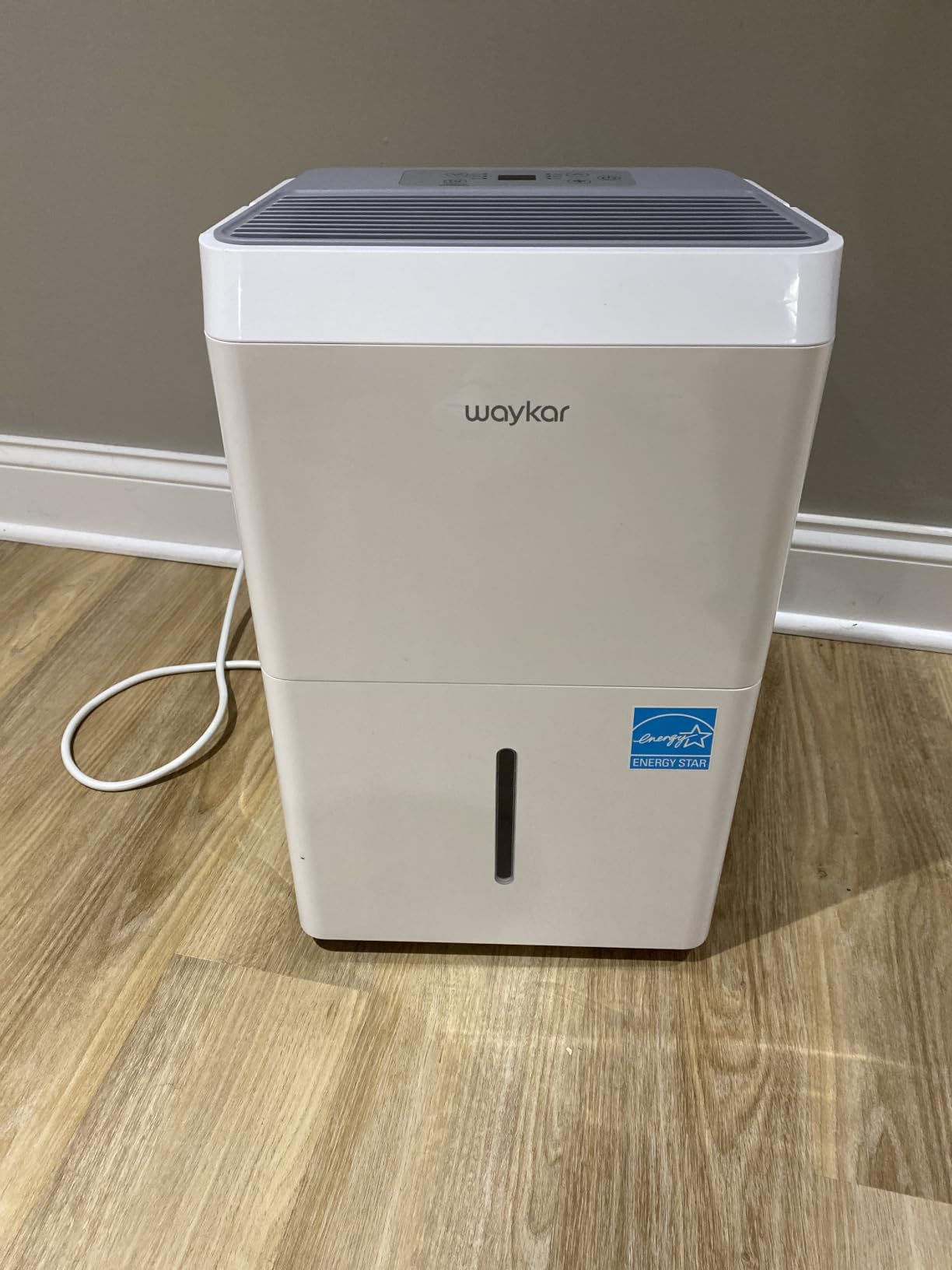
Owner photos consistently show a compact footprint with casters and a rear cord wrap, which is a practical detail when the garage floor is your only available real estate. Several buyers also mention fast warranty replacements arranged without much friction.
The 470 watt draw is worth noticing. In a space running 20 or more hours a day, energy is a bigger line item than most people budget for, and that draw is high for a unit in the 120 pint class.
Is it worth running a dehumidifier in a garage that drops below 40F?
Below the rated defrost floor, no compressor unit is the right answer. Frost accumulates on the coil faster than auto-defrost can clear it, and you end up with a cold coil collecting nothing while the compressor works against itself.
Two options work at those temperatures. Use a desiccant unit rated for sub-freezing spaces, or add heat. If you are already considering garage heating for comfort, our guide to the best space heaters for garages covers the sizing for that side of the problem, and a heated garage above 45F makes almost any auto-defrost unit viable.
Where this model overreaches
The 1.24 gallon tank is the weak point for anyone not running continuous drainage. At 120 pints per day, that fills in well under a day, and owners who skip the drain hose end up hauling it out constantly.
The nine to twelve month failure reports also deserve weight in your decision. If you want a machine that survives multiple winters untouched, the metal-bodied ALORAIR units carry much longer warranty coverage.
5. ALORAIR Sentinel HD55S 120 Pint Metal Crawlspace Dehumidifier
ALORAIR 120 Pints Energy Star Crawlspace Dehumidifier, Sentinel HD55S
120 PPD saturated
55 PPD AHAM
1300 sq ft
41.7 lbs
metal body
Pros
- Alloy metal housing built for crawl spaces
- basements and workshops
- Continuous gravity drainage ends tank-emptying entirely
- Automatic defrost performs correctly without ice buildup
- ETL listed with a 6-year limited warranty
Cons
- At 41.7 pounds it is awkward to move into a tight crawl space
- Gravity drain only so the unit must sit high enough to drain
- Noticeably louder than consumer-grade models
This is the build-quality outlier. Where most of the units in this roundup use plastic cabinets, this one uses a metal housing, and that difference shows in crawl spaces, workshops, and anywhere with dust, vibration, or a car being backed in nearby.
The warranty is the other differentiator: 1 year parts and labor, 3 years on the refrigeration system, 5 years parts on the refrigeration system, all under a 6-year limited warranty headline, matched only by the other ALORAIR unit in this roundup. That length of cover is what matters most on a machine you plan to run unattended through a season.
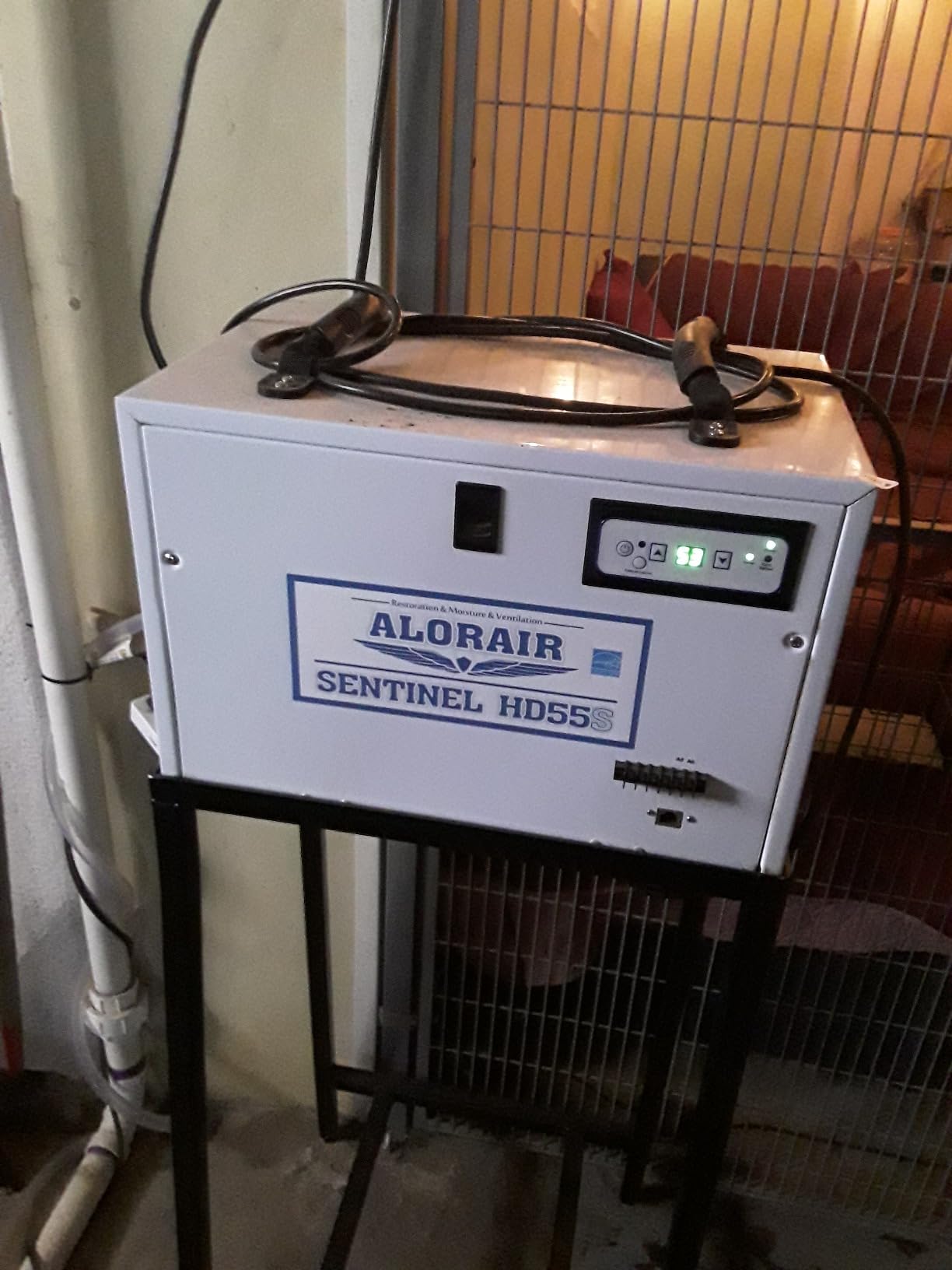
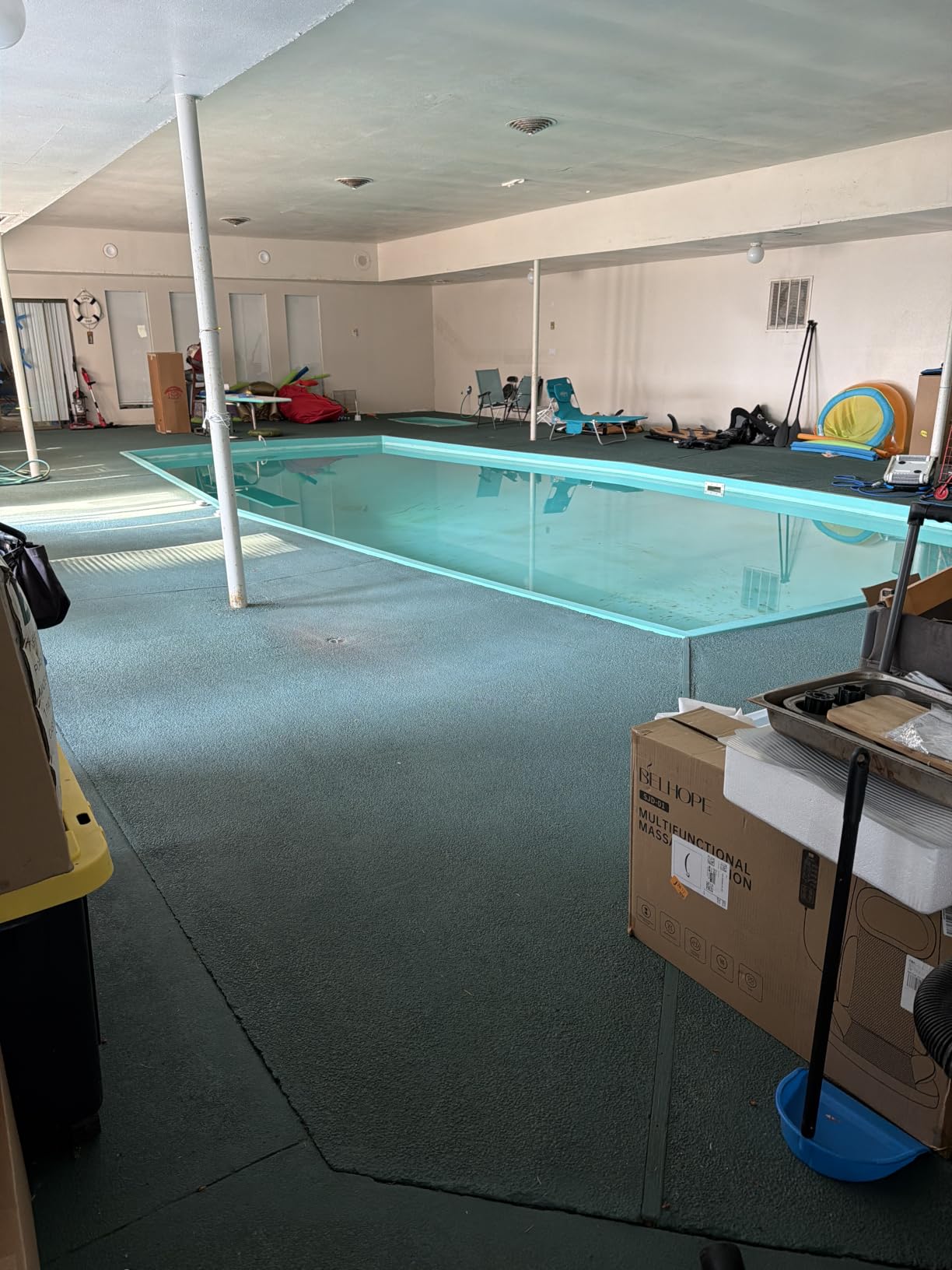
Its coverage figure looks modest at 1300 square feet, but that number is closer to how these commercial-style machines actually perform than the inflated coverage claims on consumer units. Crawl space and pool house owners report large, steady water removal rather than headline figure chasing.
Note the capacity line, which reads 120 pints per day at saturation and 55 pints per day at the AHAM standard. The second figure is the honest one for a space that is not already near saturation. As with any unit, treat the lower test-condition number as your planning figure.
Why the metal build matters in a garage
Garages are hostile to electronics. Dust, sawdust, humidity, and a car kicking up grit while it starts all attack the same components. A metal chassis dissipates heat better and tolerates knocks in a way a plastic shell does not.
If your garage is a working space rather than a storage closet, the noise is worth weighing too. Commercial metal units run louder than consumer plastic models, and this one is audible in an adjacent room or above a ceiling.
What the missing pump means for you
There is no condensate pump here, so water leaves through gravity drainage only. That means the unit has to sit above the level of your drain, which in a typical garage means a stand, a wall shelf, or a floor drain at a high point.
It is a real limitation for a flat slab. Owners using this in low spots typically plumb a gravity line to a floor drain rather than fighting the elevation.
6. AEOCKY 50 Pint Ultra-Quiet Dehumidifier for Small Garages
AEOCKY 50 Pint/Day, 3500Sq.Ft Ultra-Quiet 40dB Dehumidifier with Drain Hose
50 PPD
3500 sq ft
380 W
40 dB
0.8 gal tank
Pros
- Very quiet at about 40 dB even on the higher fan setting
- Compact and light enough to move between rooms on casters
- Auto-defrost supports cooler rooms and unheated cellars
- Three-year machine warranty with copper tubing
- Simple drain hose connection and readable controls
Cons
- 0.8 gallon tank fills several times a day
- Humidity control range starts at 40 percent RH
- Tank must stay installed even on continuous drainage
This is the single-car garage, small workshop, or RV-adjacent storage space pick. At about 40 dB and 25 pounds, it is the easiest unit here to move, reposition, and live with.
Its published capacity covers two test conditions, 50 pints per day at 95F and 95 percent RH, and 38 pints per day at 86F and 80 percent RH. That 38 pint figure is realistic for a small garage and more than enough to hold a bay steady.
Owners rate it highly for near-silent running, compact size, and effective moisture control in medium spaces. The most common piece of advice in the reviews is to set up continuous drainage straight away rather than relying on the tank.
The 40 to 80 percent humidity control range is the one design choice that matters in a storage garage. You cannot set this unit below 40 percent, which is honestly a sensible floor, since that is roughly where over-drying problems start for stored materials.
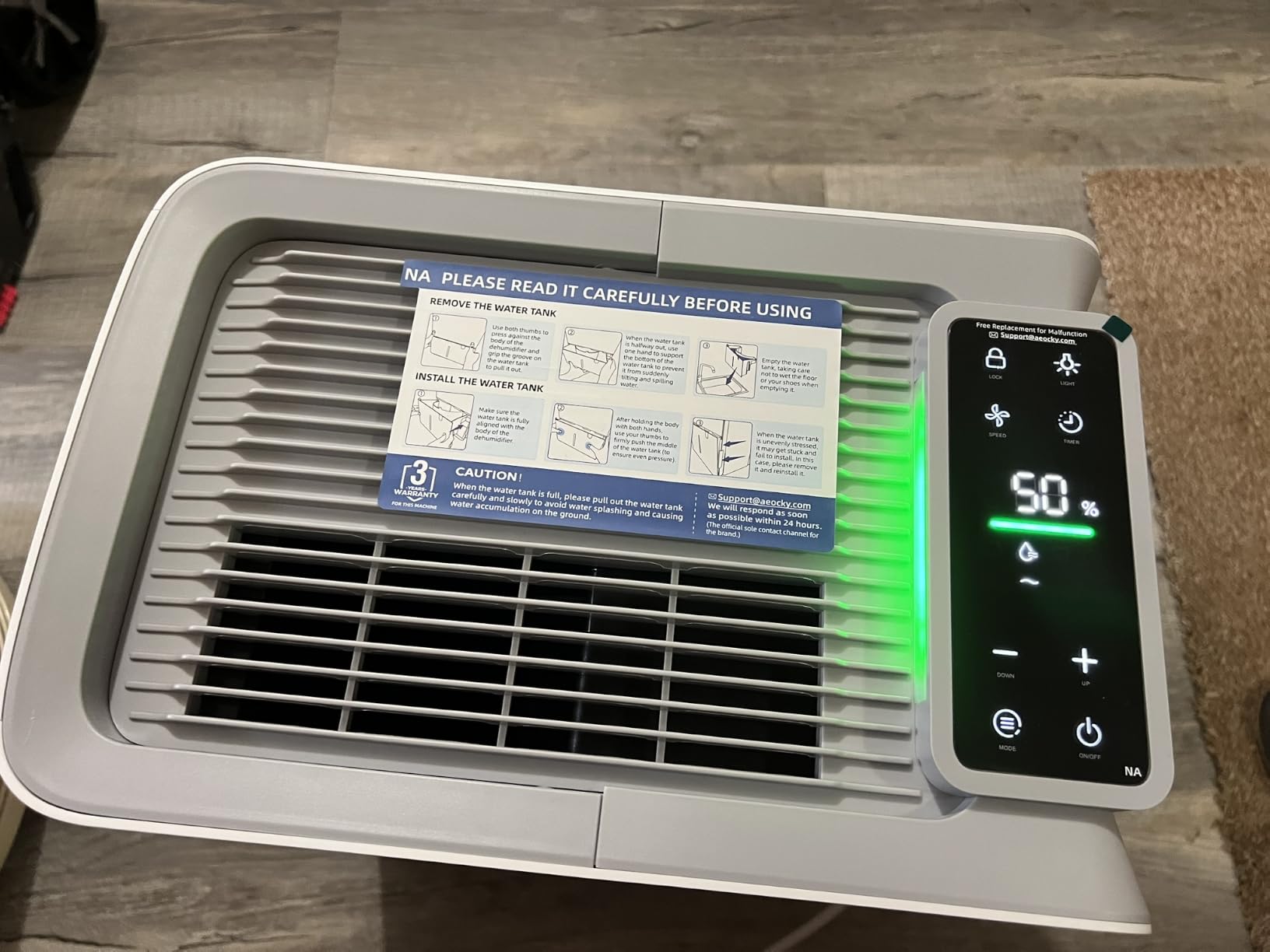
Owner images show the low-profile horizontal cabinet, which fits under a workbench or against a wall much better than the tall tower designs. The 360 degree casters make moving it between the workshop and the storage bay a one-hand job.
The multicolor ambient light is a minor gimmick, but it does let you read the humidity state from across the room without walking over, which is genuinely useful in a space you visit occasionally.
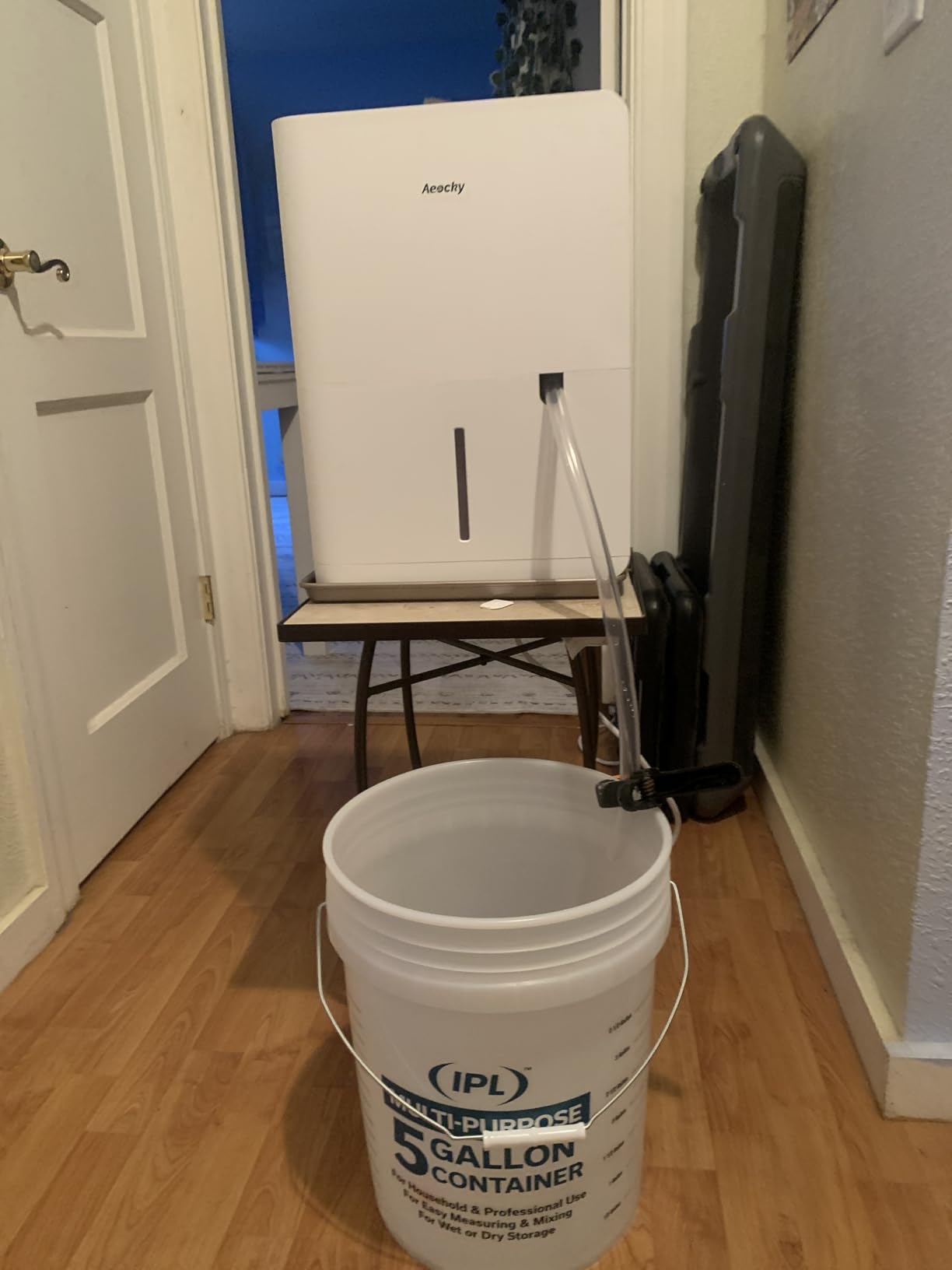
When 50 pints is genuinely enough
A single-car garage under 300 square feet, a small storage bay, or a workshop corner where damp is the only problem. In those spaces a bigger machine just costs more to run for the same result, because the air reaches the set point and the compressor stops.
It also makes sense as a second machine alongside a larger unit, drying a closed corner or a storage cabinet area that the big unit’s airflow never reaches properly.
When you need to step up instead
Move up when you have a two-car bay, a wet vehicle tracked in regularly, or a space where the humidity reading climbs back above 60 percent within a day of the machine stopping.
The 0.8 gallon tank is the practical limit here. At 50 pints of rated capacity, it can fill several times in a day, so without a drain hose this becomes a chore rather than a set-and-forget install.
7. AEOCKY 80 Pint Dehumidifier with 16.5 ft Pump
AEOCKY Dehumidifier with Pump Up to 16.5ft Energy Star Most Efficient 2025
80 PPD
4500 sq ft
16.5 ft pump
ENERGY STAR ME 2025
Pros
- Long pump lift at 16.5 ft
- the tallest of the consumer units here
- Allows continuous drainage with no floor drain anywhere on the slab
- ENERGY STAR Most Efficient 2025 certification
Cons
- Smallest review base in this roundup at 511 ratings
- Pump-equipped designs add failure points versus gravity-only units
- Tank must stay in place for either drainage method
The deciding feature is the 16.5 foot upward pumping lift, the tallest of the consumer pump units in this group. If your garage slab has no floor drain and no low point, that single spec is what makes unattended operation possible.
Capacity is published the honest way, at 80 pints per day at 95F and 95 percent RH, and 56 pints per day at 86F and 80 percent RH, across up to 4500 square feet. The rotor compressor and 7mm pure copper pipes match the build quality of the more expensive units here.
Reviewers point to the pump as the reason they bought it, and to the low noise it produces despite the pumping hardware. The dry-run sensors are a sensible addition, since a pump running dry is the fastest way to kill an unattended install.
The caution here is review volume. With 511 ratings, this is the thinnest feedback base of the twelve, and it is a newer model. Some owners report early pump or overall reliability issues, which is the kind of pattern that takes a couple of seasons of data to clear.
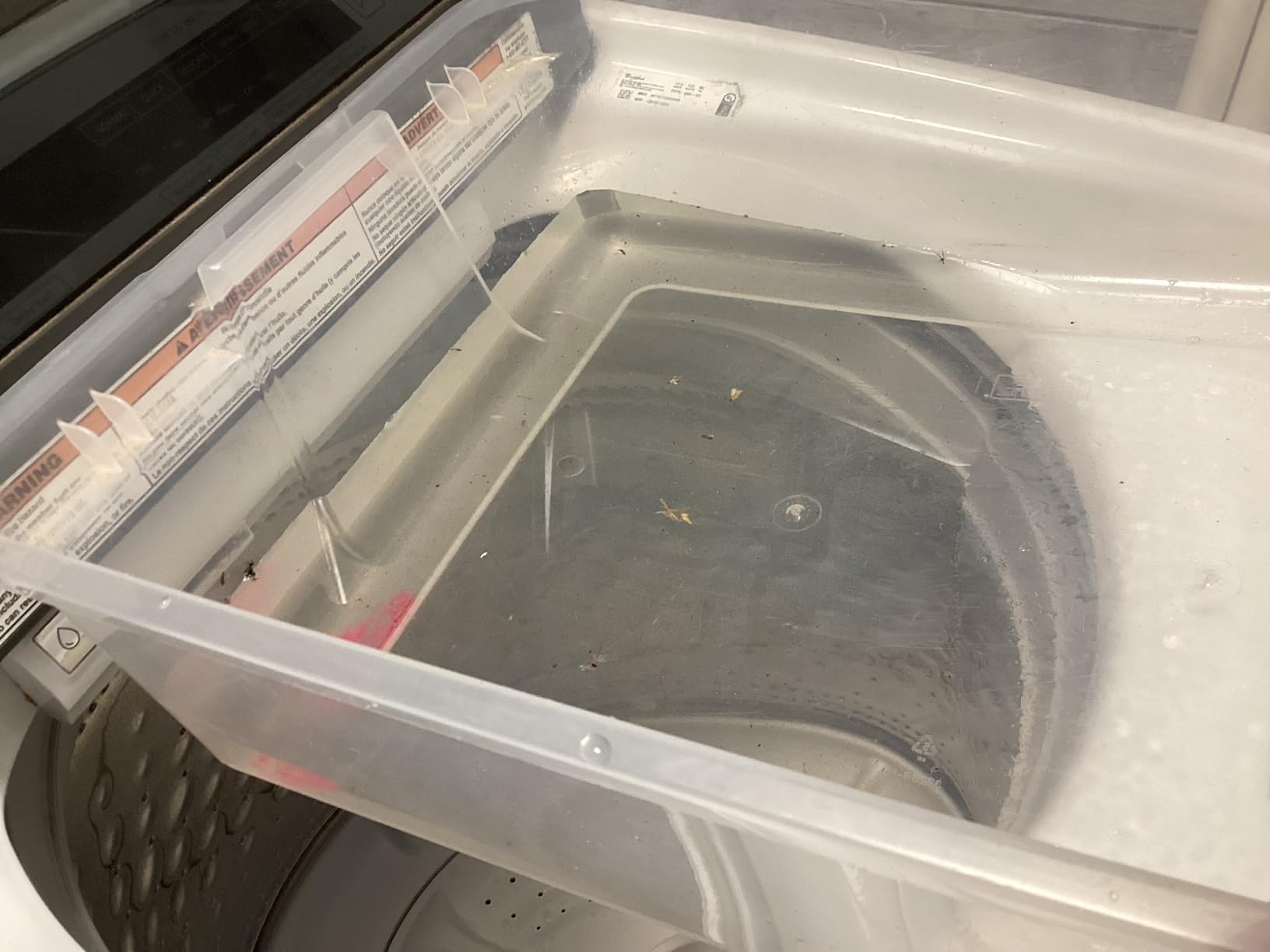
Owner photos show a slim upright body that runs water up and out to a wall or exterior drain without needing a stand. The narrow footprint also means you can tuck it against a wall where a wide machine would block a bay door.
Both the gravity and pump drainage paths require the tank to remain seated, so plan shelf height accordingly. The pump moves water up, but the machine still needs a stable, level base.
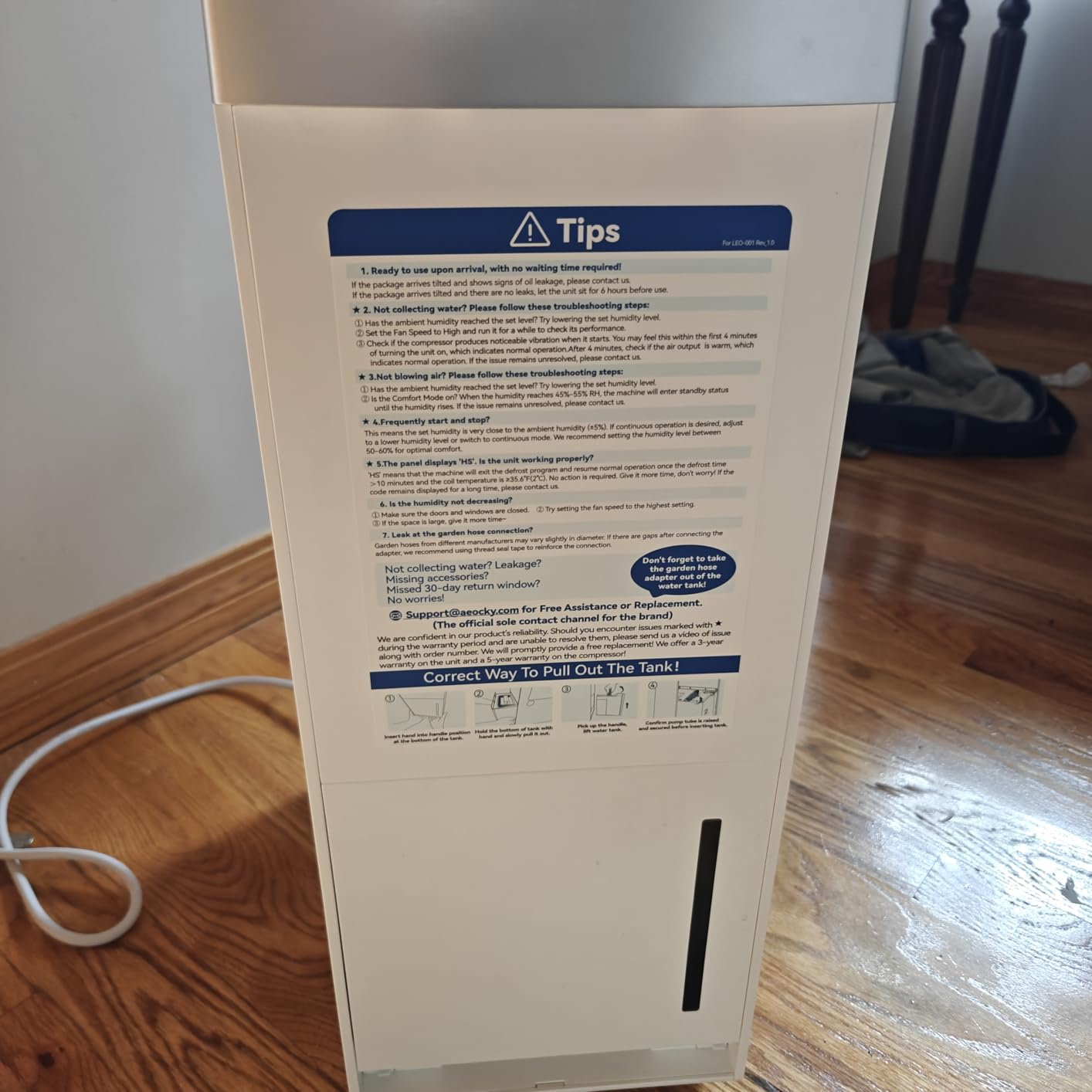
Do I need a dehumidifier with a pump for a garage?
You need a pump if your garage has no floor drain, no sloped path to one, and no low point you can drain toward. A raised foundation, a slab poured flat to the door, and a workshop layout with no sink are all common reasons.
If you do have a floor drain, gravity drainage is simpler, has fewer moving parts, and is one less thing to fail while you are away. A pump adds a motor, a float switch, and a failure mode to a machine you plan to forget about.
How to check before you commit
Measure from the unit location to your nearest drain point vertically, not just across the floor. A 16.5 foot lift sounds generous, but the pump head rating assumes a short, reasonably straight hose run.
Look for pump models with dry-run protection, because an unattended garage install with a pump that can burn out is the failure mode owners complain about most often.
8. Gasbye 115 Pint ENERGY STAR 2026 Dehumidifier with 5-Tier Copper Coil
Gasbye 4500 Sq.Ft. 2026 Energy Star Dehumidifier for Basement & Large Rooms with Drain Hose, Max 115 Pints/Day | 45dB Quiet Compressor | 1.7 Gal Water Tank | Auto Shut-Off & Restart, Black
115 PPD
6000 sq ft
500 W
45 dB
rated to 65F
Pros
- Publishes capacity at three separate temperature and humidity points
- 5-tier copper coil with thickened reinforced tubing
- ENERGY STAR 2026 certified
- Auto shut-off and restart with 3 percent hysteresis
Cons
- Heavy at 43 pounds
- Rated ceiling of 86F for stated performance
- 500 watt draw is among the highest in the group
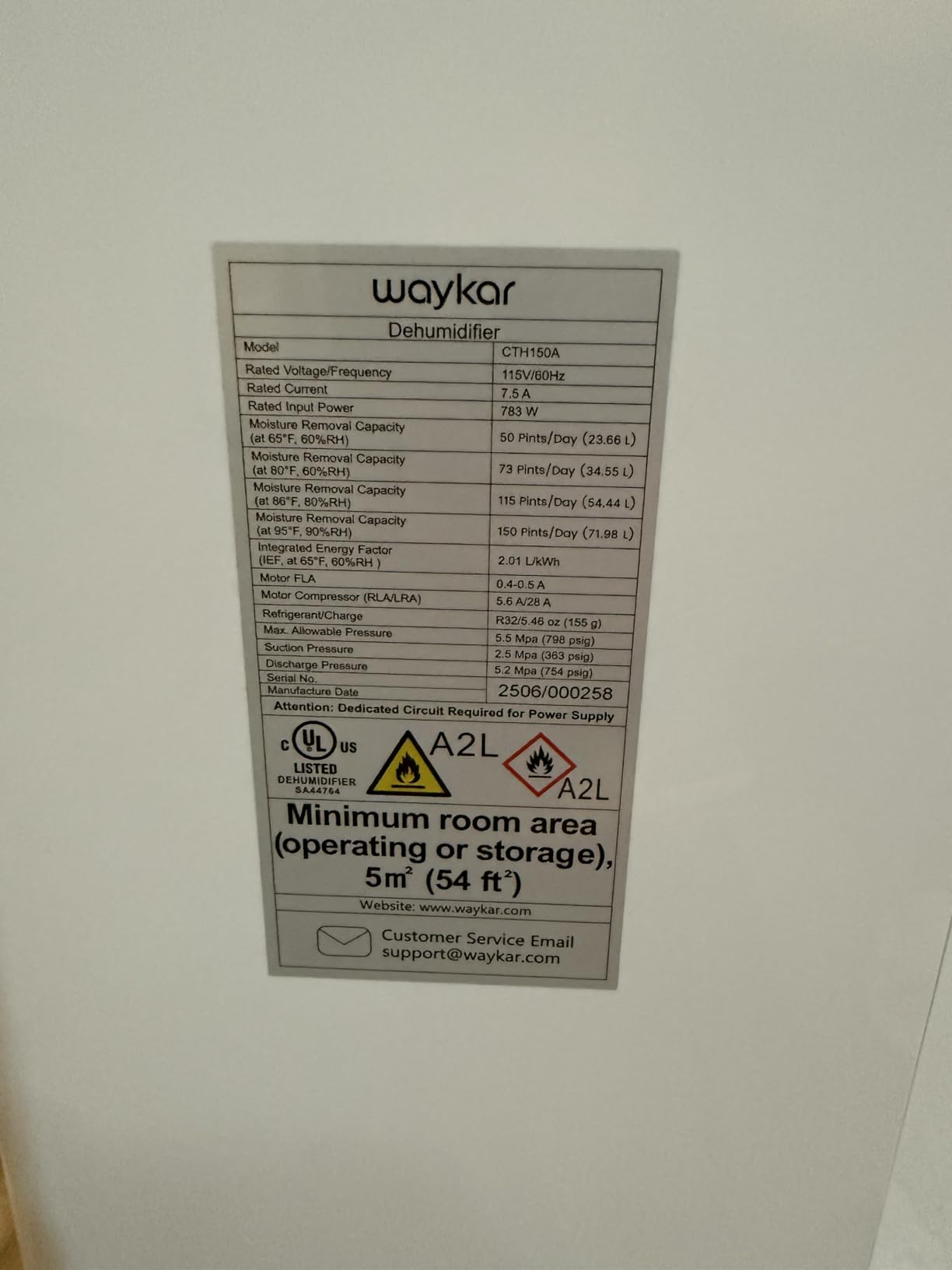
The highest average rating in this roundup, and the only unit that publishes a three-point capacity curve, which tells you more about real-world performance than any other spec on this page. It rates 115 pints per day at 86F and 80 percent RH, 73 pints at 80F and 60 percent RH, and 50 pints at 65F and 60 percent RH.
That third number matters. It means the manufacturer expects real extraction at 65F, which is a colder ambient condition than most competitors even claim to handle. It is not a frost-free guarantee, but it tells you the compressor is being tested outside the lab.
The build is the other argument. A 5-tier copper coil and thickened reinforced tubing are what you want in a space that will be cycled through freezing and thawing seasons, and owners specifically call out that the tubing is built to outlast the usual first-or-second-year coil failures.
Auto shut-off and restart with 3 percent hysteresis plus power-outage memory is a small spec that makes a real difference. A 3 percent band means the machine cycles less often than a 5 or 10 percent unit, which reduces both wear and noise.
What the 65F capacity point changes
It changes sizing decisions in moderate climates. If your garage runs 60 to 70F for most of the humid season, the 50 to 73 pint range is your real operating window, and 115 is the theoretical ceiling in near-saturated air you will rarely see.
It also means this unit keeps working in a garage that gets genuinely chilly in the evening without needing a heater to keep the coil clear.
Where the trade-offs sit
At 43 pounds this is one of the heaviest machines here, and 500 watts is among the highest draws. If your garage is your primary workspace and you move the machine often, that is worth planning around.
The 86F upper temperature rating for stated performance is also modest. A west-facing garage bay in summer can sit above that, and outside that ceiling the published figures no longer apply.
9. Waykar 150 Pint Commercial Dehumidifier with Pump
Waykar 150 Pint Commercial Dehumidifier with Pump & Drain Hose for Basement
150 PPD
7000 sq ft
520 W
9.84 ft pump lift
38.6 lbs
Pros
- 150 pints per day across up to 7000 square feet
- Built-in pump lifts water 9.84 ft with floor drain and gravity options
- Self-drying function supports long unattended runs
- ENERGY STAR certified
Cons
- 520 watt draw is the highest in this roundup
- Pump needs re-enabling after an unplug in normal shutdown
- 90F upper temperature rating is modest for hot garages
This is the shop-floor and warehouse-garage pick. 150 pints per day across up to 7000 square feet, with a built-in pump that lifts 9.84 feet and alternatives for a floor drain or gravity run.
The self-drying function is the detail that separates it from a plain compressor unit. Before shutting down, the machine runs its own coil dry, which prevents the mold and mildew that develops in a unit that just stops with a wet evaporator.
For a garage that needs to hold a target through a whole work week without anyone thinking about it, that combination of self-drying, 30 to 80 percent control, and a digital readout is exactly right. Owners mention the pump making unattended drainage simple, and appreciate the efficiency rating for a machine of this output.
The 520 watt draw is the highest we measured across the twelve, and a shop running it around the clock will feel that in the monthly bill. The 90F upper temperature rating is also modest for a garage bay that heats up on a July afternoon.
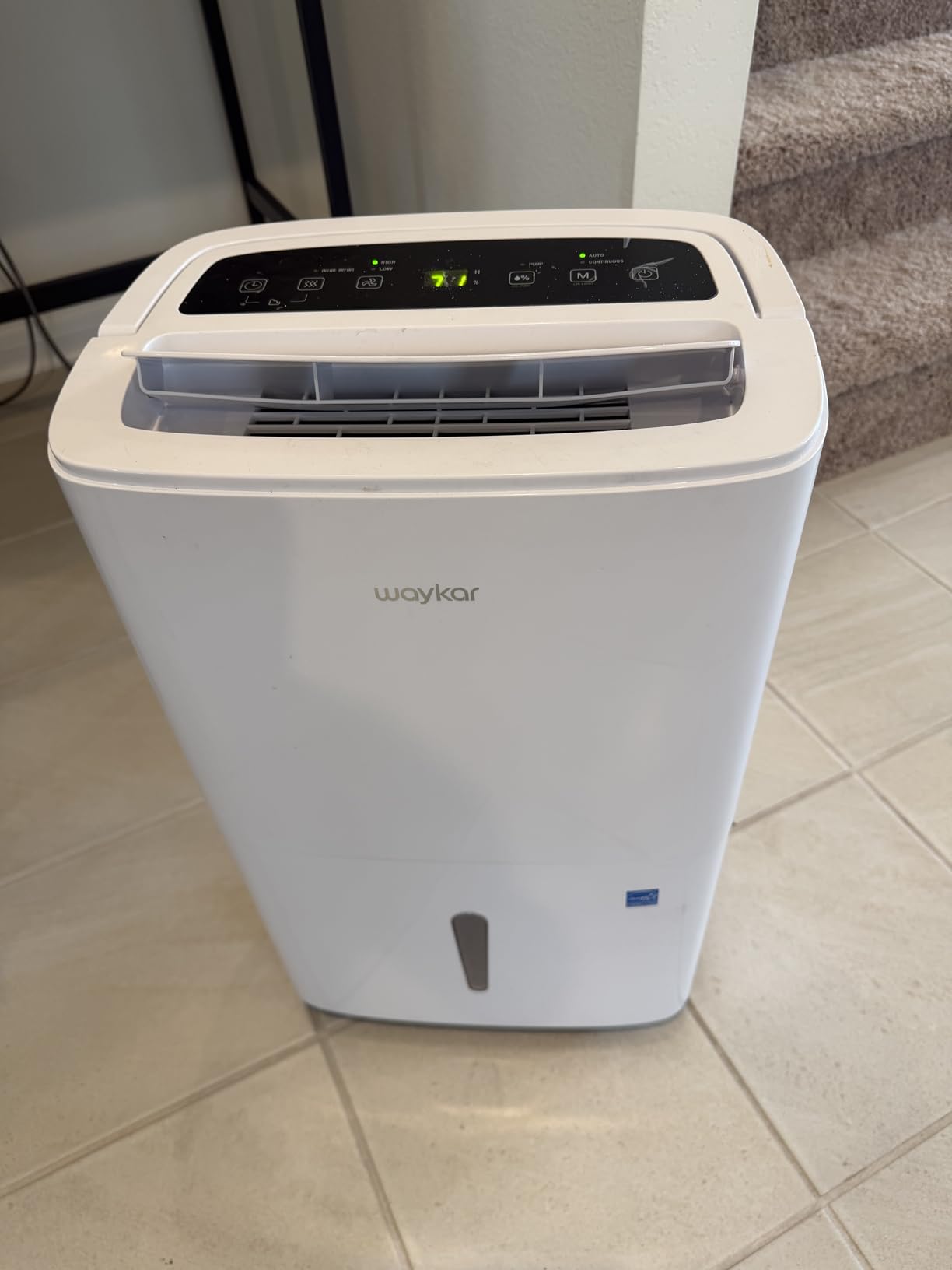
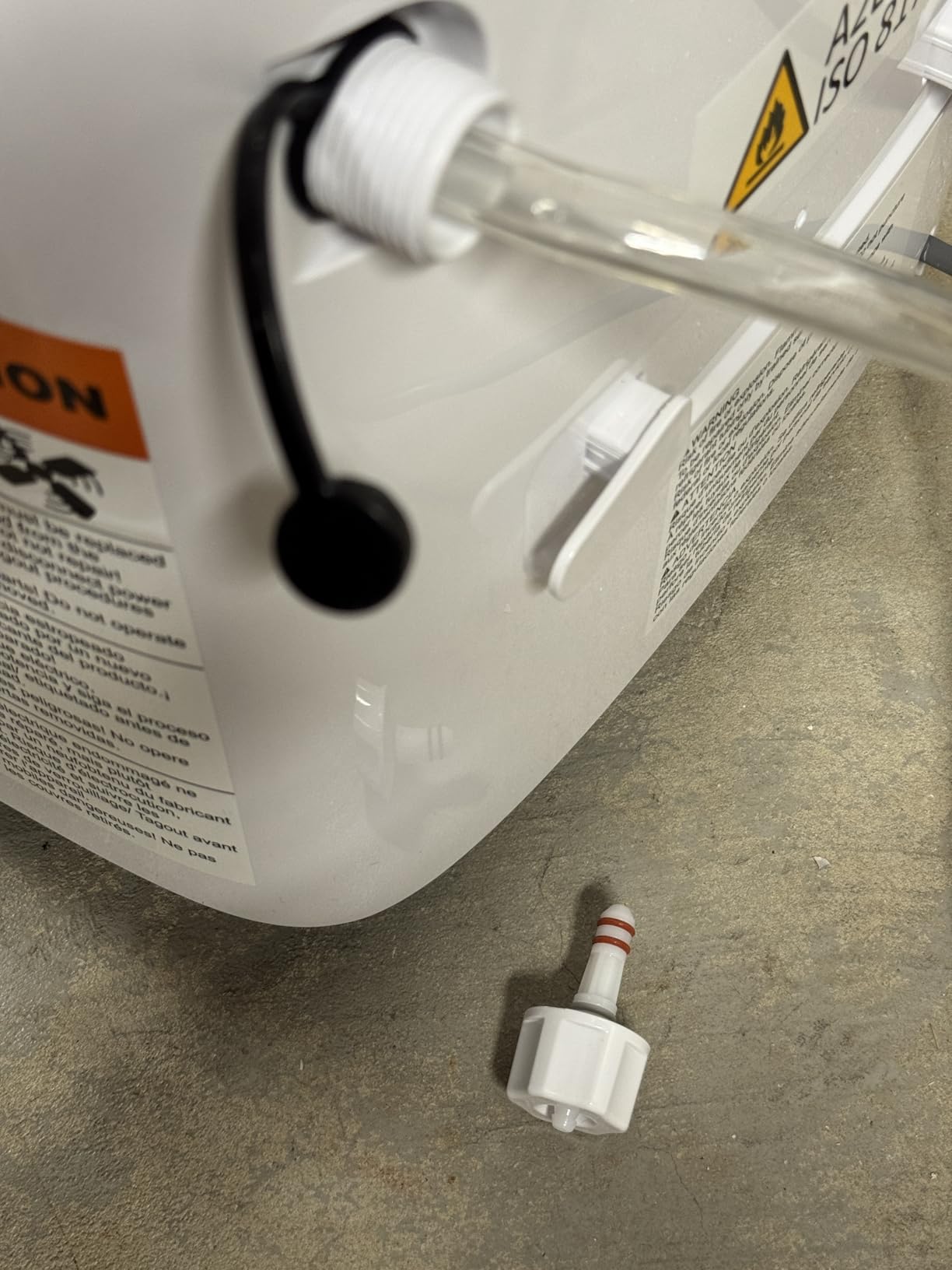
Owner photos show a tall, narrow cabinet on omnidirectional casters, which is a smart footprint choice for a space where you need to keep the floor clear for a vehicle lift or a workbench.
The pump re-enabling issue after a power interruption is the one recurring operational complaint. Auto restart restores the compressor, but the pump may need a button press, so test it before you leave the building for the weekend.
How big is too big for a garage?
Too big means you pay for capacity you never use and carry power draw for it, plus a machine that is awkward to reposition. You need the space to be wet enough, or open enough, that the unit is running a meaningful share of the time.
This machine earns its size in a detached shop with an unheated slab, a garage with an attached workshop area, or a space where vehicles come in soaked. In a small closed bay it would spend most of its life off.
Commercial versus residential in a garage
Residential units optimize for quiet and appearance. Commercial units optimize for duty cycle, continuous drainage, and serviceable construction, and they are usually quieter in operation because they are not chasing a decibel target.
If your garage is a place you work in rather than a place you store things in, the commercial category is usually the better trade. Just confirm the warranty terms and that the electrical supply can carry the rated draw.
10. ALORAIR 70 Pint Pump Dehumidifier for Crawl Spaces and Tight Bays
ALORAIR 70 PPD Dehumidifier with Pump for Crawl Space and Basement
35 PPD AHAM
70 PPD sat
1000 sq ft
19.6 ft pump
alloy steel
Pros
- 19.6 foot pump lift is the tallest in this roundup
- Alloy steel construction for demanding spaces
- Automatic defrost with auto restart after power interruption
- Under 50 dB operation
- 6-year limited warranty
Cons
- Lowest average rating in the set with a 16 percent one-star share
- 35 pints per day at AHAM is modest
- Coverage limited to about 1000 square feet
This is the spec pick for raised floors, enclosed porches, and garages with a low crawl space under the slab level. The 19.6 foot pump lift is the tallest in the roundup, which is what makes installation possible in a space with nowhere to gravity drain.
Automatic defrost with auto restart after a power interruption is a well-matched feature set for a space that is hard to reach. Nobody wants to walk a crawl space to restart a machine after a storm knocked the power out.
Owners appreciate the pump lift, the solid metal build, and defrost reliability. The 6-year limited warranty headline is among the longest available, with two years of full coverage.
Where I would temper expectations: the rated capacity is 35 pints per day at the AHAM standard, which is modest, and coverage is stated at about 1000 square feet. It is a purpose machine for a constrained space, not a whole-garage solution.
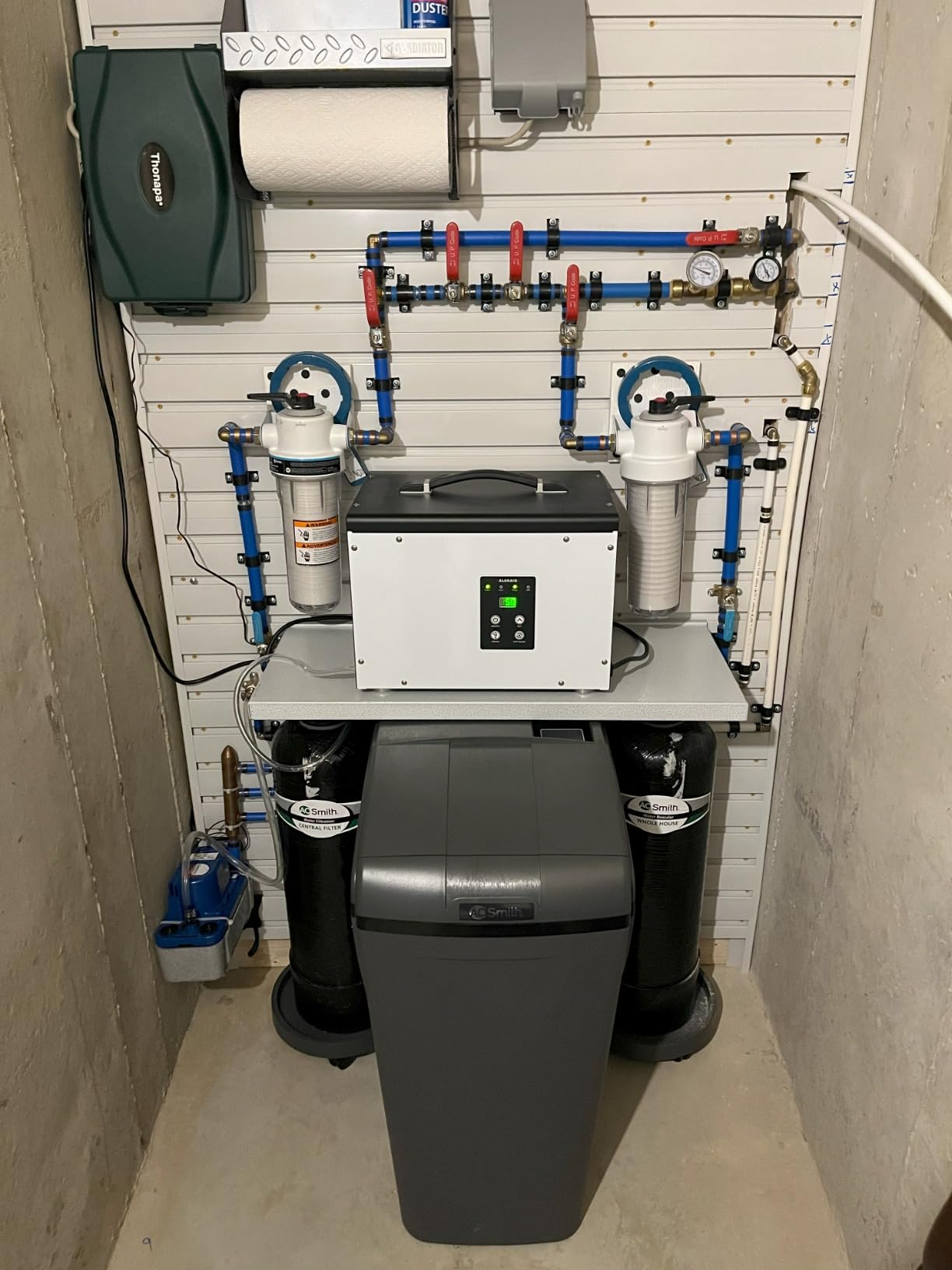
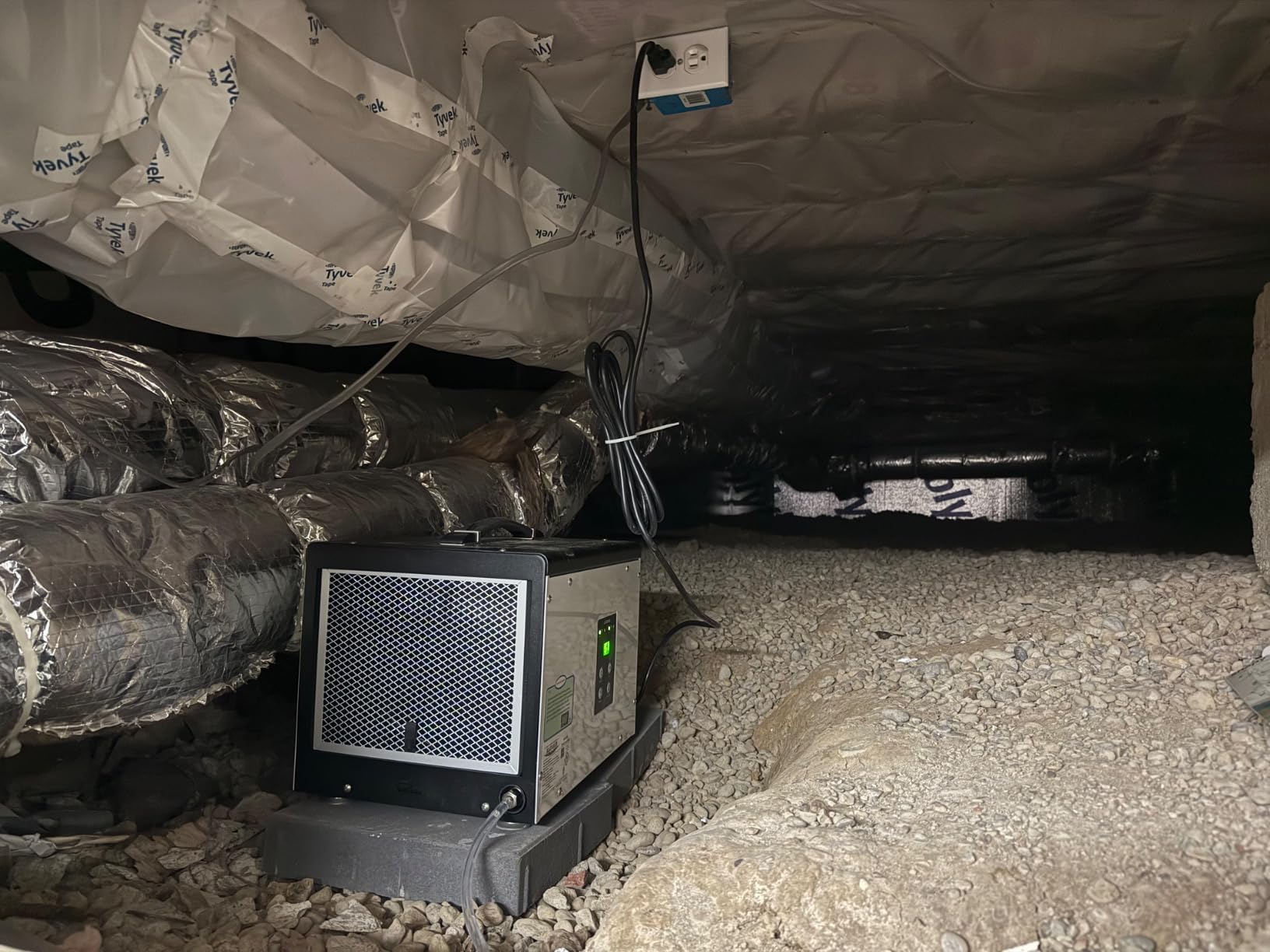
Owner photos show a low, wide alloy steel chassis that fits under a joist bay far better than the tall consumer towers. The footprint is genuinely compact for the output class, which is the point of the design.
Ratings are the most mixed in this roundup, with a notable share of one-star reviews focused on durability and warranty service friction rather than on how the machine performs day to day. That is worth weighing against the long warranty headline.
Is a 1000 square foot capacity enough for a garage?
For a full two-car garage, no. That figure describes a crawl space or an enclosed under-floor area, and running this as your only unit in a 500 square foot bay will leave it cycling constantly.
It is the right answer when the actual damp problem is under the floor, or when the garage has a sealed storage area at a different elevation from the main bay.
Why a tall pump lift matters under a floor
Under a raised floor you are often draining into a pump pit that is well below the unit, and gravity is not available. A 19.6 foot lift covers a basement-depth pit from a unit sitting on the crawl space floor.
It also lets you keep the unit in a corner where the electrical and airflow are best, rather than positioning it around a drain. Just confirm the hose run stays within the pump head rating.
11. avylo 90 Pint Pump Dehumidifier at 235 Watts
avylo Dehumidifier for Basement with Pump and Hose, Max 90 Pints/D, White
90 PPD
5000 sq ft
235 W
41 dB
15 ft pump lift
Pros
- 235 watt draw is the lowest here for 90 pints of rated capacity
- ENERGY STAR Most Efficient 2025 with an EER of 2.05 L/kWh
- Large 2.11 gallon top-mounted tank with full-tank reminder
- 5-year manufacturer warranty
Cons
- Smaller review base than most competitors with 339 ratings
- Floor drain pipe not included
- Tank must be emptied once before pump drainage setup
- Heavier than comparable 80 pint plastic units
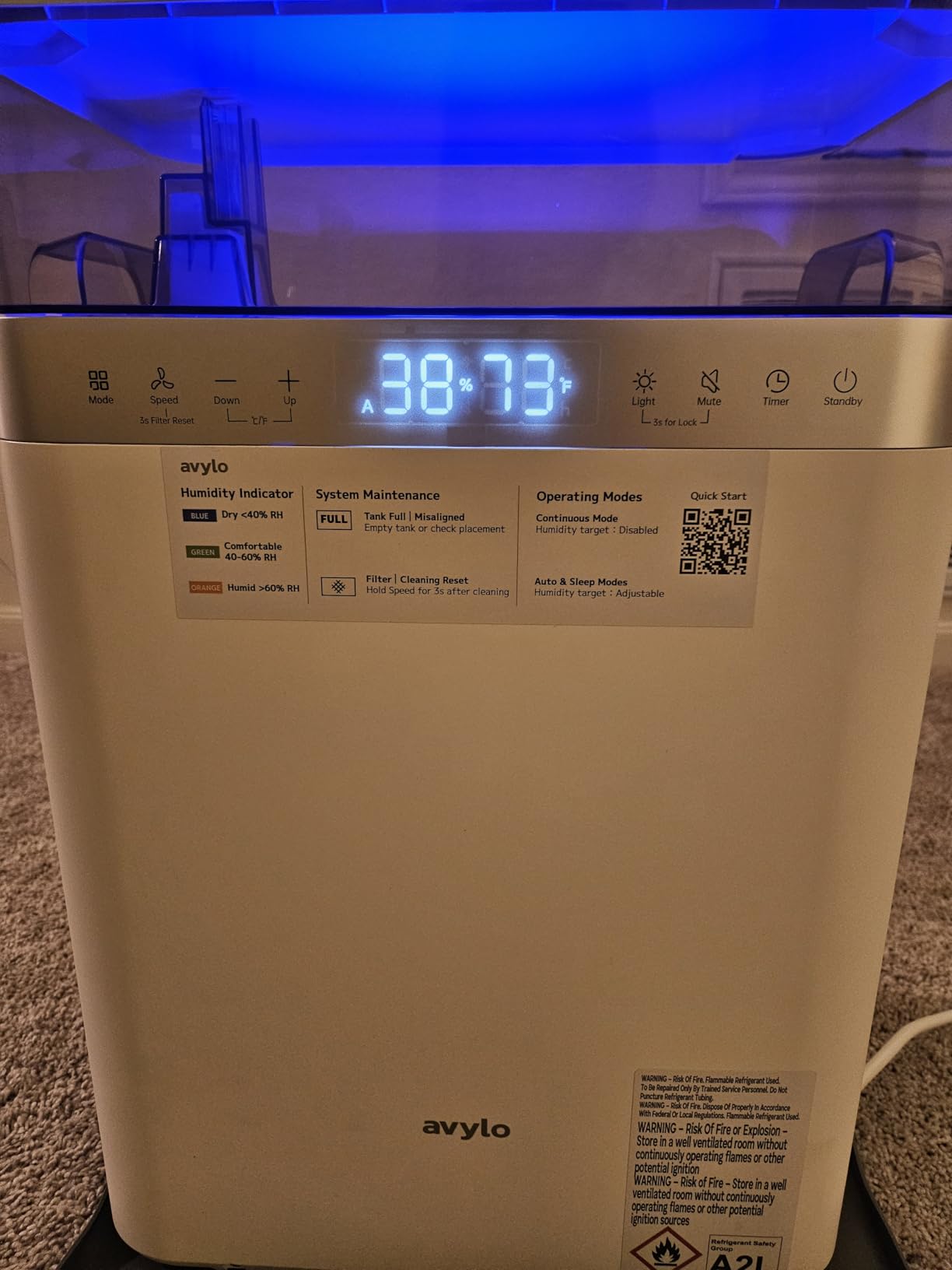
This is the running-cost pick. Its 235 watt draw is the lowest here for a unit rated above 50 pints per day, and in an unheated garage running 20 or more hours a day, that difference compounds over years.
The published figures are 90 pints per day at 90F and 90 percent RH across up to 5000 square feet, with ENERGY STAR Most Efficient 2025 certification and an EER of 2.05 L/kWh. Owners highlight the efficiency, the generous tank, and the 15 foot pump lift for garage and basement installs.
The 2.11 gallon top-mounted tank is unusually large for this class, and mounting it on top means you can see the water level without crouching down. The full-tank reminder and auto shut-off are both present.
Five-year manufacturer warranty coverage is among the longest consumer warranties here, which is a real advantage for an appliance most owners run continuously through a humid season.
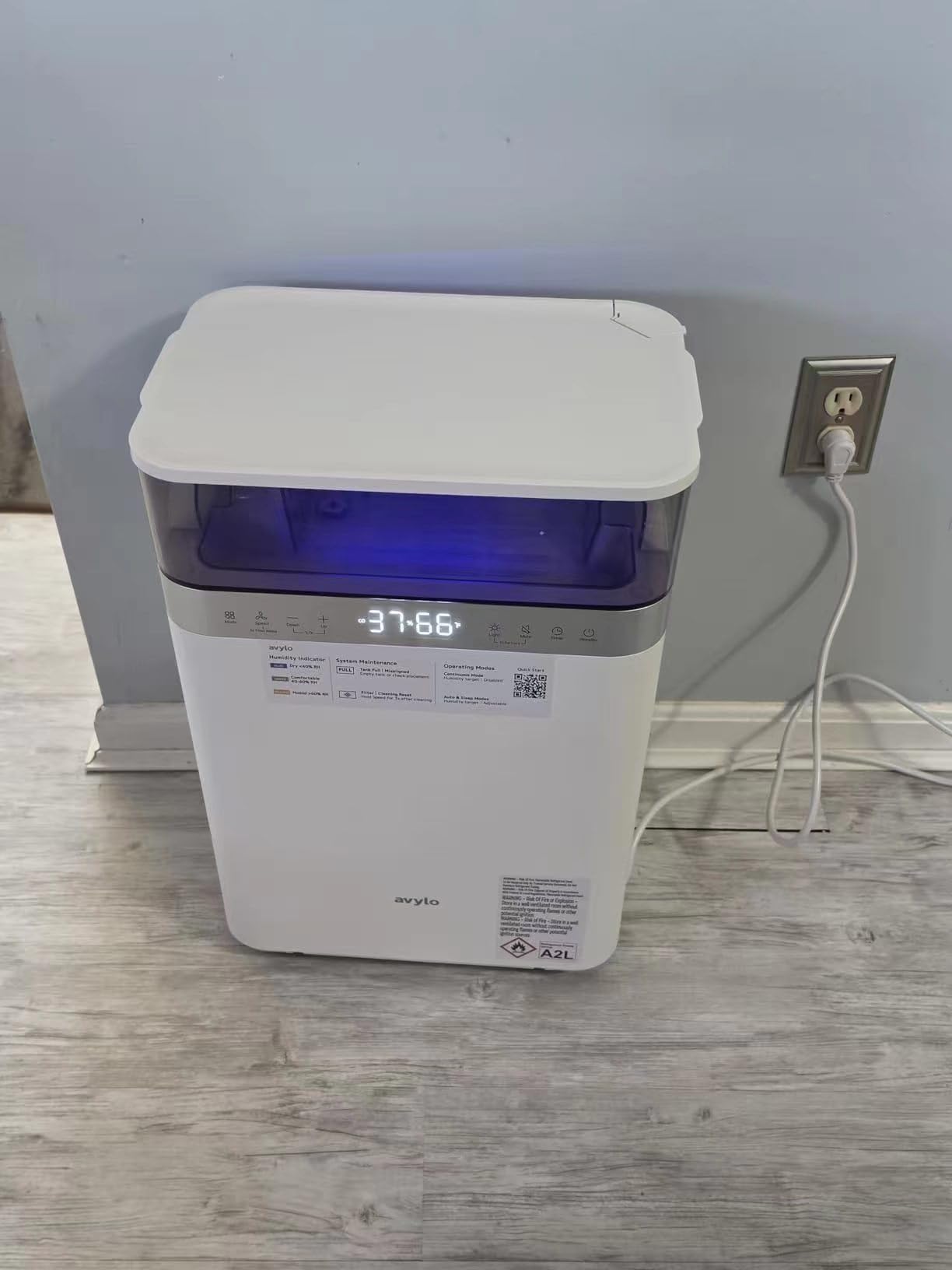
Owner photos show a broad, low cabinet with a top-mounted tank and an LED readout that displays live humidity and temperature. The 41 dB operation and the light-off mode both make it workable in a space you use in the evening.
One setup detail trips people up: empty the tank once before you hook up either the gravity line or the pump hose, otherwise residual water in the tank can leak at the connection during the first cycles.
How much does a garage dehumidifier cost to run?
Multiply the rated wattage by your hours per day and by your local electricity rate, then add a small motor allowance. At 235 watts running 20 hours a day, that is about 141 kilowatt-hours a month before motor losses, which lands in the low tens of dollars in most US markets.
Compare that to a 520 watt shop model running the same 20 hours and the gap is large, often more than the purchase price difference over two or three seasons. This is why wattage belongs in the buying decision, not just capacity.
Is a pump worth the extra parts?
For a garage with no drain path, yes and it is not close. Fifteen feet of lift covers most residential slab situations and lets the machine run unattended for weeks at a time.
For a garage with a working floor drain, a gravity-only model is simpler and has fewer failure points. Weigh that against the convenience of not planning drain routing at all.
12. Frigidaire 50 Pint Dehumidifier with Wi-Fi
Frigidaire 50 Pint Dehumidifier w/Wifi
50 PPD
4500 sq ft
470 W
2.7 gal tank
Wi-Fi
Pros
- Wi-Fi app control for remote monitoring and adjustment
- 50 pints per day across up to 4500 square feet
- Large 2.7 gallon tank emptied once or twice daily
- Quiet at roughly 45 dB on the low setting
- Washable air filter and auto shut-off when full
Cons
- Several reports of units failing within months
- Display shows only the target humidity and not the current reading
- 44.5 pounds and a bulky square footprint
- 1 year limited warranty
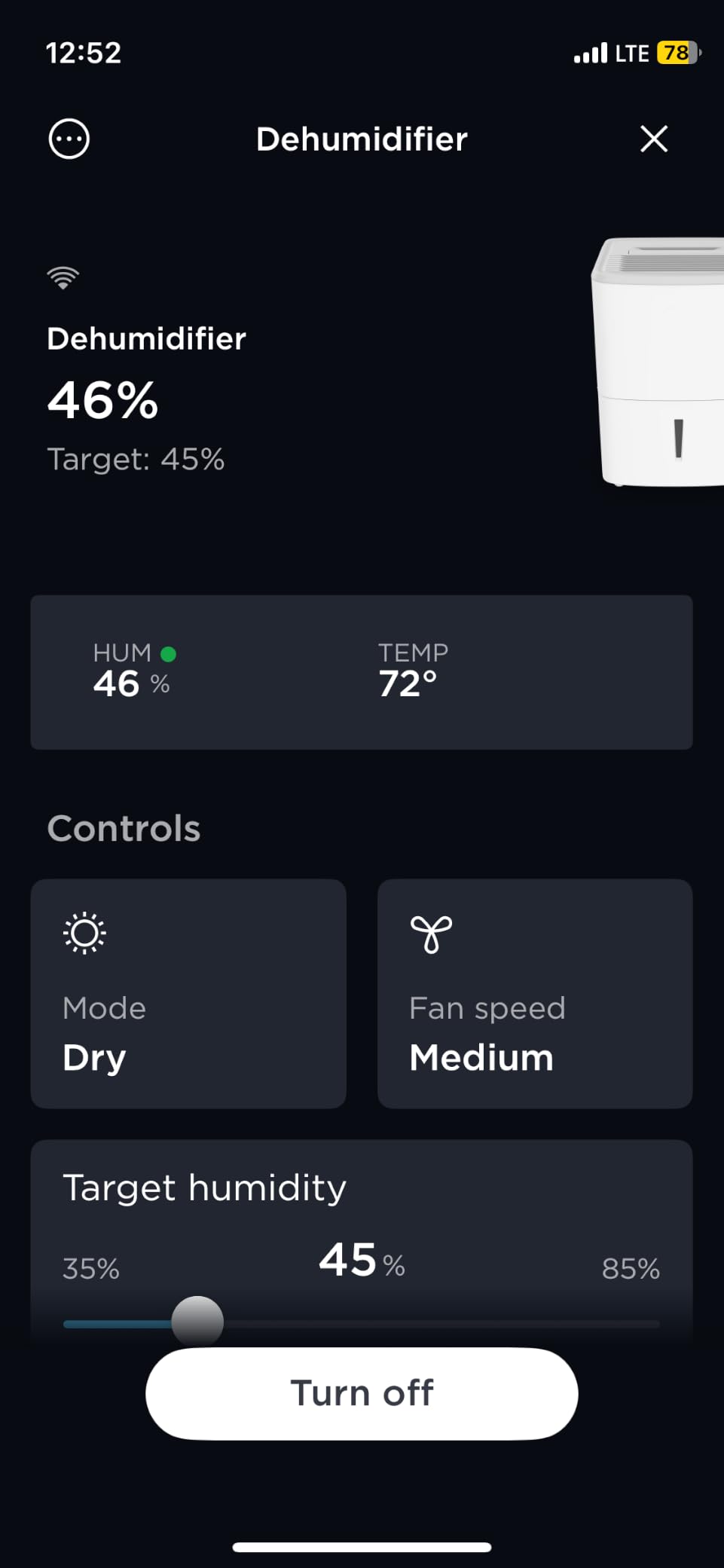
This is the pick for a garage you do not want to visit just to check on. The Wi-Fi app lets you see and adjust humidity remotely, which turns a check-in trip into a glance at your phone, and that is a real quality-of-life difference in a space at the end of a driveway.
Capacity is 50 pints per day for up to 4500 square feet, with 235 cfm of airflow, three fan speeds, and a 2.7 gallon tank that needs emptying once or twice a day rather than constantly.
Owners like the combination of quiet running, strong extraction, and app control, especially in humid climates. The washable filter and auto shut-off when the tank fills are both sensible for a space that collects dust.
Be honest about the drawbacks. Durability feedback is the main negative thread, with reports of units failing within months of purchase and a one-year limited warranty that is the shortest in this roundup. The display also shows the target rather than the current reading, so you still want a separate hygrometer to know what is actually happening.
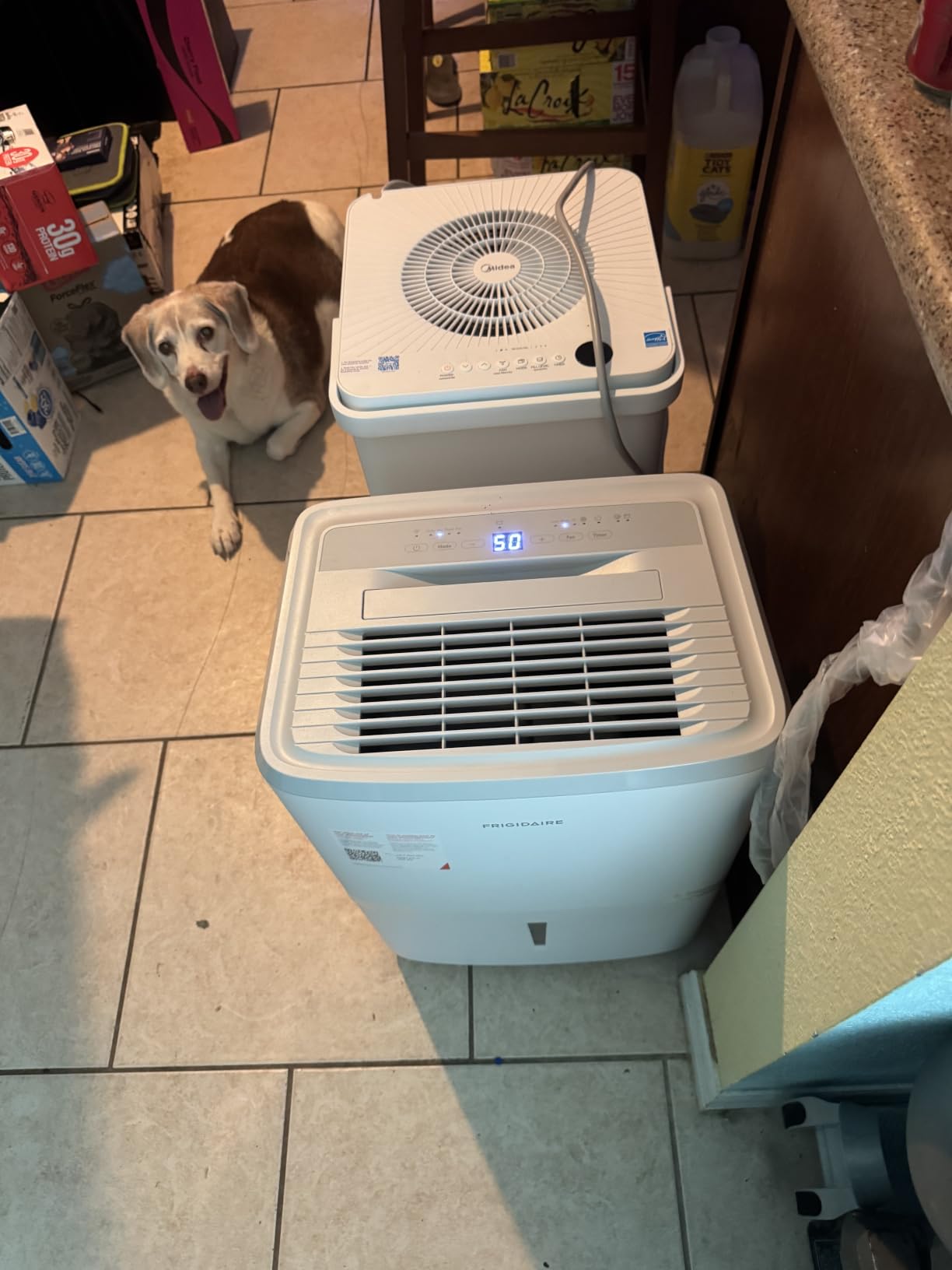
Owner photos show a large, modern cabinet with a clean front panel and a generous tank that is genuinely visible from standing height, which saves crouching every time you need to check the level.
It is the heaviest unit in this roundup at 44.5 pounds with a 24-inch square footprint, so plan the floor space before you commit. In a small single-car bay that bulk is a real constraint.
Is a connected dehumidifier worth it in a garage?
It earns its place when the space is detached or at the back of a property, because remote monitoring replaces a physical check-in. You can catch a full tank, a power interruption, or a humidity climb before it becomes a problem.
It matters less if you are in the garage every day anyway. An app is a convenience, not a dehumidification feature, and it does not improve extraction or cold-temperature performance.
Who should look past this one
Anyone in a cold climate, because this listing does not publish a minimum operating temperature and the category treats that silence seriously. In a 40F garage, the coil will ice and the app will happily tell you it is at target while nothing is being collected.
Also look past the 470 watt draw for a 50 pint machine. It is more than twice the power of the AEOCKY 50 pint at 380 watts, and far more than several 80 pint competitors.
How to Choose a Garage Dehumidifier
Five decisions matter, and you can make all of them in about ten minutes once you have a tape measure. Do them in this order, because each one narrows the next.
How many pints per day do you need?
Match capacity to floor area and to how wet the space gets. The rough mapping: a one-car garage under 300 square feet is comfortable with a 50 pint machine, a two-car garage of 400 to 600 square feet wants 50 to 80 pints, a workshop or three-car bay of 600 to 1200 square feet wants 80 to 150 pints, and anything larger should be looked at as a light commercial install.
Then adjust for conditions. A garage with a bare cold slab, wet cars tracked in, and a door open to a humid yard will need more capacity than the square footage alone suggests. A finished, insulated, conditioned garage needs much less.
What minimum operating temperature should you insist on?
This is the spec to check on the manufacturer’s page before you buy anything. Here is the matchup by garage type: an attached or heated garage held above about 55F can run any auto-defrost unit on this list, an unheated garage that stays in the 40s to low 50s wants a unit rated to 42F, and a garage that drops below 40F needs a desiccant system or added heat.
Only one model in this roundup publishes a cold rating below 65F that we consider a true cold-garage spec, and it states 42F. One other publishes three capacity points down to 65F, which is useful but not the same claim. The rest are silent, and silence in this category is a reason to keep looking.
Gravity drain, pump, or tank?
A tank works if you remember to empty it, which in a garage you rarely visit means you do not. Gravity drainage works if you have a floor drain or a sloped run to one. A built-in pump works everywhere, and the lift height is what you pay for, from about 9.8 ft to 19.6 ft in this group.
For a flat slab with no drain, buy the pump. For a garage with a working floor drain, save the money and skip it. In both cases, continuous drainage is the feature that makes a garage dehumidifier a set-and-forget install rather than a chore.
DOE vs AHAM pint ratings: why the numbers changed
Older listings quote an AHAM figure, measured at 86F and 80 percent RH. Newer listings quote a saturated-capacity figure at 95F and 95 percent RH, which sounds far more impressive because the test conditions are extreme. A unit rated 80 pints saturated may do 56 pints at standard conditions, and that lower number is your realistic garage planning figure.
Always look for both numbers if they are published, and treat the higher one as marketing and the lower one as engineering. The Gasbye unit on this list publishes three points, which is the gold standard for honesty in this category.
Noise, energy use and where the unit actually goes
For an attached garage you use as a workshop or gym, anything under about 45 dB is worth paying for. For a detached storage space, noise is irrelevant and you should optimize for wattage instead, since a machine running 20 hours a day is an appliance purchase, not a comfort purchase.
Placement is not a detail. Leave clearance on the intake and outlet, keep the unit away from the garage door so it does not pull in outside air, and put it where the air moves through the space rather than in a corner. A hygrometer on the wall a few feet off the floor gives you a reading that reflects the whole room rather than the outlet.
On set point, be conservative. Aiming for 30 to 40 percent in a storage garage can over-dry wood, leather, paper, and adhesives, and the fix is a set point between 50 and 60 percent with the unit cycling off overnight. Owners running these machines through winter report a range from three or four hours a day in a well-insulated space to 22 or more in a cold, leaky one, and that spread is driven far more by set point and insulation than by capacity.
Five Setup Mistakes That Ruin a Garage Dehumidifier
Almost every performance complaint we read about these units traced back to installation rather than to the machine. Five mistakes account for most of them.
Setting the target too low. Chasing 35 percent RH in a storage garage gets you a machine that runs constantly, dries out stored materials, and quietly raises your power bill. Fifty to sixty percent is the practical range for most garage contents.
Relying on the tank. Every one of these units fills up. In a garage you visit twice a month, a tank is a slow leak you do not notice until there is water on the slab. Hook up continuous drainage in the first week.
Running it in cold air on a unit rated for warm air. If the manufacturer publishes a defrost floor and your garage drops below it, the machine will ice up. Match the rating to your coldest expected temperature, not your average one.
Blocking airflow. Pushing the unit against a wall or into a tight corner starves it of intake air, and the rated capacity quietly stops being real. Give it clearance on all sides and keep the discharge louvers pointed across the space.
Ignoring the electrical install. A garage is a wet location, so the receptacle should be GFCI protected, and a machine running 20 hours a day belongs on a dedicated circuit rather than sharing an outlet with a welder or compressor. Continuous-duty appliances like this should not run off an extension cord, and none of the models here are rated for that use.
Frequently Asked Questions
Is it a good idea to put a dehumidifier in a garage?
Yes, when the garage is unheated, uninsulated, or in a humid climate and you are storing materials moisture damages. A cold concrete slab, wet vehicles tracked in, no ventilation, and daily temperature swings all produce condensation that causes surface rust, soft cardboard, and musty odors. In a conditioned garage you use every day, the noise and power cost usually buy you very little, so skip it.
What size dehumidifier do I need for a garage?
A one-car garage under 300 square feet is comfortable with a 50 pint per day unit. A two-car garage of 400 to 600 square feet wants 50 to 80 pints. A workshop or three-car bay of 600 to 1200 square feet needs 80 to 150 pints, and larger spaces should be treated as light commercial installs. Add capacity for wet vehicles tracked in and a bare slab.
What type of dehumidifier is best for an unheated garage?
A compressor unit with a published auto-defrost rating, a low-temperature operating specification, and continuous drainage. Auto-defrost cycles the compressor and heater to clear frost from the cold coil, without which the unit ices up and stops collecting water. Below the rated defrost floor, use a desiccant unit rated for sub-freezing spaces or add heat to keep the garage above 45F.
What is the number one rated dehumidifier?
Across the twelve garage models we compared, the highest average rating belongs to the Gasbye 115 pint ENERGY STAR 2026 unit, which also publishes a three-point capacity curve down to 65F. Our overall pick is the Waykar 80 pint 5000 square foot model, chosen for its balance of capacity, a 270 watt draw, 42 dB operation, and the deepest owner feedback base in the category.
How cold can a dehumidifier run before it freezes?
It depends entirely on the published minimum operating temperature for that model. In this roundup, one unit is rated down to 42F, another publishes usable capacity at 65F, one states 65F for its defrost sensors, and the rest do not publish a figure at all. Below the rated floor the evaporator coil ices over, airflow stops, and extraction drops to nearly nothing until the frost is cleared.
What is the best humidity level for a garage?
Hold 50 to 60 percent relative humidity for most storage garages, measured with a wall-mounted hygrometer a few feet off the floor rather than at the unit outlet. Pushing the set point down to 30 or 40 percent can over-dry stored wood, leather, paper, and adhesives, and it makes the unit run far longer than it needs to for no real benefit.
Final Verdict on the Best Dehumidifiers for Garages
For most garages, the Waykar 80 pint 5000 square foot model is the pick. It pairs real capacity with a 270 watt draw, runs at 42 dB, carries an ENERGY STAR certification and a two-year warranty story, and sits behind the deepest owner feedback base in the category, which means the failure modes are already documented rather than a surprise waiting for you.
If your garage gets genuinely cold, the Waykar 120 pint model rated to 42F is the only unit here with a published defrost floor suited to a sub-freezing space, and its 40 dB operation makes it viable in an attached bay. If your garage is oversized, open, or functions as a shop, the Yaufey 150 pint or the Waykar 150 pint commercial model give you the extraction headroom to hold a set point without running constantly.
Whichever one you pick, the setup decides the outcome more than the model does. Match the defrost rating to your coldest night, run continuous drainage from day one, set the target between 50 and 60 percent, and put the unit on a GFCI-protected dedicated circuit. Get those four right and any of the twelve above will do the job quietly for years.
We update this roundup as new models land and as the manufacturers revise their published specifications, so check back through 2026 and beyond for the current standing.