
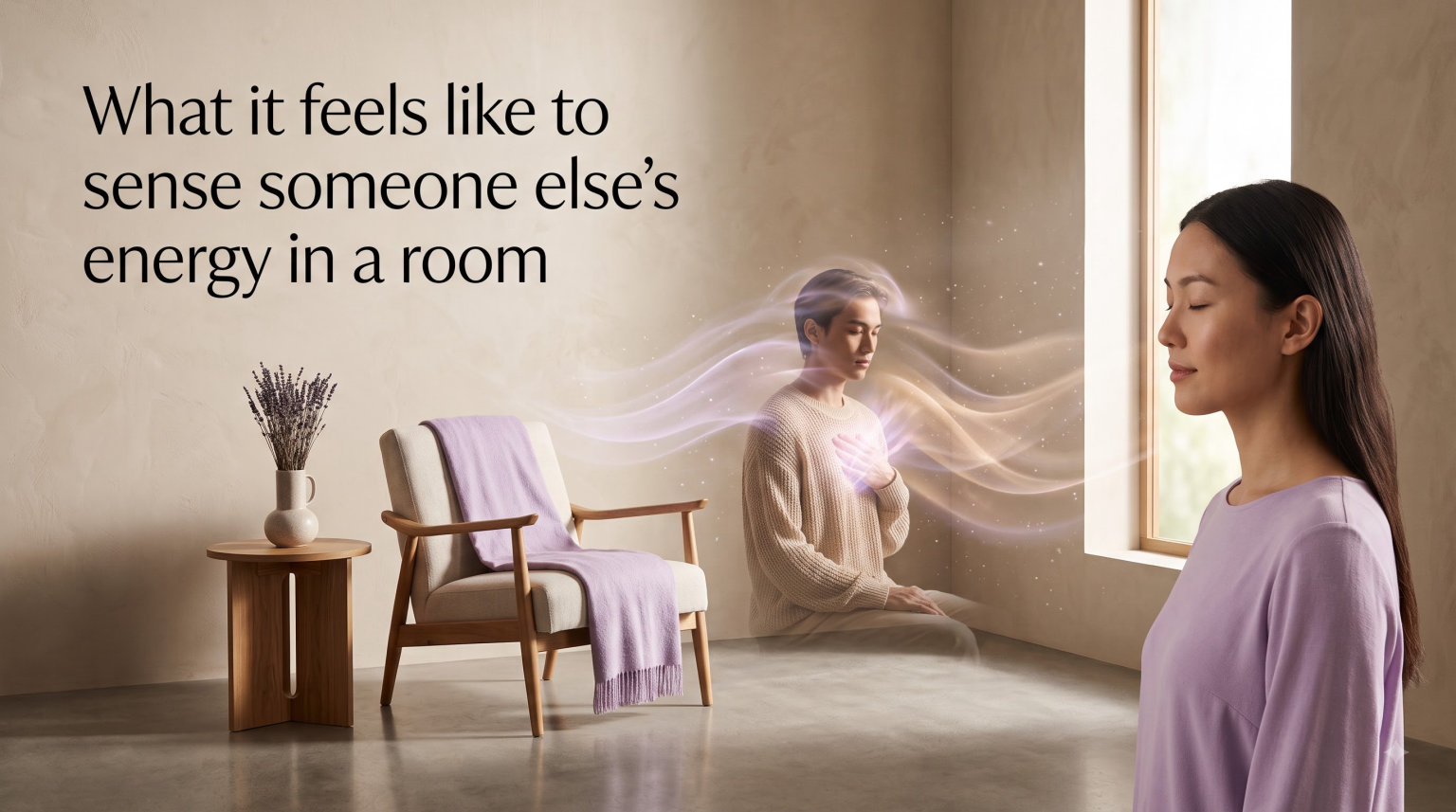
I have walked into rooms that felt heavy before anyone spoke a word. The air seemed thick. My shoulders tightened. My chest pressed inward as if something invisible pressed back. That quiet knowing that someone in the room was carrying grief, anger, or anxiety, without them saying a single word, is what it feels like to sense someone else’s energy in a room.
If you have ever wondered whether what you feel around other people is real, you are not alone. Many sensitive people describe the same experience. Some call themselves empaths. Others identify as highly sensitive people, or HSPs. Some call this ability clairsentience, a form of clear feeling. The name matters less than recognizing what is happening inside your body and learning how to work with it.
In this guide, I will walk you through what sensing someone else’s energy actually feels like, why your body responds this way, how to know whether you are feeling your own emotions or someone else’s, and what to do when a room drains you. Updated for 2026, this guide pulls together both lived experience and what science has begun to explain about sensitive nervous systems.
Table of Contents
What Sensing Someone Else’s Energy Actually Means?
Sensing someone else’s energy means you are picking up emotional or energetic information from another person, often before they speak or even look at you. Many people describe it as a sudden knowing, a felt sense, or a wave of emotion that does not match their own mood. This is not imagination. It is your nervous system registering another person’s state through subtle cues like body language, tone, micro-expressions, and possibly energetic fields that science is still studying.
The experience is sometimes called empathic perception or clairsentience. Empaths and HSPs tend to feel these signals more strongly than the average person. You might sense the room’s mood the moment you walk in, even before anyone has greeted you. You might feel tired after a short conversation with someone who is struggling. You might feel inexplicably anxious in a crowd, even if nothing visible is wrong. These are all forms of energy sensing.
What It Feels Like in the Body: Common Physical Sensations
What it feels like to sense someone else’s energy in a room usually begins as a physical sensation in your chest, stomach, or skin. You may feel a sudden wave of emotion that has no clear source. You may notice your breath change. Your body often responds before your mind names what is happening. Here are the most commonly reported sensations.
A wave of heaviness in the chest that feels like pressure or sadness, even when you are not personally sad.
Tightness in the throat or stomach when someone nearby is upset, anxious, or holding back tears.
A sudden temperature shift, such as feeling cold near one person and warm near another.
Tingling on the skin or scalp when entering a charged room or standing next to someone with strong emotions.
A heavy, drained feeling in the shoulders or legs after short social interactions.
Sudden mood swings, like a flash of anger, fear, or grief that does not fit your situation.
A buzzing or vibrating sensation in the hands, solar plexus, or around the head.
Instinctive aversion or pull, where your body leans away from one person and toward another without knowing why.
Most people I have spoken with describe a specific hot spot in the body, often the heart or stomach, where the foreign emotion lands. Pay attention to where you feel things first. That spot is often your personal entry point for other people’s energy.
Clear Signs You Are Picking Up Another Person’s Energy
Sometimes the signs are obvious. Other times they slip under the radar for years. Here are six common indicators that you are sensing someone else’s energy rather than reacting to your own thoughts.
You feel emotionally different the moment you walk into a room, even before anyone speaks to you.
Your mood shifts to match whoever you are with, and you struggle to hold your own emotional baseline.
You feel physically exhausted after social interactions, especially with people who are venting or going through hard times.
You know things about people before they tell you, sometimes called intuition or a felt sense of truth.
You feel anxious or drained in crowds, even in places where nothing visibly threatening is happening.
You take on other people’s problems as your own and have a hard time letting go, even hours after leaving them.
If three or more of these feel familiar, you are very likely sensing energy on a regular basis. The next question most people ask is whether there is a scientific reason for it.
The Science Behind Why You Can Feel Other People’s Energy
There is a real biological mechanism behind why some people feel other people’s energy more strongly than others. Researchers have identified mirror neurons, special brain cells that fire both when you experience an emotion and when you watch someone else experience it. These neurons help you understand other people by, in a sense, trying on their state inside your own body.
People with more active mirror neuron systems tend to score higher on measures of empathy and emotional sensitivity. The limbic system, the part of the brain that processes emotion, also plays a role. Sensitive people often have more reactive limbic systems, meaning emotional cues from others register more intensely. Polyvagal theory, developed by Dr. Stephen Porges, adds another layer. It explains how the vagus nerve reads safety and threat in the environment, including subtle cues from the people around you.
None of this proves energy fields in the metaphysical sense. It does prove that your nervous system is built to pick up emotional information from other humans. For highly sensitive people, that system runs at a higher volume.
Empath vs HSP vs Clairsentient: What Is Your Sensitivity Type
These three labels overlap, but they are not identical. Knowing which one fits you can help you understand your strengths and your vulnerabilities.
Empath: Feels other people’s emotions as if they were their own. Often described as the most intense form of energy sensitivity. Empaths can absorb moods from strangers.
Highly Sensitive Person (HSP): A trait coined by psychologist Dr. Elaine Aron. HSPs process sensory and emotional information deeply. They are easily overwhelmed by stimuli, including other people’s energy.
Clairsentient: A spiritual term for clear feeling. Clairsentients receive intuitive hits as physical sensations, gut feelings, or sudden knowing.
You can be more than one. Many people who identify as empaths also meet the criteria for HSP and have clairsentient moments. What matters is recognizing your sensitivity and giving yourself tools to manage it.
Can You Feel Someone’s Energy From a Distance
Many sensitive people report feeling someone they love from across town, across the country, or even farther. A sudden wave of anxiety that turns out to match the moment a loved one was in an accident. A phone call that comes right when you were thinking of someone. These experiences are common in empath communities, and the science on distance sensing is still evolving.
One explanation is that we pick up on emotional cues in real time, even at a distance, through the nervous system and subconscious cues. Another is that close bonds create shared emotional rhythms. A third, more spiritual explanation is that energy does not respect physical distance in the way we assume. Whichever interpretation fits you, the experience is real to you, and that matters.
How to Protect Your Energy and Ground Yourself?
Sensitivity is a gift, but without boundaries it becomes a burden. The most important skill for any energy-sensitive person is learning how to clear, ground, and protect your own field. Here are the practices our team has seen make the biggest difference.
Grounding Practices
Grounding pulls you out of other people’s energy and back into your own body. Try standing barefoot on the earth for a few minutes. Try a slow walk in nature. Try placing both feet flat on the floor and taking five deep belly breaths while you picture roots growing from your soles into the ground. Even 60 seconds of grounding can interrupt an energy drain.
Energy Clearing Techniques
After a heavy conversation or a crowded event, give yourself a few minutes to clear. Splash cold water on your face and wrists. Shake your hands and arms briskly for 30 seconds, an old technique used by energy healers. Step outside for fresh air. Take a shower and visualize the water washing off any energy that is not yours.
Setting Boundaries With Your Awareness
You do not need to absorb everything. Picture a bubble of light or a shield around you before you enter a charged room. Mentally say, “Only my own energy belongs here.” Notice when your mood is not yours and consciously return to your breath. Boundaries are not walls. They are permissions you give yourself to stay in your own body.
Daily Practices That Build Resilience
Sleep, hydration, and quiet time protect sensitive people more than any single technique. Schedule 10 minutes of true quiet into your day. Limit scrolling and news exposure. Choose environments that match your nervous system, especially on high-sensitivity days.
How to Tell Your Emotions Apart From Absorbed Energy?
The hardest part of being sensitive is knowing which feelings are yours. A simple practice helps. When a strong emotion appears, pause and ask three questions. What was I feeling 30 minutes ago? Does this emotion fit my situation? Does it match the mood of someone near me, or someone I was just thinking about?
If the emotion does not fit you but fits someone else, you have likely absorbed it. Name it as not yours, take a breath, and let it pass through. Over time, this becomes faster. You stop carrying other people’s weight and start feeling your own life more clearly.
For 2026, many people are naming this ability for the first time. If that is you, give yourself permission. What you feel is real. Your body is not betraying you. It is doing what it was built to do. The next step is learning how to listen with discernment.
Frequently Asked Questions About Sensing Other People’s Energy
What does it mean when you can sense someone’s energy?
Sensing someone’s energy means you are picking up emotional or energetic information from them, often as a physical feeling in your body, before they speak. It is a sign of an active mirror neuron system and a responsive nervous system.
What does sensing energy feel like?
Most people describe it as a wave of emotion that has no clear source, a heaviness in the chest or stomach, sudden temperature changes, tingling skin, or exhaustion after short interactions. You may also feel pulled toward or away from certain people without knowing why.
Can empaths feel when someone is thinking about them?
Many empaths report a sudden wave of emotion, an image, or a physical sensation when someone they are close to is thinking about them. Science has not confirmed this at a distance, but the experience is widely reported and worth taking seriously.
Can soulmates feel each other’s energy?
People in deep emotional bonds often report feeling each other’s states more strongly than average. Shared nervous system rhythms, mirror neurons, and emotional attunement all contribute. Whether you call it soulmates or close bonds, the experience is real and common.
How do I know if I am absorbing someone else’s energy?
Ask yourself three questions. Does this emotion fit my situation? Was I feeling this 30 minutes ago? Does it match the mood of someone near me or someone I was just thinking about? If not, you are likely carrying absorbed energy that you can release with grounding and breath.
What is the difference between empathy and energy sensing?
Empathy is the ability to understand and share another person’s feelings. Energy sensing goes further, often producing physical sensations, mood shifts, or intuitive hits that feel like you are taking in their state directly. Empaths are a more intense version of both.
Trusting Your Sensitivity as You Move Forward
Now you know what it feels like to sense someone else’s energy in a room, and you have a framework for understanding why it happens. The body sensations you feel are real signals from a sensitive nervous system. The mirror neurons, limbic responses, and polyvagal cues that drive them are well documented. The spiritual interpretations of distance sensing and aura reading sit alongside this science as complementary lenses, not competing ones.
Here is what I would encourage you to do next. Notice where in your body you first register other people’s energy. Practice the three-question check to find out which emotions are yours. Build grounding and clearing into your daily rhythm so sensitivity stops being a burden and starts being a gift. Most importantly, give yourself permission to trust what you feel. So many people grow up dismissing their own perception. Your sensitivity is part of who you are.
If you want to go deeper into energy work, discernment practices, and protection techniques, keep exploring. The room you walk into next time will feel different when you know what your body is doing. You can stay in your own energy, respond to others with compassion, and leave the room without carrying what was never yours to carry. That is the gift of learning what it feels like to sense someone else’s energy in a room.