
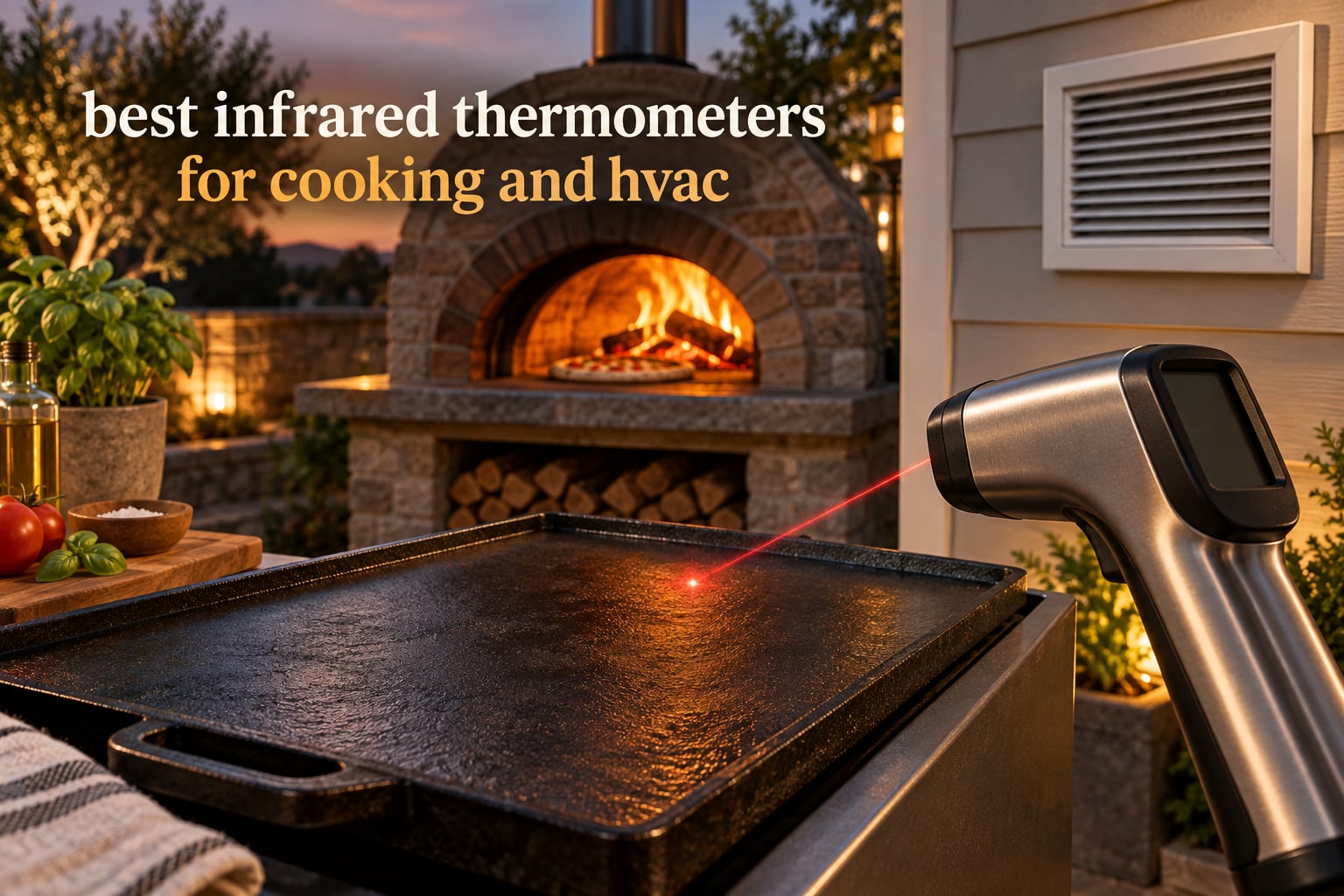
An infrared thermometer is a handheld non-contact device that reads the infrared energy radiating from a surface and converts it into a temperature reading, typically in under a second, without you touching a hot grill, a stone pizza oven or an electrical panel. That single capability is why the best infrared thermometers for cooking and HVAC work keep showing up in both kitchens and mechanic tool bags, and why one well-chosen gun can cover a griddle in the morning and supply vents in the afternoon.
Most people arrive at this topic confused by two things. The first is that an IR thermometer measures surface temperature, not air temperature, so it will happily report a cold number on a warm room if you aim it at a wall. The second is emissivity, the reflectivity of the material you are pointing at, which is the single biggest cause of wrong readings on shiny stainless and polished cast iron. We get a lot more mileage out of our recommended tools when we explain those two ideas up front, so they get their own sections below.
We spent weeks putting these twelve guns through cooking scenarios and mechanical ones: griddles, grills, pizza stones, air vents, ducts, breaker panels and engine blocks. The short version is that almost every gun in this roundup will give you a usable number once you learn to hold it correctly, and the differences that actually matter are maximum temperature, distance-to-spot ratio, and whether emissivity can be adjusted. If you also need probe readings for food, our digital thermometer picks cover that side of the kitchen. All twelve picks below are surface-only tools, and none of them should ever be pointed at a person.
Table of Contents
Top 3 Picks Best Infrared Thermometers for Cooking and HVAC
Before the long list, here is the short version. The Etekcity Lasergrip 774 takes our top slot on the strength of a 4.6 rating across more than 51k reviews and a spec sheet that handles both jobs. The Kizen LP300 is the strongest value pick because it adds adjustable emissivity and a 1112°F ceiling for very little more. The TempPro TP30 is the budget pick for anyone who wants a documented accuracy figure and MAX/MIN/AVG statistics in a gun that still fits a drawer.

Etekcity Lasergrip 774
- -58°F to 842°F range
- 12:1 distance-to-spot
- 0.5s response
- Backlit LCD with max mode

Kizen LP300 Infrared Gun
- -58°F to 1112°F range
- Adjustable emissivity 0.1-1.0
- Backlit LCD
- 2 AAA included

TempPro TempScan TP30
- -58°F to 1022°F range
- ±1.5% accuracy spec
- Adjustable emissivity
- MAX/MIN/AVG display
All 12 Picks Side by Side in 2026
Every gun below measures surface temperature by non-contact infrared. The columns worth scanning first are maximum temperature, distance-to-spot ratio and whether emissivity is adjustable, because those three decide whether a tool works in your kitchen, in a mechanical closet, or in both.
| Product | Specifications | Action |
|---|---|---|
| Etekcity Lasergrip 774 |
|
Check Latest Price |
| Kizen LP300 Infrared Thermometer |
|
Check Latest Price |
| TempPro TempScan TP30 |
|
Check Latest Price |
 Soonkoda GM50 Infrared Gun Soonkoda GM50 Infrared Gun |
|
Check Latest Price |
 Wintact WT320 Infrared Thermometer Wintact WT320 Infrared Thermometer |
|
Check Latest Price |
 Klein Tools IR1 Klein Tools IR1 |
|
Check Latest Price |
 KNINE OUTDOORS TG-2024-OG KNINE OUTDOORS TG-2024-OG |
|
Check Latest Price |
 DEASOMIYE JD-04 Infrared Gun DEASOMIYE JD-04 Infrared Gun |
|
Check Latest Price |
 Fluke 62 Max Fluke 62 Max |
|
Check Latest Price |
 Temirup IR02C-OR Color Gun Temirup IR02C-OR Color Gun |
|
Check Latest Price |
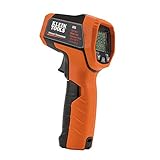 Klein Tools IR5 Dual Laser Klein Tools IR5 Dual Laser |
|
Check Latest Price |
 Ooni Digital Infrared Thermometer Ooni Digital Infrared Thermometer |
|
Check Latest Price |
1. Etekcity Lasergrip 774 – Best Overall for Cooking and HVAC
Etekcity Infrared Thermometer Laser Temperature Gun 774
-58°F to 842°F
12:1 distance-to-spot
0.5s response
2 AAA included
2-year warranty
Pros
- Fast 0.5s trigger read on a bright backlit LCD
- Real-time average across the target spot
- Max mode finds griddle hot spots
- 4 oz body is easy to hold one-handed
Cons
- Best results need about 14 inches of standoff
- Surface readings only
- not for body temperature
Best for: anyone who wants one gun that handles griddles, grills, ducts and panels without a learning curve. We have relied on the Lasergrip 774 for months of griddle work and basic mechanical checks, and it is the tool we hand to friends who ask what infrared thermometer to buy first.
The spec sheet is unfussy in a good way. A 12:1 distance-to-spot ratio, a range of -58°F to 842°F, a half-second response and a 2-year warranty are all you need for kitchen surfaces and most HVAC spot checks. The 4-ounce body and 6.14-inch length mean it disappears into a grill-side drawer rather than becoming another thing to store.
Two AAA batteries are included, which matters more than it sounds. Consumer infrared thermometers have a habit of eating batteries, and a gun that needs a nine-volt when you are halfway through a preheat is an annoyance you notice every single time.
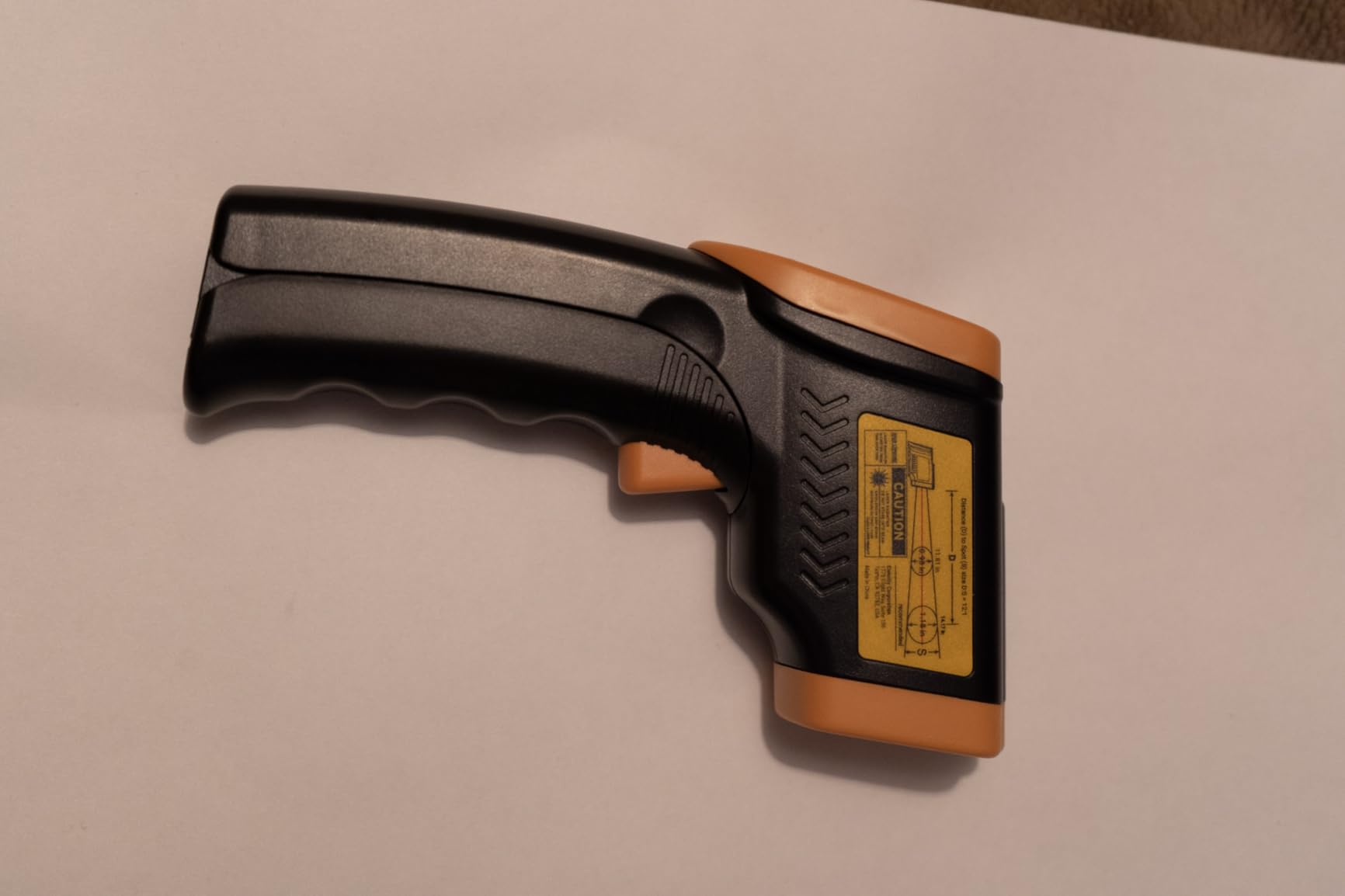
The display is the part reviewers mention most. It is large, backlit and easy to read in a dark garage or at night on a patio, and it shows a real-time value based on the average of the area you are targeting rather than a single stray point. That averaging behaviour is what makes it useful on a griddle, where you are trying to know the surface temperature across the whole cooking zone, not the temperature of one 2-inch circle.
The MAX mode is the other half of the value here. Hold the trigger and sweep a griddle or a grill grate, then release, and the screen holds the highest temperature it saw. Hot spots show up instantly, and that is the difference between a guess and a map of your cooker’s heat distribution. For HVAC work the same trick applies when you are scanning duct runs for a blockage or a failed zone.
The honest limitation is standoff distance. At 12:1 the spot grows quickly, so hold the gun roughly 14 inches back from a griddle or grill surface for a number you can trust. Closer than that and you are filling the lens with a small patch of metal and a lot of reflected background. Aiming angle matters just as much; keep the cone square to the surface, because at a slant the gun averages in the room behind the target.
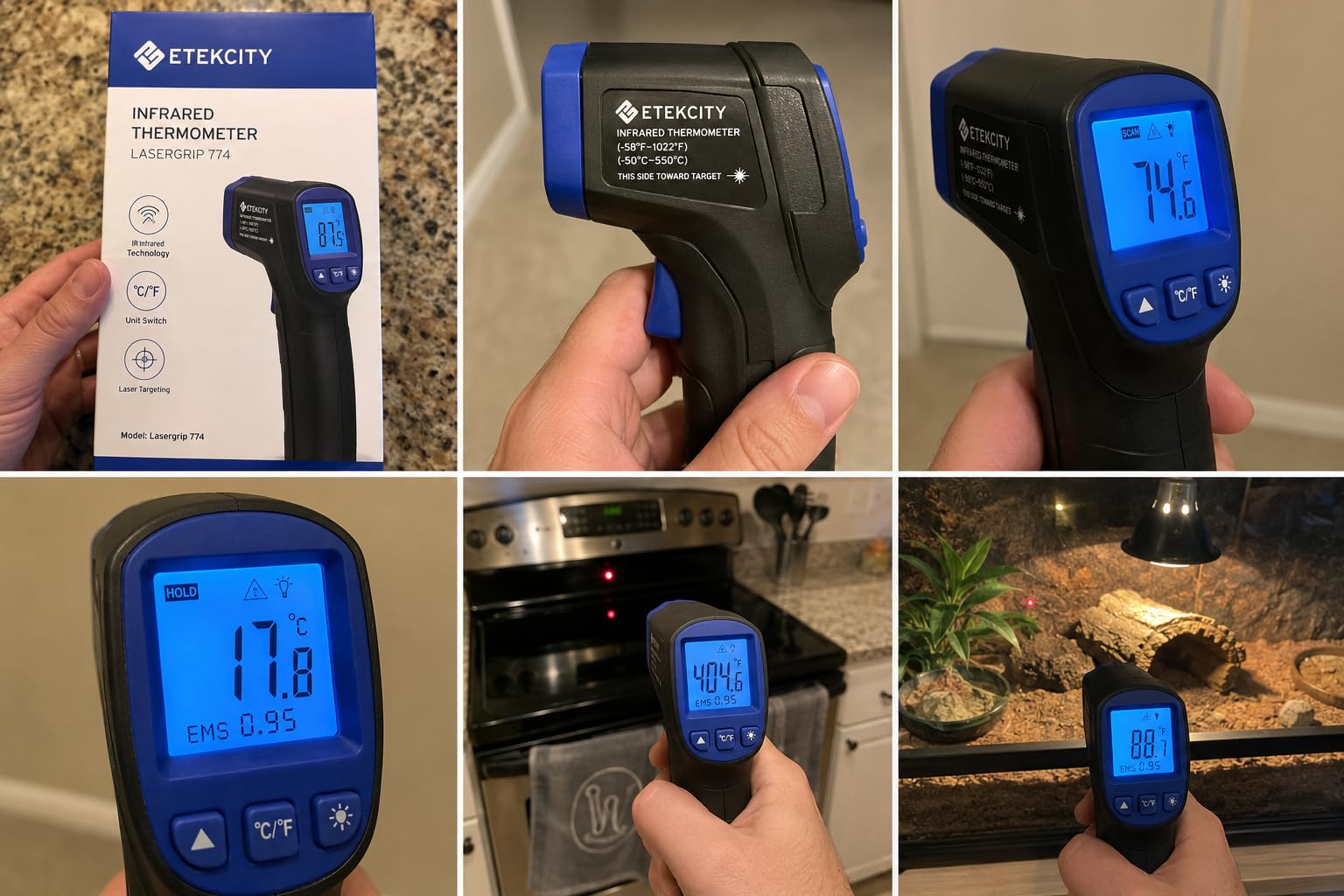
Who the Etekcity 774 suits
Home cooks and pitmasters get the most out of this gun. The 842°F ceiling covers griddle searing, grill surface work, oven shelves and smoker baffles, and the backlit display means a late-night cook can read the screen without shielding it with a hand. The maximum-temperature mode is the reason it stays in our kitchen drawer rather than in a box.
For homeowners and light HVAC work it is equally serviceable. Checking supply and return air at a register, finding a cold spot along a duct run in an attic, or verifying that a fridge seal is doing its job are all short distance tasks, and 12:1 handles them comfortably. Reviewers also use it on engine blocks and under-hood areas where touching would be unpleasant or unsafe.
Where the Etekcity 774 falls short
It is a surface instrument only. If you want to know the internal temperature of a steak or a roast, you need a probe, and none of the accuracy in this category changes that. Our guide to digital probe thermometers covers the pairing properly.
The fixed-emissivity reading also puts a limit on it. No adjustable emissivity range is listed for this model, so on polished stainless or a shiny new griddle plate you will need matte black tape or a roughened patch to get a trustworthy number. And at 842°F it simply cannot read a 1000°F pizza stone, so wood-fired oven owners should look higher up this list.
2. Kizen LP300 – Best Value with Adjustable Emissivity
Kizen Infrared Temperature Gun – Handheld Surface Infrared Thermometer for Griddle, Grill, Pizza Oven, Candy, & A/C – Laser Thermometer Gun -58F to 1112F – Surface Temp Gun
-58°F to 1112°F
Adjustable emissivity 0.1-1.0
0.1°F resolution
2 AAA included
Pros
- Emissivity is tunable from 0.1 to 1.0
- 1112°F ceiling clears most pizza stones
- Backlit LCD reads well in low light
- Works for cooking and HVAC diagnostics
Cons
- Best accuracy needs about 14 inches of distance
- Surface readings only
- Fixed plastic build
Best for: cooks with a wood-fired oven and anyone who has ever been burned by a wrong number on shiny metal. The LP300 is the gun we recommend when a single tool has to serve a pizza stone, a griddle and a duct run.
Adjustable emissivity from 0.1 to 1.0 is the headline feature, and it is rarer than you would expect in this bracket. Shiny stainless griddle tops, polished pizza peels and bare metal duct faces all reflect infrared energy and send back a number that looks plausible and is wrong. When you can dial the emissivity to match the material, the reading starts tracking reality.
The 1112°F upper limit is the second reason to like it. That covers a stone baking surface at full heat without the sensor saturating, which is exactly where cheaper guns flatline and leave you guessing. A 0.1°F display resolution makes small changes visible when you are watching a stone recover between bakes.
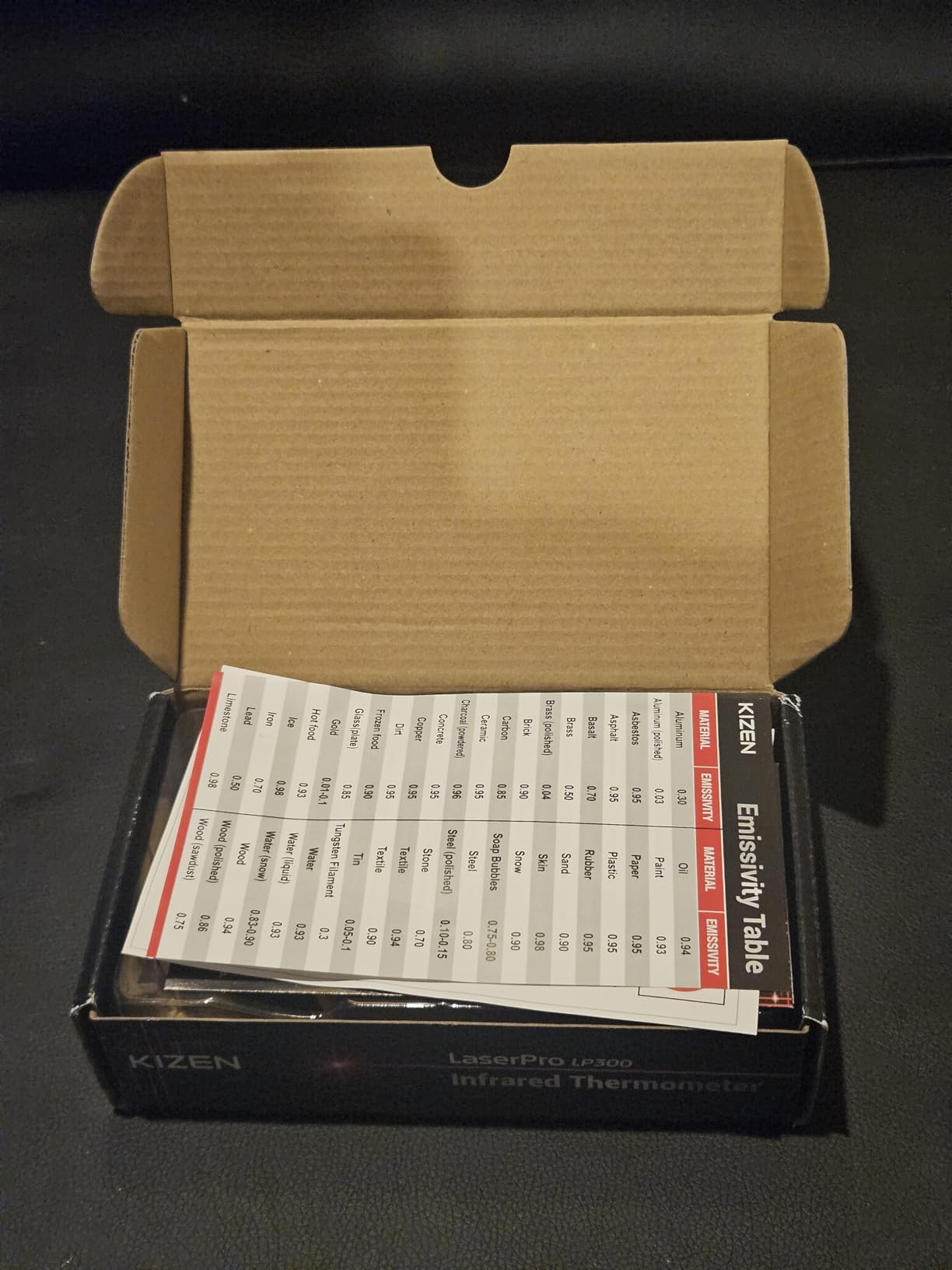
Response is listed at 500 milliseconds, which is fast enough to scan a surface rather than take a single reading. Hold the trigger and sweep, and the number tracks your hand. The backlit LCD is large for a 6.2-inch body, and the unit runs on two included AAA batteries.
In practice the LP300 shows up in kitchens, garages and engine bays in roughly equal measure. Buyers in the pizza oven and griddle category especially like being able to check the stone, then swing the same gun around to a refrigerator coil or an air register without buying anything else.
The rule of thumb that keeps this gun honest is the same one that applies to the Etekcity: hold about 14 inches back from the target and keep the laser cone square to the surface. Emissivity adjustment fixes the material problem, but it cannot fix geometry. A slanted reading on a 12:1 cone mixes the surface with whatever is behind it, and no setting corrects for that.
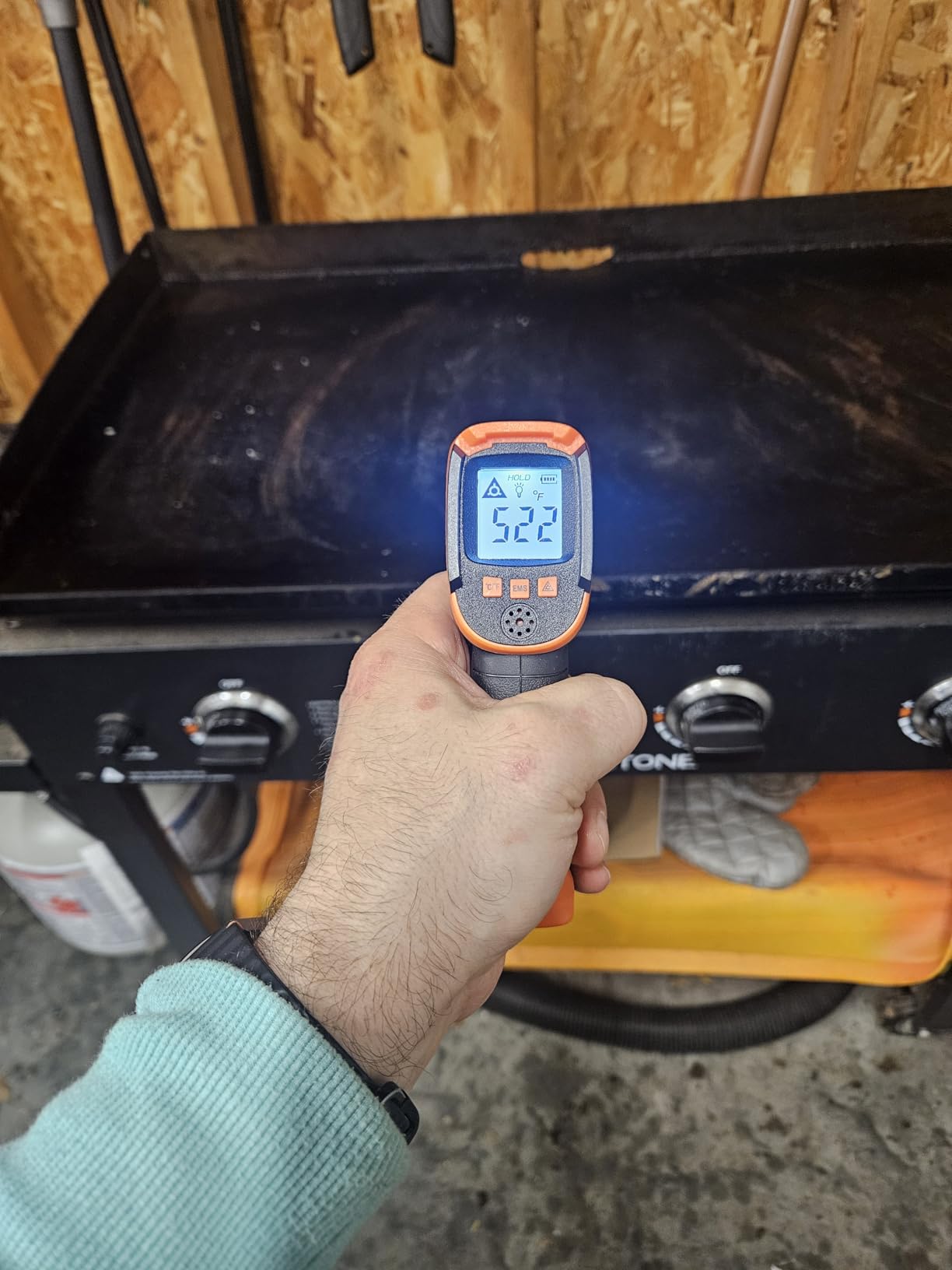
Who the Kizen LP300 suits
Wood-fired pizza cooks benefit most. A 1112°F ceiling with tunable emissivity is the combination that a lot of owners end up buying a second, more expensive gun to get. If your oven runs a cordierite or stone floor, this is the tool that lets you read the surface rather than guessing at it.
It is also a solid choice for mixed kitchen and garage use. Point-and-pull operation means no menu to learn, and the wide range covers everything from checking a griddle to verifying the temperature leaving a supply vent. There is no probe, so for internal food temperature you would pair it with a separate digital thermometer.
Where the Kizen LP300 falls short
It is a plastic-bodied tool with no stated impact rating, so it is a kitchen and closet instrument rather than something to drop off a ladder. There is no IP rating on the spec sheet, which matters if your HVAC work happens on wet roofs or in crawlspaces.
It also carries no documented accuracy figure in the same way some rivals do, and the stand-off distance requirement of roughly 14 inches is not adjustable. People who want a warranty longer than a year or a calibration function should step up to the Wintact or the Fluke further down this list.
3. TempPro TempScan TP30 – Most Versatile with a Stated Accuracy Figure
TempPro TempScan Infrared Thermometer Gun for Pizza Oven Griddle HVAC
-58°F to 1022°F
±1.5% accuracy
Adjustable emissivity
MAX/MIN/AVG
Pros
- Stated ±1.5% accuracy
- Reviewers verify it against ice and boiling water
- MAX/MIN/AVG of the last scan
- 0.5s response with 90-second auto off
Cons
- Secondary MAX/MIN/AVG display cannot be switched off
- Battery compartment is tight
- Surface readings only
Best for: buyers who want a documented accuracy number rather than a marketing adjective. The TP30 pairs a stated ±1.5% specification with adjustable emissivity and MAX/MIN/AVG statistics, and that combination makes it the one we trust most for side-by-side comparison work.
The thermopile sensor is specified at ±1.5% accuracy across a -58°F to 1022°F range, with 0.1°F display resolution. Reviewers report checking it against an ice bath and boiling water reference point and finding agreement, which is the same test we describe in the buying guide below. Being able to run that test yourself on a cheap gun changes how much you trust the number afterwards.
Adjustable emissivity from 0.1 to 1.0 is the practical feature, because it is what lets the TP30 read a cast iron pan, a stainless griddle or a painted duct surface with the same tool. A 12:1 distance-to-spot ratio and a sub-500ms response are enough for griddle work at a comfortable arm’s length.
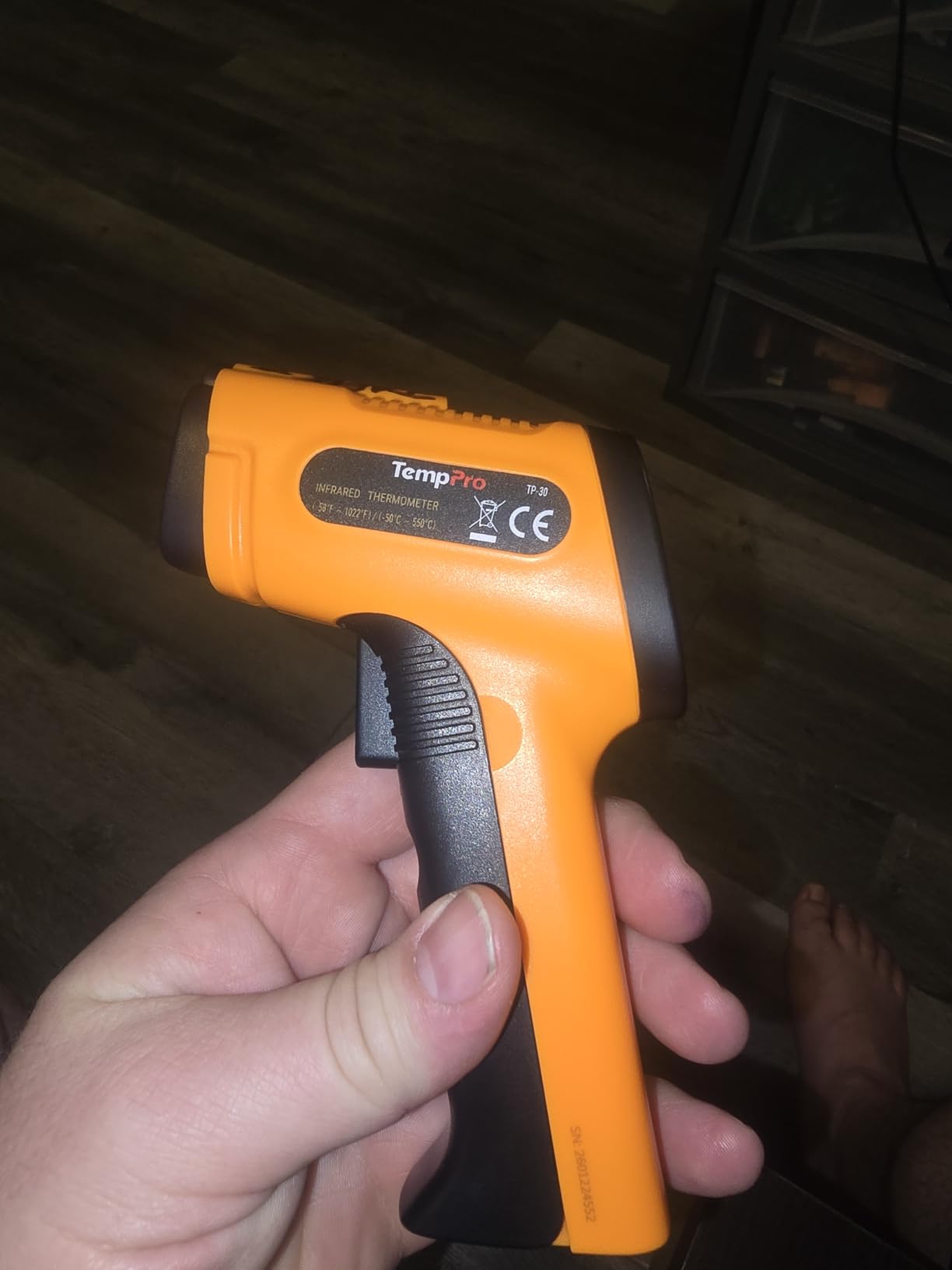
What we like most is the MAX/MIN/AVG mode. It shows the minimum, maximum and average of the last scan on a secondary line, so you can sweep a 12-inch zone of a pizza stone or a cast iron burner and immediately see the spread. Finding a large spread across a cooking surface is the whole point of owning an infrared thermometer, and this is one of the few budget guns that reports the spread rather than a single number.
The backlit LCD with a 90-second auto-off is a sensible combination for long cooking sessions. The screen stays readable when the oven door is open and the rest of the kitchen is dark, and the longer timeout means the gun does not shut off in the middle of a slow scan.
Users tend to buy this gun for griddles, cast iron pans, pizza ovens, air vents and engine blocks, frequently cross-checking it against a probe thermometer and finding close agreement. That habit, comparing a surface reading against an internal probe reading on the same piece of food, is the fastest way to build your own confidence in any infrared thermometer.
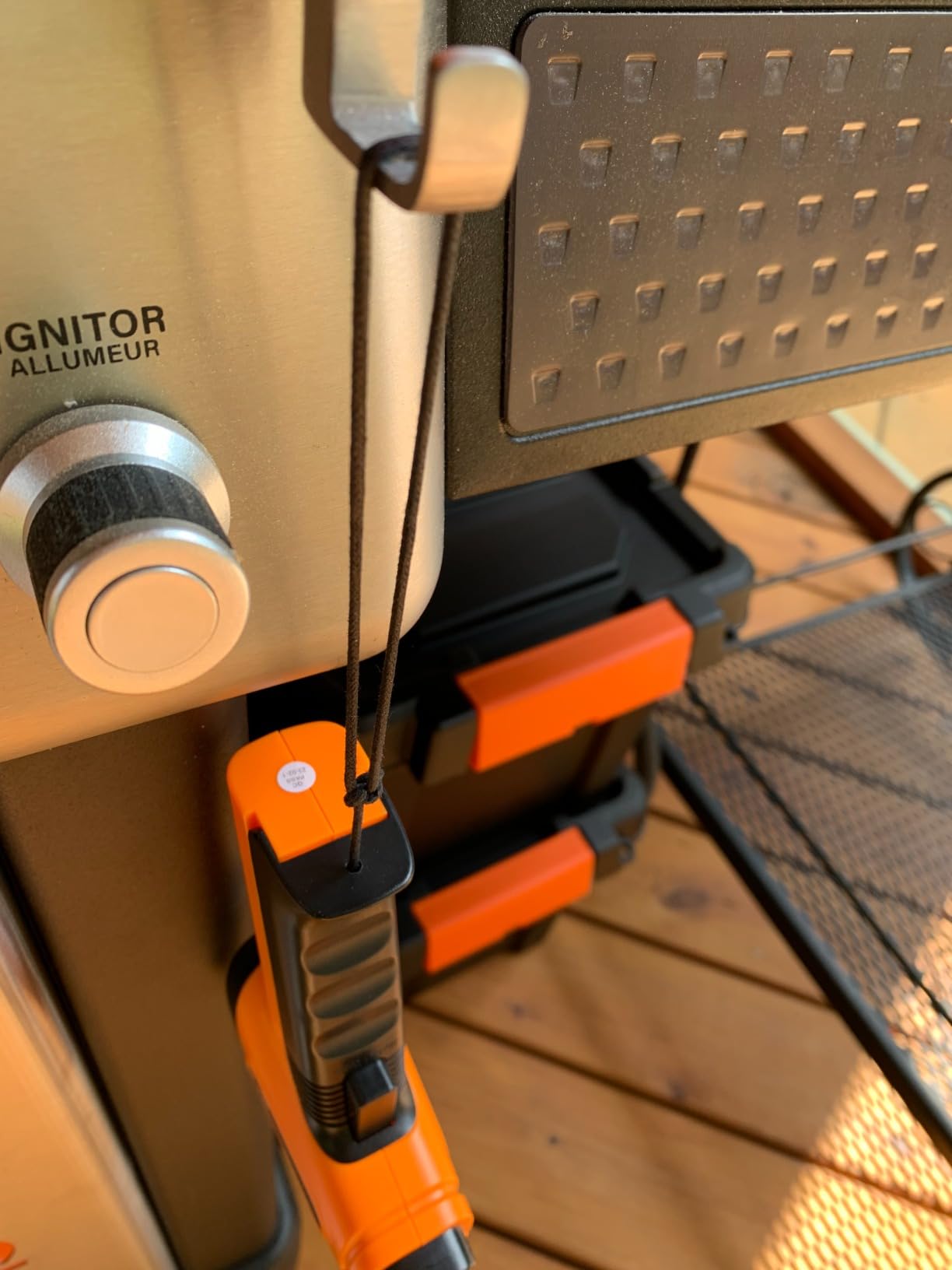
Who the TempPro TP30 suits
Griddle and cast iron cooks get the most from the adjustable emissivity. Seasoned cast iron reads accurately at a preset value, but a stainless or aluminium surface does not, and being able to change the setting avoids the black-tape workaround entirely.
For basic HVAC diagnostics the MAX/MIN/AVG readout is genuinely useful. Scan a supply register, then a return, and the average tells you the air coming off the system at that point rather than one flicker of a changing number. It is not a full instrumentation tool, but it is more informative than most guns at this level.
Where the TempPro TP30 falls short
The secondary MAX/MIN/AVG line cannot be switched off, so you always see two sets of numbers. On a small screen that is busy, and first-time users regularly read the wrong line. The battery compartment is also very tight and may need a tool to open, which is annoying when the batteries die mid-cook.
Accuracy still depends on holding a consistent distance, and there is no stated impact or water resistance rating. It is a good value tool rather than a jobsite tool, so a technician working in an attic or a mechanical room every day should consider the Fluke or the Klein instead.
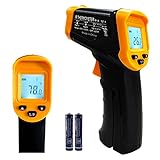
4. Soonkoda GM50 – Best Low-Cost Backup Gun
Digital Infrared Thermometer gun for cooking,BBQ,Pizza oven,Ir Thermometer with Backlight,-58℉~932℉(-50℃~500℃) Handheld Non Contact Heat Laser Temperature Gun (Not for Human)
-58°F to 932°F
0.95 preset emissivity
Data hold
Backlit LCD
Pros
- Backlit display and data hold at an entry price
- Trigger-hold SCAN then release to HOLD workflow
- 0.95 preset suits organic and oxidized surfaces
- Compact 5.83-inch body
Cons
- Fixed 0.95 emissivity
- 932°F ceiling is lower than most rivals
- Surface readings only
Best for: a second gun for the grill shed, a rental unit, or anyone who wants a backup they will not mind losing. The GM50 does the basic surface reading well and stops there.
It covers -58°F to 932°F with 0.1°C or 0.1°F resolution and a backlit LCD, which is more than a lot of entry-level tools give you. The workflow is trigger-hold to scan, release to hold, and the 8-second auto-off keeps the batteries alive between uses.
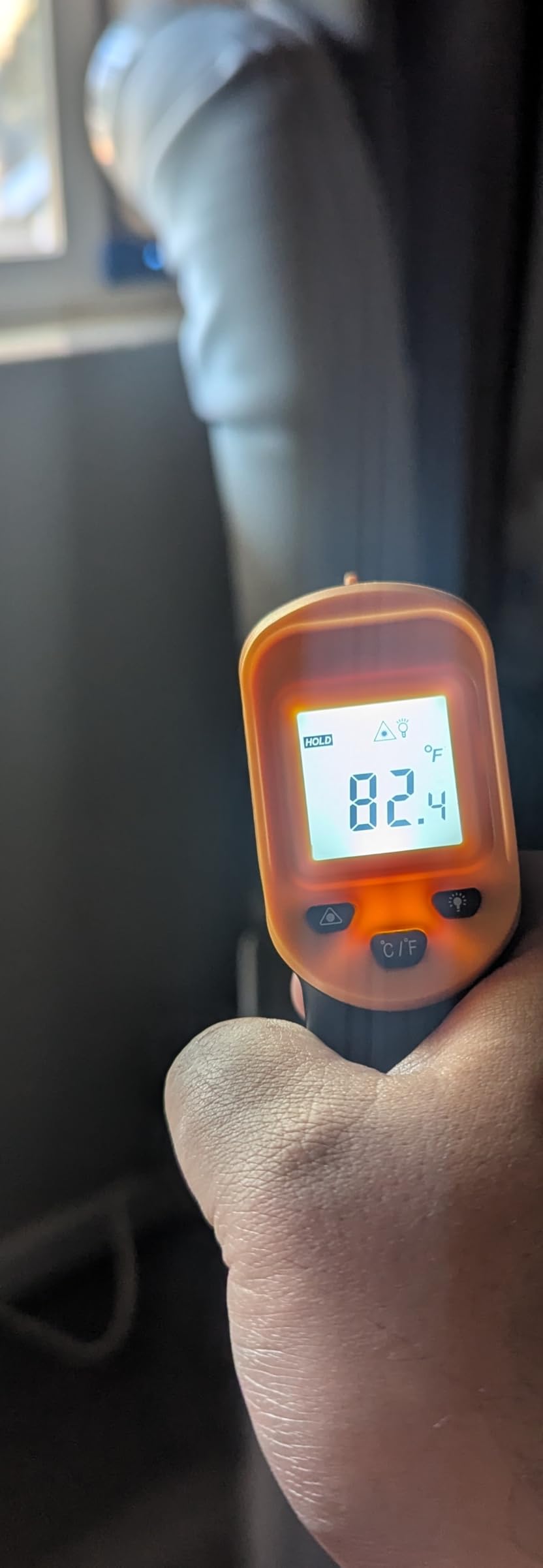
The preset 0.95 emissivity is the right default for most cooking surfaces. Food, cast iron with seasoning, painted metal and oxidized brick all sit close to that value, so for griddle and grill checks the numbers line up with what a probe thermometer reports.
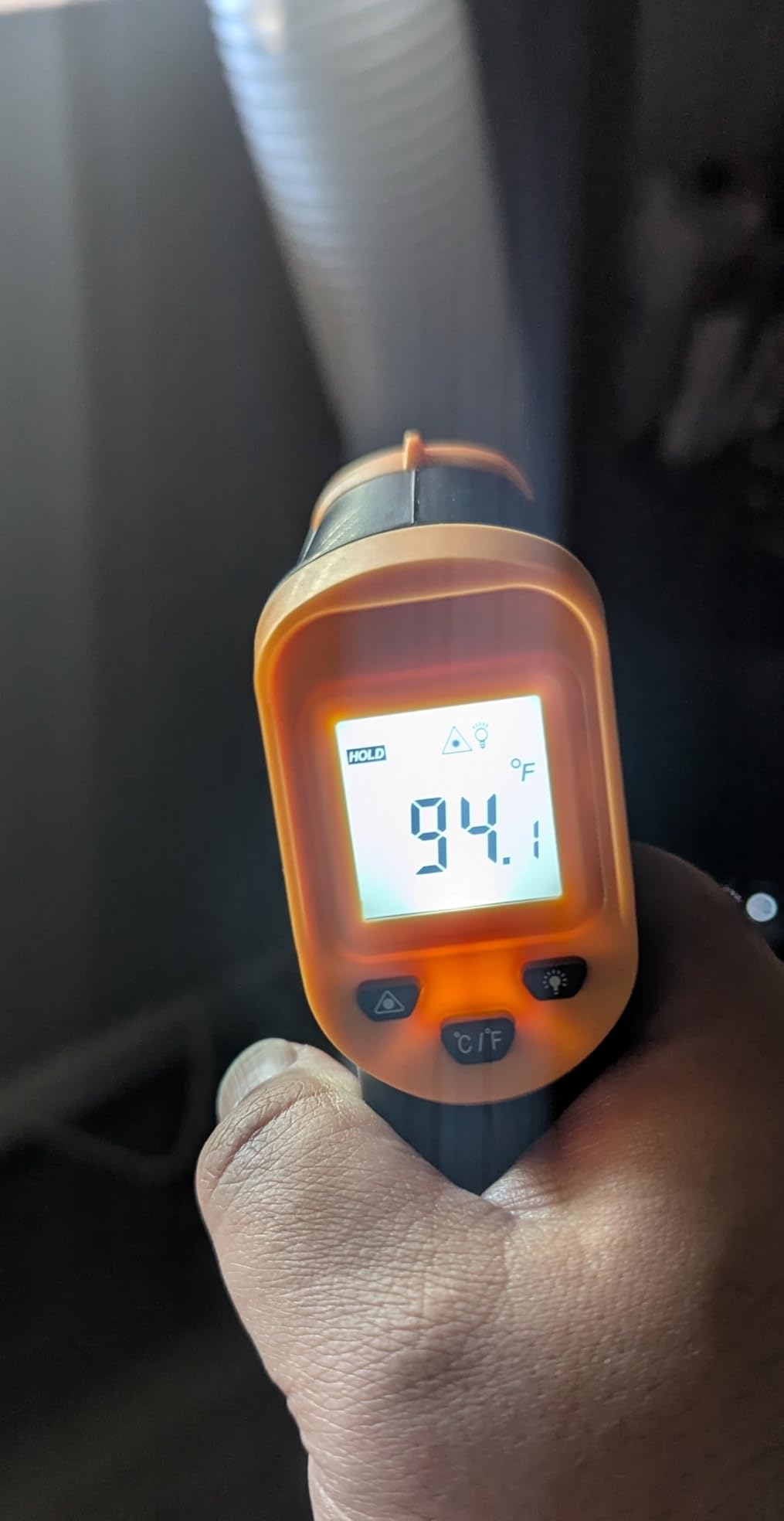
Buyers treat this as a budget gun for griddle, grill and pan surface checks rather than a precision instrument. The value argument is straightforward: you get a backlit screen, a hold function and a wide range without spending much, which is enough for spot checks and for confirming that a thermostat is doing roughly what it should.
It is also a 5.83-inch body running on two AAA batteries, so it is easy to keep in a toolbox and cheap enough to own twice. Having one in the kitchen and one in the garage is a reasonable way to stop migrating a single device between the two.
Because emissivity is fixed at 0.95, shiny or polished metal will read low, and the only fix is to put matte black tape or a roughened patch on the surface. That is fine for a pan edge you are testing once, and it is a bad workflow for a duct face you need to check every month.
Who the Soonkoda GM50 suits
Occasional griddle and grill cooks will be happy with it. If your routine is checking a burner or confirming a pan is preheated, the 0.95 preset already matches the surface and the backlit screen handles a dim kitchen. It also covers a reasonable low end at -58°F, which is useful for a freezer or a chilled ingredient surface.
It works as a secondary tool in a two-gun setup. Serious pizza owners who already own a high-temperature gun can keep one of these in a kitchen drawer for pan and fridge checks rather than hauling the specialist unit out for every task.
Where the Soonkoda GM50 falls short
The 932°F ceiling is the hard limit. A stone pizza oven at temperature exceeds it, and the reading will be unreliable at the top of that range, so it is the wrong tool for wood-fired baking or forging. The fixed emissivity is the second limitation, and together they define it as a general-purpose budget gun.
There is no max/min/average mode, no alarm and no calibration function, so it will not help you find a spread across a surface. It is also not intended for measuring human body temperature, and a consumer infrared forehead thermometer is the correct device for that job, as we cover in our forehead thermometer guide.
5. Wintact WT320 – Best for Griddle Cooking with a Built-In Calibration
Wintact Infrared Thermometer, Digital Surface Temperature Gun -58℉ to 1094℉
-58°F to 1094°F
±1.5% accuracy
Calibration function
Adjustable emissivity
Pros
- Checked against ice bath and boiling water by reviewers
- Adjustable emissivity plus a calibration function
- Backlit LCD with max/min and low battery alert
- 12-month warranty with replacement service
Cons
- Plastic casing feels light
- Laser pointer sits slightly off the spot
- 1-second response is slower than rivals
Best for: griddle owners who want to check accuracy themselves and adjust the gun when they find drift. The WT320 is the rare tool in this price range that lets you correct it in the field rather than living with whatever it reads.
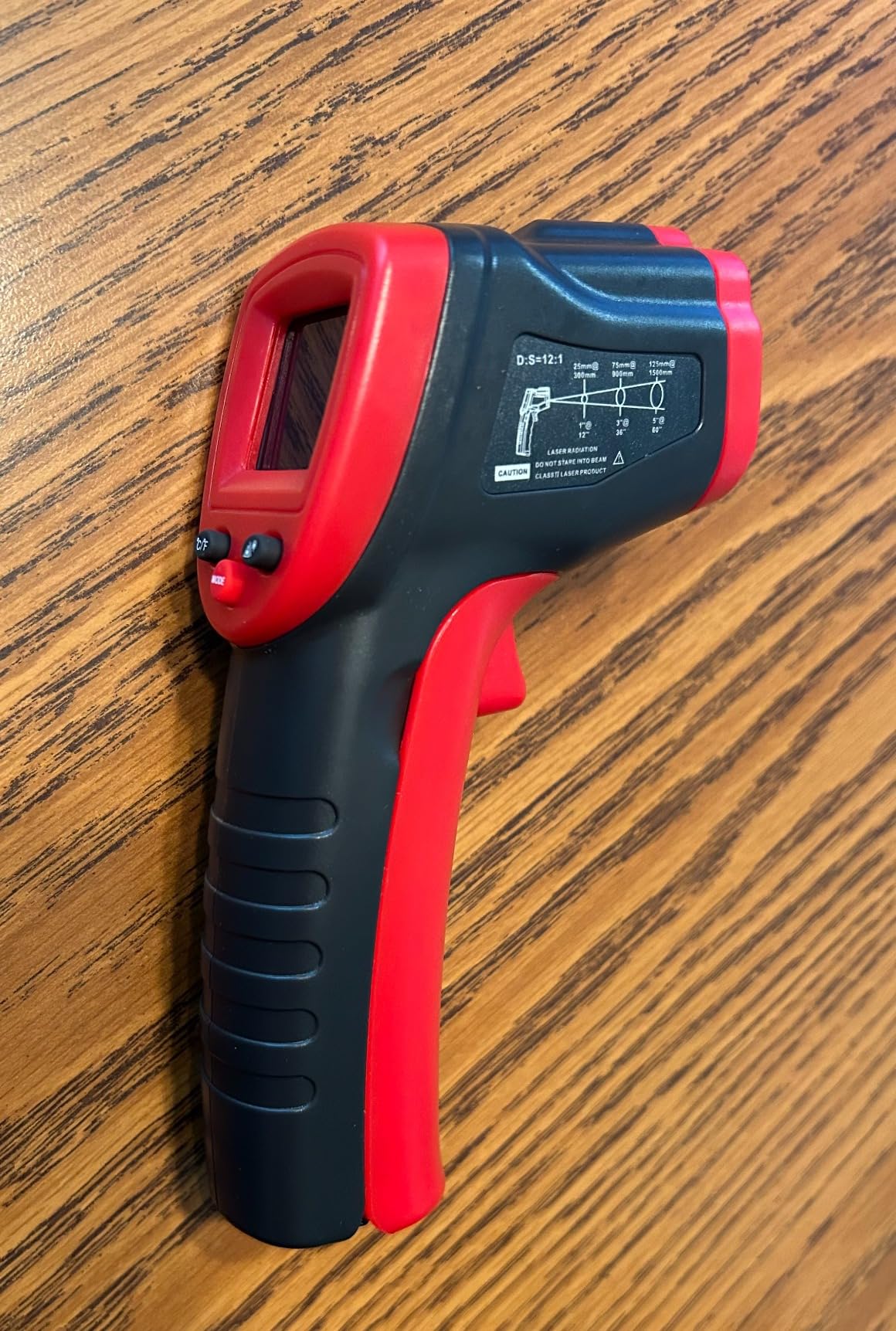
The range runs -58°F to 1094°F at a stated ±1.5% accuracy, which is around ±2.7°F at the low end of the scale. That is more than enough for griddle work and most smoker surfaces, and the 1094°F ceiling clears a hot pizza stone too.
Emissivity is adjustable from 0.10 to 1.00 with a 0.95 preset, and there is a built-in calibration function of plus or minus 5 degrees. Owners with instrumentation backgrounds report checking the gun against an ice bath at 32°F and boiling water at 212°F and finding readings within roughly 0.2 degrees, which is the strongest accuracy reporting we found in this roundup.
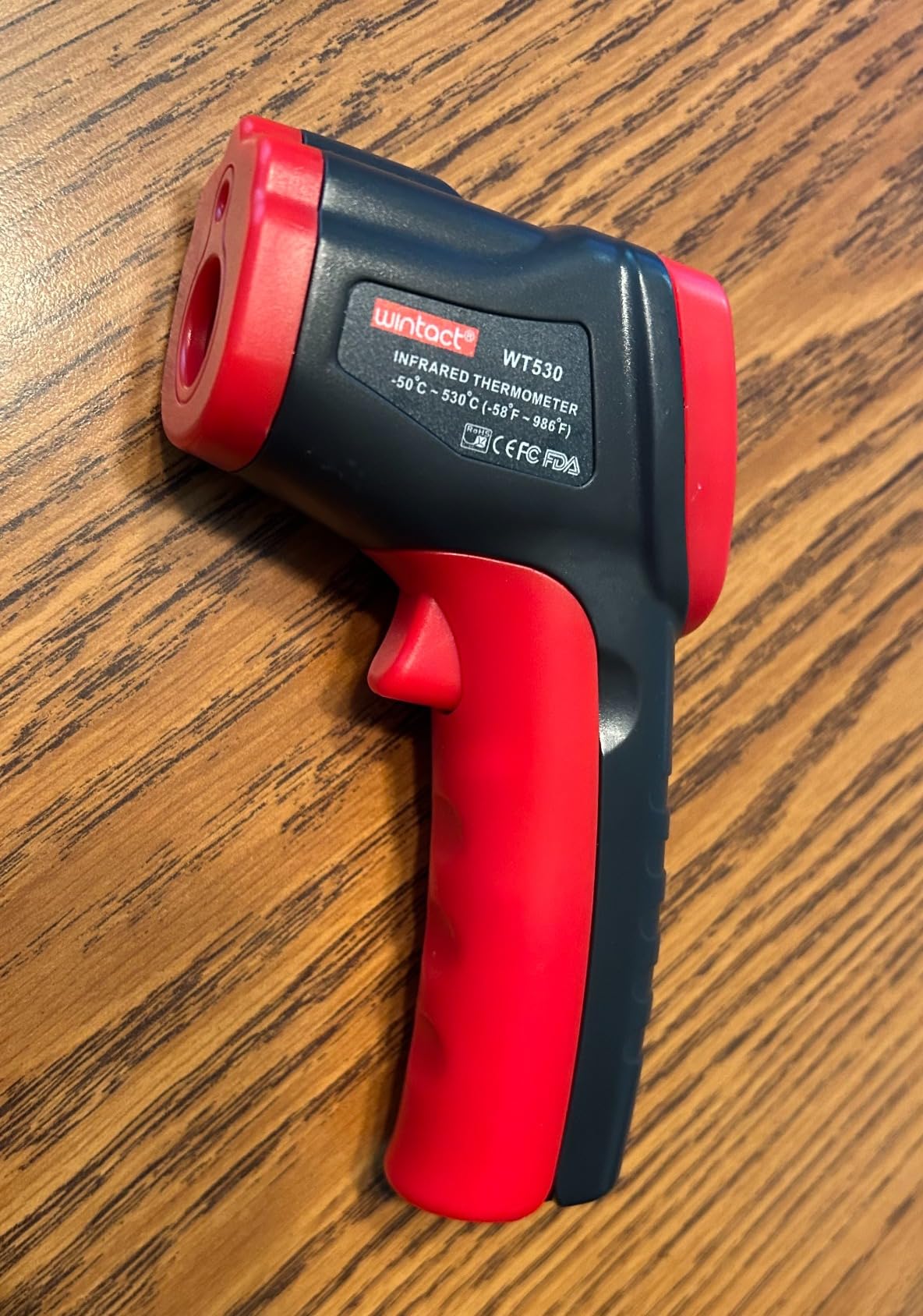
The feature list is generous for the category: backlit LCD, max/min display, Celsius and Fahrenheit switching, a low battery indicator and a 7-second auto-off. Cooking users report it working well on flat-top griddles, frying pans and pizza ovens, and the 12:1 distance-to-spot ratio is adequate for close-range work.
One practical note on the calibration function: use it to correct a known offset, not to make a reading look better. Check the gun against a reference you trust, calculate the difference, and enter that. A unit that reads 3 degrees high on an ice bath will read 3 degrees high everywhere, and correcting that offset at the low end is a reasonable approximation across the range.
Response time is listed at 1 second, which is slower than the half-second guns above it. You will notice it if you are sweeping quickly across a surface looking for hot spots, and you will not notice it at all if you are taking a steady reading on a griddle or a duct face.
Who the Wintact WT320 suits
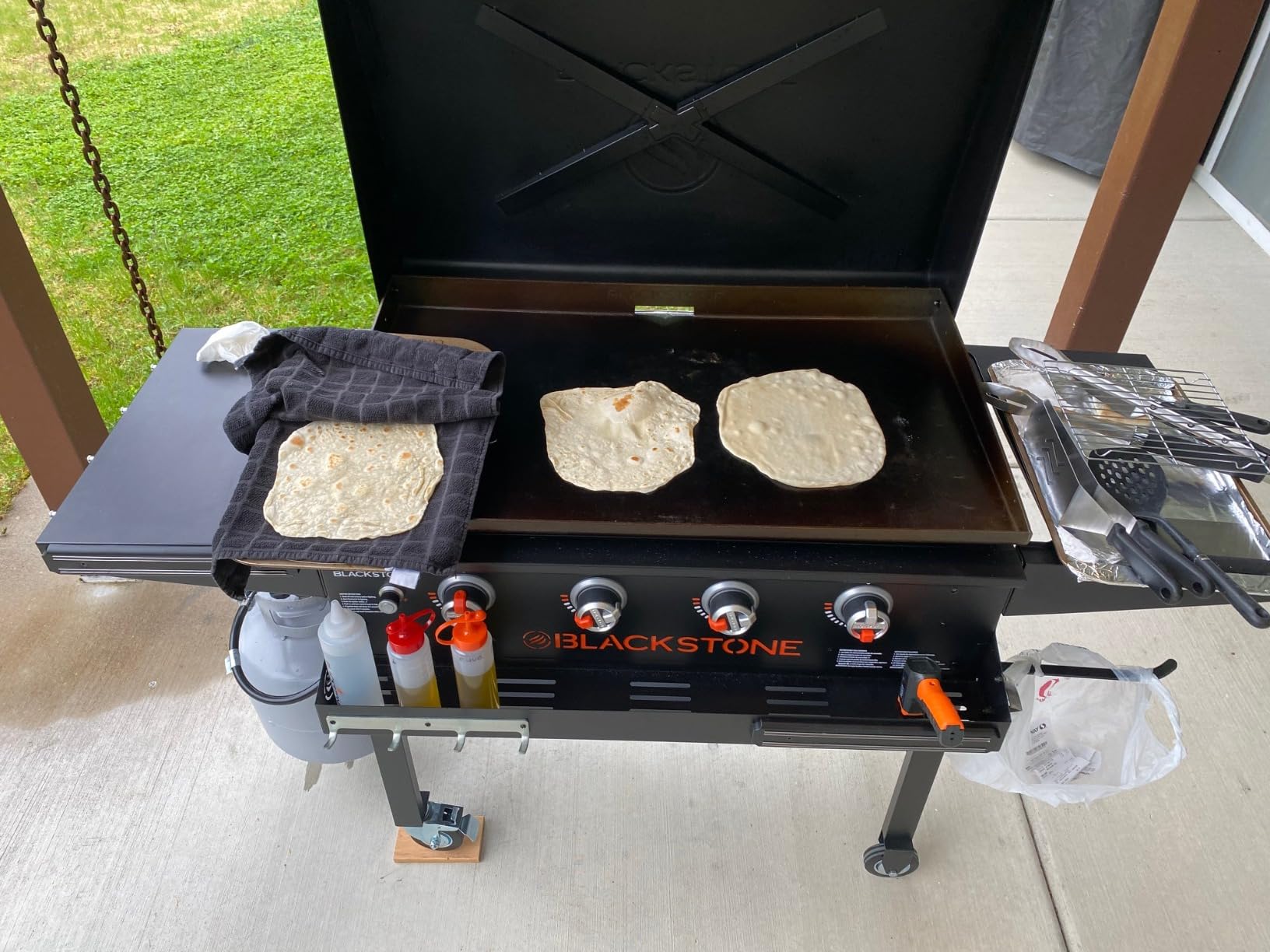
Flat-top griddle cooks are the natural match. The wide range handles a ripping hot cooking surface, the adjustable emissivity handles a stainless or cast iron top, and the calibration function means you can confirm the gun is still reading correctly after a year of use rather than assuming it.
It also works well for homeowners checking appliances and ductwork, since the max/min modes help you find a spread across a surface and the low battery indicator prevents a surprise shutdown during a long inspection. Deep-fry oil surface checks are another use cooking owners mention, though a separate probe thermometer is still the right tool for the food itself.
Where the Wintact WT320 falls short
The plastic shell feels light and, in the words of reviewers, a little flimsy compared with a rubberised professional tool. There is no stated drop rating, so it is not a belt-pouch instrument. The laser pointer also sits slightly off the actual measurement spot, which matters when you are trying to target a specific breaker or a small hot spot.
That offset is a good reminder of a habit worth building: aim by the cone, not the dot. Hold the gun at the distance the ratio implies and trust the circle the optics describe rather than the laser marker alone. The 1-second response and the 12-month warranty are the other two trade-offs against faster, better-supported rivals.
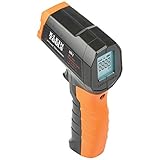
6. Klein Tools IR1 – Best for Electrical and HVAC Spot Checks
Klein Tools IR1 Infrared Thermometer with Targeting Laser, Auto-Hold, More
-4°F to 752°F
10:1 distance-to-spot
Fixed 0.95 emissivity
6.6 ft drop rated
Pros
- Rugged housing with 6.6 ft drop protection
- Backlit display for dark work areas
- Laser targeting and auto-hold
- Comes with a custom storage pouch
Cons
- Fixed 0.95 emissivity
- 752°F ceiling is low for very high heat
- 9V battery rather than AAA
- Celsius switching described as cumbersome
Best for: electricians, HVAC technicians and serious DIYers who need a tool that survives a tool belt. The IR1 is built for the jobsite in a way the kitchen guns are not.
Drop protection to 6.6 feet, a rubberised-feel housing and an included custom pouch are the details that matter here. The 100-gram body and 6.01-inch length make it easy to carry all day, and a single targeting laser with a 10:1 distance-to-spot ratio gives you a defined spot at a working distance from a panel or a return vent.
Response is 0.5 seconds and the display is backlit, which matters when you are working in a plenum or a dark mechanical room. Auto-hold means you can pull the trigger, point, and look at the number without trying to keep a finger down and read at the same time.
Electricians, HVAC techs and DIYers use the IR1 to verify vent output temperatures, diagnose cooling problems, check attic and appliance surface temperatures, and spot overheating components on circuit boards. Finding a failing motor or a capacitor that is running hot is a text-book non-contact job, and the backlit screen is what lets you do it in an unlit closet.
The 752°F ceiling is well matched to that work. HVAC supply air, refrigerant lines, motors, transformers and panel components all sit far below that, and in a mechanical environment the tool never approaches its limit. It is only in a wood-fired oven or a forge that the ceiling becomes the deciding factor.
Emissivity is fixed at 0.95, which is a reasonable default for painted metal, duct sheet and most electrical components. On bare or shiny metal you will need tape or paint, same as any fixed-emissivity gun. The 9V battery is included, though one reviewer reported receiving a depleted cell, so check it before a job rather than at the panel.
Who the Klein IR1 suits
Technicians who work on both heating and cooling equipment will find the range and optics appropriate. A 10:1 ratio at 12 inches gives you a spot about 1.2 inches across, which is small enough to isolate a single vent register or one breaker and large enough to read without fuss at a normal arm’s length.
The drop rating and pouch are what separate it from a kitchen gun. If the thermometer spends its life in a belt pouch next to screwdrivers and conduit, the build matters more than an extra feature on the menu. Electricians checking for hot spots on a panel or a motor start capacitor are exactly the user this tool is shaped for.
Where the Klein IR1 falls short
There is no adjustable emissivity, which rules it out for accurate work on polished metal. If your diagnostics involve bare sheet metal or shiny duct faces, the Klein IR5 further down adds a 0.1-1.0 adjustment range and a dual laser, and it is the better tool for that.
The 752°F ceiling also means this is not a cooking thermometer for high-heat work, and the 9V battery format is less convenient than the AAA cells used by the kitchen picks. Celsius and Fahrenheit switching is described as cumbersome, which is a small irritation for anyone reading a metric spec sheet.
7. KNINE OUTDOORS TG-2024-OG – Best for Garage, RV and Outdoor Checks
KNINE OUTDOORS Infrared Thermometer Gun, -58℉ to 1112℉
-58°F to 1112°F
12:1 distance-to-spot
Adjustable emissivity
Backlit LCD
Pros
- Light 7-inch body is easy to hold for long scans
- Adjustable emissivity across a wide range
- Continuous scan while holding the trigger
- Backlit eye-protect display for outdoor work
Cons
- No max/min/avg or alarm functions
- No built-in calibration function
- Surface readings only
Best for: a general-purpose outdoor gun used on RV and trailer tyres, appliance surfaces, reptile basking spots and garage equipment. The TG-2024-OG is light, quick and honest about what it does.
The headline numbers are good: -58°F to 1112°F, a 12:1 distance-to-spot ratio, adjustable emissivity from 0.1 to 1.0 and 0.1°C or 0.1°F resolution. That 1112°F ceiling is well above what most griddles and grills reach, and it makes this a credible tool for high-heat cooking surfaces as well as outdoor checks.
Adjustable emissivity is the feature that separates it from the cheapest guns. Being able to match the setting to a black tyre sidewall, a painted cabinet or a chrome bumper is the difference between a number you can act on and one you cannot.
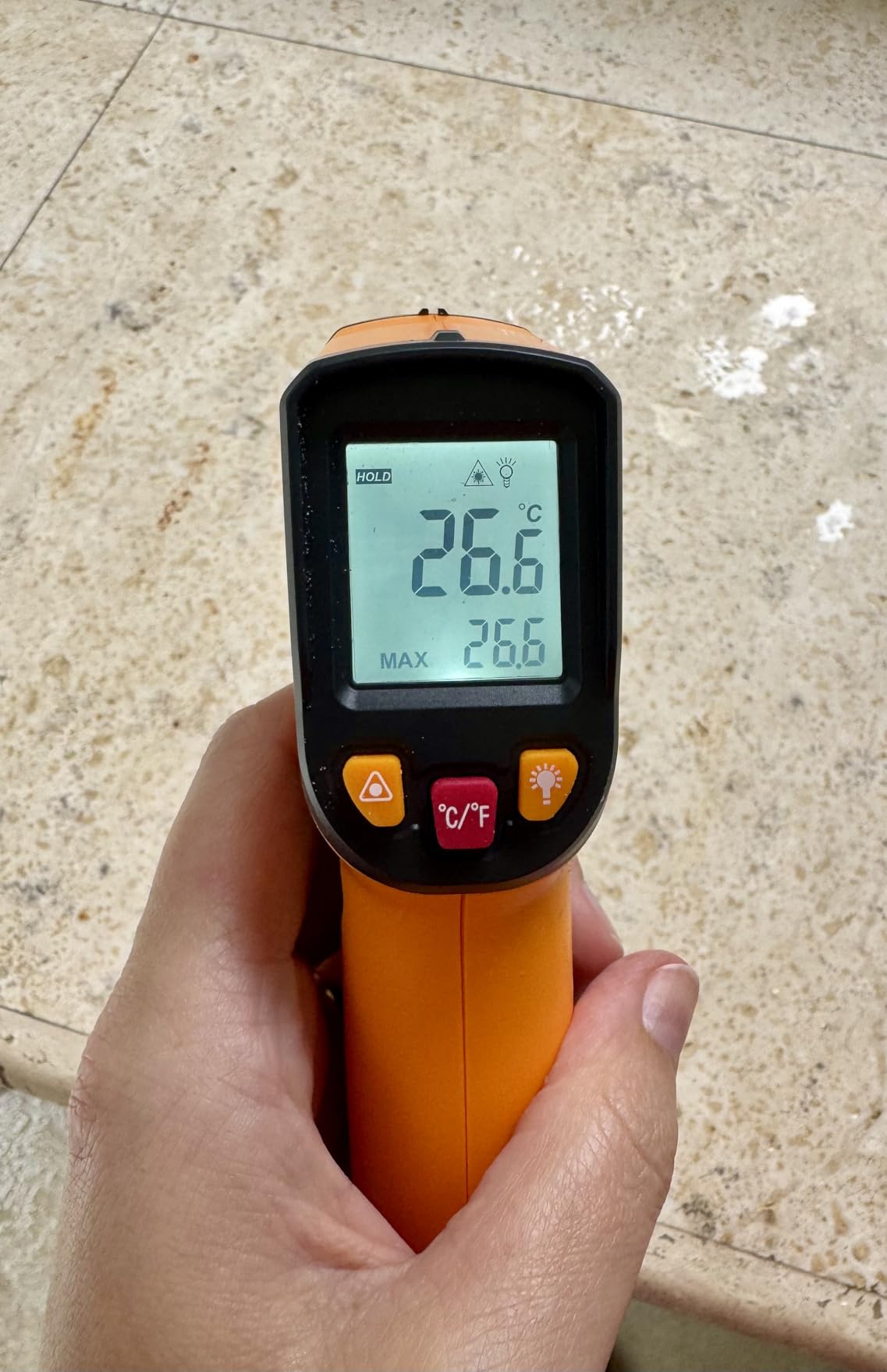
Owners use it across griddles and BBQ surfaces, HVAC vent temperatures, RV and trailer tyres, reptile basking spots and 3D printer beds. That range of uses is a fair summary of where a light handheld gun earns its keep, and the laser dot makes aiming on a griddle surface precise enough to compare left and right halves of a cooking zone.
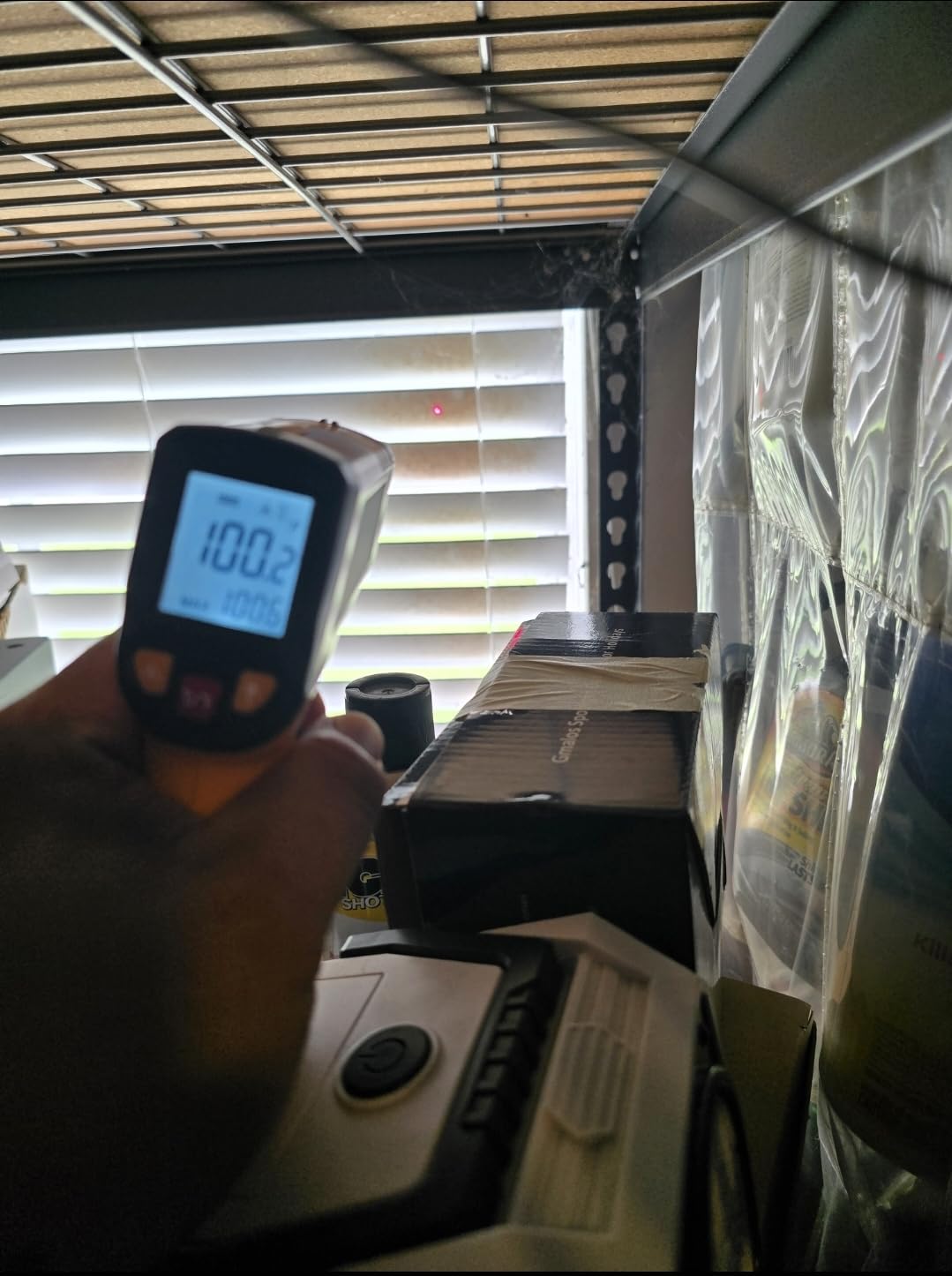
Holding the trigger gives a continuous live scan, which is the mode you want when you are sweeping an area rather than taking a single measurement. The backlit eye-protect LCD stays readable in a garage or an outdoor cooking area, and the small, light body means you can hold your arm up for a long scan without fatigue skewing your aim.
What it does not have is statistics. There is no max/min/average, no alarm and no calibration function, so if your workflow depends on finding the spread across a surface you will need a different gun. For a single spot check, a hot spot hunt by eye, or a quick look at a vent, none of that is necessary.
Who the KNINE TG-2024-OG suits
Outdoor and vehicle users get the most from it. Checking tyre sidewalls, an engine bay, a trailer wall or a garage appliance is exactly the kind of task where a light, quick gun with adjustable emissivity makes sense, and the wide temperature range handles both cold outdoor surfaces and hot mechanical ones.
It also works as a general household tool. Reptile basking spots, a 3D printer bed, a pizza stone and an air register are all readable with it, and the 7-inch body with a backlit screen is easy to use one-handed while the other hand holds a flashlight or a panel cover.
Where the KNINE TG-2024-OG falls short
No calibration function means you cannot correct drift in the field, and no alarm or statistics mode means it is a poor fit for a systematic HVAC survey. Technicians who need a documented protocol and a repeatable record should use the Fluke 62 Max instead.
There is also no stated impact or water resistance rating, so it belongs on a workbench and in a garage rather than on a roof or in a crawlspace. And like every gun here, it measures surfaces only. For anything involving a person, a dedicated device is the correct choice, and our baby thermometer roundup covers the safest options for infants.
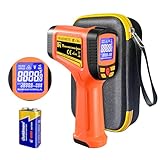
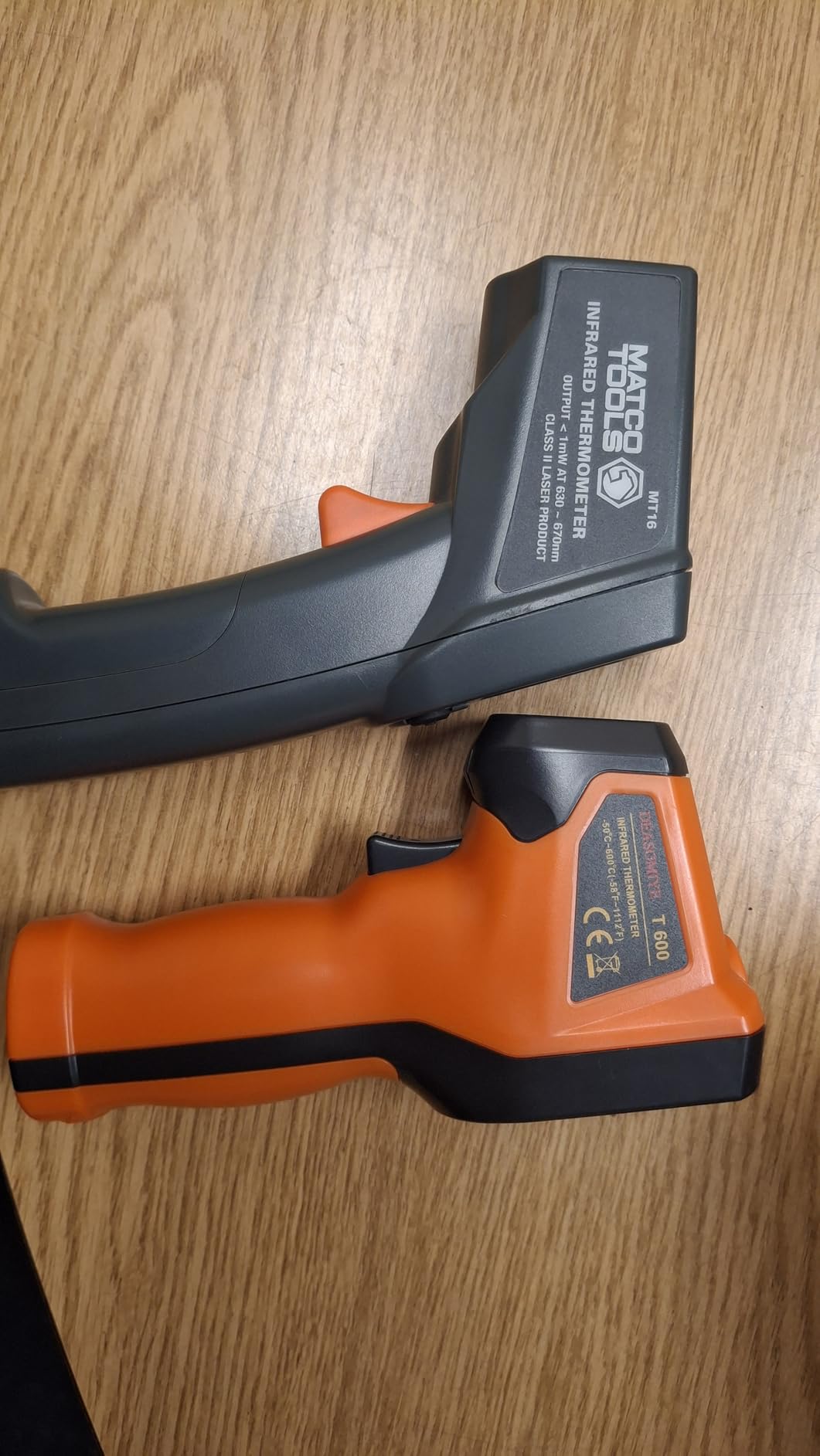
8. DEASOMIYE JD-04 – Best for Forge, Kiln and Long-Distance Work
-58°F to 2732°F Digital Infrared Thermometer Gun, 50:1 Distance Ratio Laser Temperature Gun with MAX/MIN/AVG Measure and Alarm, Heat IR Temp Gun for Cooking, Griddle, HVAC, Industrial Forging
-58°F to 2732°F
50:1 distance-to-spot
Dual laser pointers
High and low alarms
Pros
- 2732°F ceiling covers forging
- kilns and furnaces
- 50:1 ratio lets you stand well back from hot work
- Dual lasers plus high and low alarms
- MAX/MIN/AVG shown in real time
Cons
- Surface readings only
- 9V battery rather than AAA
- Heat radiation skews readings near molten metal
Best for: anyone who needs to read very hot surfaces from a distance. The JD-04 is the only gun in this roundup that covers forging and kiln temperatures and gives you the optics to stay out of the radiant heat.
The range runs -58°F to 2732°F, which covers furnaces, kilns, pizza ovens and forge work. The 50:1 distance-to-spot ratio is the other half of the value: at 12 inches the spot is already several inches wide, which lets you read a glowing workpiece or a kiln shelf without leaning into the radiant heat.
Two laser pointers show the edges of the measurement area rather than a single dot, so you can see the footprint you are actually averaging. High and low alarms give audible feedback when a reading crosses a threshold, and the MAX/MIN/AVG display updates in real time during a scan.
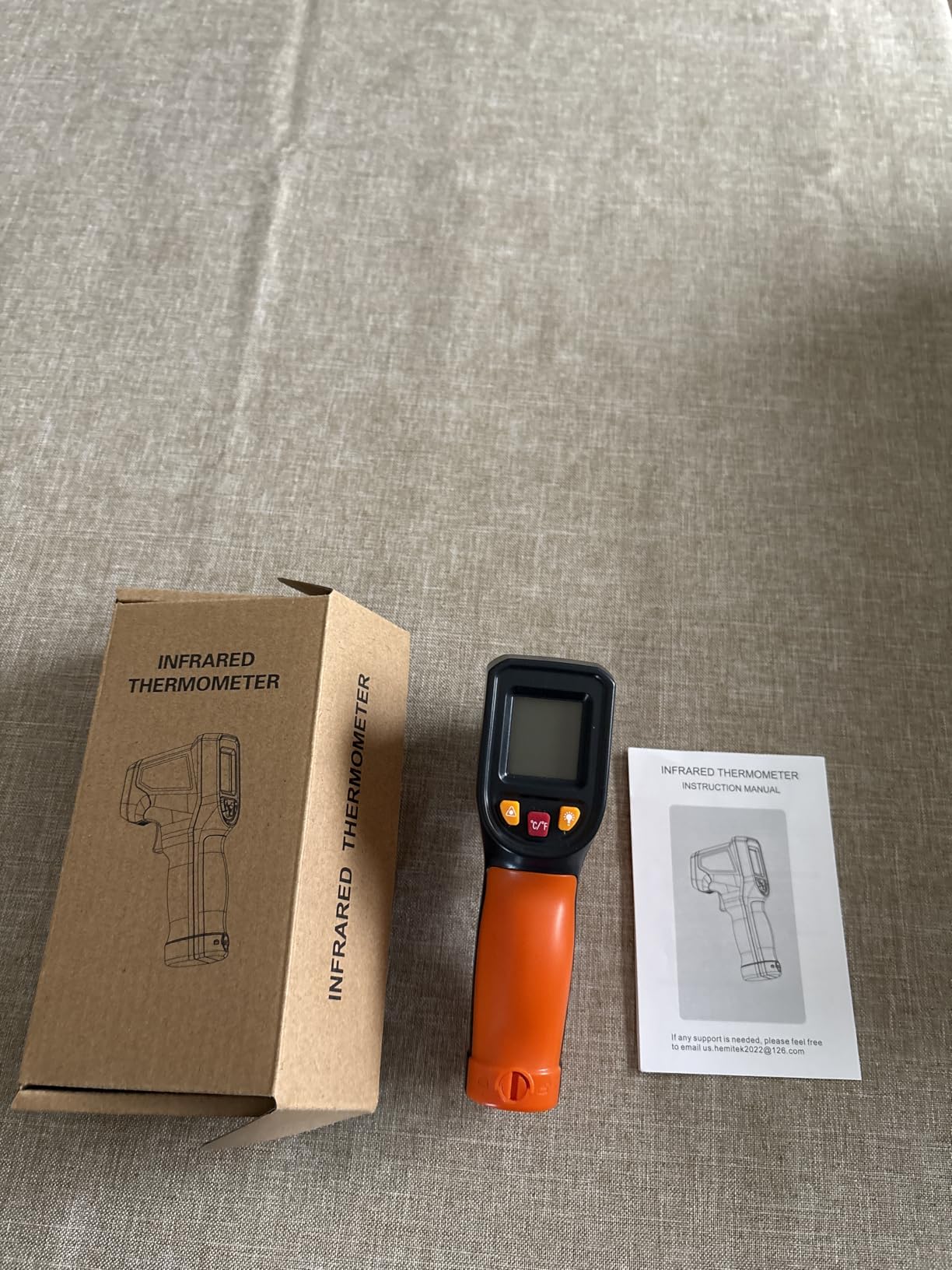
This is a specialist tool for people with a real heat source rather than a kitchen range. A 2732°F ceiling and a 50:1 ratio cover a wood-fired oven, a blacksmith forge, a pottery kiln or a furnace, and the included toolbox and manual make it easy to keep organised between uses.
Response is 0.5 seconds and the backlit LCD shuts off after 15 seconds, with a low battery indicator so you are not surprised mid-work. The 6.3-inch body runs on a single included 9V battery.
One caution is worth stating plainly. Infrared readings near an open flame or molten metal are affected by the radiant heat in the air, not only the surface, so the number can read high or low depending on how much of the cone is filled by the source. For a forge or a kiln shelf this is not a problem, but do not treat it as a reading of molten material itself.
Who the DEASOMIYE JD-04 suits
Hobby and professional forge workers, kiln operators and anyone running a wood-fired oven that regularly exceeds 1000°F are the core users. The 50:1 ratio is what makes it safe and practical to use, because you can hold a metre or more back from a hot chamber and still get a usable spot size.
It is also the only pick here with audible alarms, which is genuinely useful when you are watching a furnace through a small window or working with gloves on and cannot stare at the display. MAX/MIN/AVG in real time lets you log a heat cycle without writing anything down until the end.
Where the DEASOMIYE JD-04 falls short
It is not a cooking thermometer in the way the Kizen or the TempPro is, and it carries no stated accuracy figure. Its average rating also sits a notch below the leaders in this roundup, which usually reflects build consistency rather than a dramatic accuracy problem.
For ordinary HVAC and griddle work it is overkill, and the 9V battery is less convenient than AAA cells. The unit also measures surface temperature only and is not for human use. Anyone reading a home kitchen who wants a simpler, lighter tool should look at the first five picks instead.
9. Fluke 62 Max – Best for HVAC Diagnostics and Repeatable Accuracy
Fluke 62 Max Industrial Infrared Thermometer, -22 to +932 Degree F Range, Single Laser Targeting, 10:1 Distance to Spot Ratio, IP54 Rating, Includes 3 Year Warranty, (Not for Human Temp)
-22°F to 932°F
±1.5°C or ±1.5%
IP54 rated
3m drop rated
3-year warranty
Pros
- Repeatable readings that match calibrated reference instruments
- Min
- max
- difference and average display
- IP54 and 3 meter drop rated
- 10 hour AA battery life
Cons
- Menu and settings are poorly documented
- 932°F ceiling is low for pizza oven work
- Emissivity must be set correctly on shiny metal
Best for: technicians who need a reading they can defend on a commissioning document. The Fluke 62 Max carries the highest average rating in this roundup and the build to match, and it is the tool we would buy for repeat HVAC measurements rather than one-off checks.
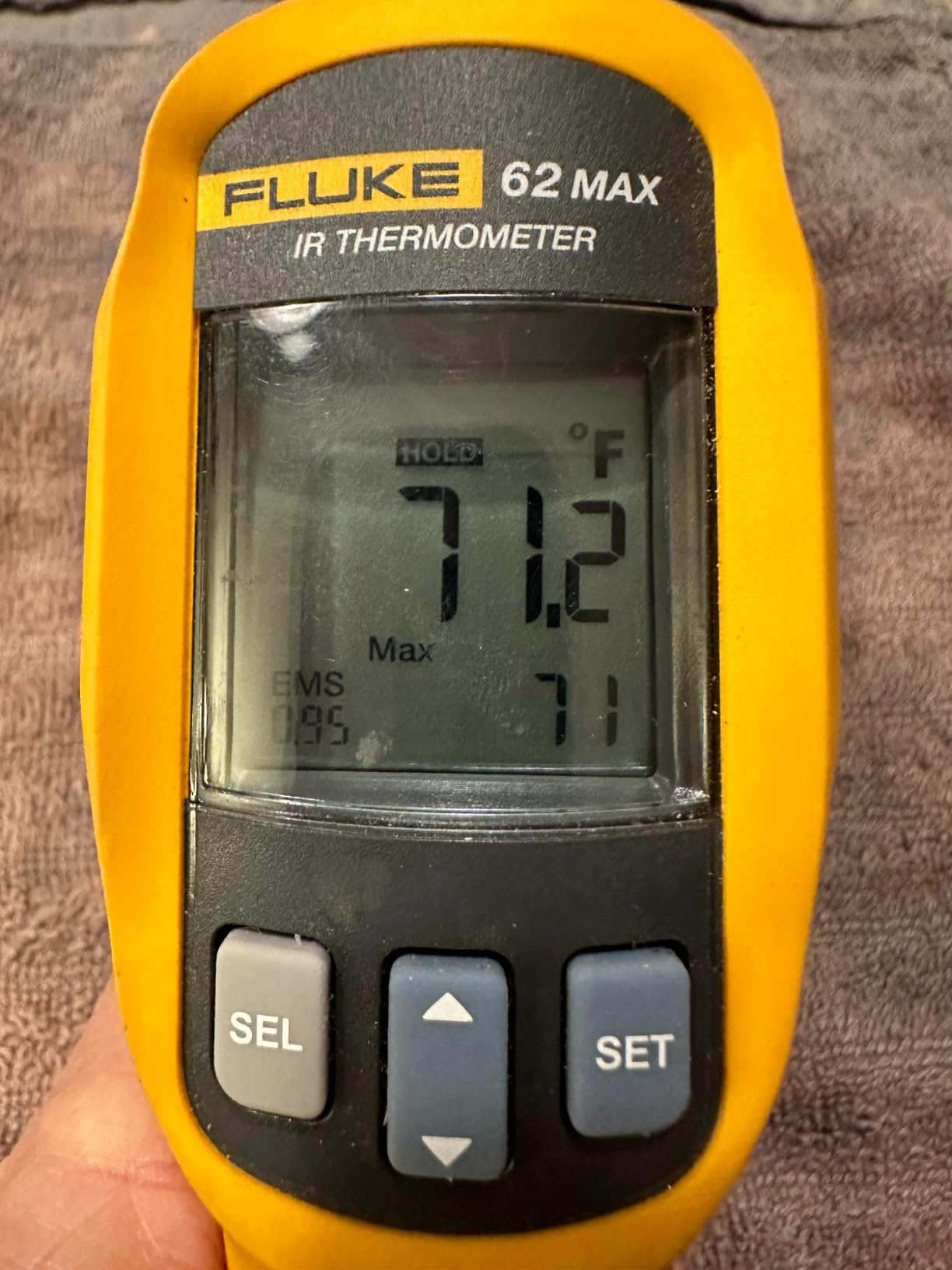
Accuracy is specified at ±1.5°C or ±1.5% of reading across a -22°F to 932°F range, with a 500-millisecond response. Reviewers consistently report readings that agree with calibrated reference instruments, which is the property that actually matters when you are comparing a supply vent against a return and drawing a conclusion from the difference.
The display shows minimum, maximum, difference and average, and the difference mode in particular is useful on a duct run. Scan a span of duct, then scan it again after a change, and the difference readout tells you whether your work moved anything without you having to remember the earlier number.
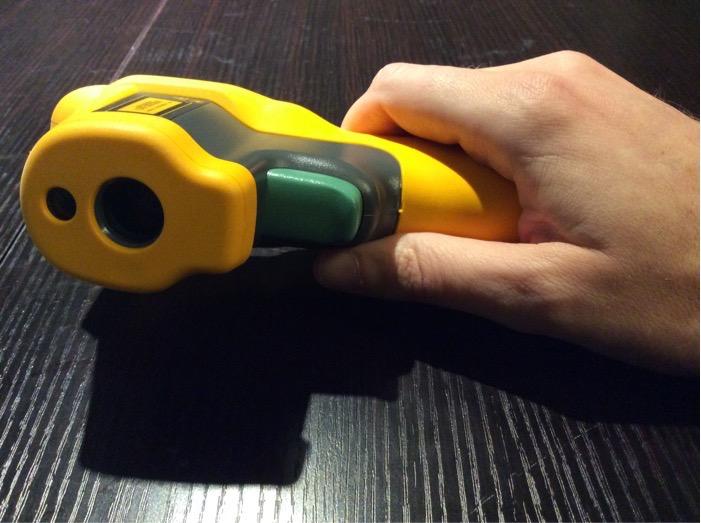
Durability is the other argument. The housing carries IP54 dust and splash protection and is drop rated to 3 meters, and the outer material is stainless steel rather than ABS plastic. At 0.26 kilograms and 6.8 inches it is still small enough to clip to a tool belt, and a single AA battery gives about 10 hours of use.
Electricians, HVAC technicians and engineers use it for commissioning, bearing and motor monitoring, 3D printer bed temperatures, and finding heat or cold spots around a home. The 10:1 ratio is modest compared with the 50:1 gun above, and that is the correct trade-off for a tool where you are working a few inches from the target.
The most common criticism we found is documentation, not performance. The manual does not explain the settings and menu adjustments clearly, so budget ten minutes with the device before a commissioning visit rather than during one. Emissivity also still has to be set correctly on shiny metal, exactly as with every gun in this list.
Who the Fluke 62 Max suits
HVAC technicians running system diagnostics will use the difference and average modes constantly. Comparing supply and return air, scanning a duct run for a blockage, checking an air handler coil for a freeze pattern, and verifying a motor that is running hot are all measurements where a repeatable number changes the conclusion.
Industrial and electrical users get the IP54 and 3-meter drop rating, which no kitchen gun in this roundup offers to the same standard. The 3-year warranty is also the longest here, and a unit that will be on a service truck for years is worth pairing with a longer support period than one year.
Where the Fluke 62 Max falls short
The 932°F ceiling is the main limitation. It is well short of what a wood-fired pizza stone or a forge reaches, so cooks who need high-temperature readings still need a second gun. The 10:1 ratio also means you must get reasonably close, which is fine in a mechanical room and less comfortable in front of a 900°F oven mouth.
It is also the most expensive tool here, which changes the calculation for a casual buyer. If you cook a few times a month and never open a service panel, the Etekcity or the Kizen will serve you well. The Fluke earns its place when a measurement has to be repeatable and documented.
10. Temirup IR02C-OR – Best 2-in-1 with a K-Type Probe and Humidity Sensor
Infrared Thermometer Gun, Non Contact Digital Laser Thermometer Temperature Gun with Color LCD for Cooking, Home Repairs, Humidity Measurement, Adjustable Emissivity -58°F to 1472°F(-50~800°C)
-58°F to 1472°F
Includes K-type probe
±1.5% accuracy
Humidity and dew point
Pros
- Combines non-contact laser readings with a contact K-probe
- HTU20 sensor adds ambient temperature
- humidity and dew point
- Colour backlit VA display
- Two alarm modes including a spoilage alarm
Cons
- Laser aim sits away from where you expect it
- Some colour variants have a lower range
- Surface readings are not for humans or animals
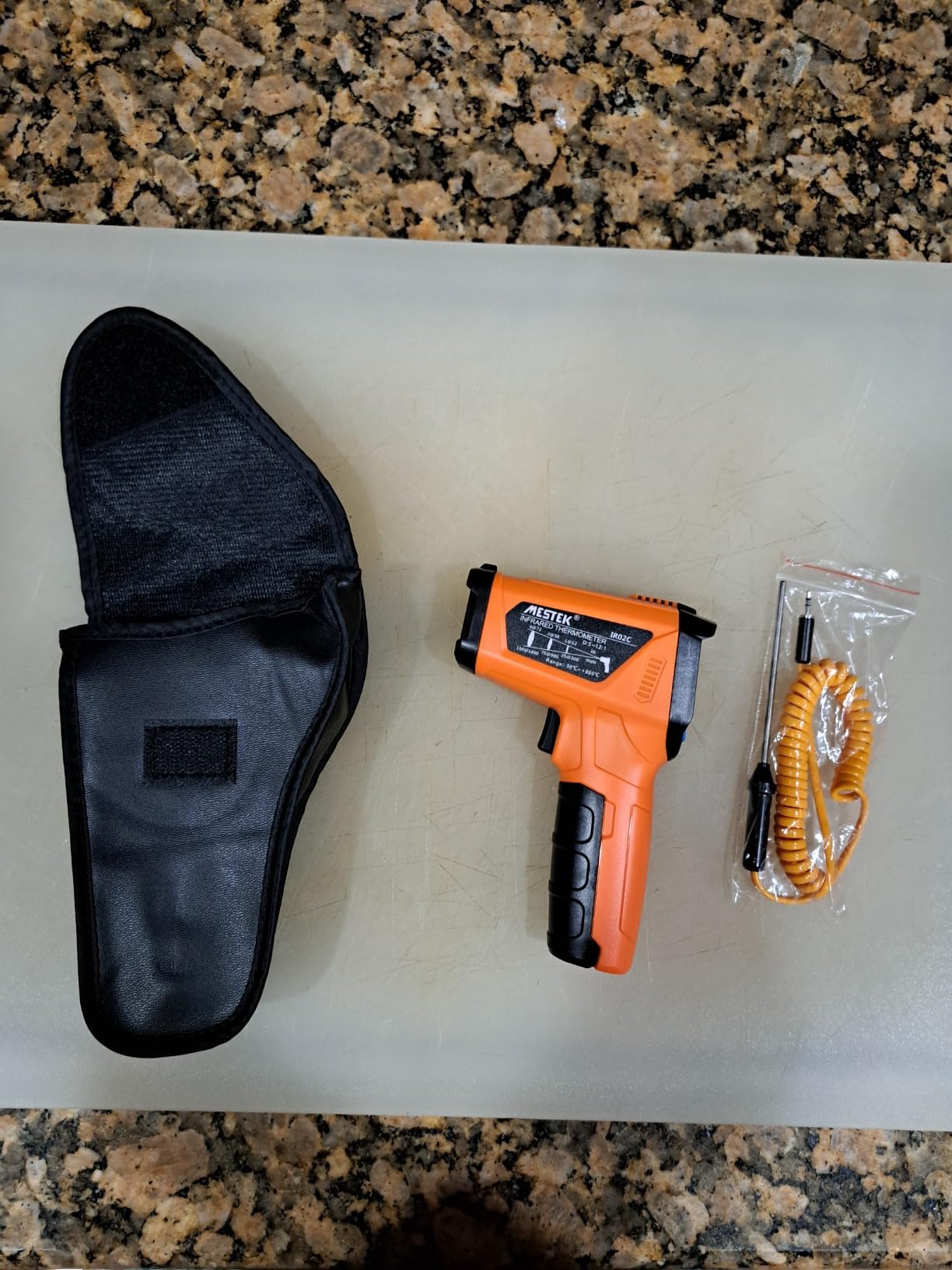
Best for: buyers who want one device to do both jobs. The IR02C-OR combines non-contact surface readings with a K-type contact probe, which solves the single most common complaint in this category: a surface gun that cannot tell you whether the food is actually done.
The range runs -58°F to 1472°F at a stated ±1.5% accuracy with a 12:1 distance-to-spot ratio and a 0.5 second response. The included K-type thermocouple handles internal temperature, so you can scan a griddle surface, then push the probe into a chicken breast without switching devices.
What genuinely surprised us is the environmental sensor. The HTU20 module reports ambient temperature, humidity and dew point alongside the surface reading, and that combination has real HVAC value. A supply-air reading paired with the humidity and dew point around the coil tells you a lot more about a condensation problem than a surface number alone.
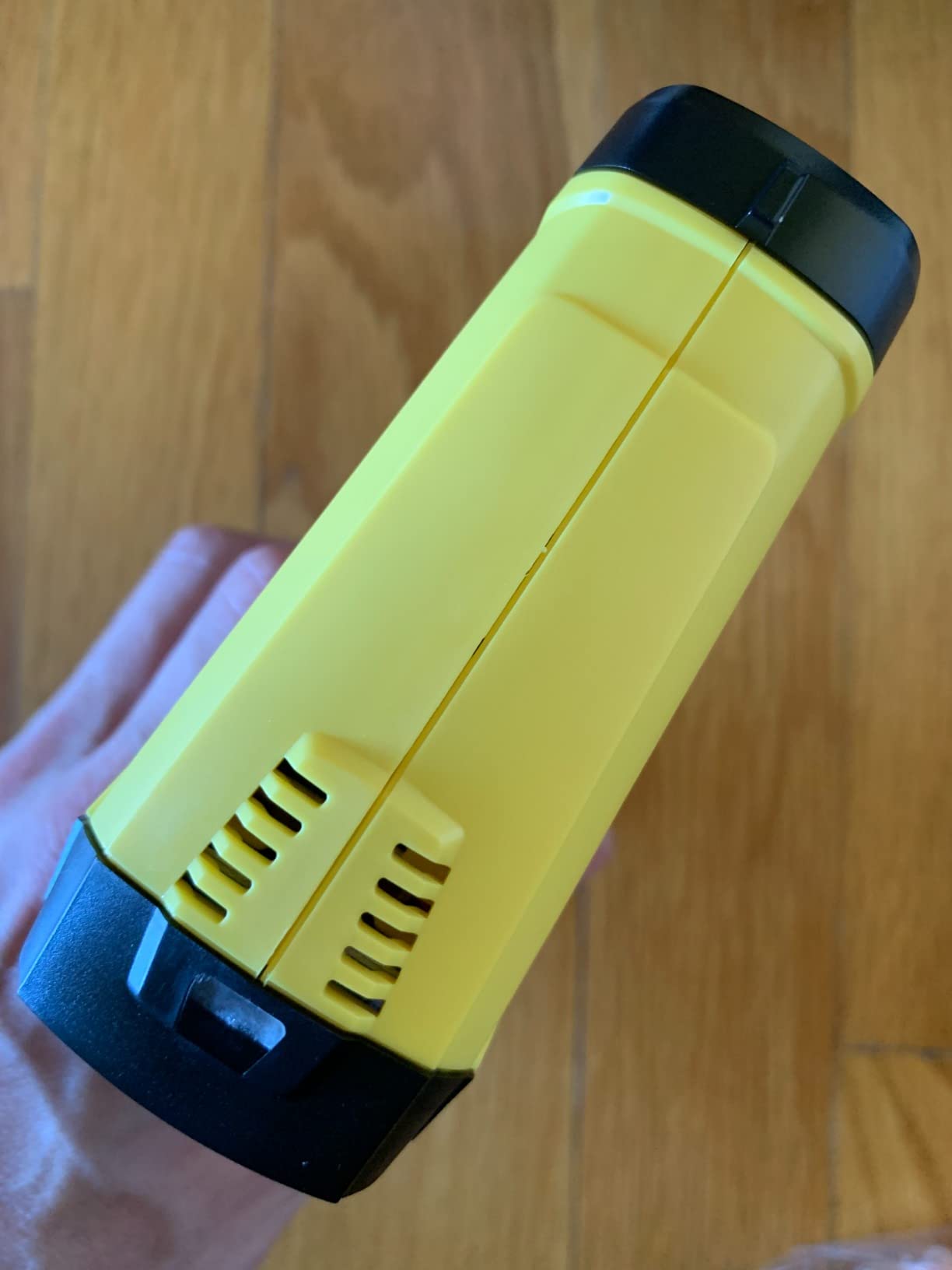
The display is a full-colour backlit VA screen rather than a monochrome LCD, and there are 13 laser points giving guidance across the aim area alongside adjustable emissivity from 0.1 to 1.0. Two alarm modes are included, one for spoilage and one for temperature difference, and MAX/HOLD with a 25-second auto-off and a low battery indicator round out the display functions.
The accessory bundle is generous for the money: the K-type thermocouple, a screwdriver for the battery door, a carry bag, batteries and a manual. Reviewers frequently compare the accuracy favourably against a Fluke, and there is a 2-year manufacturer warranty with a 24-month replacement service.
Two practical warnings. The laser aim is not where users intuitively expect it, so it takes practice to point accurately, and some colour variants of this model have a lower maximum range than the 1472°F headline figure. Check the range on the unit you actually receive before relying on it for high-temperature work.
Who the Temirup IR02C-OR suits
Cooks who want one device for surface and internal temperature get the most obvious benefit. Griddle work, smoker checks and roast cooking all involve both questions, and carrying a single tool with a fold-out probe is simpler than carrying two devices and remembering which one you are holding.
HVAC and home inspection users get a different kind of value from the environmental readings. Humidity and dew point around an evaporator coil or a supply vent help you understand condensation and comfort problems, and a 25-second auto-off makes it practical to leave on a ladder while you take several readings in a row.
Where the Temirup IR02C-OR falls short
The 12:1 ratio is average, so it is not the right tool for reading a distant kiln or a long duct run from the floor. The colour screen is also a power draw, and the 8-hour battery life is shorter than the multi-day convenience of an AA-powered tool like the Fluke.
It remains a surface instrument for the non-contact side, so it should not be pointed at people or animals, and the probe is a general-purpose thermocouple rather than a food-grade certified one. For a dedicated high-heat reading, the DEASOMIYE or the Ooni covers more ground.
11. Klein Tools IR5 – Best for Visualising a Whole Surface
Klein Tools IR5 Dual Laser 12:1 Infrared Thermometer, Digital Thermometer Gun with Backlit Display, Dual Laser Targeting and Auto Scan, Wide Temperature Range
-22°F to 752°F
Dual laser 12:1 targeting
Max, min, avg, diff modes
6.6 ft drop rated
Pros
- Dual lasers show the exact circle being measured
- Max
- min
- avg and diff give real analysis
- Adjustable emissivity 0.1-1.0
- Solid build with 6.6 ft drop protection
Cons
- Laser circles spread wider than the spot at 12 inches
- Reads a few degrees off against a Fluke 62752°F ceiling
- 9V battery drains fast
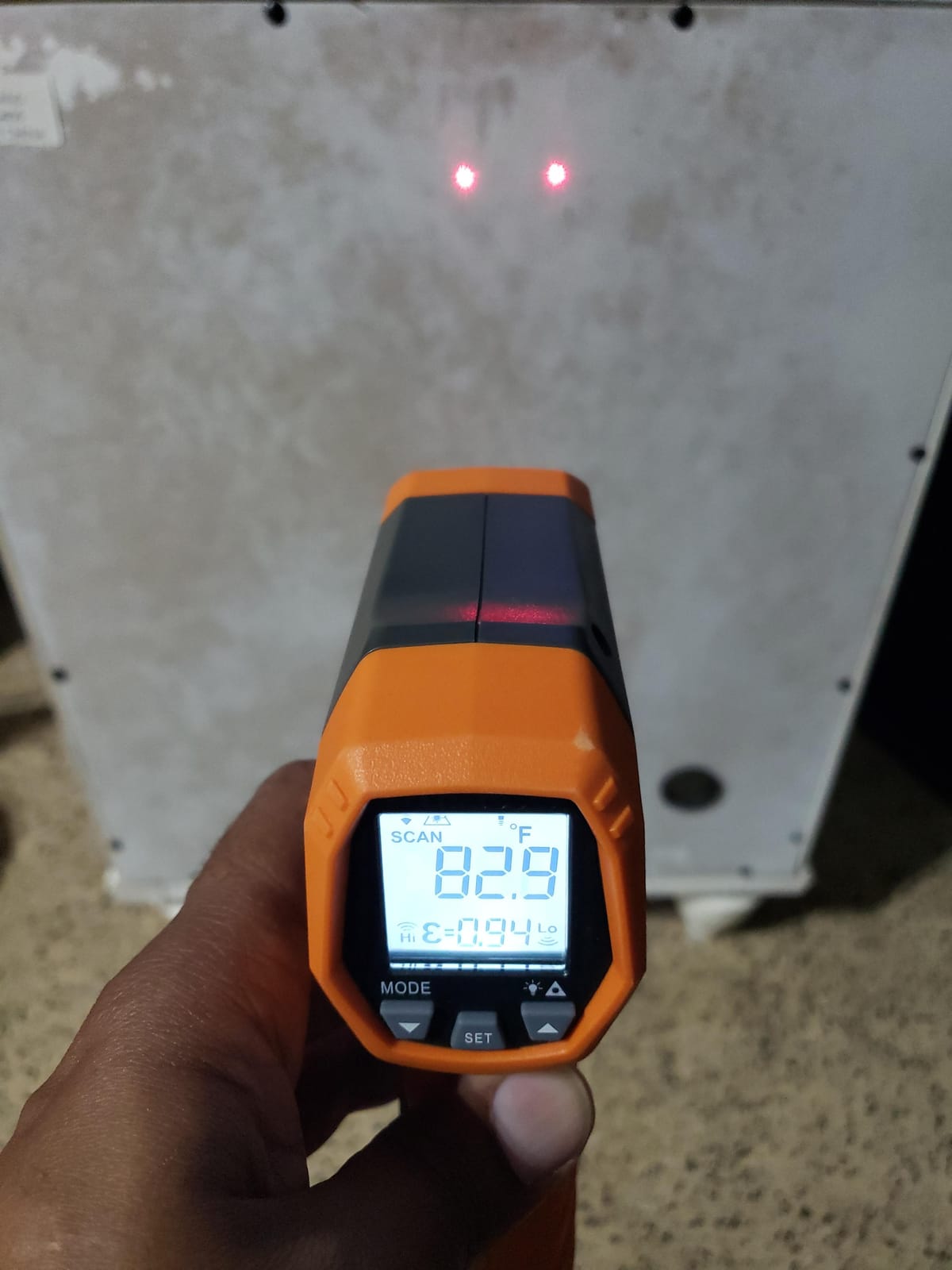
Best for: anyone who needs to average an area rather than point at a spot. The dual lasers on the IR5 draw the circle the gun is actually measuring, which is the most useful thing on this whole list for griddle and cooking-surface work.
With a single dot you are guessing where the measurement area sits. With two lasers bracketing the spot you can see it, place it deliberately, and take a reading that means what you think it means. On a griddle you can set the circle over a 4-inch zone and get the average temperature of that zone, which is a completely different measurement from a single point on the steel.
It also carries more analysis than any other gun in this price range: max, min, average and difference, plus high and low alarms. Emissivity is adjustable from 0.1 to 1.0, and the stainless steel body has 6.6-foot drop protection with a custom pouch included.
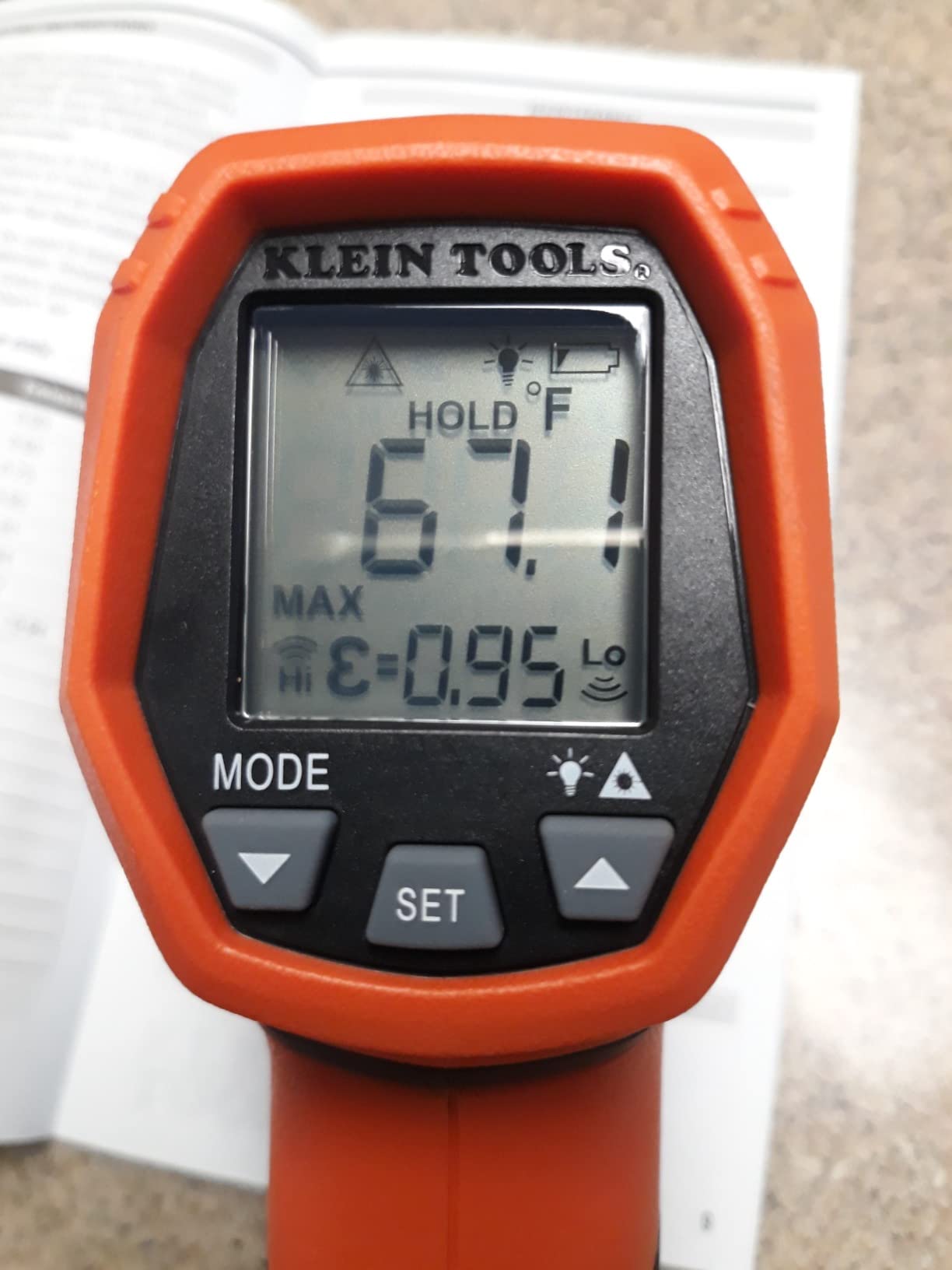
The range is -22°F to 752°F with a 12:1 ratio and a 1-second response, which covers griddle, grill and general HVAC work comfortably. Reviewers note it is made in the USA, and enthusiasts of the brand rate the build quality highly, describing it as solid and heavy in the hand.
There is a specific quirk to know about. At 12 inches the two lasers spread wider than the one-inch spot the optics actually measure, which is a deliberate design choice so you can see the area, but it means the visible circle is larger than the true measurement area. Aim slightly tighter than the laser ring suggests if you want the spot to match your intent.
Accuracy is listed a few degrees off against a reference instrument such as the Fluke 62, which matters if you are comparing two guns. For relative work, sweeping a surface and finding the spread, that is not a meaningful problem. The 9V battery drains quickly, there is no manual on/off switch, and one buyer received a dead battery in the box.
Who the Klein IR5 suits
Griddle and griddle-adjacent cooks are the biggest beneficiaries of the dual laser. The difference and average modes let you quantify a hot spot rather than just seeing one, which is how you find an uneven burner or a damaged heating element on a flat-top.
HVAC professionals like it for the same reason, pairing the visible spot with the statistics modes on a supply or return vent. The adjustable emissivity also makes it usable on metal duct faces where a fixed-emissivity gun would need a tape patch first, and the drop protection suits a working tool.
Where the Klein IR5 falls short
The 752°F ceiling rules it out for high-temperature cooking and forging, and the 1-second response is slower than the half-second guns in the value tier. On pure accuracy, reviewers report it reading a few degrees off a Fluke 62, which is expected at this level but worth knowing if you are chasing a tight tolerance.
It also sits close to the Fluke in cost while being less accurate, and the pouch lining is reported as thin. If your priority is documented accuracy rather than spot visualisation and alarms, the Fluke 62 Max is the better buy with a longer warranty to match.
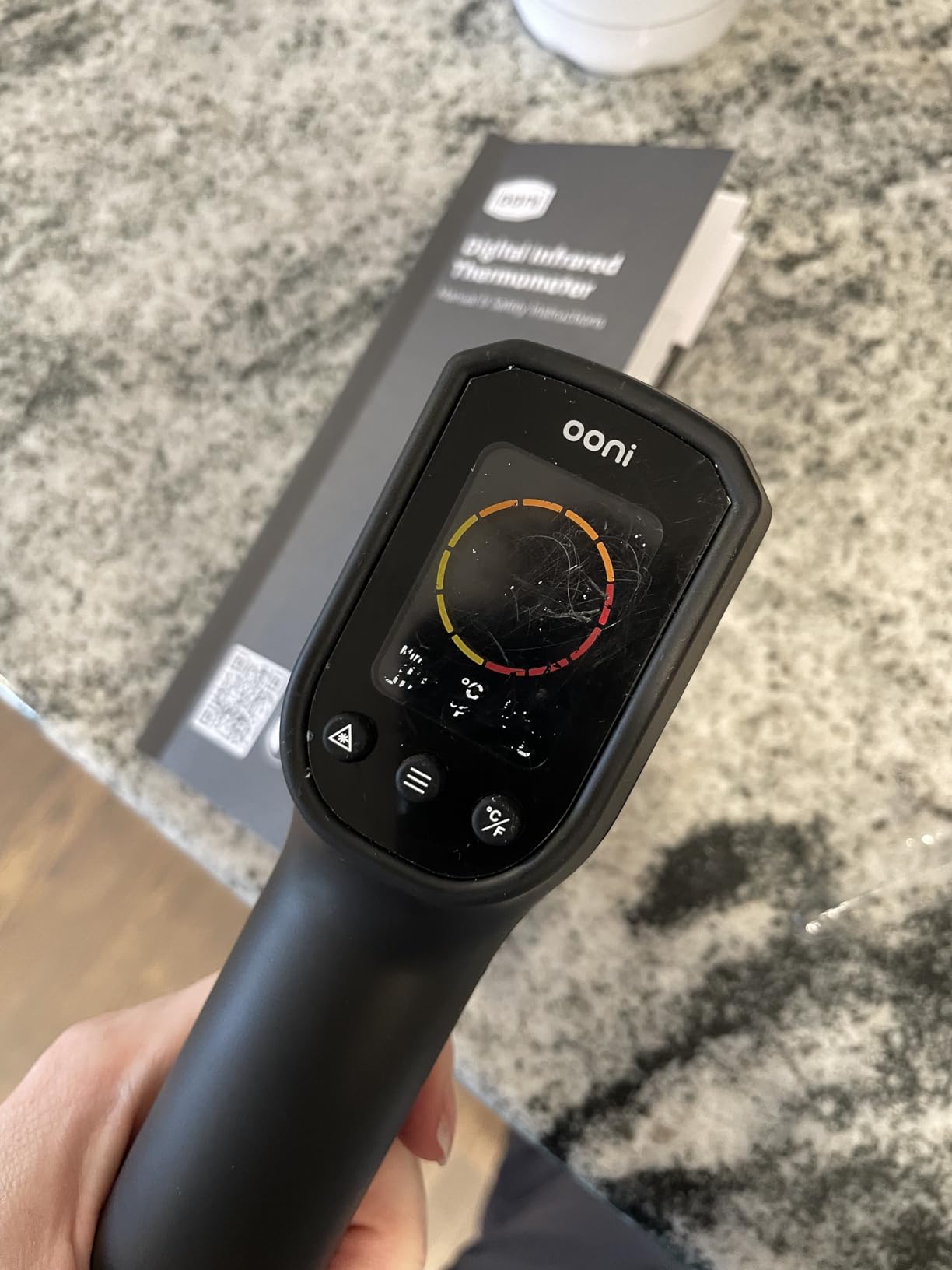
12. Ooni Digital Infrared Thermometer – Best for Pizza Ovens
Ooni Digital Infrared Thermometer Gun – Instand Read Digital Thermometer with LCD Display, for Indoor and Outdoor Cooking, Barbecue Laser Thermometer
Up to 999°F
Calibrated for cordierite stone
Under 300ms response
Scan mode
Pros
- Factory calibrated for Ooni cordierite baking stones
- Under 300ms response with min
- max and average scan mode
- Colour-coded display makes hot and cool spots obvious
- Solid rubberised build with a hang loop
Cons
- Only useful up to 999°F
- Colour ring display drops out on very hot surfaces
- Protective screen film is awkward to remove
Best for: pizza oven owners who want to read a stone rather than guess at it. The Ooni is factory calibrated for cordierite baking stones, which removes the biggest source of error in pizza-oven temperature work.
A cordierite stone is a dense ceramic that absorbs and emits infrared energy differently from steel or brick. A gun set to a generic preset will read a stone incorrectly, and the Ooni ships calibrated for exactly that material, with adjustable emissivity available for steel decks and other surfaces.
Response is under 300 milliseconds, the fastest in this roundup, and a temperature scan mode reports minimum, maximum and average across the stone. The colour-coded numerical display means a hot or cool patch is obvious at a glance, which is how you balance a pizza oven fire and find where to move the dough.
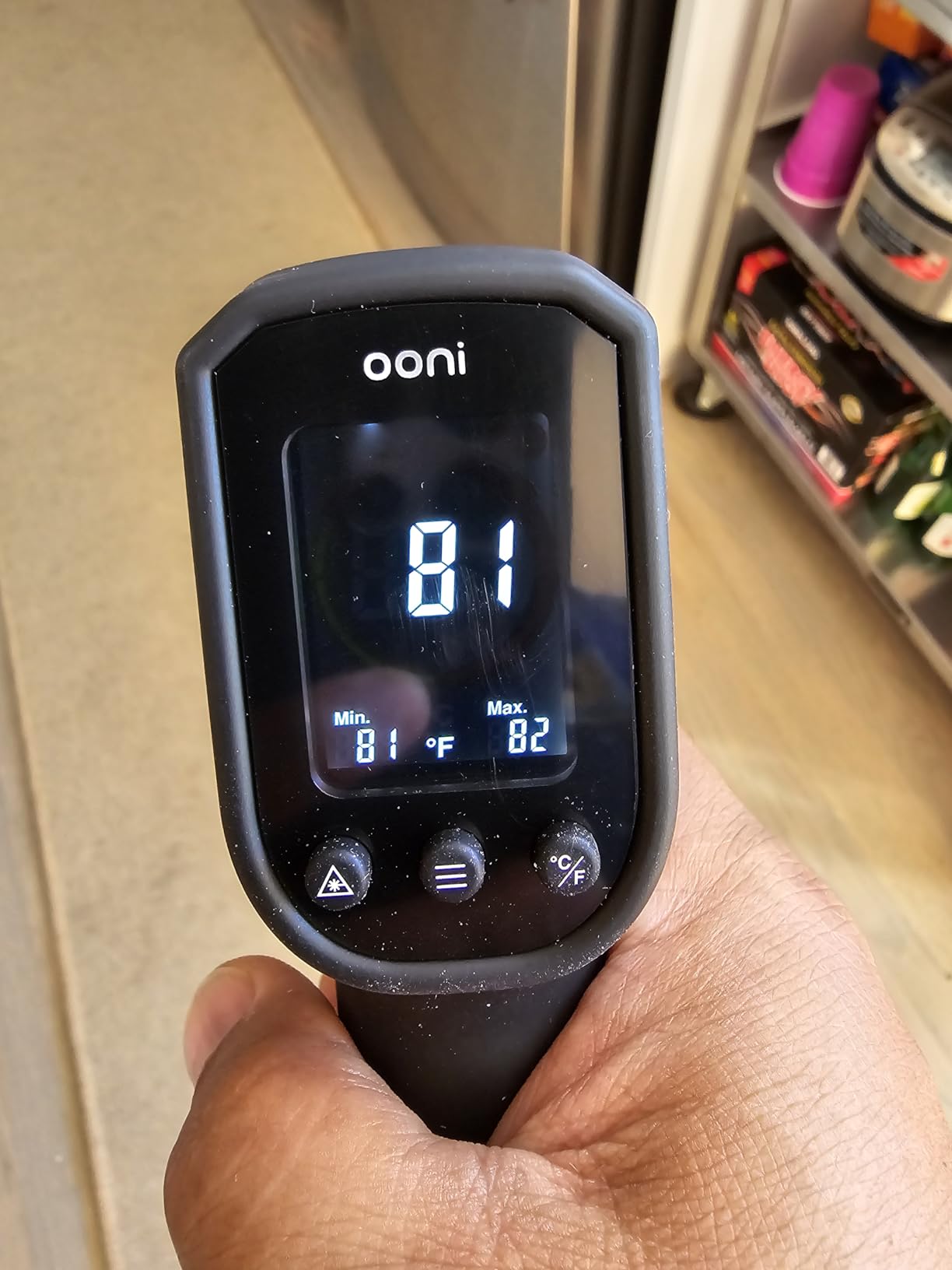
Owners use it to find hot and cool spots across the floor of an Ooni oven and to confirm recovery temperature between bakes. It is consistently described as accurate when compared against other probes, well made, and easy to operate, with a solid weighty feel and a rubberised finish that survives a drop.
There is a real on and off switch, which is a small detail that matters when the unit lives in a shed next to the oven, and the included aluminium hang loop makes storage simple. Two Duracell AAA batteries are included and the backlit display reads well in any light.
Two limitations are worth being clear about. The 999°F ceiling is below what a forge or a kiln needs, and below what some very hot wood-fired ovens reach at peak. The colour ring display also stops appearing when the target surface is very hot, which is frustrating at exactly the moment you most want the visual cue, so rely on the numbers there.
Who the Ooni Digital Thermometer suits
Pizza oven owners benefit most, which is why this is its own category rather than a footnote under the Kizen. A stone-specific calibration plus a sub-300ms response means you can check a spot, move the dough, and check again inside the same breath without the number lagging behind your hand.
Anyone cooking on a steel or stone deck will also benefit from the adjustable emissivity, and the scan mode with min, max and average is useful on any large flat cooking surface. The hang loop and proper power switch make it a kitchen tool rather than a drawer casualty.
Where the Ooni Digital Thermometer falls short
It is a dedicated cooking tool with a 999°F ceiling, so it does nothing for HVAC diagnostics and will not read a furnace or a kiln. Its review base is also much smaller than the generic guns, which means fewer owners have stress-tested it, and the premium over a general-purpose gun is real.
If you need one gun for a kitchen and a mechanical closet, this is the wrong shape of tool. The Fluke 62 Max or the Klein IR5 covers professional work; the Kizen or the Etekcity covers everyday cooking and light diagnostics. Buy the Ooni for the oven, and something else for everything else.
How to Choose an Infrared Thermometer for Cooking and HVAC
The right infrared thermometer is the one whose limits match the hottest surface you will point at and whose optics let you stand at a safe distance from it. Everything below is a decision you can make from a spec sheet in a couple of minutes, before you ever unbox the tool.
Distance-to-spot ratio decides how close you can stand
The distance-to-spot ratio, written as 12:1 or 50:1, tells you the diameter of the measurement circle for every foot you are away from the target. At 12:1, holding the gun 12 inches back gives a spot roughly 1 inch across, and at 24 inches the spot is roughly 2 inches across. Aim at a target smaller than the circle and you are averaging it with whatever surrounds it, which is how a griddle check turns into a meaningless number.
For griddle and grill work, a 12:1 ratio is comfortable because you are already standing about a foot back. For a pizza oven or a furnace you want more, and the JD-04 at 50:1 lets you read a hot chamber from several feet away. For HVAC panels and duct faces, 10:1 or 12:1 is plenty because you are working close.
Household infrared heaters and saunas aside, the optics you need for a kitchen or a mechanical room are the ones on these guns. If you also want a whole-body heat device, our infrared sauna tent review covers that category properly.
Emissivity decides whether a reading is real or noise
Emissivity is a number from about 0.1 to 1.0 describing how well a surface radiates infrared energy. Matt black cast iron with seasoning, brick, ceramic and food all sit near 0.95, which is why the preset on a cheap gun works fine for a griddle or a pizza stone in many cases. Polished stainless, bare aluminium and chrome sit far lower, and a gun set to 0.95 will report a number that is too cool by a wide margin.
The fix for a fixed-emissivity gun is physical: put a piece of matte black electrical tape on the surface, let it reach temperature, and measure the tape rather than the metal. Emissive tape is sold for exactly this purpose and is the standard field fix technicians use. The better fix is a gun with an adjustable 0.1 to 1.0 range, which is what separates the Kizen, the TempPro, the Klein IR5, the KNINE and the Temirup from the rest of this list.
For cooking, expect good results on cast iron, stone, ceramic and food, and expect to use tape or a setting change on shiny steel. For HVAC, painted duct sheet and equipment cabinets read fine at 0.95, while bare galvanised or aluminium duct faces need adjustment or tape.
Match the temperature range to your hottest surface
A gun rated to 932°F cannot read a 1000°F pizza stone, and a gun rated to 752°F is a tool for mechanical rooms rather than ovens. Work out the highest temperature you will actually point at, then buy headroom above it, because a saturated sensor at the top of its range gives you a number with no relationship to reality.
For most home cooking, 842°F to 1112°F is the useful band. The Etekcity at 842°F covers griddles, grills and ovens; the Kizen, the KNINE and the Wintact at 1094°F to 1112°F also clear a hot pizza stone. Beyond that, the Temirup reaches 1472°F and the DEASOMIYE reaches 2732°F for kilns and forging. For HVAC, anything above 752°F is wasted ceiling, because supply air, motors and refrigerant lines stay far below it.
Test accuracy yourself at the ice point before you trust it
Anyone can run an accuracy check at home in ten minutes. Fill a bowl with ice and water, stir it, and aim the gun at the surface of the water. The reading should sit close to 32°F. Repeat with a pan of water at a rolling boil and check against 212°F. If the gun is off by a consistent amount at both points, the Wintact with its calibration function lets you enter an offset, and any gun can be swapped if it is far out.
This matters because the headline accuracy figures assume a correctly set emissivity and a correctly sized spot. A gun that is accurate on matte black tape can still read a stainless griddle wrongly, and the ice-point test tells you the sensor and optics are behaving before you blame the surface. Owners with instrumentation backgrounds do exactly this, which is why their reports are worth more than a spec sheet alone.
Five HVAC measurements worth taking on any system
A repeatable diagnostic beats an ad-hoc sweep every time, and the whole protocol fits on one page. First, measure supply and return air at the same register. A split of roughly 16 to 22 degrees is normal on a cooling call; a much smaller split on a hot day often points to low airflow or a failing compressor, and a much larger split can indicate a system that is barely cooling at all.
Second, scan across every supply vent on the floor plan and note the readings. Rooms served by a vent that reads well below the others point to a balancing or duct problem rather than an equipment problem. Third, run the gun along an accessible duct run looking for a step change in temperature, which is where a blockage, a closed damper or a disconnected branch shows up.
Fourth, check the air handler coil and the surrounding insulation for a freeze pattern, aiming at the coil face and the adjacent cabinet interior. Fifth, look at motors, capacitors and electrical connections while the system runs, and compare the reading against the same component elsewhere in the system. A bearing or capacitor running significantly hotter than its twin is one of the cheapest faults to find and the easiest to miss with a contact thermometer.
Keep a consistent distance and angle throughout, hold the tool to the same standoff for every reading, and note the distance next to the number. Technicians who do this produce a record rather than an impression, and it is the difference between a guess and a diagnosis.
Why readings go wrong: distance, angle, lens and glare
Most wrong readings come from technique rather than a faulty device. Holding the gun too close fills the cone with a small area of target and a lot of reflected surroundings. Aiming at an angle mixes in the room behind the object, which is why a tilted reading on a 12:1 cone can be tens of degrees off. Both problems disappear once you hold the tool square, at the distance the ratio implies.
A dirty lens is quieter but just as damaging, because it attenuates the signal in a way that is hard to notice from the display. A film of grease from handling a griddle or a dusty attic will degrade readings without giving you any warning. Wipe the lens with a dry cloth before you start and again when the number stops making sense.
Sunlight and humidity both interfere. Direct sun on a surface raises the true temperature, so a scan of a west-facing duct in the afternoon is measuring a different condition than the same duct at night. High humidity and condensation change how energy radiates from a surface, which is why the Temirup, with its dedicated humidity and dew point sensor, is useful when you are chasing a condensation complaint rather than a temperature one.
Safety notes for a laser thermometer
Never point a laser sight at a person’s eyes, and never at a pet. The visible laser dot on these units is a low-power aiming beam intended for surfaces, and the instruments are explicitly not for measuring human body temperature. For fever screening, use a device designed and rated for it; our baby thermometer guide covers the safe options for the youngest family members.
Do not scan through glass. Glass is opaque to the infrared radiation these sensors read, so a reading taken through a window or a oven door glass is meaningless, and a hot surface behind glass can also be a burn hazard you cannot see. Open the door or lift the lid, and accept that the reading will change as the surface cools, or work on a surface you can see directly.
Watch your hands. A surface reading of 400°F is a surface that will burn you, and the gun will happily confirm it. Respect the radiant heat around molten metal and open flame, where the air temperature is high enough to cause injury even where the surface reading looks modest.
One gun or two if you cook and do HVAC work
One gun can genuinely do both jobs, and for most people that is the right answer. The Etekcity Lasergrip 774, the Kizen LP300 and the TempPro TP30 all cover cooking surfaces and light mechanical diagnostics, and carrying one device is simpler than carrying two. The Kizen, in particular, at 1112°F with adjustable emissivity, covers a stone pizza oven and a duct run in the same tool.
Buy two when your cooking reaches above 1000°F and your mechanical work needs repeatability. A wood-fired oven owner with a real forge habit, or a technician who needs documented commissioning readings, is better served by a cooking-specific gun such as the Ooni or the DEASOMIYE alongside a Fluke 62 Max or a Klein IR5. Two specialised tools beat one compromised one.
The Temirup IR02C-OR sits between those positions. Its included K-probe and humidity sensor make it the most genuinely dual-purpose unit in this roundup, and it is a reasonable single answer for someone who cooks often and does occasional home inspection work.
Frequently Asked Questions
What is the best infrared thermometer for HVAC use?
The Fluke 62 Max is the strongest choice for HVAC diagnostics, with a stated accuracy of ±1.5°C or ±1.5% of reading, min, max, difference and average display, IP54 protection and a 3 meter drop rating. Technicians who need a cheaper option and do occasional checks often use the Klein Tools IR1, which adds a 10:1 ratio and drop protection to a lighter body.
Which digital infrared thermometer is best for cooking?
For general cooking the Etekcity Lasergrip 774 is the best all-rounder, with a 4.6 rating across more than 51k reviews, a range of -58°F to 842°F, a 12:1 distance-to-spot ratio and a maximum mode for finding griddle hot spots. Cookers who need adjustable emissivity or a higher ceiling should step up to the Kizen LP300, which reaches 1112°F.
What is the best infrared thermometer for a pizza oven?
The Ooni Digital Infrared Thermometer is factory calibrated for cordierite baking stones and responds in under 300 milliseconds, with a scan mode reporting minimum, maximum and average across the floor. For a broader range, the Kizen LP300 reaches 1112°F and the DEASOMIYE JD-04 reaches 2732°F at a 50:1 distance-to-spot ratio for very hot chambers.
Are infrared thermometers accurate for grilling and griddle cooking?
Yes, with correct technique. Grills and griddles are matte, seasoned surfaces close to the standard 0.95 emissivity preset, so readings are usually within a couple of degrees of a probe thermometer. Hold the gun about 14 inches back, keep the laser cone square to the surface, and clean the lens first, since distance and angle cause far more error than the sensor does.
What is the accuracy of infrared thermometers?
Accurate budget guns are typically specified at ±1.5% of reading, and the Fluke 62 Max is specified at ±1.5°C or ±1.5%. Real-world accuracy also depends on emissivity, distance and angle, so a shiny surface or a tilted reading will be wrong regardless of the spec. You can verify any gun at home by checking it against an ice bath at 32°F and boiling water at 212°F.
Are infrared thermometers safe to use?
They are safe for surfaces when used as intended, with three firm rules. Never point the laser at a person or a pet, and never use these units for body temperature, since a purpose-built forehead or ear device is the correct instrument. Never take a reading through glass, which blocks infrared, and keep your hands clear of any surface the gun reports as hot.
The Bottom Line on Cooking and HVAC Thermometers in 2026
The Etekcity Lasergrip 774 is the pick we would buy first, because a 4.6 rating across more than 51k reviews, a fast response and a maximum mode make it the most proven tool here for griddles, grills and everyday mechanical checks. Add a Kizen LP300 if you need adjustable emissivity and a 1112°F ceiling, or a TempPro TP30 if you want a published accuracy figure and MAX/MIN/AVG statistics in a cheaper body.
For work that has to be repeatable rather than merely quick, the Fluke 62 Max earns its place with a 3-year warranty, IP54 protection and a difference mode that makes HVAC diagnostics far easier to defend. Pizza oven owners should look at the Ooni, calibrated for cordierite stone, and anyone reading above 1000°F needs the DEASOMIYE JD-04 with its 50:1 optics.
Whichever you choose, learn the two habits that separate a useful reading from a disappointing one: hold the gun at the right distance, square to the surface, and set emissivity to match the material. Check the 2026 line-up against the highest temperature you will actually point at, and buy the probe thermometer separately if you also need internal food temperatures. The right infrared thermometer for cooking and HVAC work is the one whose limits match your surfaces, and all twelve here do that job well within their stated range.